Summarize this documentation using AI
Every few months, a DTC founder shows us a growth strategy deck with a bowling alley slide in it. Beachhead segment as the lead pin, adjacent niches falling in sequence, tornado of mainstream demand at the end. The logic is elegant, the book it comes from is a classic, and for a consumer brand it is the wrong map for the wrong territory.
The bowling alley comes from Geoffrey Moore's Crossing the Chasm, arguably the most influential B2B technology go-to-market book ever written. Moore's models earned their reputation. The problem is scope: they describe how discontinuous technology innovations get adopted by organizations. DTC brands sell continuous, low-consideration products to individuals. Almost every assumption that makes the bowling alley work disappears in that translation.
This piece is the first of two versus essays this week; the second, Beyond Growth Loops, takes on the loop orthodoxy. Here, we break down what the bowling alley actually claims, why it fails consumer brands, and what to run instead.
What the Bowling Alley Framework Actually Says
In Moore's model, a company crossing from early adopters to the mainstream market should:
- Win a beachhead: dominate one narrow niche with a complete "whole product" solution for that niche's painful problem.
- Knock down adjacent pins: use the beachhead's references and word-of-mouth to enter neighboring segments, either the same buyers with a new use case or similar buyers with the same use case.
- Ride the tornado: when mainstream demand ignites, switch from niche marketing to mass distribution.
The engine underneath is reference-based buying. Pragmatist B2B buyers will not purchase risky new technology until buyers just like them vouch for it. Each pin falls because the previous pin's customers serve as references for the next. That is the entire transfer mechanism, and it is worth being precise about, because it is exactly what DTC lacks.
Five Reasons the Bowling Alley Breaks for DTC
1. There Is No Chasm in a $40 Purchase
Moore's chasm exists because adopting enterprise technology is high-risk, high-commitment, and organizationally disruptive. Buying a moisturizer, a protein powder, or a dog treat is none of those things. Consumers experiment constantly; category entry barriers are a tap on an ad. Where there is no chasm, a chasm-crossing strategy is solving a problem you do not have, while ignoring the one you do: most first-time buyers never return.
2. Reference Chains Don't Drive Consumer Categories
The pin-to-pin transfer requires buyers who research peers before purchasing. Consumer purchase behavior runs on brand memory, availability, creator content, and impulse, not reference calls. Word-of-mouth exists, but it is diffuse social proof, not the segment-sequenced reference chain the framework depends on. Knocking down the "yoga moms" pin does not make the "runners" pin wobble.
3. Niche Domination Is Often Negative-Sum for Brands
In B2B, owning a vertical means pricing power and low churn. In DTC, hyper-niching mostly shrinks your addressable audience while CAC keeps rising platform-wide. Consumer brands grow primarily by reaching more light buyers, not by extracting more from a captured niche. The bowling alley's sequencing instinct, focus everything on one segment until it is dominated, can starve a consumer brand of the broad reach its economics actually require.
4. The Framework Has No Retention Layer
The bowling alley is an acquisition sequencing model. It assumes that once a segment is won, it stays won, true under B2B switching costs and annual contracts, false in consumer, where the relationship is re-decided at every order. A DTC brand that nails segment sequencing but ignores subscription retention has built a beautiful pipeline into a leaking bucket. The classic Bain finding applies: a 5% retention improvement lifts profit 25-95%, and no amount of pin-sequencing substitutes for it.
5. "Whole Product" Means Something Different When Usage Is Invisible
Moore's whole-product concept, surround the core technology with everything the niche needs to succeed, is genuinely useful. But in B2B the vendor can see adoption happening and intervene. For DTC, the "whole product" is the outcome the customer gets at home: results, habit formation, education. That layer is built with lifecycle messaging and replenishment logic, which the framework has no vocabulary for.
What to Run Instead: Sequencing for Consumer Economics
Keep the discipline of sequencing. Change what gets sequenced.
Sequence Capabilities, Not Segments
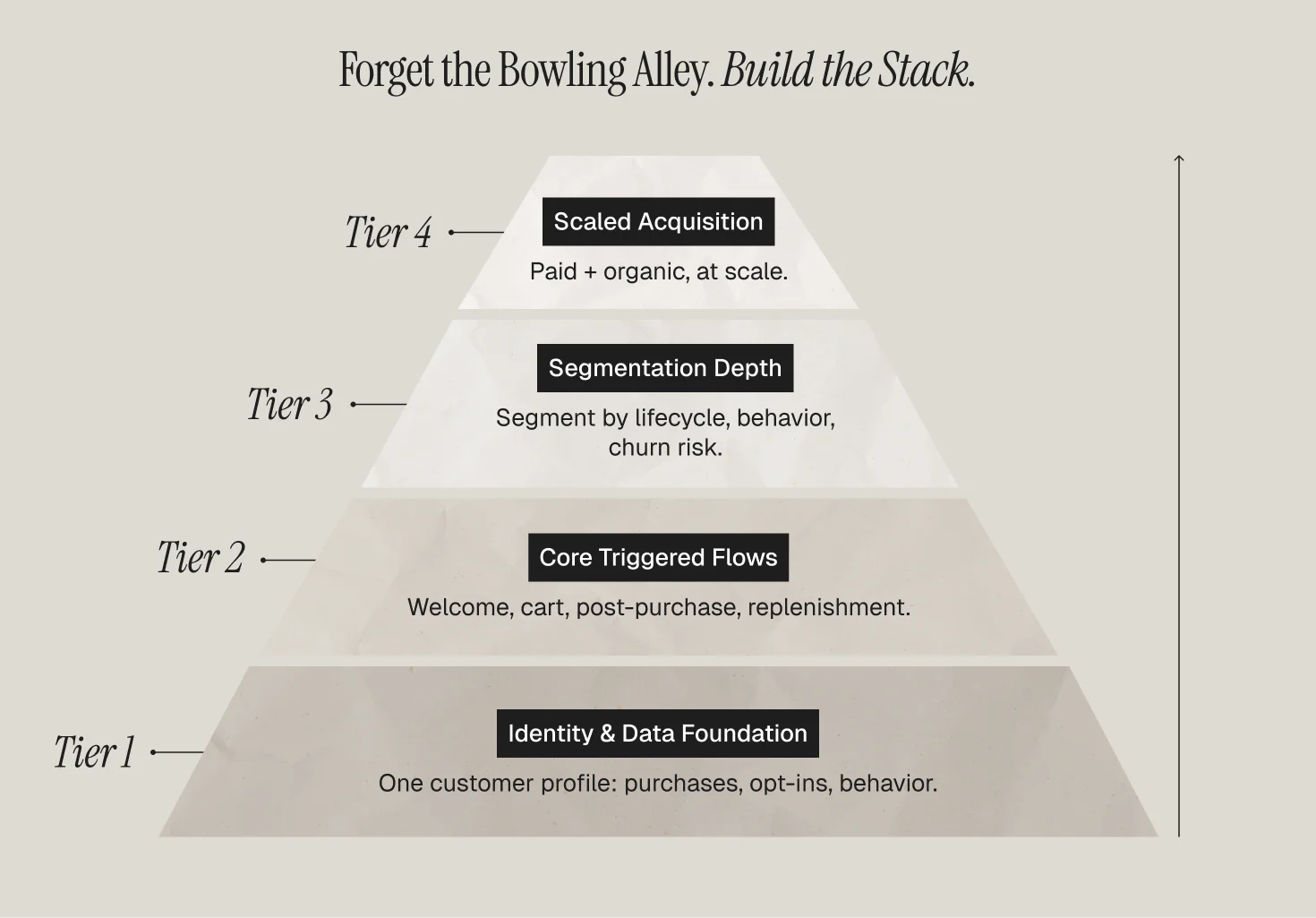
The consumer equivalent of the bowling alley is building the B2C Retention Stack in order: identity and data foundation first, core triggered flows second, segmentation depth third, then scaled acquisition. Each capability compounds the next, which is what the pins were supposed to do.
Win a Position, Not a Niche
DTC beachheads are memory positions ("the electrolyte for fasting") rather than reference-locked segments. Broad reach plus a sharp position beats sequential niche domination in categories bought on impulse and habit.
Build the Retention Layer the Framework Skips
Map the post-purchase journey, then deploy the flows that re-win each order: onboarding education, replenishment triggers, win-back sequencing, and churn-risk detection. Our Subscription Retention Matrix maps which levers fit which subscription model.
Measure Cohorts, Not Pins
Progress is a rising repeat-rate curve by monthly cohort, not a conquered-segment checklist. Cohort analysis is the scoreboard consumer economics actually respect.
How Propel Builds the Alternative
Propel designs retention marketing systems for DTC and B2C brands: the data foundation, lifecycle flow architecture, and cohort reporting that turn first orders into durable revenue, on Klaviyo, Customer.io, or Braze.
Frequently Asked Questions
What is the bowling alley framework?
The bowling alley is a go-to-market model from Geoffrey Moore's Crossing the Chasm: dominate one niche beachhead segment, then use its customer references to enter adjacent segments one by one (like falling pins) until mainstream "tornado" demand ignites. It was built for discontinuous B2B technology adoption.
Why doesn't the bowling alley strategy work for DTC brands?
Its transfer mechanism, reference-based buying between adjacent segments, barely exists in consumer purchasing, and its core problem (crossing a high-risk adoption chasm) does not apply to low-consideration products. It also contains no retention layer, while repeat purchase is the defining economic problem for DTC.
Is Crossing the Chasm still relevant in 2026?
Yes, for its original domain: B2B and deep-tech products with long consideration cycles, organizational buyers, and reference-driven adoption. Concepts like the whole product and beachhead focus remain excellent there. The error is applying its segment-sequencing mechanics to consumer brands.
What should DTC brands do instead of the bowling alley?
Sequence capabilities instead of segments: build a retention stack (data foundation, triggered lifecycle flows, segmentation) before scaling acquisition, hold a sharp memory position in the category, and measure progress with cohort repeat-rate curves rather than conquered niches.
What is a beachhead market in DTC terms?
For consumer brands, a beachhead is best understood as a positioning wedge, a specific use case or identity the brand owns in customers' memory, rather than a closed segment to dominate through references. It concentrates creative and product focus without capping reach.