
Summarize this documentation using AI
Product-led growth is the most successful go-to-market idea SaaS ever produced. OpenView's Product Benchmarks research found that PLG companies are twice as likely to grow quickly as their sales-led peers. Free trials, product-qualified leads, activation metrics, usage-based expansion: the playbook works, and it works so well that it escaped SaaS entirely.
Which is the problem. Over the past three years, DTC founders and operators have been handed PLG frameworks in board meetings, accelerator curriculums, and LinkedIn carousels as if a supplement brand were a self-serve analytics tool. It is not, and the frameworks fail in predictable, expensive ways.
At Propel, we run lifecycle and retention systems for consumer brands, and we regularly inherit marketing calendars built on borrowed SaaS logic. This article breaks down exactly where PLG thinking breaks for DTC, and what the consumer-native alternative looks like.
What PLG Actually Assumes (And Why SaaS Gets Away With It)
PLG is not just "let the product sell itself." It rests on four structural assumptions:
- A free or low-friction entry tier. The user can experience core value before paying.
- Continuous usage data. The vendor sees every click, so activation and expansion can be measured and triggered in-product.
- Near-zero marginal cost of trial. Another free workspace costs the vendor almost nothing.
- Expansion revenue inside one account. Seats, usage tiers, and upsells mean one converted user compounds for years.
Every one of those assumptions collapses at a DTC brand. A trial of your product is a physical unit with real COGS and real shipping. Your "usage data" is a delivered package you cannot observe. And there are no seats to expand: growth in account value comes from one thing only, the second, third, and fourth order.
The Four Ways PLG Frameworks Break for DTC
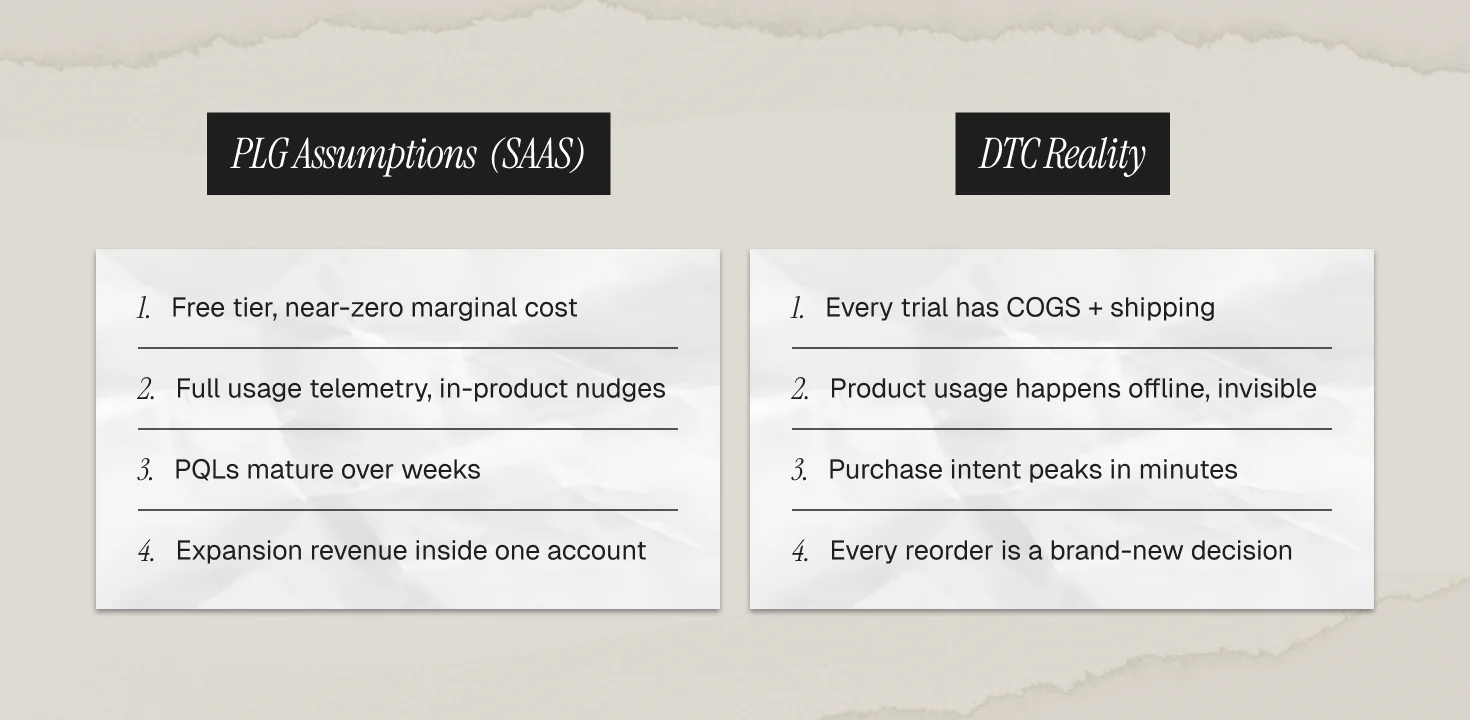
1. There Is No Free Tier for a Physical Product
The engine of PLG is risk-free value delivery before the purchase decision. DTC's closest equivalents, sampling programs, heavy discounting, and free-shipping-and-returns, all carry hard costs that scale linearly with volume. A SaaS company can support a million free users on marginal infrastructure spend; a beverage brand sampling a million cans has burned a Series A.
What brands actually do when told to "lower the barrier to first value" is discount. And discount-acquired customers anchor on the discounted price, which corrodes lifecycle revenue from the first order onward.
2. Activation Metrics Don't Transfer
In SaaS, activation is observable: the user connected a data source, invited a teammate, hit an aha moment. The vendor watches it happen in real time and nudges accordingly.
For a DTC brand, the equivalent moment, the customer actually using the product and liking it, happens in a kitchen or a bathroom cabinet, completely out of view. You cannot fire an in-product tooltip at a moisturizer. Customer activation absolutely exists in DTC, but it must be engineered through owned channels: post-purchase education flows, usage check-ins, and review capture, not product telemetry. That is a lifecycle messaging problem, and it lives in your ESP, not your app.
3. PQLs Have No Consumer Equivalent
The product-qualified lead assumes a long consideration cycle where usage signals predict purchase intent. DTC purchase cycles are minutes to days, and intent signals are browse and cart behavior, not feature adoption. Treating a quiz-taker like a PQL and routing them into a two-week "nurture" sequence is how brands lose buyers who were ready on day zero. The right model is behavioral triggers that respond within minutes and hours, not lead scoring that matures over weeks.
4. Expansion Revenue Is Actually Retention Revenue
SaaS net revenue retention comes from seat and usage expansion inside a signed account. DTC has no contract to expand. Repeat purchase is a brand-new decision every single time, made by a customer who is being retargeted by your competitors at that exact moment. Benchmarks put average ecommerce repeat purchase rates around 25-30%, meaning the average brand loses seven of ten first-time buyers.
This is why the classic finding popularized by Bain's Fred Reichheld still governs consumer economics: a 5% increase in retention lifts profits by 25% to 95%. The compounding engine PLG locates inside the product, DTC must build inside the customer relationship.
What DTC Brands Should Run Instead: The Lifecycle-Led Growth Model
The honest translation of PLG's core insight, let the customer experience drive growth, into consumer terms is lifecycle-led growth. The product still matters most; the difference is where the compounding loop lives.
Build the Retention Stack Before Scaling Acquisition
Our B2C Retention Stack framework sequences this: data foundation, then triggered lifecycle flows, then segmentation depth, then paid acquisition on top. Brands that invert the order pour traffic into a leaking system.
Replace Activation Metrics With Lifecycle Milestones
Instead of "time to aha," track second-order rate within 60 days, subscription opt-in rate, and review submission. Our 90-Day Activation Playbook for DTC maps the exact owned-channel interventions for each milestone.
Replace PQL Scoring With Real-Time Behavioral Triggers
Browse, cart, replenishment-window, and churn-risk triggers respond to intent while it exists. The flow inventory in Best Klaviyo Flows for DTC Brands covers the core set.
Measure Lifecycle Revenue, Not NRR
DTC's version of net revenue retention is cohort-level lifecycle revenue: what a monthly acquisition cohort is worth at day 30, 90, and 365. It is the single best early-warning metric a consumer brand can run, and it is the metric acquisition-vs-retention budget decisions should hang on.
When PLG Thinking Is Worth Borrowing
To be precise rather than contrarian: three PLG habits do transfer well. Obsessing over the first-experience quality (unboxing is your onboarding). Instrumenting everything you can own (email, SMS, site, and app events into one customer profile). And ruthless focus on time-to-value (fast shipping and day-one education flows). Borrow the habits. Leave the framework.
How Propel Builds Lifecycle-Led Growth for Consumer Brands
At Propel, we design and operate retention marketing systems for DTC and B2C brands on Klaviyo, Customer.io, and Braze: the data foundation, the triggered flow architecture, and the cohort reporting that replaces borrowed SaaS dashboards.
Frequently Asked Questions
What is product-led growth (PLG)?
Product-led growth is a go-to-market strategy where the product itself drives acquisition, conversion, and expansion, typically through free trials or freemium tiers, in-product onboarding, and usage-based upsells. It was developed for SaaS, where marginal cost per user is near zero and vendors can observe usage in real time.
Why doesn't PLG work for DTC brands?
PLG's four structural assumptions, free entry tiers, continuous usage telemetry, near-zero trial cost, and in-account expansion revenue, all fail for physical products. DTC trials carry COGS and shipping, product usage happens offline, purchase cycles are short, and repeat revenue requires winning a new decision every order.
What should DTC brands use instead of PLG?
Lifecycle-led growth: a retention-first operating model built on owned-channel data, triggered lifecycle messaging across email, SMS, and push, and cohort-based lifecycle revenue measurement. Frameworks like Propel's B2C Retention Stack sequence the build order.
Do activation metrics apply to ecommerce?
Yes, but redefined. Instead of in-product aha moments, DTC activation is measured through second-order rate within 60 days, subscription opt-in, and review submission, and it is driven through post-purchase education and check-in flows rather than product tooltips.
Is PLG ever relevant for consumer brands?
Brands with a genuine digital product surface, apps, connected hardware, or content layers, can borrow PLG tactics for that surface. And PLG's underlying habits (first-experience obsession, event instrumentation, time-to-value focus) transfer well even where the framework does not.
![Featured image: How to Retain Customers for DTC Brands? [2025 DTC Customer Retention Hacks]](https://cdn.prod.website-files.com/69bbf9f7f2a3f75341357ebc/69f4b4beca1ad9bc2396581f_69c7cec9542fddb736941d63_698ae4608e508c6f91ef375b_68ac289b7bea7b13d0832b6b_DTC%25252520customer%25252520retention%25252520strategies-2-min.jpeg)