
Summarize this documentation using AI
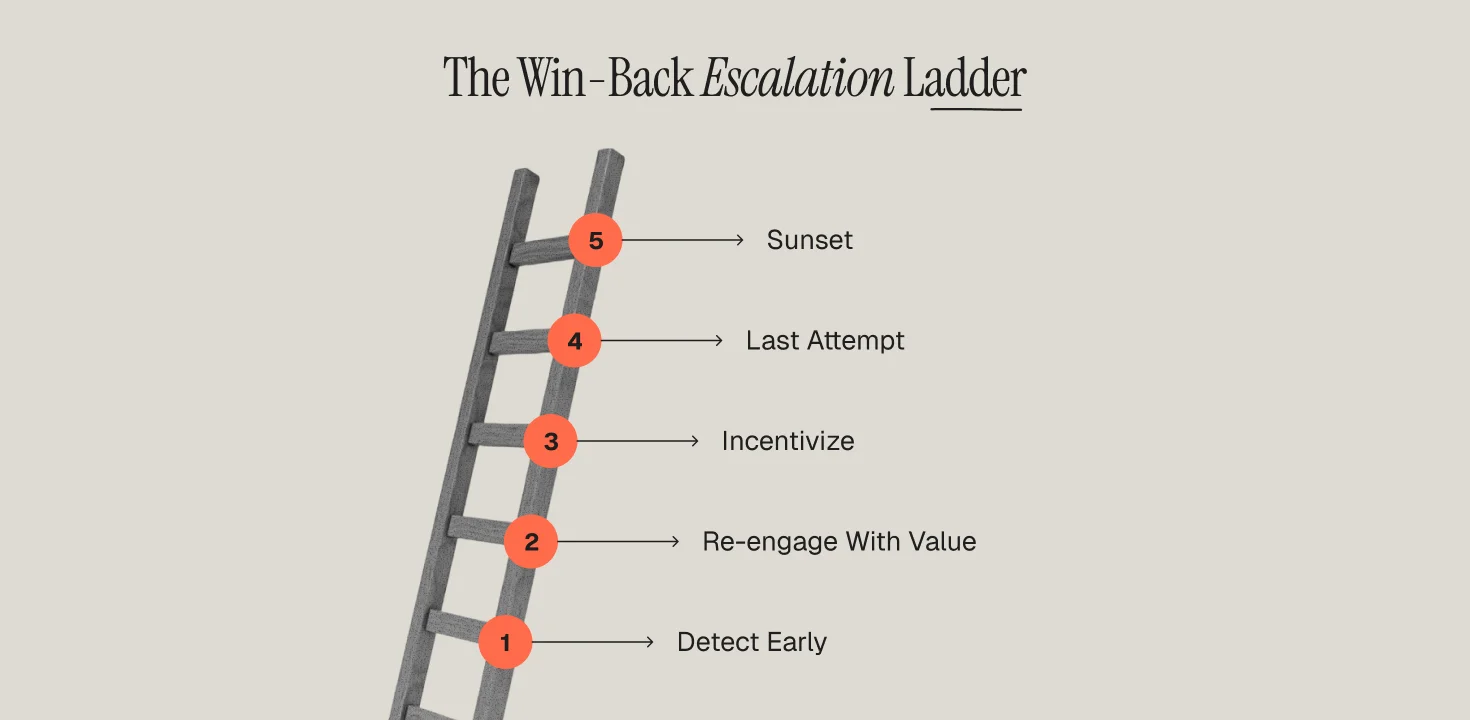
The Win-Back Hierarchy is a ranked escalation ladder for recovering a lapsing customer, moving from the cheapest, least intrusive intervention up to the last resort of sunsetting, so you never lead with a discount you did not need to give. Most brands run win-back backwards: they blast a 30%-off coupon at every inactive contact and burn margin and email deliverability at the same time. Done in the right order, win-back is one of the highest-ROI channels in retention, because reactivating a lapsed customer costs roughly 5 to 10x less than acquiring a new one. The Hierarchy is the sequence that captures that value without wasting it.
Key Takeaways
- Win-back is a ladder, not a coupon. Escalate through five rungs in order, from cheapest to most expensive, and stop as soon as the customer returns.
- Start before they leave. Detecting at-risk customers early, via predictive churn signals, beats any post-lapse offer.
- Know your two benchmarks. A healthy win-back flow converts 2 to 5% of lapsed recipients (top quartile 5 to 10%), while program-level reactivation runs 12 to 20%.
- Lead with value, not margin. Discounts belong near the top of the ladder, not the bottom, or you train customers to lapse on purpose.
- Sunset the unrecoverable. A sunset flow protects deliverability so your win-backs keep landing in the inbox.
What the Win-Back Hierarchy Is
The Win-Back Hierarchy exists because most win-back programs are one blunt instrument (a discount) applied to a nuanced problem (why did this customer stop?). A ladder replaces the blunt instrument with a sequence, so you spend the least you can to recover each customer and escalate only when the cheaper rung fails. It is the recovery half of retention marketing, and it pairs with the preventive half: the best win-back is the one you never have to send because you caught the customer before they lapsed. Understanding the mechanics of a win-back email flow is the foundation; the Hierarchy is how you sequence it.
Rung 1: Detect Early
The cheapest win-back is prevention. Before a customer is fully lapsed, they leave signals: slowing purchase frequency, declining engagement, a missed refill. Catching these with a system for identifying users about to churn lets you intervene while the relationship is still warm, which is far more effective and far cheaper than trying to resurrect a cold one. Rung one is not an email at all; it is the monitoring that tells you an email is needed.
Rung 2: Re-engage With Value
When a customer does go quiet, the first outreach should carry value, not a discount. Remind them why they chose you, surface what they are missing, share genuinely useful content, or highlight new reasons to return. This rung recovers the customers who simply drifted, and it does so without spending a cent of margin. The best retention email strategies concentrate their creativity here, because a value-led re-engagement that works is pure profit compared to a discount that also would have worked.
Rung 3: Incentivize
If value alone does not bring them back, now you introduce an offer, and you make it feel earned and specific rather than a blanket coupon. This is where the classic win-back flow earns its keep. Expect a well-run win-back flow to convert 2 to 5% of lapsed recipients, with top-quartile programs hitting 5 to 10%. The reason the offer sits on rung three and not rung one is simple margin math: every customer you recover with value on rung two is a customer you did not have to discount here.
Rung 4: Last Attempt
Before you give up, make a final, honest attempt: a "we are about to stop emailing you" message, ideally with a channel switch (try SMS if email has gone unread) and a clear, low-friction path back. Last-attempt messages consistently outperform their send volume because they create mild urgency and self-select the customers who still care. Use proven retention email templates to get the tone right: direct, warm, and free of desperation.
Rung 5: Sunset
When a contact does not respond to the full ladder, stop emailing them, on purpose. A sunset flow suppresses chronically disengaged contacts to protect your sender reputation, which keeps your deliverability high so that every earlier rung actually reaches the inbox. Sunsetting feels like giving up, but it is the opposite: it is the discipline that makes the whole hierarchy work for everyone else.
The Economics of Win-Back
The reason to run this as a hierarchy rather than a single discount is money. Reactivation costs roughly 5 to 10x less than new acquisition, and program-level reactivation across all channels typically runs 12 to 20%. But those returns evaporate if you lead with margin or if poor list hygiene tanks your deliverability. Sequenced correctly, win-back is among the cheapest revenue a brand can earn, which is exactly why it deserves a framework instead of a reflex. It is also the natural complement to reducing subscriber churn in the first place.
Frequently Asked Questions
What is the Win-Back Hierarchy?
A five-rung escalation ladder (detect, re-engage with value, incentivize, last attempt, sunset) for recovering lapsing customers in order of cost, so you spend the minimum required and escalate only when needed.
What is a good win-back conversion rate?
A healthy win-back flow converts 2 to 5% of lapsed recipients, and top-quartile programs reach 5 to 10%. Program-level reactivation across all channels runs 12 to 20%. These use different denominators, so do not compare them directly.
Should I always offer a discount to win customers back?
No. Discounts belong on the third rung, after value-led re-engagement. Leading with a coupon trains customers to lapse deliberately and erodes margin you did not need to spend.
How do I win back customers before they fully churn?
Detect them early. Use churn-risk signals like slowing frequency and falling engagement to intervene while the relationship is warm, which is cheaper and more effective than post-lapse recovery.
Why is sunsetting part of a win-back framework?
Because a sunset flow protects deliverability by suppressing chronically unengaged contacts, which keeps your earlier win-back messages landing in the inbox instead of the spam folder.
![Featured image: How to Identify Users Who Are About to Churn [2026 Guide for Retention Marketers]](https://cdn.prod.website-files.com/69bbf9f7f2a3f75341357ebc/69f4b4ad14f8c675169e0cba_69c7cec26de0e50005c6e495_698ae45b9ecbf9983380f731_6909f1e088d37bed0144f247_Identify%25252520User%25252520churn-2-min.png)


