

Summarize this documentation using AI
The Subscription Retention Matrix is a framework that sorts subscription churn into quadrants (by whether it is involuntary or voluntary, and early or late in the lifecycle) and assigns the right retention lever to each, so you stop fighting every cancellation the same way. The most expensive mistake in subscription retention is pouring energy into win-back discounts while ignoring the largest and cheapest-to-fix category of loss. About 53% of all customer attrition is involuntary churn (failed payments and expired cards), not customers deciding to leave. The Matrix makes sure you fight each kind of churn with the tool that actually works on it.
Key Takeaways
- Not all churn is the same. The Matrix splits loss by involuntary vs voluntary and early vs late, producing four quadrants that each need a different fix.
- Half your churn is a billing problem. Roughly 53% of attrition is involuntary (failed payments), the cheapest churn to recover and the one most brands ignore.
- Early voluntary churn is an activation problem, best solved with onboarding and a strong first cycle, not a discount.
- Late voluntary churn is a value and win-back problem, solved with re-engagement and a win-back flow, not a blanket coupon.
- Retention beats re-acquisition every time. Acquisition costs 5 to 25x more than retention (HBR), and a 5% retention lift can raise profits 25% to 95% (Bain).
What the Subscription Retention Matrix Is
Subscription brands tend to talk about churn as a single number, which is why they tend to fight it with a single tool (usually a save-offer). But a customer whose card expired is nothing like a customer who canceled because they stopped seeing value, and treating them identically wastes money on one and insults the other. The Subscription Retention Matrix separates churn so each type gets its own response. It sits underneath the broader discipline of subscription retention and gives structure to the tactics in a subscription retention strategy. Once you can name which quadrant a cancellation belongs to, the fix becomes obvious.
The Two Axes
The first axis is cause: involuntary (a payment failed) versus voluntary (the customer chose to stop). The second axis is timing: early (the customer churned before reaching real value) versus late (they churned after a period of use, from fatigue, price, or a better alternative). Those two axes create four quadrants, and the point of the framework is that each quadrant has a different root cause and therefore a different lever. Getting the calculation and tracking of subscription churn right is what lets you place each lost customer in the correct box in the first place.
Quadrant 1: Involuntary Churn
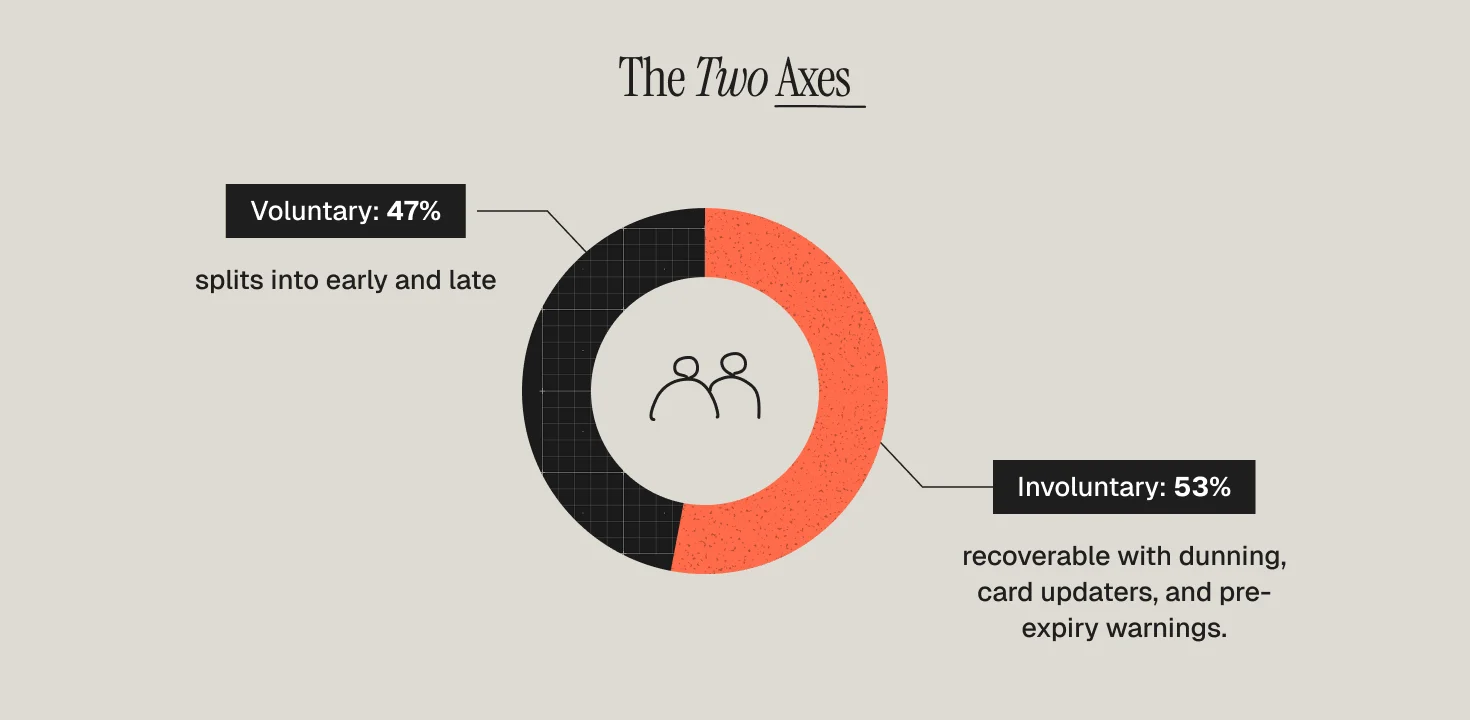
This is the biggest and most under-served quadrant. When about 53% of attrition is involuntary (Recurly), the single highest-ROI retention project for most subscription brands is not a fancier win-back sequence, it is a proper dunning and payment-recovery system: smart retry timing, card-updater services, and pre-dunning warnings before a card expires. These customers wanted to stay. Recovering them costs almost nothing relative to acquisition, which already runs 5 to 25x more expensive than retention (HBR). If you do nothing else with this framework, instrument this quadrant first.
Quadrant 2: Early Voluntary Churn
Early voluntary churn means the customer canceled before the product became a habit, which is almost always an activation and onboarding failure. The fix lives upstream: a first cycle that delivers obvious value, clear expectations, and a reason to reach the second renewal. For consumable subscriptions, a well-timed replenishment flow and a strong first-30-days experience do more than any save-offer, because they prevent the cancellation instead of trying to reverse it. This is the same early-window logic that governs how to reduce subscriber churn generally.
Quadrants 3 and 4: Mid and Late Voluntary Churn
Mid and late voluntary churn come from fatigue, price sensitivity, or a competitor, and they need value reinforcement before they need a discount. The levers here are engagement between billing cycles, pause-instead-of-cancel options, and a properly sequenced win-back flow for those who do lapse. The tactics that work specifically for retaining subscription customers concentrate here. The mistake to avoid is leading with margin: a coupon aimed at a customer who left over value teaches them to leave again next renewal.
How to Use the Matrix
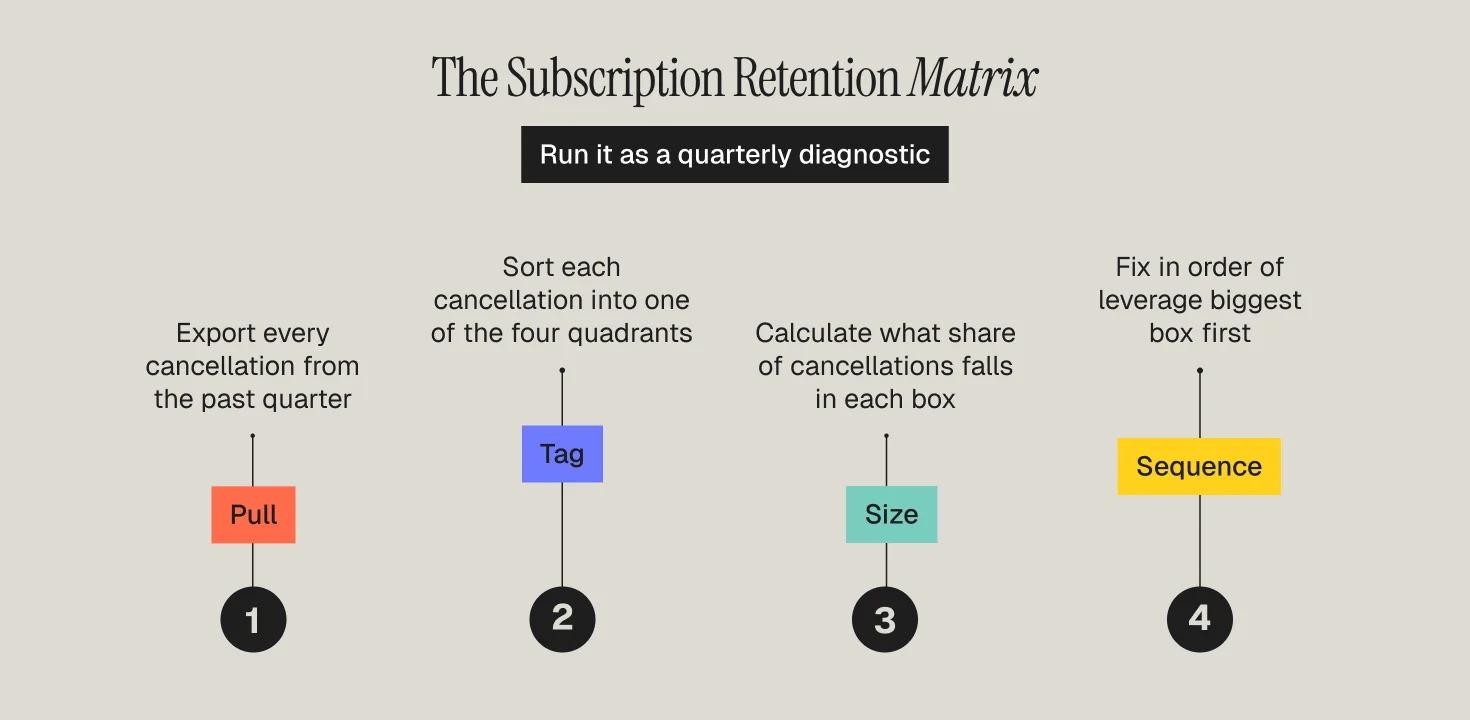
Run it as a quarterly diagnostic. Pull your cancellations, tag each one by quadrant, and size the four boxes. Most brands are shocked to find the involuntary quadrant is the largest and the least addressed. Then sequence your work by leverage: fix billing recovery first (Quadrant 1), shore up activation second (Quadrant 2), and refine value and win-back last (Quadrants 3 and 4). The Matrix does not replace your subscription retention playbook; it tells you which page of it to open first.
Frequently Asked Questions
What is the Subscription Retention Matrix?
A framework that classifies churn by cause (involuntary vs voluntary) and timing (early vs late) into four quadrants, each with its own retention lever, so brands fix the right problem instead of blanketing every cancellation with a discount.
What is involuntary churn and why does it matter so much?
Involuntary churn is loss from failed payments and expired cards. It matters because it is roughly 53% of all attrition (Recurly) and is the cheapest churn to recover, usually through dunning and card-updater tools.
How do I reduce early voluntary churn?
Treat it as an activation problem. Deliver clear value in the first cycle, set expectations, and use flows like a replenishment sequence to earn the second renewal.
When should I use a discount to save a subscriber?
Sparingly, and mostly for late voluntary churn where price is the genuine driver. Leading with discounts for every cancellation trains customers to churn and erodes margin. Reinforce value first.
Which quadrant should I fix first?
Almost always involuntary churn, because it is the largest quadrant for most brands, the cheapest to fix, and made up of customers who never wanted to leave.
![Featured image: Subscription Retention Strategies: How to Keep Subscribers Beyond 90 Days [2025 Guide]](https://cdn.prod.website-files.com/69bbf9f7f2a3f75341357ebc/69f4b508f4dc60785ebaaf64_69c7cedddc6c12e3e9aeb102_698ae476c97c64c12d4b1033_685e9ef7195ed0904d788146_Retention%25252520That%25252520Converts-2-min.png)


![Featured image: Can Retention Marketing Retain Users for Subscription Brands [2025 Guide]?](https://cdn.prod.website-files.com/69bbf9f7f2a3f75341357ebc/69f4b45858833d682c4fc23b_69c7ceae39b8cc63e1a13f6c_698ae44007cc0213759854b9_68309e555fb5b3daf862d849_Subscription%25252520Retention%25252520Marketing-2-min.png)
