
Summarize this documentation using AI
Subscription retention is the percentage of subscribers a business keeps over a given period — and, in practice, the system of onboarding, flows, billing choices, and save mechanics that stop them from cancelling. It is the mirror image of churn: if your monthly churn is 6%, your monthly retention is 94%. But the headline number hides where retention is actually won. It is not won at the cancel page with a last-minute discount. It is won in the first 30 days, on the billing screen, and at the payment retry. This guide defines subscription retention, shows you how to measure it correctly, and breaks down the levers that move it in 2026.
Key takeaways
- Subscription retention is the inverse of churn — the share of subscribers you keep over a period. Average DTC subscription monthly churn in 2026 is 6.5–8.5%, so a strong monthly retention rate is roughly 93–95% (Finsi, 2026).
- The first month is the highest-leverage window. First-month churn runs 12–30% across verticals, and subscribers who engage with the product in month one are 3–5x more likely to still be subscribed at month 12 (Finsi, 2026).
- Billing cadence is structural, not cosmetic. Moving a cohort from monthly to annual prepay cuts churn 60–80% on the same product (Eightx, 2026).
- A quarter to 40% of churn is involuntary (failed payments) — recoverable with dunning before you touch a single line of copy (Finsi, 2026).
- Category beats cadence. Replenishment subscriptions average under 4% monthly churn; curated boxes run 10–15% (Eightx, 2026).
Subscription retention, defined
Subscription retention measures how many subscribers continue paying across a period — monthly, quarterly, or annually. The simplest version is the customer retention rate: of the subscribers you started the period with, what share are still active at the end (excluding new sign-ups)? Its inverse is subscription churn, the share who cancelled or lapsed.
Retention and customer lifetime value (LTV) are joined at the hip: small changes in retention compound into large changes in LTV, because every retained subscriber keeps paying without re-incurring acquisition cost. That is why retention is the cheapest growth lever most brands ignore — the classic Bain / HBR finding is that a 5% increase in retention can lift profits 25–95%, though the exact figure varies by industry.
Three flavors are worth tracking:
- Customer retention — the headcount of subscribers kept.
- Revenue retention — the dollars kept, which matters when you have multiple plan tiers.
- Net revenue retention — revenue kept after adding expansion (upsells, add-ons). If expansion outpaces churn, net retention can exceed 100% even as some subscribers leave.
How to measure subscription retention
The core formula:
Monthly retention rate = (subscribers at end of month − new subscribers) ÷ subscribers at start of month × 100.
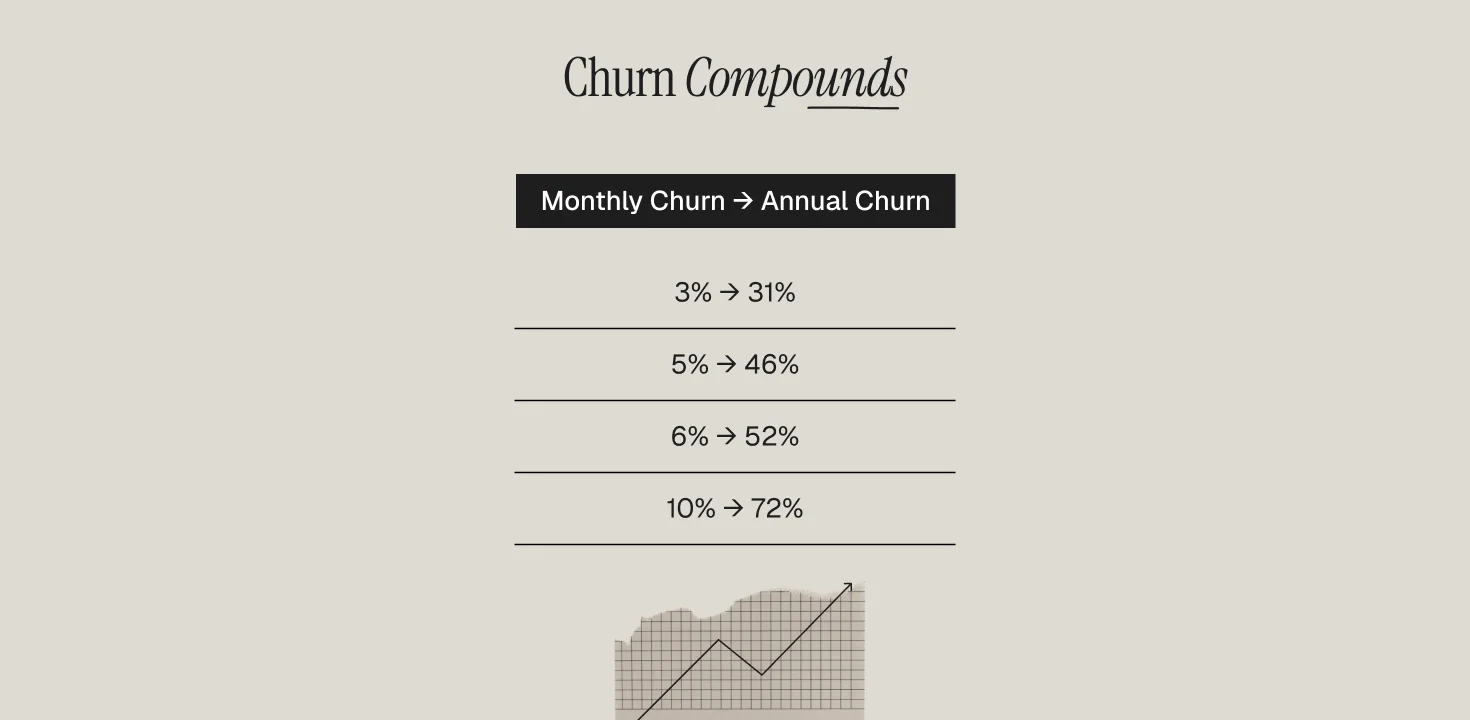
The trap most operators fall into is reading monthly churn at face value. Churn compounds. A 5% monthly churn rate compounds to 46% annual churn — almost half your base gone in a year — and 6% compounds to roughly 52% (Eightx, 2026). Always annualize before you celebrate a low monthly number.
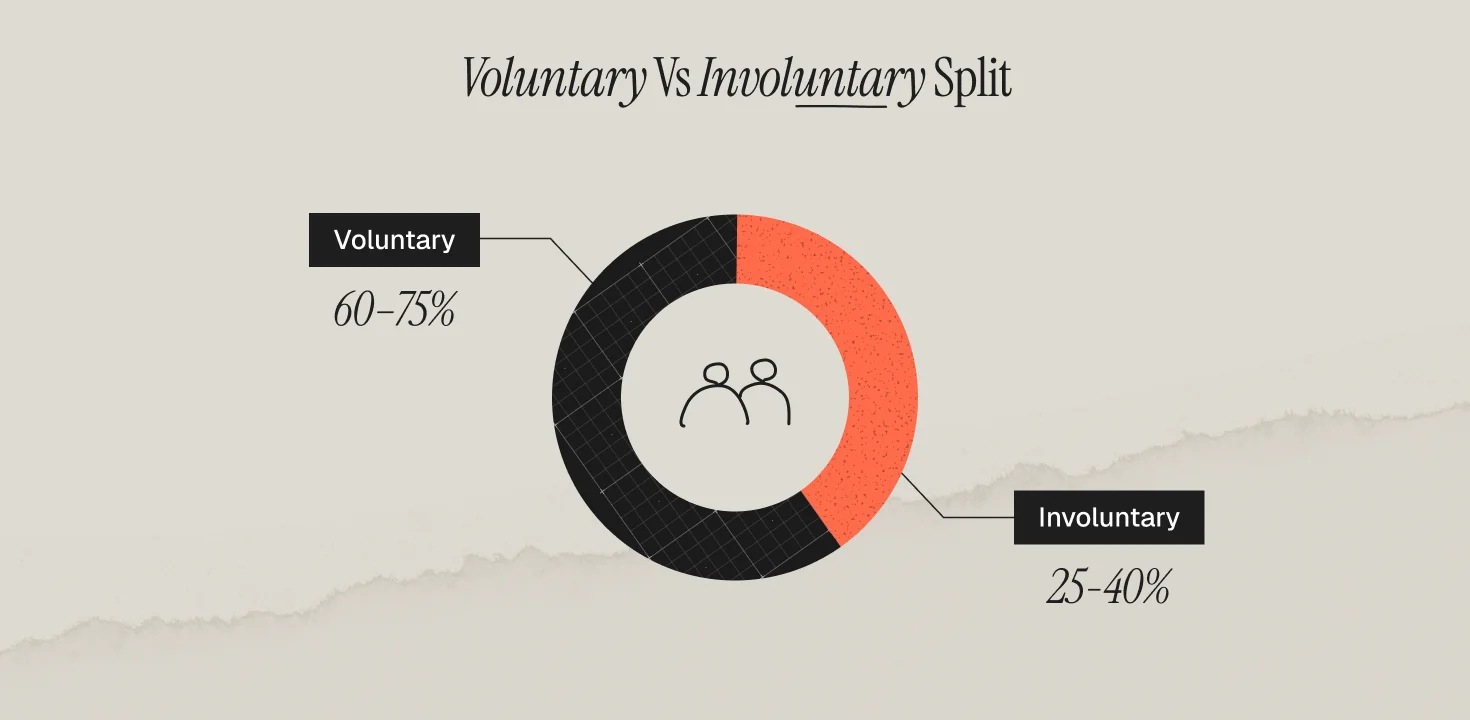
You also have to separate voluntary churn (the customer actively cancels) from involuntary churn (the card fails and retries run out). Across DTC subscriptions, voluntary churn is 60–75% of the total and involuntary is 25–40% (Finsi, 2026). They need completely different playbooks — and the involuntary side is usually the faster win.
Benchmarks by category (monthly churn, 2026)
For a fuller breakdown, see Propel's customer retention rates by industry.
Why retention is won before the cancel page
Here is the counterintuitive part. Most teams pour their retention budget into the cancel flow — better save offers, smarter win-back, a slicker "are you sure?" screen. But by the time a subscriber hits cancel, the decision was made weeks earlier. First-month churn of 12–30% tells you the leak is at the front of the lifecycle, not the back. The cancel page is a lagging indicator of an onboarding failure.
The levers that actually move subscription retention
1. The first 30 days (onboarding)
Subscribers who engage with the product in month one are 3–5x more likely to still be subscribed at month 12 (Finsi, 2026). Your onboarding sequence — not your cancel flow — is the highest-leverage program you own. Treat the welcome series as a usage-driving engine, not a receipt: set expectations, drive first use, and celebrate the first milestone before the second charge lands.
2. Billing cadence
Annual prepay subscribers retain at roughly 2.5x the rate of monthly subscribers (28% vs 11% at month 12), and migrating a cohort to annual cuts churn 60–80% on the same product (Eightx, 2026). Each monthly billing event is a chance to cancel and a chance for the card to fail; annual prepay removes eleven of them. Offer annual at a 10–20% discount and time the migration to a moment of trust — after the third successful delivery, or right after a positive review.
3. Dunning (involuntary churn)
A quarter to 40% of your churn is failed payments, not unhappy customers (Finsi, 2026). Brands with no dunning lose 8–15% of subscribers a year to payment failures; smart retries bring that down to 2–5%. Fix card-update prompts and retry logic before you spend a dollar on a win-back campaign.
4. Flexibility (skip, pause, swap)
When the only options are "keep paying" or "cancel," customers who would happily pause cancel instead. Subscriptions that offer skip, pause, and swap churn 15–30% less, and paused customers return at 40–60% versus 5–15% for outright cancellers (Finsi, 2026).
5. Acquisition quality
Retention starts upstream. Subscribers acquired through heavy discounting churn 2–3x faster than full-price acquirers (Finsi, 2026). A subscriber acquired at $60 who stays 18 months beats one acquired at $20 who churns in 3.
6. Win-back — with a holdout
Re-engage lapsed subscribers in the 14–60 day window, but always carve out a holdout group. A large share of "recovered" revenue would have returned on its own; a holdout is the only way to prove your win-back is incremental. For the full playbook, see how to reduce subscriber churn and how to retain customers for subscription brands.
Common mistakes
- Treating retention as a cancel-page problem instead of an onboarding problem.
- Reading monthly churn without annualizing it.
- Lumping voluntary and involuntary churn into one number.
- Buying subscribers with discounts, then wondering why they do not stick.
- Spending win-back budget on subscribers who would have returned anyway.
Frequently Asked Questions
What is subscription retention?
Subscription retention is the percentage of subscribers a business keeps over a given period — the inverse of churn (94% retention means 6% churn). In practice it also refers to the system of onboarding, billing, dunning, and save mechanics that keep subscribers paying.
What is a good subscription retention rate?
A strong monthly retention rate for DTC subscriptions is about 93–95% (5–7% monthly churn). The 2026 average is 6.5–8.5% churn. Replenishment categories do better (under 4% churn); curated boxes do worse (10–15%).
How is subscription retention calculated?
Monthly retention rate = (subscribers at end of month − new subscribers) ÷ subscribers at start of month × 100. Track revenue retention and net revenue retention alongside it, and always annualize monthly churn because it compounds.
What is the difference between voluntary and involuntary churn?
Voluntary churn is when a customer actively cancels (60–75% of total). Involuntary churn is when a payment fails after retries run out (25–40% of total). Each needs a different fix; dunning is the fastest win on the involuntary side.
Does annual billing improve retention?
Yes. Annual prepay subscribers retain at roughly 2.5x the rate of monthly subscribers, and moving a cohort to annual cuts churn 60–80% on the same product.
![Featured image: Subscription Retention Strategies: How to Keep Subscribers Beyond 90 Days [2025 Guide]](https://cdn.prod.website-files.com/69bbf9f7f2a3f75341357ebc/69f4b508f4dc60785ebaaf64_69c7cedddc6c12e3e9aeb102_698ae476c97c64c12d4b1033_685e9ef7195ed0904d788146_Retention%25252520That%25252520Converts-2-min.png)
![Featured image: How to Retain Customers for Subscription Brands? [2025 Subscription Customer Retention Hacks]](https://cdn.prod.website-files.com/69bbf9f7f2a3f75341357ebc/69f4b4bc2cbd1d92393088b7_69c7cec88ba3daf13204d079_698ae46064ddfb91f910a70c_68ac286c1d9edc172c872183_Subscription%25252520customer%25252520retention%25252520strategies-2-min.jpeg)


![Featured image: 25 Best Customer Retention Strategies for 2025 [Proven Tactics With Examples]](https://cdn.prod.website-files.com/69bbf9f7f2a3f75341357ebc/69f35b6bcda8cf993f7fc359_69c7ce9f8ffef418858ff13c_698ae43079e944f4d9377adb_67b8aa4182d7411deb255076_Blog%25252520Image%25252520new-3-min.png)
