Summarize this documentation using AI
A replenishment flow is an automated email or SMS sequence that reminds a customer to reorder a consumable product right before they run out. Instead of waiting for the customer to remember, the brand estimates the product's consumption cycle (often 25-30 days for consumables), then triggers a "running low?" message 5-7 days before depletion — usually with a one-click reorder or a subscription option. The payoff is large: replenishment reminders convert at 8-15%, versus 1-3% for a standard promotional email to the same list (Finsi, 2026). For consumable categories, it is the single highest-ROI automation a lifecycle marketing program can run.
Key Takeaways
- A replenishment flow triggers a reorder reminder timed to when a product runs out — not to your promo calendar.
- Replenishment reminders convert at 8-15% vs. 1-3% for promo blasts to the same list (Finsi, 2026).
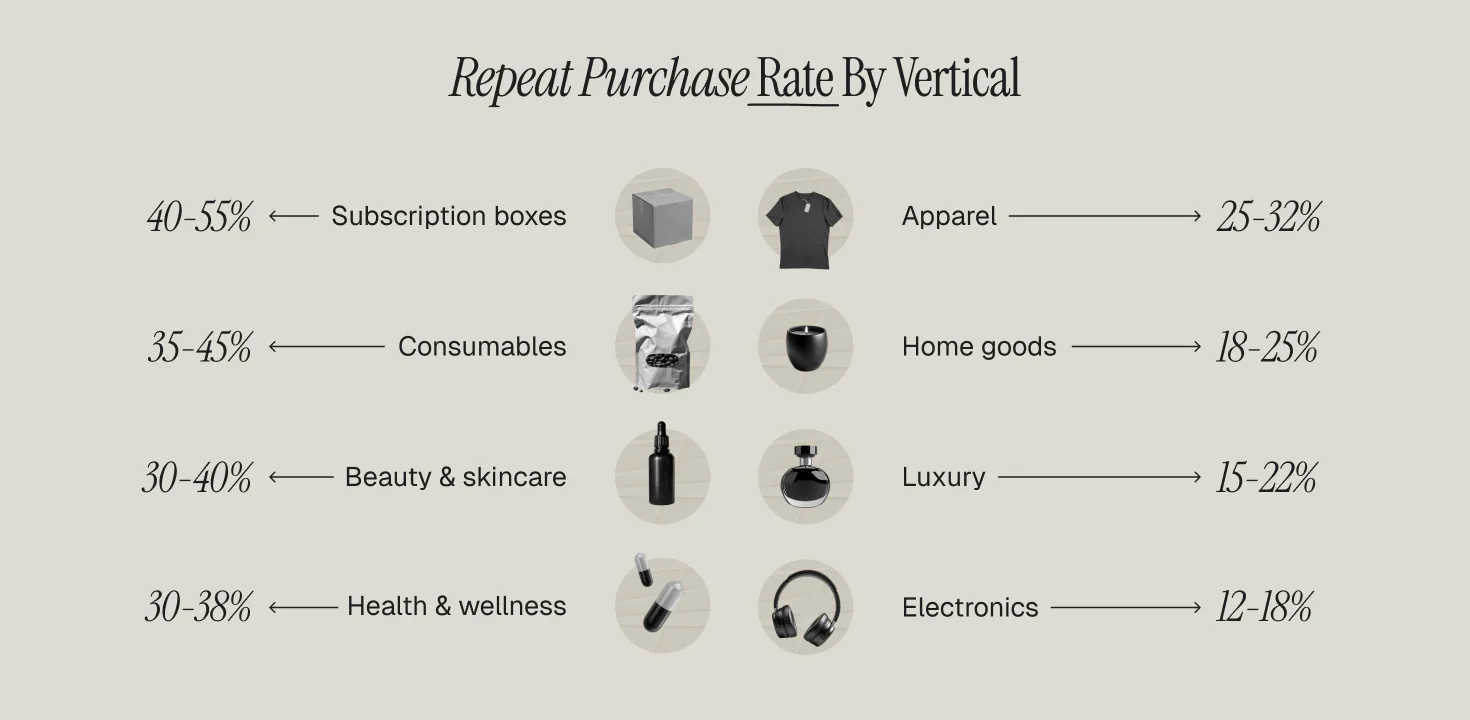
- Consumables see 35-45% 12-month repeat-purchase rates — the highest of any vertical — because of natural replenishment.
- Trigger 5-7 days before the consumption cycle ends (typically 25-30 days for consumables).
- You're 60-70% likely to sell to an existing customer vs. 5-20% to a new one (Marketing Metrics).
How a Replenishment Flow Works
The mechanics are simple. You calculate the average time it takes a customer to use up a product, then schedule an automated message to land just before they'd run out. A good replenishment email does three things: it reminds the customer their supply is low, it removes friction (a pre-loaded cart or one-tap reorder), and it offers a reason to lock in repeat buying (a 10-15% subscribe-and-save discount). The economics are unforgiving in the other direction: first orders rarely turn a profit once you account for acquisition, shipping, and returns — the margin lives in the second and third order, which is exactly what customer lifetime value (LTV) measures.
When to Trigger It (Timing Is the Whole Game)
Timing is what separates a replenishment flow from a generic "we miss you" email. For most consumables, the consumption cycle is 25-30 days, so the reminder should fire 5-7 days before estimated runout (Top Growth Marketing). Get it right and you're arriving exactly when the need is real — which is why automated flows like this generate up to 30x more revenue per recipient than one-off campaigns (Klaviyo, 2025). Fire too early and it reads as a money grab; too late and the customer has already reordered elsewhere. If building this by hand sounds painful, here's how to build personalized email flows without the manual work.
Replenishment vs. Post-Purchase vs. Win-Back
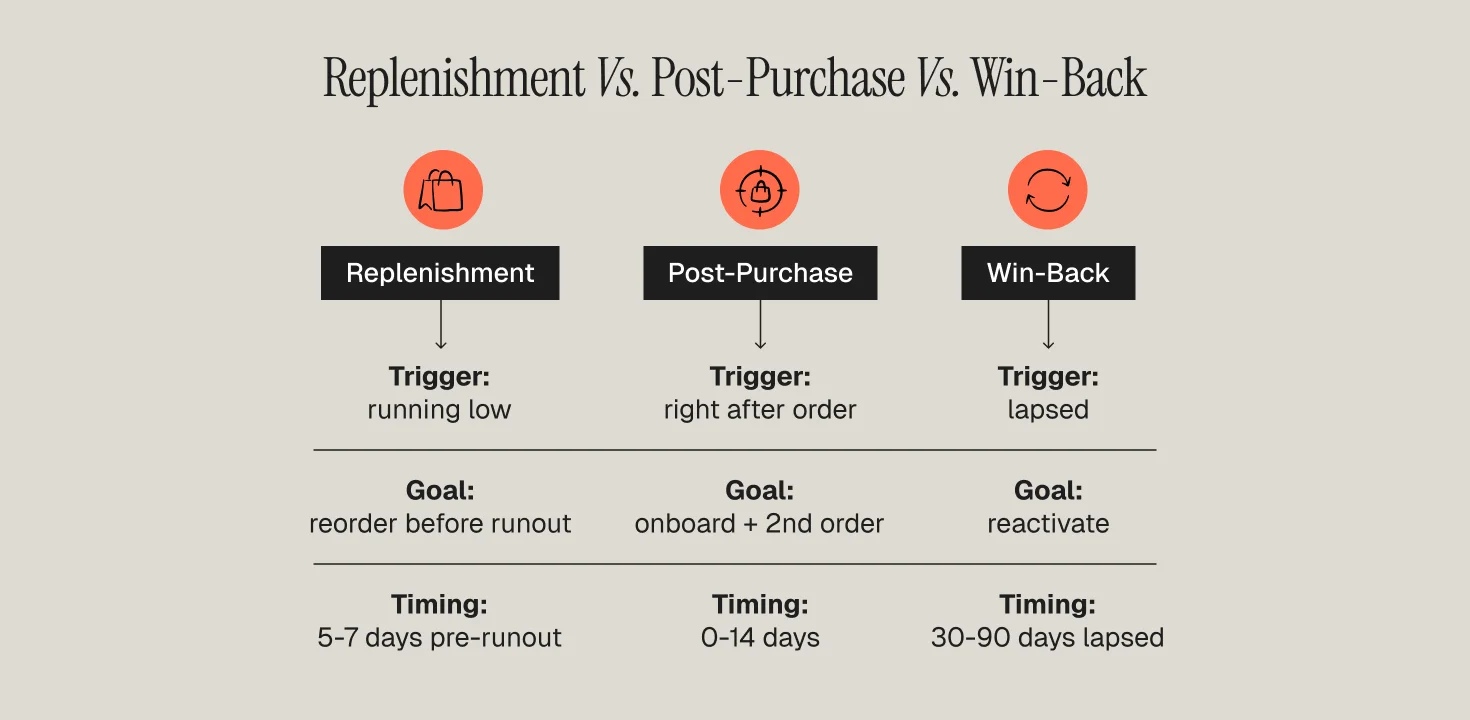
These three flows are often confused. A post-purchase flow runs immediately after an order to onboard and drive the second purchase. A win-back flow targets customers who've already lapsed. A replenishment flow sits in between — it's the proactive reorder nudge that fires before the customer lapses, timed to the product's life.
Do the Benchmarks Hold Up?
Yes — and they're vertical-dependent. The DTC average repeat-purchase rate is 25-30% over 12 months, but consumables hit 35-45% while electronics sit at 12-18% (Finsi, 2026). The difference is structural: consumables have a built-in reorder cadence, and a replenishment flow is how you capture it. It's why DTC supplement brands lean on it so heavily. There's also a compounding effect — a customer who makes a second purchase is 45% more likely to make a third (Finsi, 2026), so the first-to-second order is the highest-leverage moment in the entire lifecycle.
How to Build One in 5 Steps
- Find the cycle. Pull average days-between-orders for each consumable SKU.
- Set the trigger. Fire 5-7 days before estimated runout.
- Remove friction. Pre-load the previous item in a one-tap reorder cart.
- Add a reason to subscribe. Offer a 10-15% subscribe-and-save discount (the bridge to true subscription retention).
- Measure against promos. Compare reminder conversion (target 8-15%) to your promo baseline (1-3%).
Frequently Asked Questions
What is a replenishment flow?
An automated email/SMS sequence that reminds a customer to reorder a consumable product just before they run out, timed to the product's consumption cycle.
How well do replenishment flows convert?
Replenishment reminders convert at 8-15%, compared with 1-3% for a standard promotional email to the same list (Finsi, 2026).
When should a replenishment email be sent?
For most consumables (a 25-30 day cycle), trigger the reminder 5-7 days before estimated runout (Top Growth Marketing / Klaviyo, 2025).
What's the difference between a replenishment flow and a subscription?
A subscription auto-charges on a fixed schedule; a replenishment flow nudges a one-time buyer to reorder (often offering a subscription as the upgrade).
Which industries benefit most from replenishment flows?
Consumables — supplements, food, pet, beauty — because they have natural reorder cycles and the highest repeat-purchase rates (35-45%) (Finsi, 2026).
-thumbnail.webp)