Summarize this documentation using AI
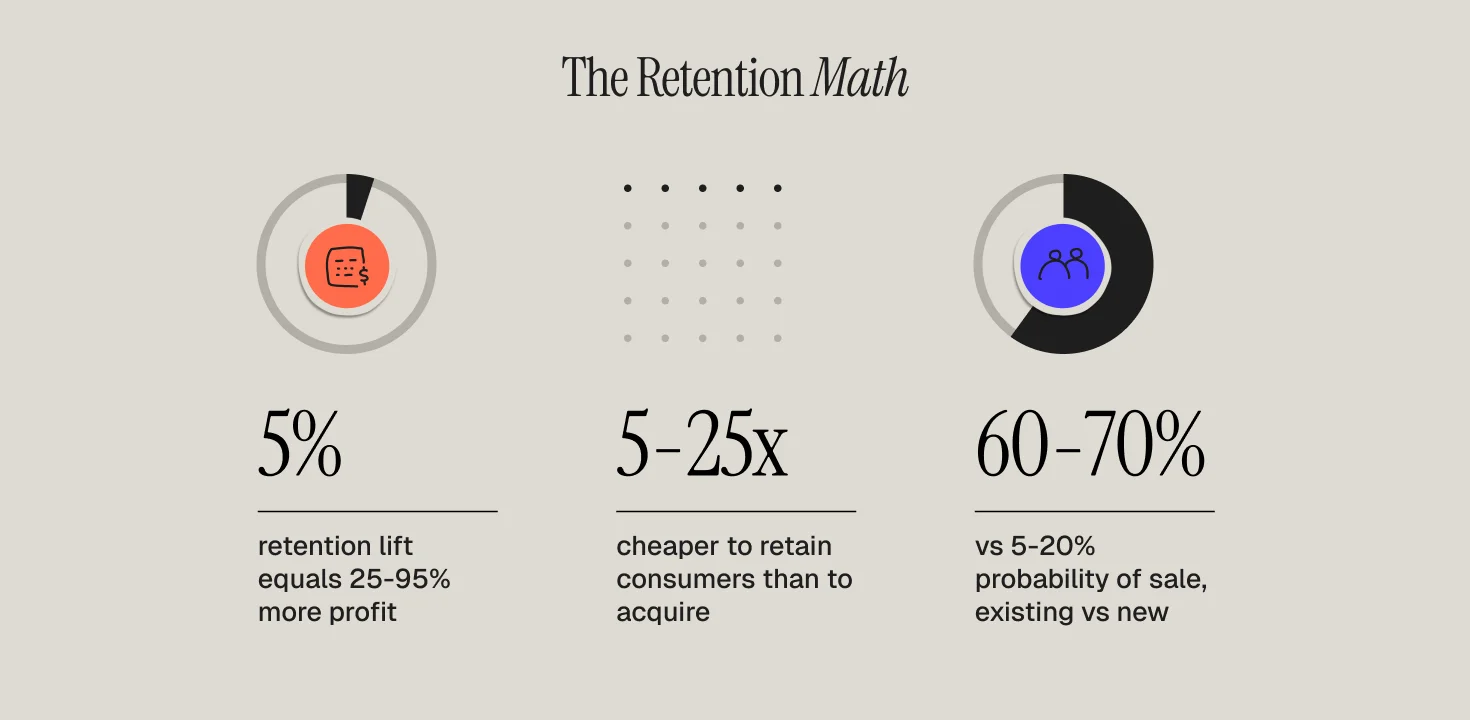
The B2C Retention Stack is the layered system of customer data, measurement, segmentation, lifecycle programs, and retention economics that a consumer brand assembles to keep customers buying instead of leaking them back into paid acquisition. Most B2C brands do not have a retention problem, they have a retention stack problem: they run one welcome email and a win-back discount, call it "retention," and wonder why churn keeps climbing. Retention only compounds when these pieces operate as one system. The stakes are financial, not cosmetic. Acquiring a new customer is five to 25 times more expensive than retaining an existing one (Harvard Business Review), and increasing retention rates by just 5% can lift profits by 25% to 95% (Frederick Reichheld, Bain & Company). This guide breaks the stack into five layers you can build in order.
Key Takeaways
- Retention is a system, not a campaign. The B2C Retention Stack has five layers (data and identity, measurement, segmentation, lifecycle programs, and economics), and a gap in any one layer caps the performance of the whole.
- The math favors retention heavily. New-customer acquisition costs 5 to 25 times more than retention (HBR), and a 5% retention lift can raise profits 25% to 95% (Bain & Company).
- You already own the demand. The probability of selling to an existing customer is 60% to 70%, versus 5% to 20% for a new prospect (Marketing Metrics, Farris et al.).
- Measurement is the layer that unlocks action. You cannot orchestrate what you cannot see, so retention rate, cohort LTV, and a customer health score are the core instruments.
- Flows are where the stack becomes revenue. Welcome and activation, replenishment, and win-back sequences convert the first four layers into compounding lifecycle revenue.
What the B2C Retention Stack Is
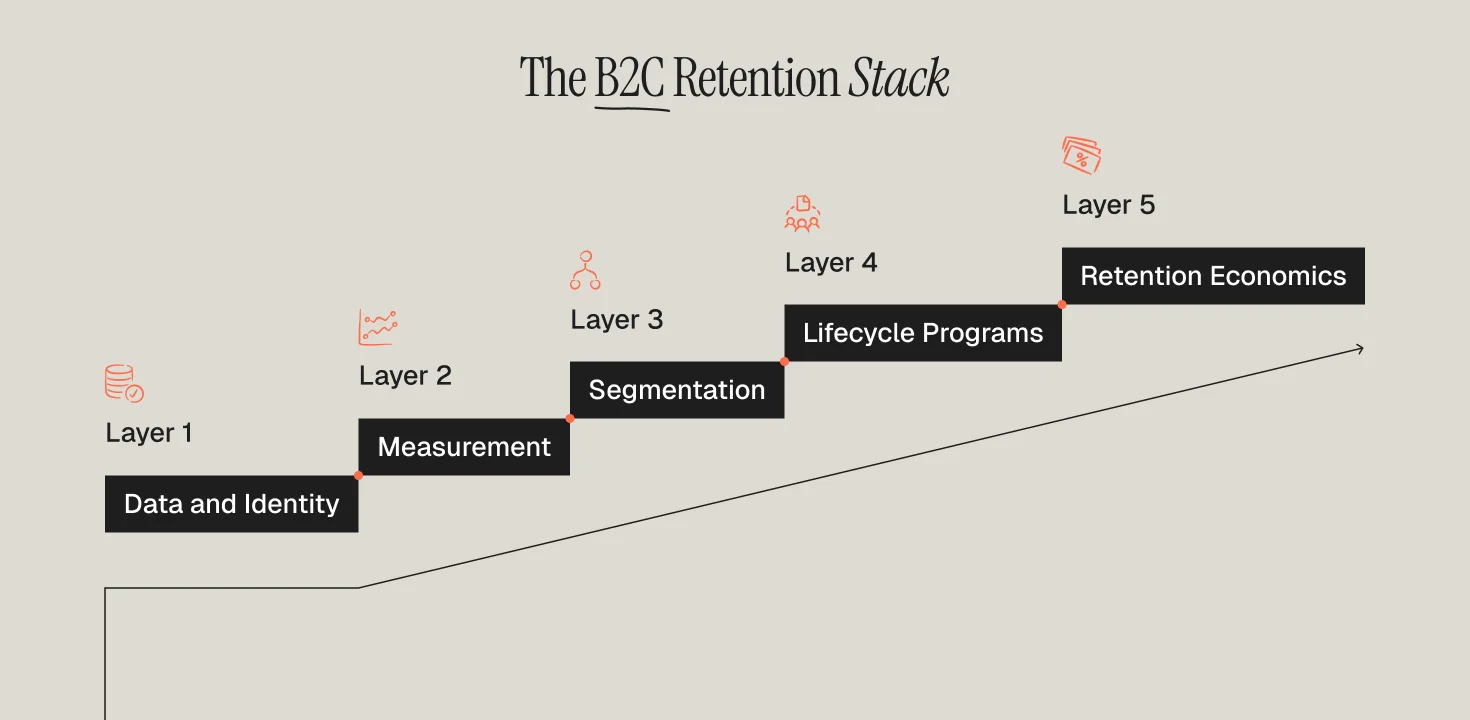
The B2C Retention Stack is a framework for treating retention as infrastructure rather than a set of disconnected tactics. Most brands practice what we call random acts of retention: a welcome email here, a loyalty punch card there, a panicked discount when churn spikes. Each piece may work in isolation, but nothing compounds because the layers are not connected. A true stack is sequenced so that each layer feeds the next, which is the core idea behind all effective retention marketing and the reason lifecycle marketing outperforms one-off campaigns. The five layers are data and identity, measurement, segmentation, lifecycle programs, and economics. Build them in that order and retention becomes a repeatable engine. Build them out of order, or skip one, and you get the leaky bucket that most consumer brands quietly live with.
Layer 1: Data and Identity
You cannot retain a customer you cannot recognize. The foundation layer is a unified profile that stitches together purchases, sessions, channels, and preferences into one identity, so a customer is the same person whether they open an email, tap a push notification, or return to the site. The highest-signal inputs here are behavioral (what people actually do) and zero-party data (what they explicitly tell you), because both are consented and durable in a privacy-first world. Without this layer, every downstream flow fires on guesses. With it, the rest of the stack has something real to act on. Think of it as the plumbing: unglamorous, invisible when it works, and catastrophic when it leaks.
Layer 2: Measurement
Measurement is the layer that turns retention from a feeling into a number you can move. Three instruments matter most. First, retention rate itself, benchmarked against your category rather than a vanity target, because a "good" rate for consumables looks nothing like one for apparel; Propel's data on customer retention rates by industry shows the DTC average repeat-purchase rate sits around 25% to 30% over 12 months, with consumables reaching 35% to 45%. Second, cohort LTV rather than a blended average, so you can see whether newer cohorts are actually retaining better or whether a few old whales are flattering the number; this is the same distinction that makes customer lifetime value a decision tool instead of a slide. Third, a leading-indicator layer, usually a customer health score, that flags at-risk customers before they lapse. If you only track the metrics that matter after the fact, you are always reacting; the retention metrics and KPIs worth mastering are the ones that predict, not just report.
Layer 3: Segmentation
Once you can see customers clearly, you have to treat them differently. Generic blasts do not retain; behavior-triggered messages do. This layer is where behavioral segmentation and RFM analysis (recency, frequency, monetary) turn a flat list into a set of lifecycle stages: new, activated, loyal, at-risk, and lapsed. Each stage needs a different message, and the reason this works is the same reason the economics favor retention: the probability of selling to an existing customer is 60% to 70% versus 5% to 20% for a cold prospect (Marketing Metrics, Farris et al.), but only if you reach the right customer with the right nudge at the right moment. Segmentation is the difference between sending everyone the same "we miss you" email and sending a lapsed high-value buyer a genuinely relevant reason to return.
Layer 4: Lifecycle Programs
This is the layer everyone starts with, and it only works because of the three beneath it. Lifecycle programs are the automated flows that carry a customer across the journey, orchestrated across email, SMS, and push. The backbone set for a B2C brand is a welcome series that earns the second purchase, an activation sequence built around the first 30 days where better onboarding measurably reduces churn, a replenishment flow timed to when a product runs out, and a win-back flow with a sunset flow to protect deliverability. These are not five separate projects; they are one connected system that hands the customer from stage to stage. When brands wire these flows to the data and segmentation layers, the same message becomes several times more effective because it is timed to behavior instead of a promo calendar.
Layer 5: Retention Economics
The top layer is the scoreboard that proves the stack is working and tells you where to invest next. Retention economics means managing to customer LTV and lifecycle revenue rather than to this month's campaign revenue. It reframes every earlier layer in dollars: a one-point improvement in cohort retention shows up here as a compounding LTV gain, and because a 5% retention lift can raise profits 25% to 95% (Bain & Company), the economics layer is usually where the CFO finally understands why retention is a growth strategy and not a cost center. When this layer is healthy, you can spend more to acquire (because you keep more), which is the flywheel every durable consumer brand runs on.
How to Build the Stack in Order
The most common mistake is building top-down: launching a win-back discount before you can even identify who is at risk. Build bottom-up instead. Get the data and identity layer clean, then stand up measurement so you have a baseline, then segment, then layer in the flows, then manage to economics. You do not need all five perfect before you start; you need each one good enough to feed the next. If you want a shortlist of moves to sequence inside this framework, Propel's roundup of retention strategies that actually work in 2026 maps cleanly onto the five layers. The brands that win are not the ones with the cleverest single campaign; they are the ones whose stack quietly compounds while competitors keep refilling a leaking bucket.
Frequently Asked Questions
What is the B2C Retention Stack?
It is a five-layer framework (data and identity, measurement, segmentation, lifecycle programs, and economics) for building retention as a connected system rather than a set of disconnected campaigns. Each layer feeds the next, so retention compounds instead of plateauing.
Is retention really cheaper than acquisition?
Yes, and by a wide margin. Acquiring a new customer is five to 25 times more expensive than retaining one (HBR), and increasing retention by 5% can lift profits 25% to 95% (Bain & Company). The probability of selling to an existing customer is also 60% to 70% versus 5% to 20% for a new prospect (Marketing Metrics).
What is a good retention rate for a B2C brand?
It depends heavily on category. Propel's retention rates by industry data puts the DTC average repeat-purchase rate around 25% to 30% over 12 months, with consumables reaching 35% to 45%. Benchmark against your vertical and your own cohorts, not a single blended target.
Which layer should I build first?
Data and identity, followed immediately by measurement. You cannot segment or orchestrate customers you cannot see, and you cannot prove impact without a baseline. Building flows before these layers is why so many retention programs stall.
Which lifecycle flows matter most for B2C retention?
The backbone set is a welcome series, an activation sequence, a replenishment flow for consumables, and a win-back flow paired with a sunset flow. Orchestrate them across email, SMS, and push.
-thumbnail.webp)
.webp)