Summarize this documentation using AI
Triggered messaging is automated communication, email, SMS, push, or in-app, sent to an individual customer in response to a specific event, behavior, or condition, rather than on a marketing calendar. A welcome email fires because someone subscribed. A replenishment reminder fires because a product is about to run out. The trigger is the customer's own action or state; the brand's role is to have the response built in advance.
The distinction sounds small and is actually the central divide in modern lifecycle marketing: batch campaigns broadcast the same message to many people at a time the brand chooses, while triggered messages deliver one relevant message to one person at the moment it matters. The revenue gap between the two is among the most consistent findings in email analytics: Klaviyo's benchmark data shows automated flows dramatically out-earning campaigns per recipient, with analyses of the same data putting flow revenue per recipient at roughly $1.94 versus $0.11 for campaigns, roughly an 18x difference.
This definition anchor covers what triggered messaging is, the seven trigger types every consumer brand should run, and how to implement them without melting your customers' patience.
Triggered Messaging vs Batch Campaigns
Campaigns are not obsolete; launches and seasonal pushes (see how brands run Black Friday email) still need them. But triggered flows are the always-on revenue floor, which is why revenue per email is the metric that exposes the difference.
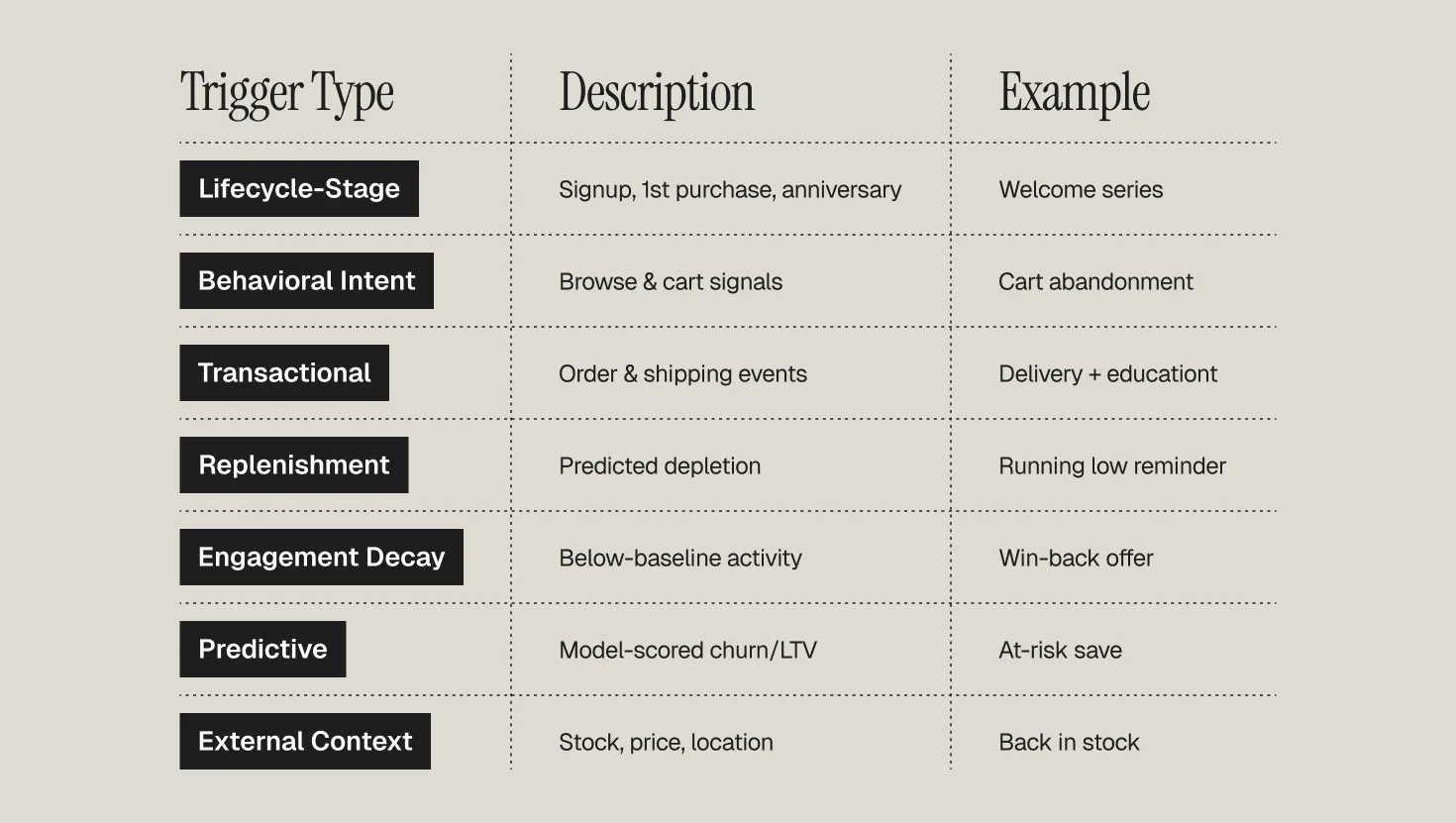
The 7 Core Trigger Types
1. Lifecycle-Stage Triggers
Fired by relationship milestones: signup (welcome series), first purchase (onboarding education), Nth purchase (loyalty invitation), subscription anniversary.
2. Behavioral Intent Triggers
Fired by observed shopping behavior: product views, category browsing, cart and browse abandonment. These carry the highest immediate purchase intent of any trigger class.
3. Transactional Triggers
Order confirmation, shipping updates, delivery confirmation. Legally and functionally distinct from marketing, and the most-opened messages a brand sends, which makes them prime real estate for education and cross-sell (used carefully).
4. Consumption & Replenishment Triggers
Fired by predicted product depletion: the replenishment flow. The workhorse of consumables, supplements, beauty, and pet categories.
5. Engagement-Decay Triggers
Fired when a customer's engagement drops below their own baseline: at-risk saves, churn-risk interventions, and eventually win-back flows and sunset flows for the unrecoverable.
6. Predictive Triggers
Fired by model output rather than a single event: predicted churn probability, predicted next-order date, predicted LTV tier crossing. The 2026 frontier, as ESPs ship native predictive attributes.
7. External & Contextual Triggers
Fired by conditions outside the customer's behavior: back-in-stock, price drop, weather, location, loyalty-points expiry. Underused and disproportionately effective because context does the personalization work.
The strategic layer connecting all seven is covered in our guide to behavioral triggers in retention marketing.
How to Implement Triggered Messaging in 4 Steps
Step 1: Instrument the events. A trigger can only fire on data you capture: site and app events, order history, subscription states, and zero-party data from quizzes and preference centers, unified per customer profile.
Step 2: Prioritize flows by revenue proximity. Ship in this order: cart/browse abandonment, welcome, post-purchase onboarding, replenishment, win-back, the core inventory in Best Klaviyo Flows for DTC (the logic ports to Customer.io and Braze).
Step 3: Set frequency governance. Triggers stack; a customer can qualify for three flows in one day. Priority rules, quiet hours, and per-channel caps keep relevance from becoming harassment.
Step 4: Measure at flow and cohort level. Judge each flow on revenue per recipient and conversion against vertical benchmarks, and judge the whole system on cohort repeat-rate lift.
How Propel Builds Triggered Messaging Systems
Propel architects lifecycle messaging systems end to end for B2C and DTC brands: event instrumentation, flow architecture across email, SMS, and push, and the reporting layer that ties every trigger to cohort revenue, on Klaviyo, Customer.io, and Braze.
Frequently Asked Questions
What is triggered messaging in marketing?
Triggered messaging is automated communication sent to an individual customer in response to a specific event, behavior, or condition, such as signing up, abandoning a cart, or a product running low, rather than being broadcast to a list on the brand's calendar. It runs across email, SMS, push, and in-app channels.
What is the difference between triggered and batch messaging?
Batch (campaign) messages go to many people at once at a time the brand picks; triggered messages go to one person when their own behavior meets a condition. Triggered flows are built once and run continuously, and they consistently generate far more revenue per recipient than batch sends.
What are examples of triggered messages?
Welcome emails after signup, cart and browse abandonment reminders, order and shipping confirmations, replenishment reminders timed to product depletion, at-risk and win-back offers when engagement decays, back-in-stock and price-drop alerts, and predictive churn interventions.
How effective is triggered messaging compared to campaigns?
Analyses of Klaviyo benchmark data put automated flow revenue at roughly $1.94 per recipient versus about $0.11 for batch campaigns, an approximately 18x gap, because triggered messages arrive when purchase intent or need is at its peak.
What do you need to set up triggered messaging?
Three layers: event instrumentation (site/app events, order data, and zero-party data unified per customer), an automation platform such as Klaviyo, Customer.io, or Braze to hold the flow logic, and frequency governance so overlapping triggers do not overwhelm customers.