.webp)
Summarize this documentation using AI
A sunset flow is an automated email sequence that identifies chronically unengaged subscribers, makes one last attempt to re-engage them, and then suppresses (stops emailing) anyone who still does not respond. Its job is not to win people back. Its job is to protect your sender reputation by removing the dead weight that drags your deliverability down, so the emails you send to engaged customers actually reach the inbox. For high-volume senders like telehealth, GLP-1, and supplement brands, a sunset flow is one of the highest-ROI flows you can build, because inbox placement is the difference between a refill reminder landing and a refill reminder vanishing.
Key Takeaways
- A sunset flow suppresses unengaged subscribers after a final re-engagement attempt. It is a deliverability tool, not a revenue tool.
- Inactive subscribers are more likely to mark mail as spam or hit spam traps. Google and Yahoo now require senders to keep spam complaints below 0.3%.
- Email lists decay ~22.5% per year (roughly 2.1%/month), so suppression has to be continuous, not a one-time cleanup.
- A typical trigger for frequent senders: no opens, clicks, or purchases in 90–120 days.
- Suppressed does not mean deleted. You keep the record; you just stop actively mailing it.
Sunset Flow, Defined
A sunset flow (sometimes called a sunset policy) is triggered when a subscriber crosses an inactivity threshold — say 90 to 120 days with no opens, clicks, or purchases. The flow sends one to three final emails ("Still want to hear from us?"), and anyone who stays silent is moved to a suppressed segment that no longer receives campaigns. Klaviyo's own documentation frames it the same way: identify the disengaged, make a last attempt, then stop sending.
The mistake most brands make is treating non-openers as lost revenue to be recovered. They are not. They are a deliverability liability. Every send to a dead address or a disengaged user tells Gmail, "people who get this mail do not want it," which pushes your good mail toward spam. Protecting that channel is foundational to customer retention for any brand that depends on email.
Sunset Flow vs. Win-Back Flow
These get confused constantly. They are not the same thing.
A win-back flow tries to reopen the wallet. A sunset flow closes the door, on purpose. You often run them in sequence: win-back fires first, and whoever ignores it flows into sunset. If you want the revenue-recovery side, see our guide on how to reduce subscriber churn.
When a Subscriber Should Enter a Sunset Flow
The right threshold depends on your send frequency. A brand emailing daily can sunset at 60–90 days of no engagement; a brand emailing twice a month should wait longer (120–180 days) so it is not suppressing people who simply receive fewer chances to engage.
Engagement should be measured on more than opens. Since Apple Mail Privacy Protection inflates open rates, smart senders weight clicks, site visits, and purchases above opens. This is where behavioral segmentation earns its keep: you are scoring real intent signals, not vanity metrics. Layering an RFM model on top lets you separate "recently lapsed but historically valuable" from "never engaged once," and treat each group differently.
How to Build a Sunset Flow (Step by Step)
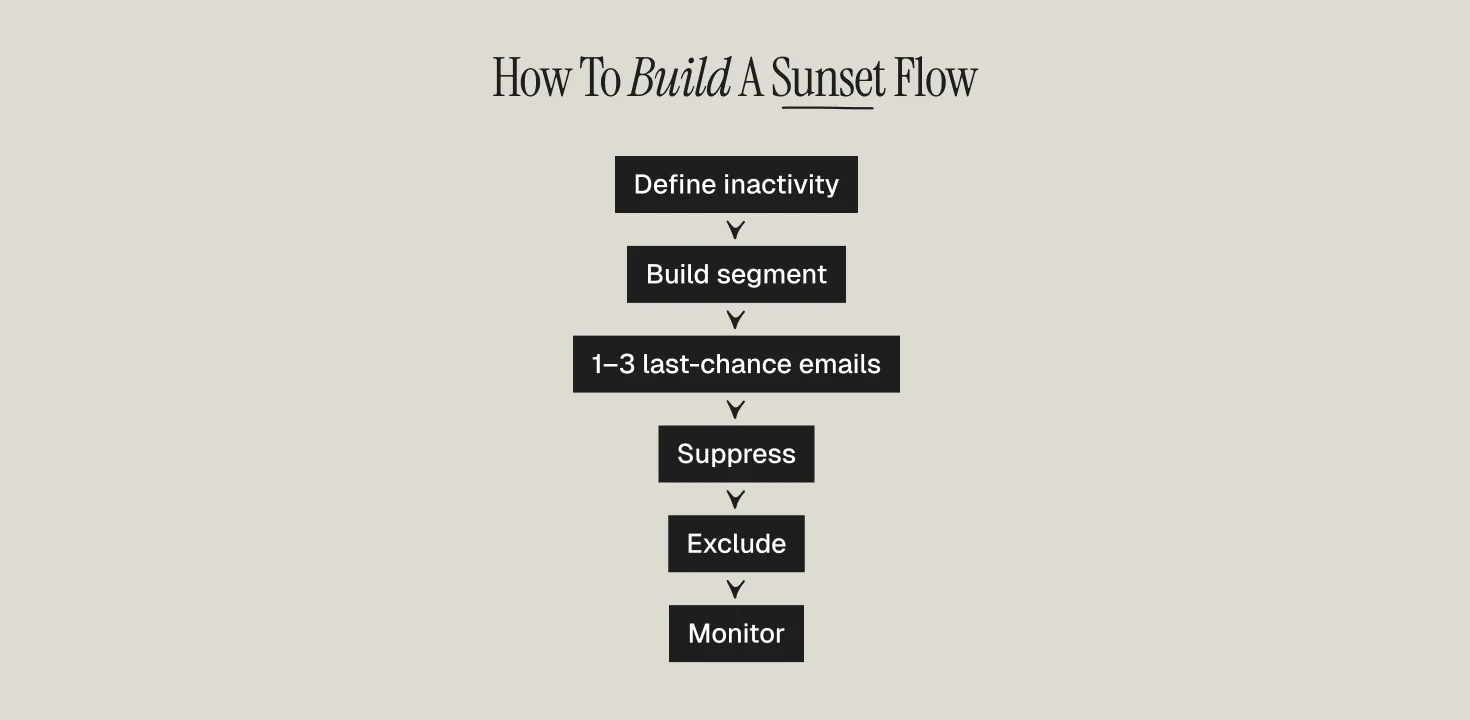
- Define inactivity. Pick your window (e.g., 90 days with no open, click, visit, or purchase) based on send cadence.
- Build the entry segment. Subscribers who meet the threshold AND are still receiving campaigns.
- Send 1–3 last-chance emails. Plain, honest, low-design: "We will stop emailing you unless you tell us to stay." A single click re-qualifies them.
- Suppress non-responders. Move silent subscribers to a suppressed list — not deleted, just removed from active sends.
- Exclude the suppressed segment from all campaigns and flows.
- Monitor deliverability. Watch your spam rate in Google Postmaster Tools; the goal is to stay well under the 0.3% complaint ceiling.
Done right, you will usually see open and click rates rise immediately after suppression — not because behavior changed, but because you stopped diluting the denominator with people who were never going to engage.
Why It Matters More for Regulated and Subscription Brands
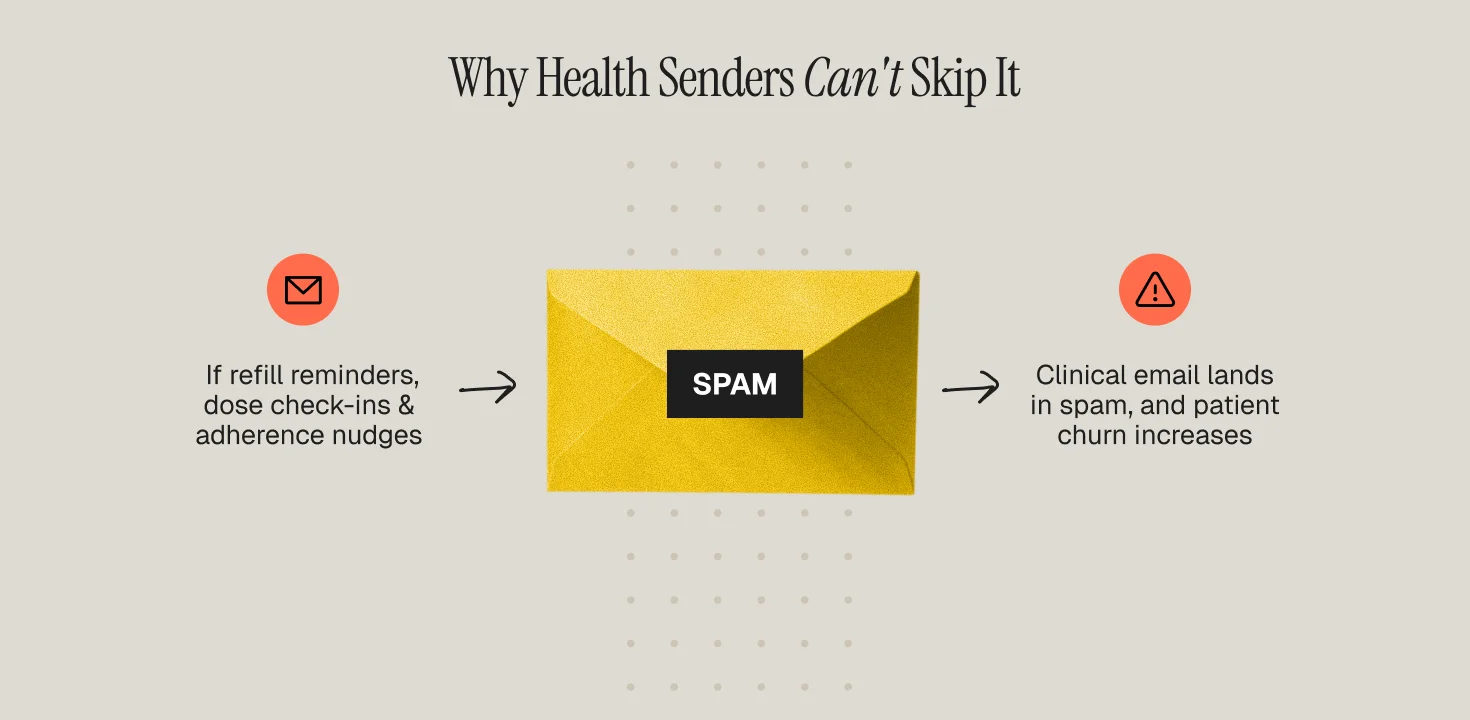
For a discount-driven ecommerce brand, a sunset flow is hygiene. For a telehealth, GLP-1, or supplement brand, it is mission-critical, because your most important emails are not promotions — they are refill reminders, dose check-ins, and adherence nudges. If those land in spam, a patient misses a refill and churns, and you may never know the email was the cause.
High-volume health senders also scale send volume fast, which is exactly when deliverability gets fragile. In one anonymized audit, a hormone-therapy brand lifted open rates from roughly 9.5% to 15%+ purely by warming the domain and pruning dead contacts as volume grew. The plumbing, not the copy, was the constraint. If that is your category, our playbooks on retention and lifecycle for telemedicine and for DTC supplements go deeper on protecting the channel that carries your clinical messages.
The uncomfortable truth: lists decay at ~22.5% a year whether you manage it or not. A sunset flow is how you decay your list on purpose, on your terms, before the mailbox providers do it for you by throttling your reputation. Pair it with strong onboarding that reduces churn early and you defend both ends of the lifecycle.
Frequently Asked Questions
Is a sunset flow the same as deleting subscribers?
No. Suppression keeps the contact record (for compliance and possible future opt-in) but stops active sending. Deletion removes the record entirely.
Will a sunset flow hurt my revenue?
Almost never in a way that nets negative. The subscribers you suppress were not opening or buying. Removing them typically improves inbox placement for the engaged majority, which lifts revenue.
How often should I run a sunset flow?
Continuously, as an always-on flow, plus a deeper manual list audit each quarter. Because lists decay ~2% a month, one-time cleanups do not hold.
What is the right inactivity window?
Tie it to send frequency: 60–90 days for daily senders, 120–180 days for low-frequency senders. Measure clicks and visits, not just opens.
Why do Gmail and Yahoo care?
Both now enforce a spam-complaint rate under 0.3% and reward engagement-based sending. Mailing the disengaged is the fastest way to breach those rules.

![Featured image: How to Identify Users Who Are About to Churn [2026 Guide for Retention Marketers]](https://cdn.prod.website-files.com/69bbf9f7f2a3f75341357ebc/69f4b4ad14f8c675169e0cba_69c7cec26de0e50005c6e495_698ae45b9ecbf9983380f731_6909f1e088d37bed0144f247_Identify%25252520User%25252520churn-2-min.png)