

Summarize this documentation using AI
70.22% of ecommerce carts are abandoned, per Baymard Institute's running meta-analysis of 50 studies. And carts are only the visible layer: for every shopper who abandons a cart, several more view a product and leave without ever adding to cart.
Those two behaviors get treated as one problem, and that is the mistake. Cart abandonment and browse abandonment are different intent levels that need different flows: different timing, different message architecture, different offers, different success metrics.
This guide separates the two cleanly, gives the 2026 benchmarks for each, and shows how to run both flows in Klaviyo (or any ESP) without them competing for the same customer. It extends the flow architecture from our guide to the best Klaviyo flows for DTC brands.
The Core Difference: Declared Intent vs Signaled Interest
Cart abandonment is declared intent. The shopper chose a variant, added it, maybe started checkout, then left. The product decision is largely made; something interrupted the transaction, most often unexpected shipping costs, forced account creation, or checkout friction.
Browse abandonment is signaled interest. The shopper viewed one or several products but never committed to one. The decision is not made; they are still comparing, researching, or just window shopping.
The practical consequence: a cart flow's job is to remove the obstacle, while a browse flow's job is to advance the decision. Copy that removes obstacles ("free shipping on your cart") lands flat on browsers; copy that advances decisions (education, comparisons, social proof) is too slow for cart abandoners. Both flows are ultimately applications of behavioral triggers in retention marketing.
What the Benchmarks Say in 2026
Abandoned cart emails are consistently the highest-performing automation in ecommerce: Klaviyo's abandoned cart benchmark data shows open rates around 50%+ and conversion rates that lead all flow types. Browse abandonment flows see materially lower conversion per recipient, but reach a far larger audience, which is why mature DTC programs run both: cart flows win on rate, browse flows win on volume.
Judge each flow against its own baseline in Klaviyo's 2026 industry benchmarks, and against your own account history in our ecommerce email benchmarks guide, not against each other.
Building the Cart Abandonment Flow
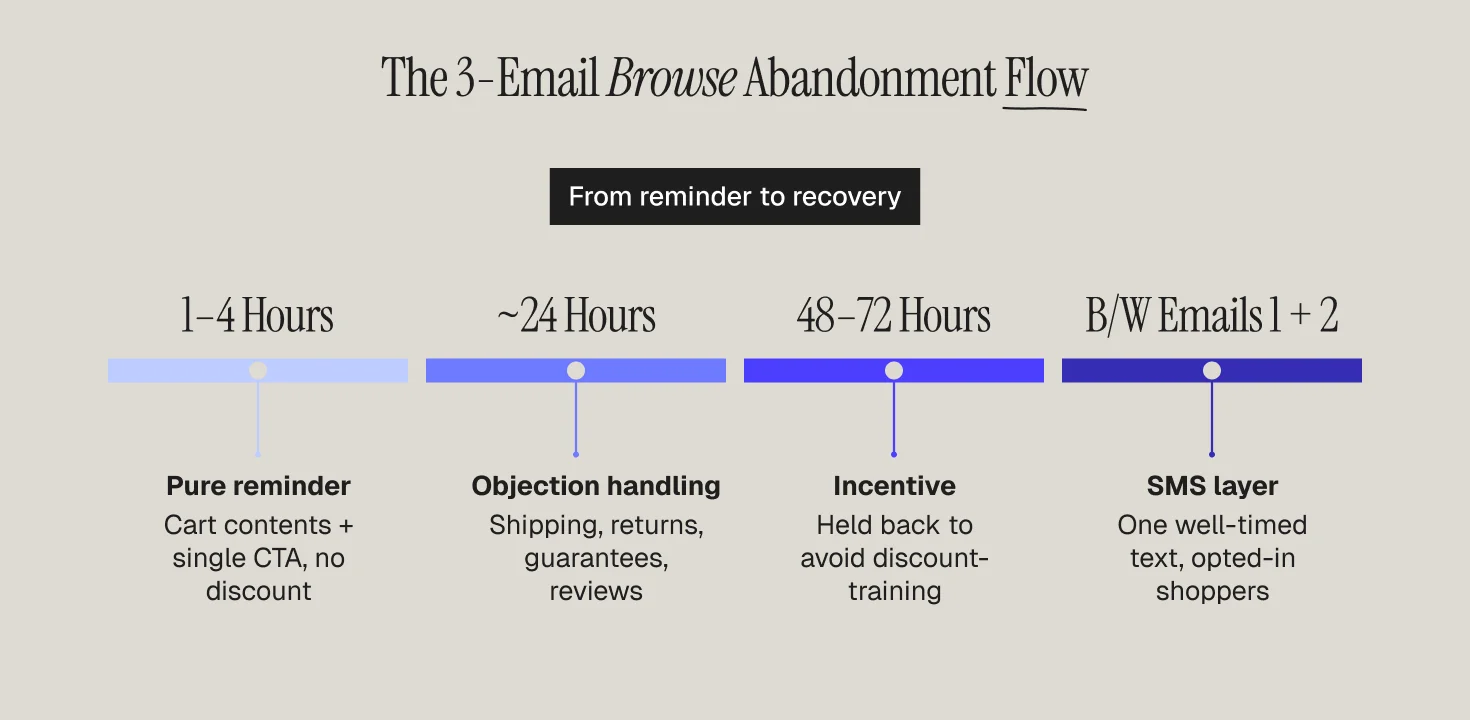
Structure (3 to 4 emails + SMS)
Email 1, 1 to 4 hours after abandonment. Pure reminder with the cart contents, product image, and a single CTA back to checkout. No discount. A large share of cart recoveries need nothing more than the nudge.
Email 2, ~24 hours. Objection handling: shipping policy, returns, guarantees, reviews of the exact product in the cart. This is where Baymard's abandonment reasons become your copy checklist.
Email 3, 48 to 72 hours. Incentive if (and only if) your margin allows, held back this long so you do not train discount-waiting. Segment high-intent checkout-starters separately; they often convert without it.
SMS layer. A single well-timed SMS between Emails 1 and 2 lifts recovery meaningfully for opted-in shoppers; coordination rules are in our guide to integrating email and SMS campaigns.
Cart Flow Rules That Prevent Damage
Suppress purchasers in real time, cap discounts by profile (repeat discount-abusers exist), and exit anyone who re-enters checkout on their own. If recovery is a major revenue line for you, our comparison of cart abandonment recovery service providers for DTC brands covers when to outsource it.
Building the Browse Abandonment Flow

Structure (2 to 3 emails)
Email 1, 4 to 24 hours after the browse session. "Still looking at [product]?" with the viewed item plus 2 to 3 alternatives from the same category. The alternatives matter: the browser has not committed to a product yet, so a single-product email guesses too hard.
Email 2, ~2 days. Category-level education or social proof: buying guide, bestseller list, UGC. Advance the decision instead of pushing the transaction.
Email 3 (optional), 4 to 5 days. Soft incentive or low-commitment CTA (quiz, sample kit, restock alert) for high-value categories only.
Browse Flow Rules That Prevent Fatigue
Trigger only on meaningful sessions (multiple product views or a threshold view time, not a single bounce), throttle to one browse flow entry per week, and always let cart abandonment take priority: if a browser later adds to cart, the cart flow supersedes and the browse flow exits. Smart filtering here is a direct application of behavioral segmentation.
Running Both Without Cannibalization
Three rules make the two flows coexist cleanly. First, strict priority: cart beats browse, always. Second, shared frequency capping so a heavy browser who also abandons a cart does not get five automations in three days. Third, unified reporting: measure incremental revenue per profile across both flows, because a browse email that pushes someone into a cart (and then into the cart flow) shows up in the wrong column if you read flows in isolation.
During peak periods like BFCM, tighten send delays and raise entry thresholds; the tactics in our Black Friday email guide apply directly to both flows.
At Propel we build cart and browse abandonment as one coordinated system inside a brand's full lifecycle marketing stack.
Frequently Asked Questions
What is the difference between cart abandonment and browse abandonment?
Cart abandonment happens when a shopper adds a product to cart (or starts checkout) and leaves without buying. Browse abandonment happens when a shopper views products but never adds anything to cart. Cart abandonment signals declared purchase intent; browse abandonment signals interest that still needs converting.
Which flow makes more money, cart or browse abandonment?
Per recipient, cart abandonment wins by a wide margin; it is consistently the highest-converting ecommerce automation. But browse abandonment reaches many more shoppers, so at the program level both contribute meaningful revenue for DTC brands.
How soon should an abandoned cart email send?
The first email should send within 1 to 4 hours of abandonment, while purchase intent is warm. Follow-ups at roughly 24 hours and 48 to 72 hours complete the core sequence.
Should browse abandonment emails include a discount?
Usually not in the first two emails. Browsers have not chosen a product yet, so discounts subsidize undecided traffic. Save incentives for a final email in high-AOV categories, or use low-commitment CTAs like quizzes and restock alerts instead.
What is the average cart abandonment rate in 2026?
70.22%, per Baymard Institute's meta-analysis of 50 cart abandonment studies. Rates vary by vertical and device, with mobile abandonment running higher than desktop.
