
Summarize this documentation using AI
A welcome series is an automated sequence of emails sent to new subscribers immediately after they sign up. It typically runs 3-7 emails over 5-14 days, and it is triggered by a single action: the moment someone joins your list.
Unlike promotional campaigns, a welcome series is not about a sale. It is about establishing the beliefs a new subscriber needs to make a buying decision. Done well, it is the highest-ROI flow in your entire email program. Done poorly, it is an expensive introduction nobody reads.

Key Takeaways
- Welcome emails average a 68.6% open rate, the highest of any email type (Oberlo).
- Multi-email welcome series generate 51% more revenue than single-email flows (Stripo).
- Welcome emails generate 320% more revenue per email than standard promotional campaigns (Invespcro).
- The optimal welcome series length is 4-6 emails over 7-14 days.
- Most brands use the welcome series to introduce their brand. Top performers use it to sequence beliefs.
Why Your Welcome Email Is the Most Important Email You Send
Your welcome email has something no other email in your program has: guaranteed attention.
New subscribers open welcome emails at an average rate of 68.6% (Oberlo). For context, industry average open rates for promotional emails sit around 20-25%. That gap represents a window of maximum attention that closes quickly and never fully reopens.
Most brands use this window to say: here is who we are, here is 10% off. That is not wrong. It is just not enough.
How Long Should a Welcome Series Be?
The short answer: 4-6 emails, sent over 7-14 days.
The longer answer depends on your product and buyer journey. A $30 skincare product needs fewer belief shifts than a $500 supplement protocol or a considered B2B tool. The rule is not about email count. It is about how many beliefs your subscriber needs to form before they will commit to a purchase.
- Short, impulse-friendly product: 3-4 emails over 5-7 days.
- Considered, higher-AOV product: 5-7 emails over 10-14 days.
What you should never do: send one email and call it a welcome series.
What Should Go in a Welcome Series?
Most welcome flows are built around what the brand wants to say. The best welcome flows are built around what the subscriber needs to believe.
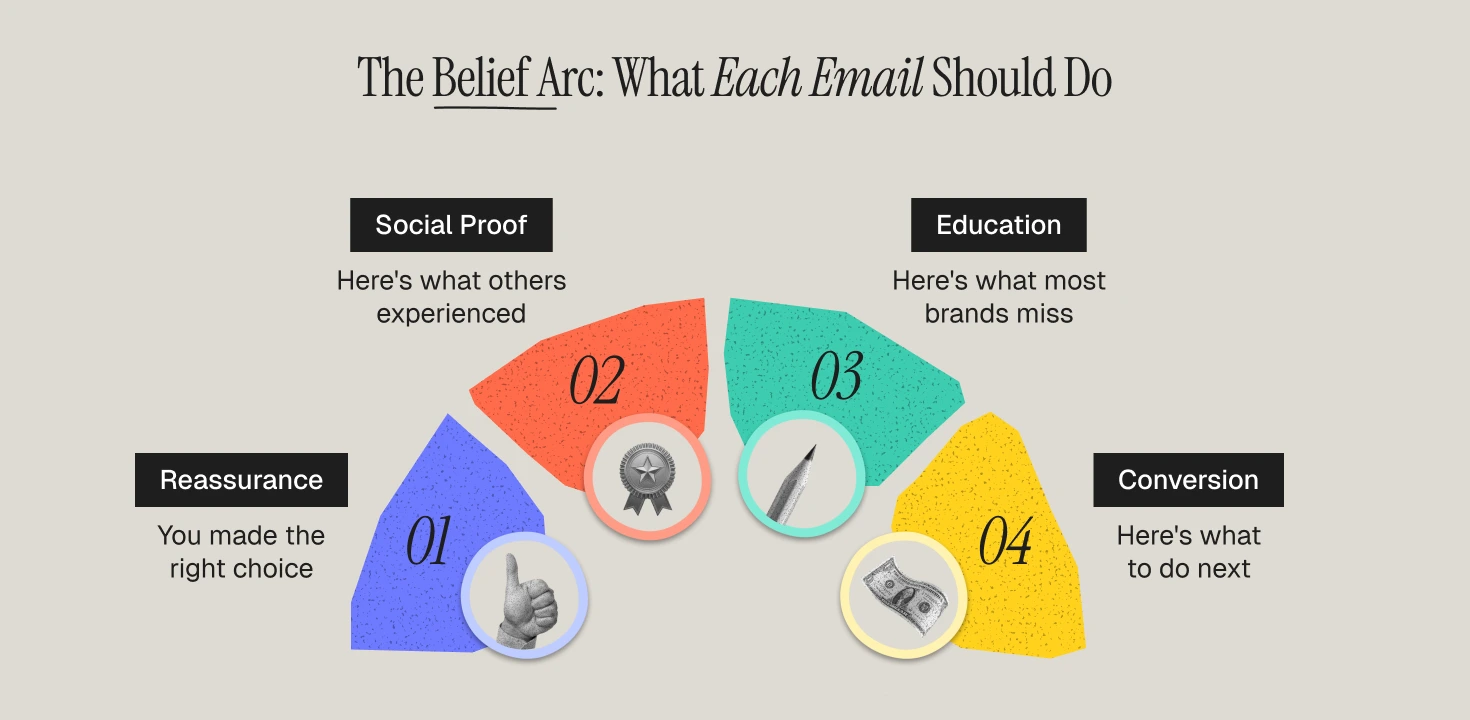
Here is the belief arc framework:
Email 1 — Reassurance. Confirm they made the right decision. Deliver on the promise that got them to subscribe. Do not sell yet.
Email 2 — Social proof. Show evidence. Customer stories, results, third-party validation. Let others make the argument you cannot make yourself.
Email 3 — Education. Teach something valuable. This is the belief-formation email. It should reframe how they think about the problem your product solves.
Email 4 — Conversion. Now make the offer. By this point, they trust you. They understand the problem. They have seen proof. The sale is a natural next step.
This is not a sequence of emails. It is a sequence of belief shifts.
Welcome Series vs. Promotional Campaigns
Welcome emails generate 320% more revenue per email than standard promotional campaigns (Invespcro). That is not an accident.
Promo campaigns compete for attention. Welcome emails have it by default. Welcome emails arrive in a moment of maximum brand interest, before subscribers have had any reason to tune you out. This is the same principle that drives the 30-day activation window — the window after first purchase where customer activation is either won or lost.
Common Welcome Series Mistakes
- Leading with a discount. It trains subscribers to wait for offers instead of buying at full price.
- Sending a brand story nobody asked for. Subscribers do not care about your origin story in email 1. They care about what you can do for them.
- Stopping at one email. A single welcome email captures less than half the revenue potential of a full series.
- Not segmenting by signup source. A subscriber who came through a quiz has different beliefs and intent than one who came through a generic pop-up.
Frequently Asked Questions
What is a welcome series in email marketing?
A welcome series is an automated sequence of emails sent to new subscribers after they join your list. It is designed to convert a new subscriber into a first-time buyer by building trust, demonstrating value, and sequencing the beliefs needed to make a purchase decision.
How many emails should be in a welcome series?
Most brands see the best results from 4-6 emails. Shorter product journeys may only need 3-4 emails. More considered or higher-AOV products benefit from 5-7. The number should reflect how many belief shifts the subscriber needs before they will buy.
What should the first welcome email say?
The first welcome email should deliver on whatever promise got someone to subscribe (a lead magnet, a discount, helpful content), and then reassure the subscriber they made a good decision. It should not sell. It should set up the emails that follow.
What is the difference between a welcome email and a welcome series?
A welcome email is a single email sent when someone subscribes. A welcome series is a sequence of 3-7 emails sent over multiple days. Multi-email welcome series generate 51% more revenue than single emails (Stripo).
Should I include a discount in my welcome series?
Only in the final conversion email (email 3 or 4), not email 1. Leading with a discount trains subscribers to hold out for offers instead of buying at full price. Use the early emails to build trust and demonstrate value first.
