
Summarize this documentation using AI
A win-back email flow is an automated lifecycle sequence that re-engages customers who have stopped buying. It fires when a customer crosses your brand's "lapsed" threshold, roughly 1.5x to 2x their normal time between orders. A good program reactivates 3-10% of lapsed customers, and the best-run ones hit 10-15%, at a fraction of acquisition cost. The mechanics are simple: a 30 to 90 day, multi-touch sequence with escalating incentives, personalized to each customer's purchase history. Most brands get one of three things wrong. They send too late, they send the same email to everyone, or they never send at all.
This guide covers what a win-back flow is, who belongs in it, when to trigger it, how to structure the sequence, the benchmarks to expect in 2026, and how to measure whether it actually worked.
Key Takeaways
- A win-back flow targets lapsed customers (people who bought and stopped), not unengaged subscribers who never bought. Define "lapsed" as roughly 2x your median time between orders.
- Reactivation is the cheapest revenue you own: acquiring a new customer costs 5 to 25 times more than keeping an existing one, and a strong win-back program returns 5 to 15x.
- Timing beats copy. The highest-leverage moment is when a customer crosses the lapsed threshold; by day 90 most have already moved on.
- Three emails work for most brands: reminder (no discount), incentive, final call. Win-back emails under 120 words outperformed longer versions by 15-25% on click-through.
- Adding SMS and retargeting on top of email increases total recovery by 25-40%.
What is a win-back email flow?
A win-back email flow (also called a re-engagement or reactivation flow) is an automated lifecycle sequence that fires when a previously active customer goes quiet. Unlike a welcome series, which converts a brand-new subscriber, a win-back flow re-opens a relationship with someone who already trusts the brand and has payment details on file. That is what makes it one of the highest-ROI levers in lifecycle email marketing: the expensive part, acquisition, is already paid for.
The economics are stark. Because it costs 5 to 25 times more to acquire a new customer than to retain one, recovering even a small slice of lapsed buyers moves revenue further than most paid campaigns. A win-back flow is cheap revenue sitting in a segment you already own.
Lapsed vs. unengaged: who belongs in the flow
The single biggest targeting error is mixing two different audiences. An unengaged subscriber never bought. A lapsed customer bought and stopped. They need different messages, and win-back flows are for lapsed customers only.
To find them, calculate the median time between orders for your repeat buyers. A customer who has gone 1.5x past that median is at risk; 2x past it is lapsed. Pair this with RFM segmentation so a five-time buyer and a one-time buyer do not receive the same sequence. Better still, act before the lapse: identify customers who are about to churn using behavioral triggers so the at-risk window becomes a save, not a win-back.
When to trigger: the 30/60/90 framework
Timing is anchored to your product's repurchase cycle, not a fixed calendar. The window most brands miss is 60 to 90 days after last purchase, but the right trigger depends on cadence:
Trigger framework source: Finsi win-back benchmarks, 2026.
The most common mistake is waiting too long. By the time a 30-day consumable buyer is 90 days silent, the decision to leave was made weeks ago. Trigger earlier, even when it feels too soon.
The three-email structure
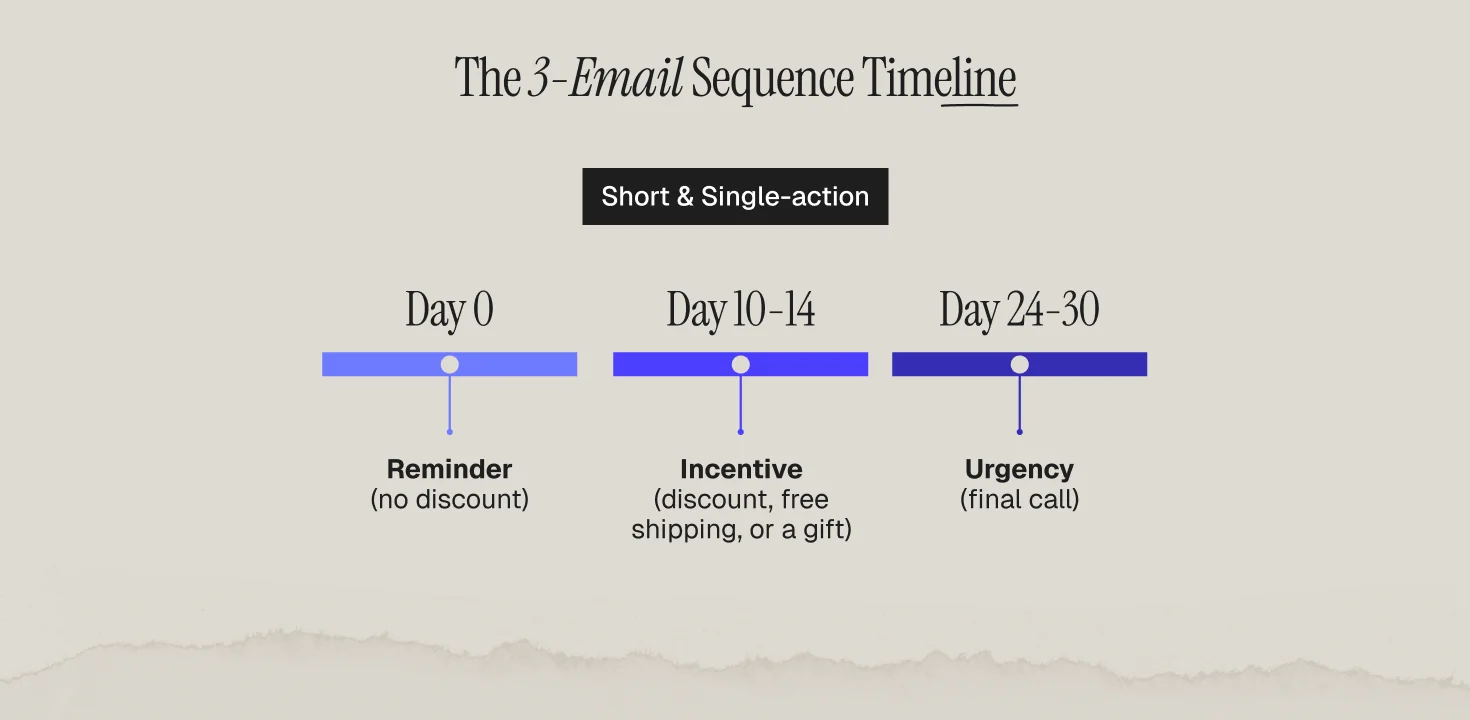
Most high-performing win-back sequences are three emails, 10 to 14 days apart:
- Email 1, the reminder (Day 0). Remind them you exist and surface relevant products. No discount yet. This tests whether a simple nudge is enough.
- Email 2, the incentive (Day 10-14). Introduce a discount, free shipping, or a gift, stronger than your standard promotional offer because you are competing with inertia.
- Email 3, the final call (Day 24-30). Signal that the offer is expiring or that you will reduce email frequency. This is the urgency email.
Keep each email short and single-action. Win-back emails under 120 words beat longer versions by 15-25% on click-through, and personalizing on purchase history lifts response rates by 20-40%. For opted-in audiences, layering SMS and retargeting on top of the email sequence lifts total recovery by 25-40%.
Win-back benchmarks (2026)
Performance depends heavily on how long the customer has been gone. Warmer segments convert far better, which is the whole argument for triggering early:
Benchmark source: Finsi, 2026. Treat as directional and validate against your own cohort data.
A realistic, well-segmented program reactivates 3-10% of lapsed customers and returns 5-15x once you net out discount and send cost. Set against rising acquisition costs, the case makes itself.
How to measure success
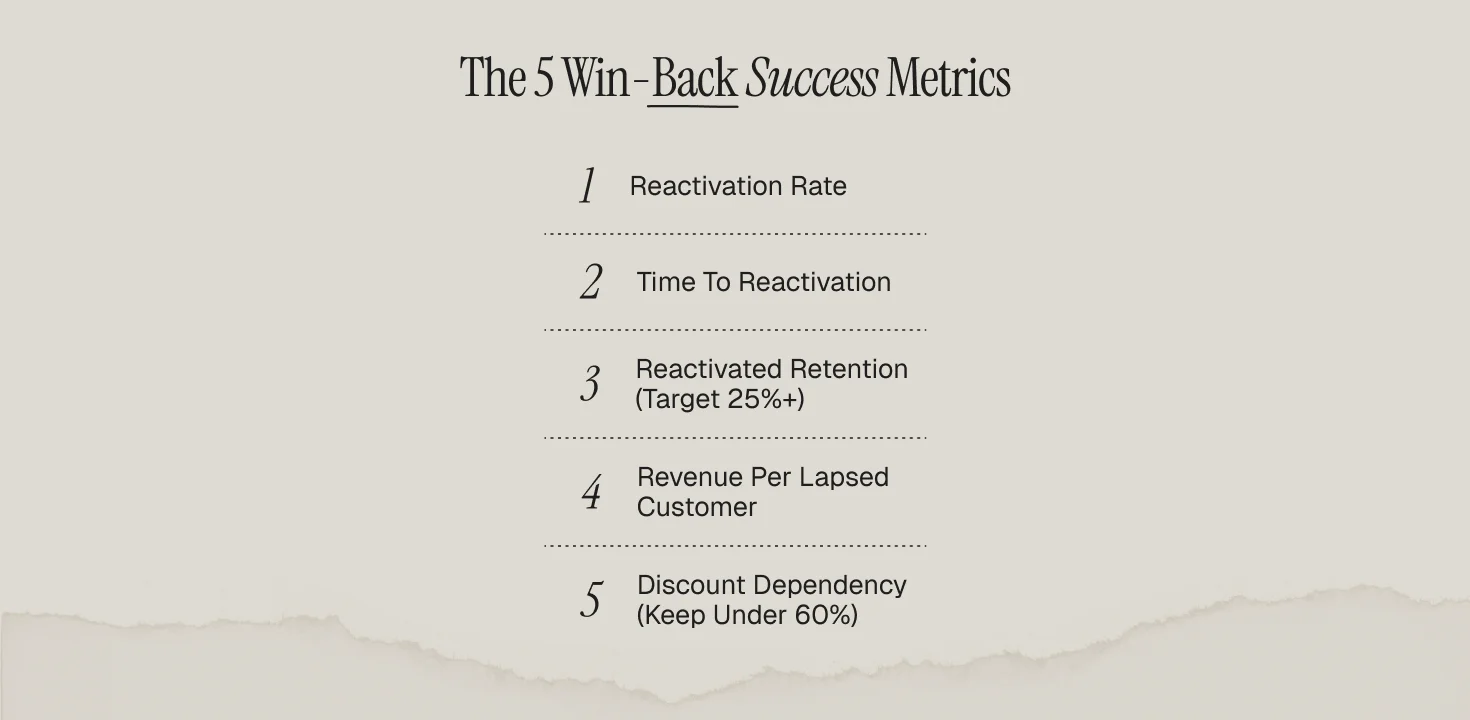
Track five things: reactivation rate (purchased within 30 days of entering the flow), time to reactivation, reactivated-customer retention (aim for 25%+ making a second purchase), revenue per lapsed customer, and discount dependency. That last metric is the trap most teams ignore: if more than 60% of reactivations use the discount code, you have trained a discount habit, not built a win-back program. Feed these numbers into your customer lifetime value (LTV) model and your broader subscription retention strategy so win-back is judged on retained value, not just first reactivation.
Common win-back mistakes
- Sending too late. The number-one error. The decision to leave is usually made before the first email goes out.
- One email instead of a sequence. A single send leaves most of the recoverable revenue on the table.
- Leading with a discount in email 1. It trains customers to wait for the next markdown.
- Treating never-bought subscribers as lapsed customers. Different audience, different message.
- Rewriting copy when the real problem is plumbing. A broken link, a stale segment, or a trigger that quietly stopped firing will sink a flow no matter how good the words are. Audit the surface first. For the deeper playbook, see how to reduce subscriber churn.
Frequently Asked Questions
When should I send a win-back email?
Anchor it to your repurchase cycle. For consumables, trigger at roughly 1.5x your average reorder interval; for non-consumables, 90 to 120 days of inactivity is common. Most brands wait too long.
What is a good win-back conversion rate?
3-10% is solid, and the best-run programs hit 10-15%. Below 2% usually means your timing is off or your lapsed definition is too broad.
How many emails should a win-back flow have?
Three works for most DTC brands: reminder, incentive, final call. More than four shows diminishing returns and starts to annoy people.
Should I offer a discount?
Not in email 1. Lead with value, introduce the incentive in email 2, and escalate in email 3. Watch discount dependency closely.
Is a win-back flow worth building?
Yes. Acquisition costs 5 to 25x more than retention, and a strong win-back program reactivates 3-10% of lapsed customers and returns 5-15x on investment.

![Featured image: How to Identify Users Who Are About to Churn [2026 Guide for Retention Marketers]](https://cdn.prod.website-files.com/69bbf9f7f2a3f75341357ebc/69f4b4ad14f8c675169e0cba_69c7cec26de0e50005c6e495_698ae45b9ecbf9983380f731_6909f1e088d37bed0144f247_Identify%25252520User%25252520churn-2-min.png)