
Summarize this documentation using AI
Every DTC brand is sitting on a list full of customers who bought once, opened a few emails, then went quiet. Reactivating them is the cheapest revenue available to you: acquiring a new customer costs 5 to 25 times more than keeping an existing one, and a lapsed buyer already knows your product, your shipping times, and your brand.
Yet most winback flows are a single "We miss you" email with a 10% code. That is not a winback strategy. That is a coupon with feelings.
This guide breaks down 10 winback email examples that work in 2026, when to send each one, and the benchmarks to judge them against. It builds on our definition of a win-back email flow and the Win-Back Hierarchy framework we use with DTC clients.
First: Who Actually Counts as "Lapsed" in 2026
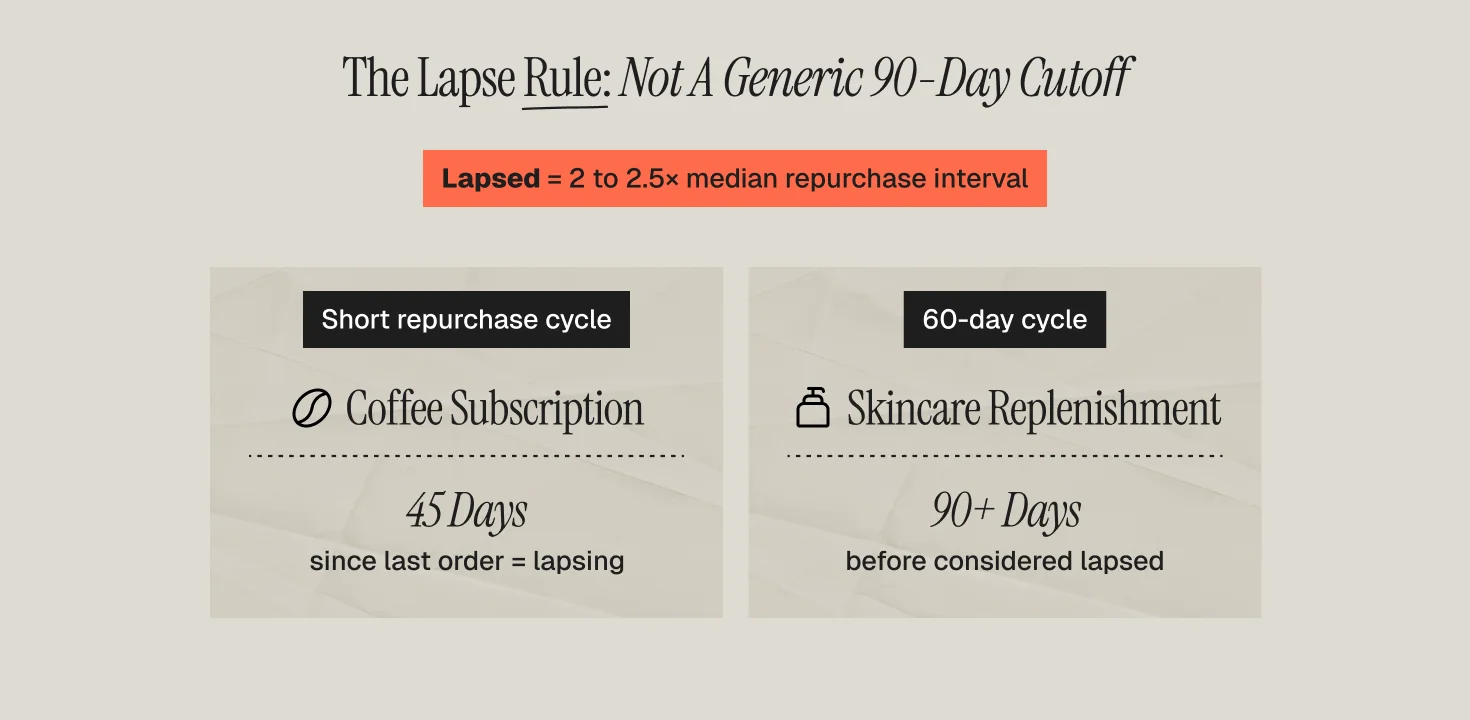
Before copying any example, define lapse relative to your purchase cycle, not a generic 90-day rule. A coffee subscription customer who has not ordered in 45 days is lapsing. A skincare customer on a 60-day replenishment cycle is not lapsed until day 90 or later.
The practical rule we use at Propel: lapse begins at roughly 2 to 2.5 times your median repurchase interval. Segment from there using behavioral segmentation, and identify at-risk customers before they cross that line with the signals covered in how to identify users who are about to churn.
What good looks like: winback and reactivation flows convert in the 1 to 2% range per email for well-segmented DTC lists, against flow email averages of roughly 1.8% conversion across ecommerce in Klaviyo's benchmark data. Anything above that is upside from better targeting, timing, and offers.
The 10 Winback Email Examples
1. The Reminder Without an Offer
The first email in the sequence should not discount. Lead with what the customer already liked: their last product, its top benefit, one review. Roughly a third of reactivations happen without any incentive, and every discount you skip protects margin. Subject line pattern: "Still thinking about your [product]?"
2. The "What's Changed" Update
Lapsed customers left a snapshot of your brand in their memory. Show them what is new since their last order: new flavors, reformulations, faster shipping, a rebrand. This works especially well for brands that iterate fast. Frame it as news, not a plea.
3. The Social Proof Stack
One email built entirely on reviews, UGC, and a "bestseller since you left" module. Lapsed buyers need their original purchase decision re-validated more than they need a code. Pull your highest-rated SKU from the customer's category.
4. The Incentive Ladder, Step One
Now the offer starts, small: free shipping or 10%. The ladder logic matters more than the numbers. If you open with your biggest discount, you train the list to wait for it, a pattern we break down in retention email strategies that actually convert.
5. The Incentive Ladder, Step Two
Escalate only for non-responders: 15 to 20%, or a gift-with-purchase for margin-sensitive brands. Gate it with a deadline that is real. Fake urgency reads instantly in 2026 inboxes.
6. The VIP Winback
Your lapsed high-LTV customers deserve a different flow than one-time buyers. Reference their history explicitly ("You've been with us through 6 orders"), offer early access or a concierge touch instead of a discount. Protecting this cohort is the highest-leverage move in the whole program because of how customer lifetime value concentrates in repeat buyers.
7. The Replenishment Nudge
For consumables, the best winback is a well-timed reorder prompt: "Running low?" with a one-click reorder. If this describes most of your catalog, your winback flow should borrow heavily from a replenishment flow rather than a generic reactivation series.
8. The Feedback Ask
"Did we get something wrong?" with a one-question survey. Response rates are modest but the replies are gold, and the email itself reactivates a surprising share of quiet customers because it reads human. Route detractor answers to support, not to more promotions.
9. The Cross-Category Introduction
If a customer lapsed on one product line, introduce another. A haircare buyer who churned may respond to skincare. This only works with clean category-level segmentation, which is also what keeps the rest of your Klaviyo flows from talking over each other.
10. The Breakup Email (Sunset)
The final email: "We're taking you off the list." It converts because it is the only email in the sequence with genuine scarcity, and everyone who ignores it should actually be suppressed. This is where winback hands off to a sunset flow, which protects deliverability for everyone still engaged.
Timing the Sequence
A structure that holds up across DTC categories in 2026: Email 1 at lapse threshold, Email 2 four to five days later, Email 3 at day 10, Emails 4 and 5 across the following two weeks, VIP branch running parallel, breakup at day 45 to 60 after flow entry. Compress for fast-cycle consumables, stretch for durables.
Measure against your own email benchmarks rather than global averages, and read winback revenue at the cohort level, not the single-send level, using the logic from cohort LTV vs blended LTV.
Where Winback Fits in the Bigger Retention System
Winback is the safety net, not the strategy. If your winback flow is doing heavy lifting every month, the leak is upstream in onboarding, replenishment timing, or engagement, the levers covered in our 12 customer retention strategies that actually work. At Propel we build winback as one layer of a full retention marketing system for DTC and B2C brands.
Frequently Asked Questions
What is a winback email?
A winback email is a message sent to a previously active customer who has stopped purchasing or engaging, with the goal of bringing them back before they churn permanently. It usually runs as an automated multi-email flow triggered by time since last purchase.
How many emails should a winback flow have?
For most DTC brands, 4 to 6 emails: one or two non-incentive emails, an escalating offer ladder, and a final breakup email. High-LTV customers should get a separate, less discount-led branch.
When should a winback flow trigger?
At roughly 2 to 2.5 times your median repurchase interval. A brand with a 40-day average reorder cycle should trigger winback around day 80 to 100, not at a generic 90-day mark.
What is a good winback email conversion rate?
Well-segmented DTC winback emails typically convert around 1 to 2% per email, with the breakup email often outperforming mid-sequence sends. Compare against Klaviyo's 2026 flow benchmarks for your industry.
Should winback emails always include a discount?
No. Lead with reminder, novelty, and social proof emails first. A meaningful share of reactivations happen without incentives, and opening with your deepest discount trains customers to lapse on purpose.
