.webp)
Summarize this documentation using AI
Behavioral segmentation is the practice of grouping customers by what they DO (their purchases, product usage, engagement, timing, and loyalty) rather than by who they are (age, location, income, or job title). Instead of sorting your audience into static demographic buckets, behavioral segmentation watches real actions: what someone bought, how often they open your emails, when they reorder, which feature they use, and where they stall. Those behaviors become the basis for segments, and each segment gets messaging matched to what that customer is actually doing right now. It is the most actionable form of customer segmentation in marketing because behavior predicts the next purchase far better than demographics do.
Key Takeaways
- Behavioral segmentation groups customers by actions (purchases, usage, engagement, occasion, loyalty), not identity, which makes it the most predictive form of segmentation for marketing.
- Businesses strong at behavioral segmentation see roughly a 15% revenue increase and 20% higher customer satisfaction.
- Segmented email campaigns earn 30% more opens and 50% more click-throughs, and 78% of marketers call segmentation their single most effective tactic.
- Personalization driven by behavior lifts revenue 5 to 15% and marketing ROI 10 to 30%, and leaders generate about 40% more revenue from it.
- The 5 core types are purchase behavior, usage and engagement frequency, occasion and timing, benefits sought, and loyalty or lifecycle stage.
What is behavioral segmentation?
Behavioral segmentation is a customer segmentation method that divides an audience into groups based on observed behavior: the actions people take with your brand, product, and marketing. Where demographic segmentation asks who the customer is, behavioral segmentation asks what the customer does. That distinction matters because two people with identical demographics (same age, same city, same income) can behave in completely opposite ways. One reorders every 30 days and opens every email. The other bought once and went quiet. Demographics treat them as the same person. Behavior treats them as two segments that need two different messages.
The behaviors you can segment on are everything a customer signals through action: purchase history, average order value, product or category affinity, session frequency, feature adoption, email and SMS engagement, time since last order, cart activity, support tickets, and lifecycle stage. Each of these is a data point that says something about intent. A customer browsing the same product page three times is showing purchase intent. A subscriber who has not opened an email in 60 days is showing churn risk. Behavioral segmentation turns those raw signals into named groups you can actually market to, which is exactly why it sits at the center of modern lifecycle marketing. For a deeper look at where this is heading, read The Future of Behavioral Segmentation in Lifecycle Marketing.
Behavioral segmentation vs demographic, psychographic & geographic segmentation
Marketers use four main segmentation types, and behavioral segmentation is the one tied to action. The fastest way to understand behavioral vs demographic segmentation (and the other two) is to compare what each one actually groups customers by:
Demographic, psychographic, and geographic segmentation describe the customer. Behavioral segmentation describes the relationship. That is why behavior outperforms the rest for triggered, timely marketing: a demographic stays mostly fixed, but behavior changes weekly, and every change is a chance to send the right message. The strongest programs layer them (behavior first, then demographic or geographic context for nuance) but behavior is the engine. If you want the broader business case, see The Advantages of Customer Segmentation in Lifecycle Marketing.
Why behavioral segmentation matters in 2026
Behavioral segmentation matters in 2026 because acquisition is expensive, attention is scarce, and generic batch-and-blast campaigns no longer convert. The numbers are blunt. Businesses strong at behavioral segmentation see roughly a 15% revenue increase and 20% higher customer satisfaction. Personalization built on behavioral data lifts revenue 5 to 15% and marketing ROI 10 to 30%, and the leaders who do it well generate about 40% more revenue from those efforts. On the channel level, 9 out of 10 marketers report increased ROI from personalization.
The reason behavioral segmentation drives those results is efficiency. When you message people based on what they just did, every send is relevant, so open rates climb, unsubscribes fall, and revenue per send goes up without spending more on acquisition. In a year where every brand is fighting rising CAC and tighter budgets, behavioral segmentation is the lever that makes the audience you already have worth more. It is also the foundation for AI-driven lifecycle marketing, because models need behavioral signals (not just demographics) to predict the next best action.
How does behavioral segmentation work?
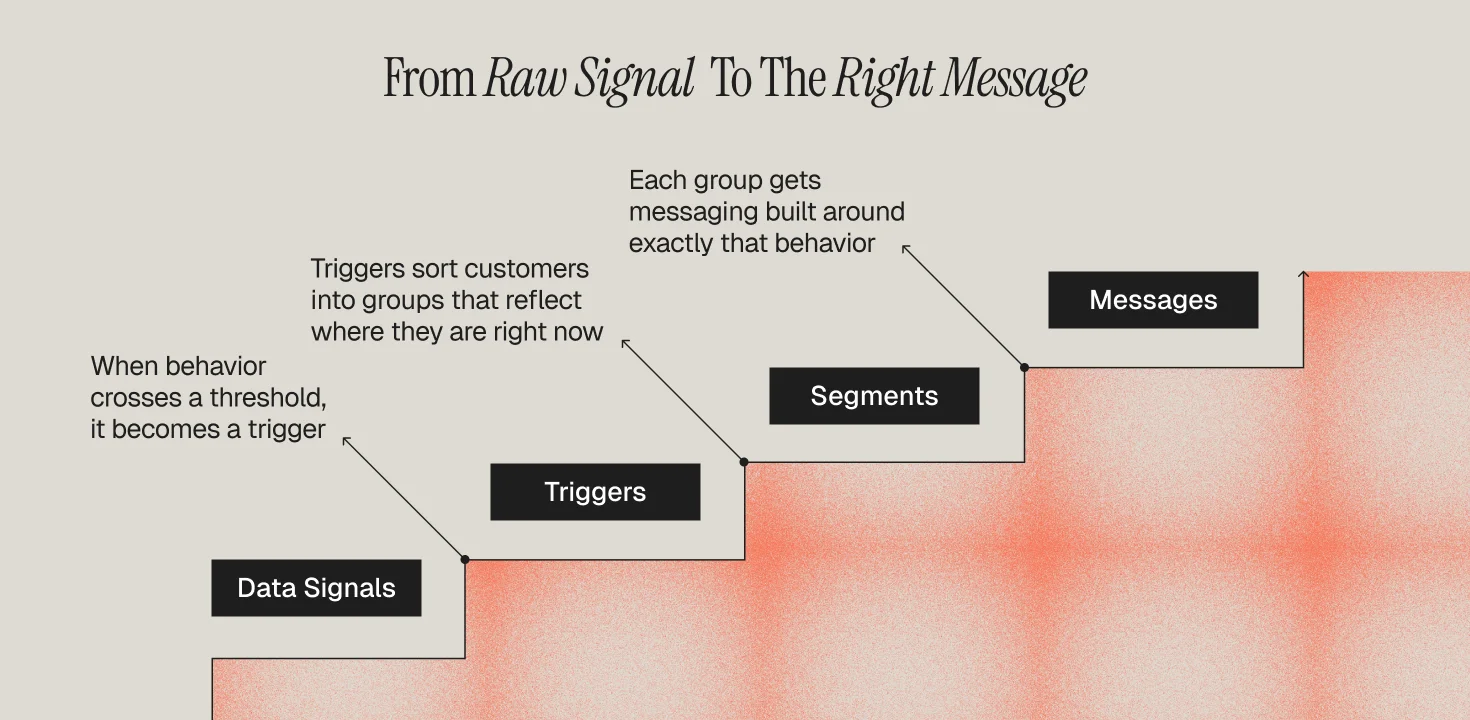
Behavioral segmentation works as a pipeline: data signals flow in, triggers fire on meaningful changes, customers fall into segments, and each segment receives a tailored message. Here is the flow end to end.
1. Data signals. Everything starts with capturing behavior: orders, page views, email opens, clicks, SMS replies, feature usage, time since last action, cart events, and reorder intervals. These signals usually live in your ecommerce platform, product analytics, and your ESP or customer engagement platform.
2. Triggers. A trigger is a rule that watches a signal and fires when it crosses a threshold: 60 days since last purchase, a third repeat order, a cart abandoned for two hours, a feature used for the first time. Triggers turn static data into real-time events.
3. Segments. Triggers sort customers into behavioral segments: at-risk, loyal repeat buyer, first-time buyer, lapsed, high-AOV, engaged-but-not-purchasing. A customer can move between segments as their behavior changes, which is the whole point.
4. Messages. Each segment gets messaging matched to its behavior: a winback offer for lapsed buyers, a replenishment reminder timed to the reorder interval, an onboarding sequence for first-timers, a VIP perk for loyal buyers. One of the most reliable behavioral models for scoring purchase behavior is RFM (recency, frequency, monetary value), covered in detail in Using RFM Analysis to Improve Retention.
What are the 5 types of behavioral segmentation?
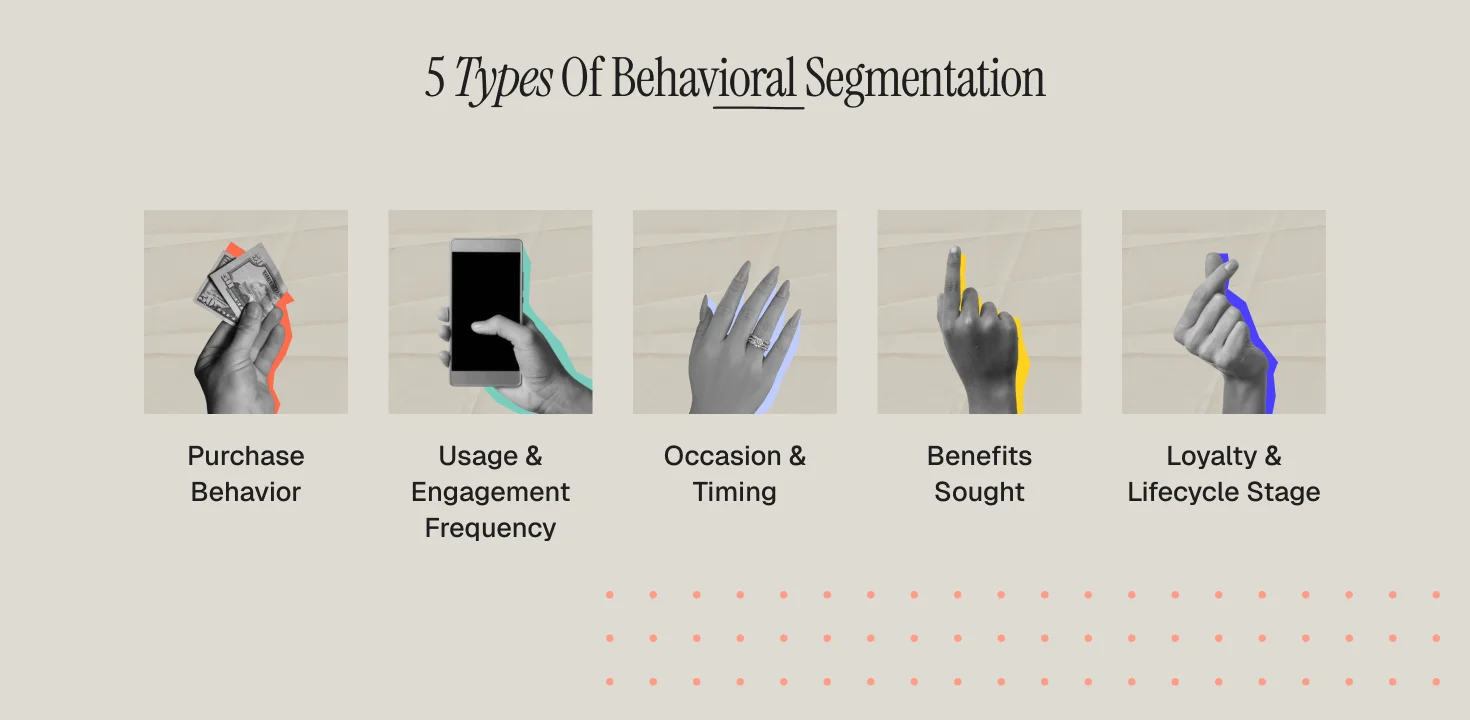
The 5 types of behavioral segmentation are purchase behavior, usage and engagement frequency, occasion and timing, benefits sought, and loyalty or lifecycle stage. Each one groups customers on a different behavioral axis.
- Purchase behavior. This segments customers by how they buy: order frequency, average order value, products and categories purchased, price sensitivity, and where they sit in the buying cycle. A customer who buys premium products at full price is a different segment than a customer who only buys during sales. Purchase behavior is the highest-signal axis because money spent is the clearest expression of intent, and it powers winback, replenishment, and upsell flows.
- Usage and engagement frequency. This groups customers by how often and how deeply they engage: daily active versus dormant, power user versus light user, high email engagement versus silent. For a SaaS or app, this is feature adoption and login cadence. For DTC, it is browse frequency and email or SMS engagement. Engagement frequency is the earliest warning system for churn, because engagement drops before revenue does.
- Occasion and timing. This segments by when customers buy and why: seasonal buyers, holiday shoppers, payday purchasers, and routine-replenishment timing. Occasion segmentation is what lets you reach a customer in the narrow window when they are ready, like a supplement reorder reminder timed to the day the last bottle runs out, or a gifting campaign before a holiday.
- Benefits sought. This groups customers by the specific outcome they want from your product. Two buyers of the same skincare line might want completely different things (one wants anti-aging, the other wants acne control) and the messaging that converts each is different. Benefits-sought segmentation aligns your copy and product recommendations to the value each group is actually chasing.
- Loyalty and lifecycle stage. This segments by where the customer is in their relationship with you: new, active, at-risk, lapsed, loyal, and advocate. Lifecycle is the master axis that ties the others together, because the right message depends entirely on the stage. A first-time buyer needs onboarding, a loyal buyer needs a VIP perk, and an at-risk buyer needs a reason to come back. For a full playbook, see 25 Best Lifecycle Marketing Strategies.
Behavioral segmentation examples
Here are concrete behavioral segmentation examples across DTC, telehealth, and subscription brands. For even more, this list of 11 Behavioral Segmentation Examples goes deep.
- GLP-1 telehealth patients segmented by refill timing. A telehealth brand groups patients by where they are in the refill cycle (5 days before refill, on the refill date, 3 days overdue) and sends a different message to each: a proactive reminder, a confirmation, and an adherence nudge with a re-engagement offer. Refill timing is pure behavioral segmentation, and in a recurring-prescription model it is the single biggest driver of retention.
- Supplement subscribers segmented by order number. A supplement brand treats order #1 buyers and order #3 buyers as separate segments. Order #1 gets education and usage tips to build the habit. Order #3 gets a loyalty offer or a bundle upsell because they have proven they will stick. Same product, completely different message, keyed entirely to behavior.
- Cart abandoners segmented by intent strength. A DTC brand splits abandoners by behavior: viewed once versus added-to-cart versus reached checkout. The checkout abandoner (highest intent) gets a fast, offer-light reminder, while the browse-only visitor gets a softer nurture.
- Lapsed buyers segmented by past value. A brand separates lapsed high-AOV customers from lapsed one-time discount buyers. The high-value lapsed segment gets a premium winback with a personal touch, the discount segment gets a standard promo.
- Engaged-but-never-purchased subscribers. Subscribers who open every email but have never bought are a distinct segment that needs a first-purchase incentive, not another newsletter.
- Power users approaching a usage milestone. A SaaS brand segments users about to hit a plan limit and sends a timely, contextual upgrade prompt instead of a generic upsell blast.
Behavioral segmentation for retention and lifecycle marketing
This is where behavioral segmentation earns its keep at Propel. Acquisition gets the headlines, but retention is where behavioral segmentation compounds, because every retention problem is really a behavior problem in disguise. Churn is a behavior (engagement dropping before cancellation). Missed refills are a behavior (a reorder window passing without action). Weak onboarding is a behavior (a first-time buyer who never reached the activation moment). You cannot fix any of them with demographics, but you can fix all of them with behavioral segments tied to triggered flows.
The Propel point of view is simple: segment by behavior, then build lifecycle flows that act on the segment in real time. Use engagement-frequency segments to catch churn early and fire a winback before the customer is gone, covered in How to Identify Users Who Are About to Churn. Use occasion-and-timing segments to nail refill timing so a recurring customer never runs out. Use lifecycle-stage segments to make onboarding adapt to what a new buyer has or has not done yet. Done right, behavioral segmentation turns retention from a quarterly panic into an automated system that compounds revenue from the customers you already paid to acquire.
Common behavioral segmentation mistakes
The most common behavioral segmentation mistake is over-segmenting. Teams get excited and build 47 micro-segments, then cannot maintain them, cannot write distinct messaging for each, and end up with overlapping audiences that conflict. You do not need 47 segments. You need a few good ones (often 5 to 8) that are genuinely different in behavior and genuinely deserve different messages. Start with the segments that map to real revenue moments (at-risk, loyal, first-time, lapsed, high-intent) and expand only when a new segment earns its place with its own message.
The second big mistake is stale signals. Behavioral segmentation only works if the behavior is current. If your at-risk segment is built on data from 90 days ago, you are messaging people based on who they used to be, not who they are now. Segments must update continuously as behavior changes, or the whole model decays. The third mistake is segmenting without acting: building beautiful segments and then sending everyone the same email anyway. A segment with no differentiated message is just a report. Behavioral segmentation only pays off when each segment changes what you send, when you send it, and why.
Segmented campaigns drive 30% more opens and 50% more clicks
The payoff of behavioral segmentation shows up most clearly in email, the highest-ROI channel marketers have. Segmented email campaigns get 30% more opens and 50% more click-throughs than unsegmented sends, which is why 78% of marketers name segmentation their most effective tactic. That lift is not a rounding error. It is the difference between a campaign that pays for itself and one that gets ignored.
It compounds because of the economics of the channel. Email remains the highest-ROI channel at roughly $36 per $1 spent, so improving open and click rates on email multiplies an already strong return. When you layer behavioral segmentation on top of a channel that already returns 36 to 1, every point of incremental engagement flows straight to revenue. That is the core argument for behavioral segmentation in 2026: it makes your best channel meaningfully better without raising spend.
Frequently Asked Questions
What is behavioral segmentation in simple terms?
Behavioral segmentation, in simple terms, is grouping your customers by what they do instead of who they are. You watch actions like purchases, email opens, product usage, and how recently someone bought, then you put people who behave alike into the same group and send each group a message that fits their behavior.
What are examples of behavioral segmentation?
Examples include splitting customers by purchase frequency (one-time versus repeat buyers), by engagement (active versus dormant subscribers), by timing (refill or replenishment windows), by benefits sought (anti-aging versus acne for skincare), and by lifecycle stage (new, loyal, at-risk, lapsed).
What is the difference between behavioral and demographic segmentation?
The difference is what each one measures. Demographic segmentation groups customers by fixed identity traits (age, gender, income, location), while behavioral segmentation groups them by actions (what they buy, how they engage, when they reorder). Demographics describe who someone is and rarely change. Behavior describes what someone does and changes constantly.
What data do you need for behavioral segmentation?
You need behavioral event data: purchase history (orders, AOV, categories), engagement data (email opens, clicks, SMS replies), product usage or browse activity, recency signals (time since last order or last session), and lifecycle indicators.
What tools support behavioral segmentation?
Most modern customer engagement and email platforms support behavioral segmentation, including Klaviyo, Customer.io, and Braze. These tools ingest behavioral events, let you build trigger-based segments, and fire automated flows when a customer's behavior changes.


![Featured image: 25 Best Lifecycle Marketing Strategies - Based on Customer Lifecycle Stages [#2025 Update]](https://cdn.prod.website-files.com/69bbf9f7f2a3f75341357ebc/69f35b7250ddb533f7fcbd8b_69c7ce9f68e818fd4aa3dad6_698ae432a7625eb340e995a0_681eed717eea07585b2e5d5c_Lifecycle%25252520Marketing%25252520Strategies-1-min.png)
![Featured image: How to Identify Users Who Are About to Churn [2026 Guide for Retention Marketers]](https://cdn.prod.website-files.com/69bbf9f7f2a3f75341357ebc/69f4b4ad14f8c675169e0cba_69c7cec26de0e50005c6e495_698ae45b9ecbf9983380f731_6909f1e088d37bed0144f247_Identify%25252520User%25252520churn-2-min.png)