Summarize this documentation using AI
Key Takeaways
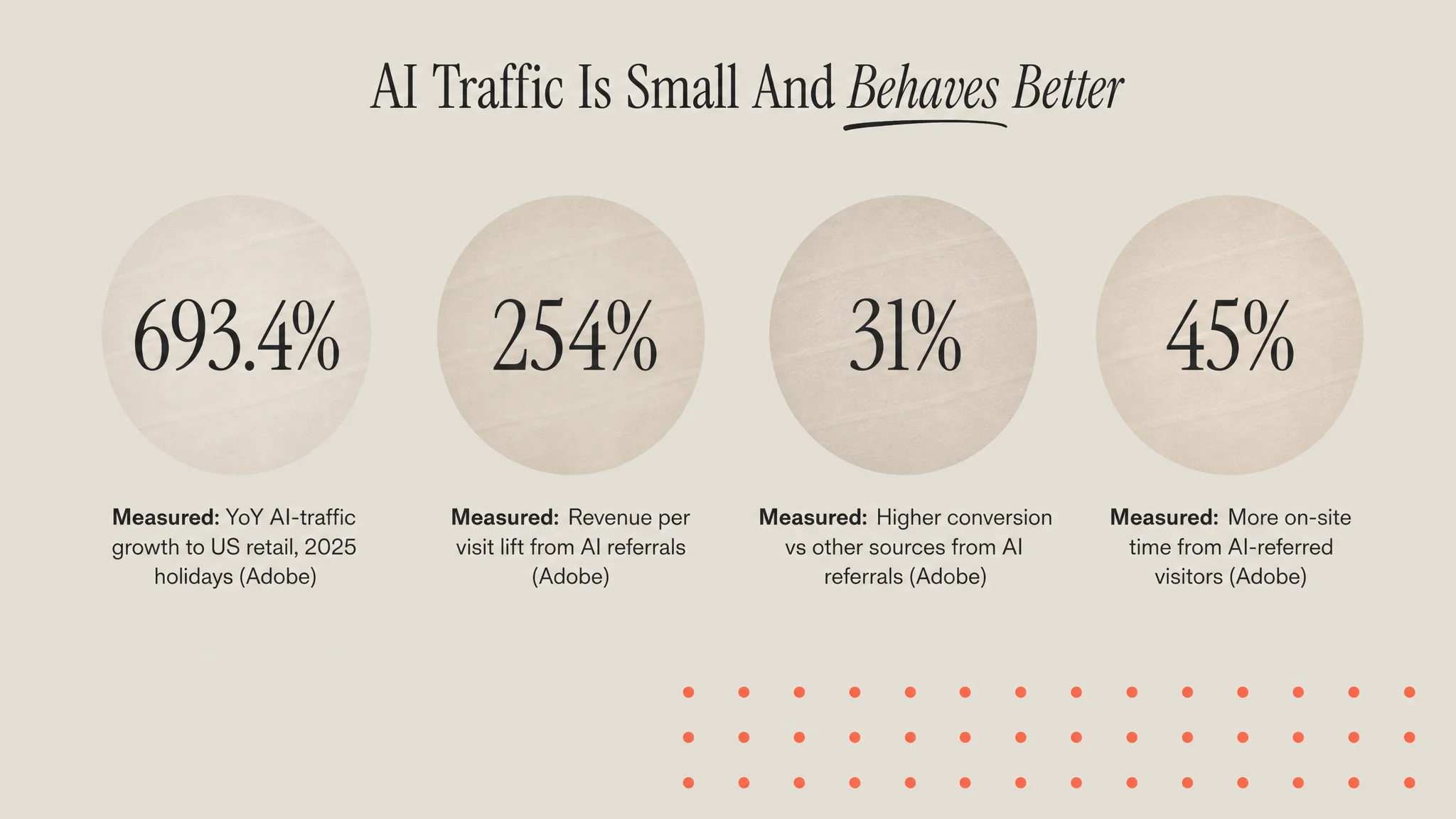
- Traffic to US retail sites from AI assistants grew 693.4% year over year across the 2025 holiday season, and revenue per visit from that traffic rose 254%, according to Adobe Analytics.
- AI-referred shoppers behave better than average once they land: 33% less likely to bounce, 45% more time on site, 13% more pages per visit, and converting 31% more than other sources.
- That is the good news. The bad news is structural: 81% of retail executives told Deloitte they expect generative AI to weaken brand loyalty by 2027.
- The two facts are not in tension. An agent that picks well for the shopper is also an agent that stands between you and the shopper, and the relationship is the asset retention is built on.
- The defence is owned channel depth: consented data, a real flow library, and a reason to come back that does not depend on being surfaced by somebody else's model.
The agentic commerce conversation has been running for a year mostly on speculation. There is now enough measured data to say something concrete, and the picture is more double-edged than either the boosters or the sceptics have been claiming.
Here is what the numbers say, and what a lifecycle team should actually do about it this quarter.
AI referral traffic is small, growing violently, and unusually good
Adobe Analytics, working from more than one trillion visits to US retail sites, reported that traffic from AI assistants and AI-powered search grew 693.4% year over year across the 2025 holiday season. November alone was up 769%, December 673%. Revenue per visit from that traffic rose 254% year to date (Adobe).
Growth rates off a small base are easy to over-read, and a 693% increase on a tiny number is still a small number. What is harder to dismiss is the quality of the traffic once it arrives.
- Bounce. Shoppers arriving from AI assistants were 33% less likely to leave immediately.
- Depth. They spent 45% more time on site and viewed 13% more pages per visit than other traffic.
- Conversion. They converted 31% more than other sources, roughly double the gap of a year earlier.
- Peak days. AI-referred conversion ran 54% higher than non-AI on Thanksgiving and 38% higher on Black Friday.
This is not what a low-intent channel looks like. A shopper who arrives having already described their problem to an assistant and been handed a shortlist has done most of the consideration work before they hit your page. They are closer to a warm referral than to a cold click.
Which is exactly why it is dangerous
Every one of those qualification steps happened somewhere you cannot see, in a conversation you do not own, mediated by a model whose ranking you cannot audit. The visit is high quality precisely because the valuable part of the journey was completed by someone else.
The loyalty problem is the one executives are actually worried about
Deloitte's 2026 Retail Industry Global Outlook found that 81% of surveyed retail executives expect generative AI to weaken brand loyalty by 2027, and about half anticipate the collapse of the current multistep shopping journey in the same window, as reported by Retail Dive.
The mechanism is straightforward. Brand loyalty in consumer categories has always been partly a habit artifact. People return to the store they know because searching again is work. Remove the work, and the habit has to be carried by something else: genuine product preference, a subscription, a loyalty balance, an unfinished relationship. Categories where the brand was mostly a search shortcut lose the most.
Wharton's Kartik Hosanagar, quoted in the same piece, put the end state plainly: retailers that cede the customer interaction risk becoming "like a fulfillment company." Amazon's answer has been to build its own assistant rather than sell through someone else's.
Most DTC brands cannot build an assistant. What they can do is make sure the relationship does not live in the discovery layer in the first place.
What this changes about retention work, and what it does not
It is worth being precise, because a lot of the advice in circulation is just old advice with the word agentic in front of it.
What genuinely changes
Discovery is now partly a retrieval problem. If an assistant is assembling a shortlist, the question is whether your pages are crawlable, specific and quotable at the moment the answer is composed. That is a different discipline from ranking for a keyword. We covered the mechanics in what an LLM citation is and the practice in what AEO for marketing is.
First-party data gets more valuable, not less. If the top of the funnel is increasingly opaque, the data you collect after the first purchase is the only clean signal you have. Zero-party data stops being a nice-to-have.
Attribution gets worse before it gets better. AI referrals are under-attributed in most analytics setups today. If you judge the channel on last-click, you will conclude it does not exist.
What does not change
The post-purchase sequence, the replenishment reminder, the win-back, the reason the second order happens. None of that is touched by how the first order was discovered. If anything, a shortened and more opaque acquisition path raises the value of every owned-channel asset behind it, because the owned channel is the only part of the journey you still control end to end.
That is also where the measured return already sits. Across more than 183,000 accounts, automated email flows produce nearly 41% of email revenue from 5.3% of sends, a gap we worked through in lifecycle marketing automation ROI in 2026.
Four things worth doing this quarter
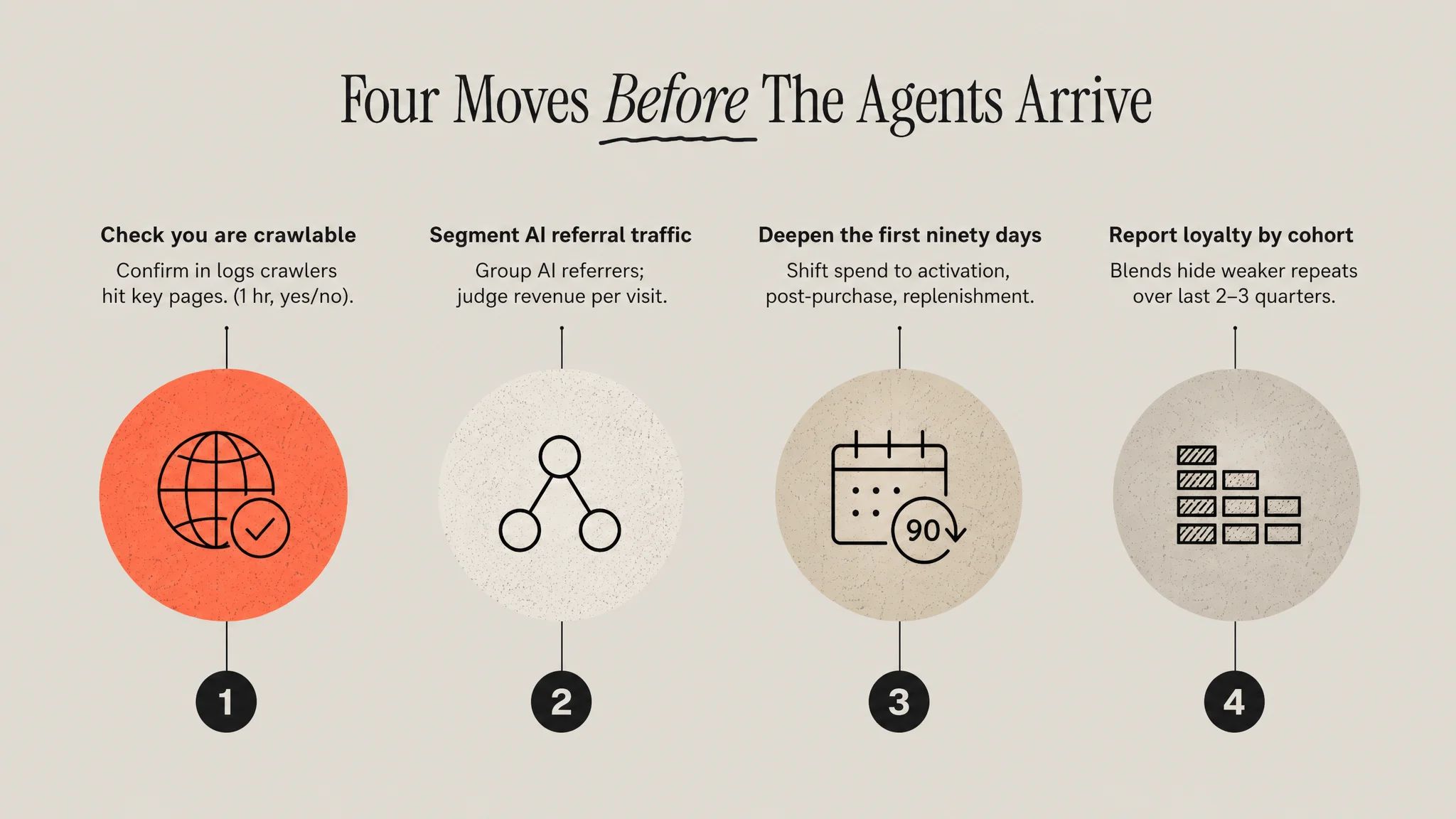
1. Find out whether AI assistants can read you at all
Check server logs for AI crawler user agents against your key pages. A blocked or slow-rendering page is a guaranteed zero in the retrieval layer, and it is the most common failure we find. This is a one-hour check with a binary answer.
2. Segment AI referral traffic and watch it separately
Set up a source grouping for known AI referrers now, while the volume is small enough to learn from. You want a baseline before the channel matters, not after. Judge it on revenue per visit rather than volume, since volume will look trivial for a while and quality is the whole story.
3. Deepen the first ninety days
If discovery is going to be increasingly out of your hands, the second purchase is where the brand relationship is actually won. That means the post-purchase sequence, the activation moment and the replenishment trigger, not more top-of-funnel spend. The 90-day activation playbook is the structure we use, and customer activation defines the moment to aim at.
4. Stop reporting loyalty as a blended number
If agent-mediated acquisition really does weaken repeat behaviour, it will show up as a cohort effect first: newer cohorts retaining worse than older ones while the blended average looks flat. A blended number will hide it for two or three quarters. The retention curve and cohort LTV versus blended LTV cover the setup.
The honest read
Agentic commerce is currently a small, fast-growing, unusually high-converting traffic source, and simultaneously the most credible medium-term threat to the direct customer relationship that DTC has faced since the iOS privacy changes.
Both of those are true at once, and the strategic response to both is the same: get retrievable so you show up in the shortlist, then build enough owned-channel depth that being in the shortlist is not the only thing keeping you alive. The brands that get hollowed out will be the ones that treated discovery as the whole relationship.
Sources
- Adobe Analytics, AI-driven traffic surges across industries (over 1 trillion visits to US retail sites, 2025 holiday season)
- Retail Dive, Retail's AI bet risks data and market share, citing Deloitte's 2026 Retail Industry Global Outlook
- Klaviyo, 2026 Email Marketing Benchmarks by Industry (183,000+ customers)
Frequently Asked Questions
What is agentic commerce?
Agentic commerce is shopping mediated by an AI assistant rather than by a person browsing directly. The shopper describes a need in conversation, the assistant searches, compares and assembles a shortlist, and the shopper arrives at a retailer having already completed most of the consideration work. For brands it shifts discovery from a ranking problem into a retrieval problem, because the assistant decides which sources it reaches for.
How much traffic do AI assistants actually send to retail sites?
Still a small share, but growing very fast. Adobe Analytics, working from more than one trillion visits to US retail sites, found traffic from AI assistants grew 693.4 percent year over year across the 2025 holiday season, with November up 769 percent and December up 673 percent. Revenue per visit from that traffic rose 254 percent year to date. Growth rates off a small base are easy to over-read, so treat the quality signals as more meaningful than the volume.
Do shoppers from AI assistants convert better?
Yes, measurably. Adobe found AI-referred visitors were 33 percent less likely to bounce, spent 45 percent more time on site and viewed 13 percent more pages per visit than other traffic. They converted 31 percent more than other sources, roughly double the gap of a year earlier, rising to 54 percent higher on Thanksgiving and 38 percent higher on Black Friday. The visit is high quality because the qualification happened before arrival.
Does agentic commerce threaten brand loyalty?
Retail executives think so. Deloitte's 2026 Retail Industry Global Outlook found 81 percent expect generative AI to weaken brand loyalty by 2027, and about half anticipate the collapse of the current multistep shopping journey in the same window. The mechanism is that loyalty has always been partly habit: people return to the store they know because searching again is work. Remove the work and the habit needs something else to carry it.
What should a DTC brand do about AI shopping agents?
Four things this quarter. Check server logs to confirm AI crawlers can actually reach your pages, since a blocked page is a guaranteed zero. Segment AI referral traffic now while volume is small enough to learn from, and judge it on revenue per visit. Move investment into the first ninety days after purchase, where the relationship is genuinely won. And report loyalty by cohort, because a blended average will hide weakening repeat rates for several quarters.