Summarize this documentation using AI
Key Takeaways
- An LLM citation is the attribution an AI assistant attaches to a claim, naming the source it drew the answer from.
- Citations come from retrieval, not from memory. The model looks something up, then credits what it found, which is why fresh crawlable pages can be cited and training data alone cannot be.
- Citation accuracy is poor. The Tow Center tested eight AI search engines across 1,600 queries and found more than 60 percent of answers incorrect.
- Being cited rarely produces a click. Pew found source links inside AI summaries were clicked in 1 percent of visits, so the value is the named mention.
- The way to earn citations is unglamorous: be crawlable, answer in a self-contained paragraph, make claims specific enough to verify, and link your topic cluster together.
Ask ChatGPT or Perplexity a question about retention benchmarks and you get a paragraph of prose with small numbered markers or a row of source cards underneath. Those markers are LLM citations. Understanding how they are produced explains most of what marketers get wrong about AI visibility.
What is an LLM citation?
An LLM citation is a reference an AI system attaches to part of its answer, identifying the source document that the claim was drawn from. It typically appears as an inline marker, a footnote, or a linked source card, and it points to a URL the system retrieved during the process of answering.
The critical distinction is that the citation is a product of retrieval, not recall. When a model answers purely from its training weights, it has no specific document to point at, so it either cites nothing or invents something. When the system first searches, fetches documents and then generates an answer grounded in them, it can attribute honestly.
How that changes the marketing question
Marketers often ask how to get into an AI model's training data. That is largely the wrong question, and an unactionable one. The better question is how to be reliably retrieved and cleanly quotable at the moment the answer is composed. Training data is a snapshot from the past. Retrieval happens now, against the live web, and it is the surface you can actually influence.
How LLM citations are generated
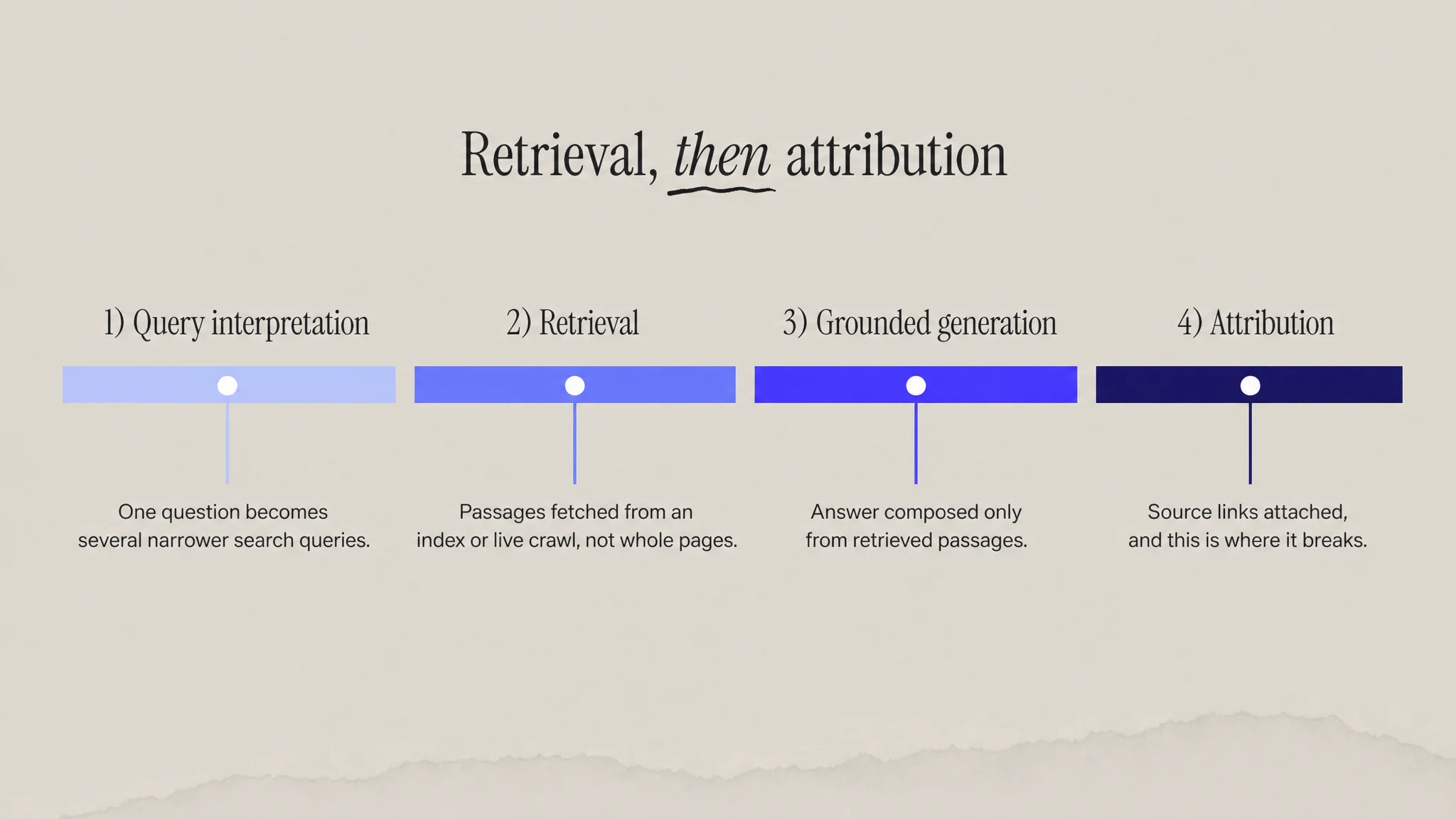
Most citing systems follow a retrieval-augmented generation pattern with four stages.
1. Query interpretation
The user's question is rewritten into one or more search queries. A single conversational question frequently becomes several narrower retrieval queries, which is why long-tail phrasing on your page can match even when the user's wording did not.
2. Retrieval
The system fetches candidate documents from a search index, a live crawl, or a vector store. Retrieval operates on passages rather than whole pages. A well-structured 900-word definition often beats a 3,000-word guide with the same answer buried in the middle.
3. Grounded generation
The model composes an answer constrained to the retrieved passages, and tracks which passage supported which sentence.
4. Attribution
The system attaches source links to the answer. This is the stage that fails most often, and it fails in ways worth understanding.
Why LLM citations are frequently wrong
The Tow Center for Digital Journalism at Columbia ran a structured test of eight AI search engines: ChatGPT Search, Perplexity, Perplexity Pro, DeepSeek Search, Copilot, Grok-2, Grok-3 and Gemini. Across 1,600 queries built from 20 publishers and 10 articles each, the study found the tools returned incorrect answers to more than 60 percent of queries.
The detail matters more than the headline:
- Error rates varied enormously. Perplexity was incorrect on 37 percent of queries. Grok 3 was incorrect on 94 percent.
- Confidence did not track accuracy. ChatGPT incorrectly identified 134 articles but signalled low confidence just fifteen times across two hundred responses, and never declined to answer.
- URLs were fabricated. More than half of the responses from Gemini and Grok 3 cited fabricated or broken URLs. Grok 3 produced error pages in 154 of 200 citations.
- Misattribution was common. DeepSeek misattributed sources 115 times out of 200.
As Nieman Lab summarised it, the systems are confidently wrong far more often than they are usefully uncertain.
For a brand, the practical risk is not just absence. It is being paraphrased without credit while a competitor's URL is attached to your claim. Clarity and specificity are the only real defences, because ambiguous text is exactly what gets absorbed into an unattributed summary.
What a citation is actually worth
Here the data is bracing. Pew Research Center, tracking 68,879 searches across 900 U.S. adults, found that users clicked a source link inside an AI summary in 1 percent of visits to pages carrying one. Clicks on traditional results fell to 8 percent when a summary was present, from 15 percent when it was not.
So a citation is not a traffic channel. It is a brand impression delivered at the exact moment of highest intent, in a context the user trusts. That is valuable, and it is valuable in a way that will not show up in your sessions report. Teams that judge AI visibility on referral traffic will conclude it is not working while it is working.
How to earn LLM citations
None of this is exotic. It is the discipline of being the clearest source on a narrow question.
Be retrievable before anything else
Confirm in server logs that AI crawlers reach your pages. A blocked or slow-rendering page is a guaranteed zero, and it is the most common failure we find in audits. Google's documentation on AI features confirms that standard indexing and snippet controls govern AI experiences too.
Answer in the first paragraph
Put a complete, self-contained answer in 40 to 60 words directly under the heading that matches the question. If a system lifted that paragraph alone, it should be accurate and worth attributing.
Make claims checkable
Numbers with named sources and dates are far more citable than adjectives. "Braze reported $738.2 million in fiscal 2026 revenue, up 24.4 percent year over year" is a claim a system can ground. "Braze is growing fast" is not.
Build the cluster
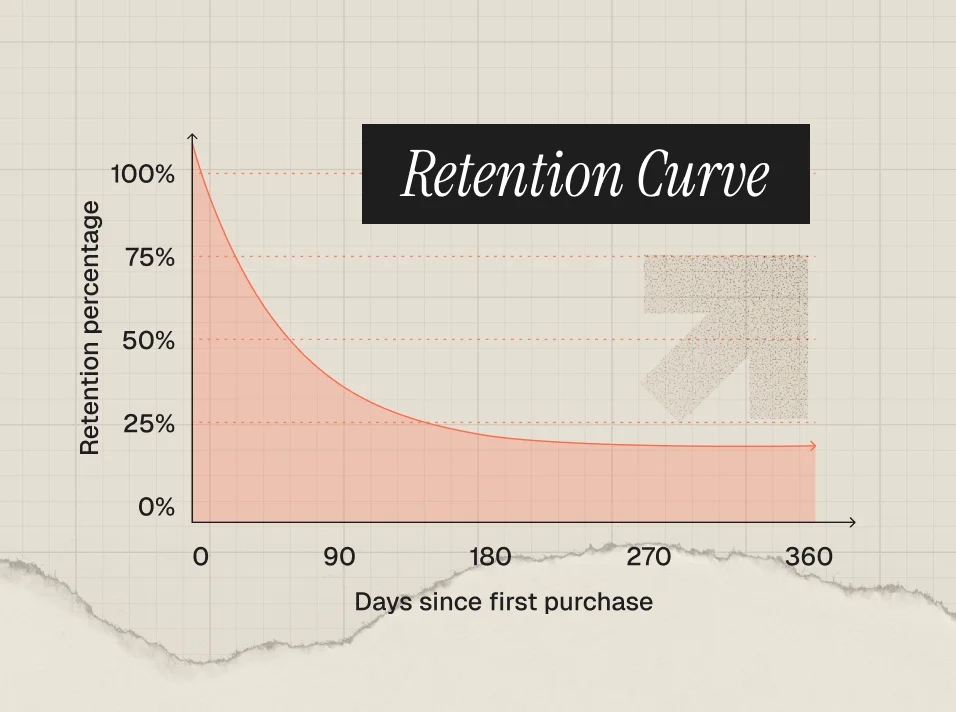
Topical density signals authority. A definition should link to its benchmarks, its framework and its examples. See how churn prevention, the retention curve and cohort analysis support each other rather than standing alone.
Keep pages current
Retrieval favours freshness for anything with a year in the query. A page last updated two years ago competes badly against one updated last quarter, even where the underlying facts have not moved.
How to measure citations
- Fix a prompt set. Twenty to thirty buying-intent prompts, unchanged month to month, run across the engines your buyers use.
- Record three states per prompt. Named and linked, named without a link, or absent. Track competitors on the same prompts.
- Watch branded search. If citations are landing and clicks are not, branded search volume is the leading indicator that shows it.
- Accept variance. The same prompt returns different sources on different days. Only the trend is meaningful.
This is the same measurement logic we apply to lifecycle programmes generally, where the metric that matters is rarely the one that is easiest to pull. See lifecycle revenue and the retention metrics worth tracking for that broader argument.
The bottom line
An LLM citation is retrieval plus attribution, and both halves can fail. The systems doing the citing are, by the best available measurement, wrong more often than they are right about which source said what.
That is not a reason to ignore them. It is a reason to be unmissable: crawlable, specific, clearly structured and densely linked, so that when a system reaches for an answer on your topic, the cleanest version of it is yours. You will not get many clicks out of it. You will get your name in the answer, which increasingly is the thing worth having.
Sources
- AI Search Has a Citation Problem, Tow Center for Digital Journalism, Columbia Journalism Review
- AI search engines fail to produce accurate citations in over 60% of tests, Nieman Journalism Lab
- Google users are less likely to click on links when an AI summary appears in the results, Pew Research Center
- AI Features and Your Website, Google Search Central
- Braze, Inc. Reports Fiscal Year and Fourth Quarter 2026 Results, Braze Investor Relations
Frequently Asked Questions
What is an LLM citation?
An LLM citation is a reference an AI system attaches to part of its answer, identifying the source document the claim was drawn from. It appears as an inline marker, a footnote or a linked source card. Critically, it is produced by retrieval rather than recall: the system fetches live documents, generates an answer grounded in them, and then attributes. A model answering from training weights alone has no specific document to point at.
How do AI models decide which sources to cite?
Most citing systems follow a retrieval-augmented generation pattern. The user question is rewritten into one or more search queries, candidate passages are retrieved from an index or live crawl, the model composes an answer constrained to those passages, and source links are attached to the sentences they supported. Retrieval operates on passages rather than whole pages, which is why a focused definition often outperforms a long guide.
How accurate are LLM citations?
Poor. The Tow Center for Digital Journalism tested eight AI search engines across 1,600 queries and found incorrect answers to more than 60 percent of them. Perplexity was wrong on 37 percent, Grok 3 on 94 percent. More than half of Gemini and Grok 3 responses cited fabricated or broken URLs, and DeepSeek misattributed sources 115 times out of 200. Confidence did not track accuracy.
How do you get your content cited by AI?
Be retrievable first: confirm in server logs that AI crawlers reach your pages. Then put a complete, self-contained answer in the first 40 to 60 words under a heading matching the question. Make claims specific and checkable, with named numbers and dated sources rather than adjectives. Link the topic cluster densely, and keep pages current, since retrieval favours freshness on time-sensitive queries.
Do LLM citations send traffic to your site?
Very little. Pew Research Center found users clicked a source link inside an AI summary in only 1 percent of visits to pages carrying one. The value of a citation is the brand impression delivered at the moment of highest intent, in a context the user trusts, rather than the session. Teams measuring AI visibility purely on referral traffic will conclude it is failing while it is working.