Summarize this documentation using AI
Key Takeaways
- AEO, or answer engine optimisation, is the practice of getting your content used and cited inside AI-generated answers rather than only ranked in a list of blue links.
- It matters because the click is disappearing. Pew Research found users clicked a search result in 8 percent of visits when an AI summary was present, versus 15 percent when it was not.
- Only 1 percent of visits to a page carrying an AI summary produced a click on a source link inside that summary.
- AEO is not a replacement for SEO. It is a layer on top: the same crawlable, well-structured content, restructured so a machine can lift a clean answer out of it.
- The measurable output of AEO is citation share, not ranking position.
A marketing team asks the same question in some form every month now. Traffic is soft, rankings look fine, and nobody can explain the gap. The answer is usually sitting at the top of the results page: an AI-generated summary that answered the question before the user ever reached a link.
Answer engine optimisation is the discipline that grew out of that gap. This piece defines it properly, explains what changes in practice, and sets out how to measure it.
What is AEO for marketing?
AEO (answer engine optimisation) is the practice of structuring and publishing content so that AI answer engines retrieve it, use it to compose an answer, and cite the source. Answer engines include Google AI Overviews and AI Mode, ChatGPT, Perplexity, Gemini, Microsoft Copilot and Grok.
Traditional SEO optimises for a position in a ranked list. The user then chooses a result and clicks. AEO optimises for inclusion in a synthesised answer, where the model has already made the choice on the user's behalf and may or may not attribute it.
The two are not opposed. An answer engine cannot cite a page it cannot crawl, parse or trust, so the technical foundations of SEO remain prerequisites. What changes is the unit of optimisation. In SEO the unit is the page. In AEO the unit is the extractable claim.
AEO, GEO and SEO: the terminology
- SEO optimises for ranked retrieval in a search index.
- AEO optimises for inclusion and citation in a generated answer.
- GEO (generative engine optimisation) is used interchangeably with AEO by most practitioners. Where people distinguish them, GEO leans toward the generative model side and AEO toward the retrieval side.
The distinction is mostly academic. The work is the same work.
Why AEO matters now: the click data
The strongest argument for AEO is not a vendor's projection. It is measured browsing behaviour.
The Pew Research Center tracked the actual browsing of 900 U.S. adults across 68,879 unique Google searches in March 2025. Around one in five of those searches produced an AI summary. The click behaviour split sharply:
- When an AI summary appeared, users clicked a traditional search result in 8 percent of visits.
- When no AI summary appeared, they clicked a result in 15 percent of visits, nearly twice as often.
- Users clicked a source link inside the AI summary itself in just 1 percent of visits.
Read the third number carefully, because it reframes the entire objective. If the citation link is clicked one time in a hundred, then the value of being cited is mostly not the click. The value is the mention: your brand named inside the answer the user actually reads. That is a brand-visibility outcome measured in impressions and attribution, not sessions.
This is why lifecycle and retention teams should care as much as acquisition teams. If fewer prospects arrive via an unbranded click, the ones who do arrive are further along and more expensive to replace. That raises the return on everything downstream, from customer activation to lifecycle revenue.
How answer engines choose what to cite
Most answer engines follow a retrieval-then-generation pattern. The system retrieves a set of candidate passages, then a language model composes an answer from them and attaches citations. Three things follow from that architecture.
Retrievability comes first
If your content is not crawlable and indexable, nothing else matters. Google's own guidance on AI features makes clear that the same indexing and snippet controls that govern classic search also govern AI experiences.
Passages are retrieved, not pages
The retrieval unit is a chunk of text, not a URL. A 3,000-word guide where the definition is buried in paragraph nine is worse for AEO than a 900-word page where the definition sits directly under a matching heading. This is the single largest structural change AEO asks for.
Attribution is imperfect
The Tow Center for Digital Journalism at Columbia tested eight AI search engines across 1,600 queries and found the tools returned incorrect answers to more than 60 percent of queries. Error rates ranged from 37 percent for Perplexity to 94 percent for Grok 3. More than half of the responses from Gemini and Grok 3 cited fabricated or broken URLs.
The practical implication is uncomfortable but useful: being the clearest, most unambiguous source on a topic is a defence against being misattributed. Ambiguity gets paraphrased into someone else's citation.
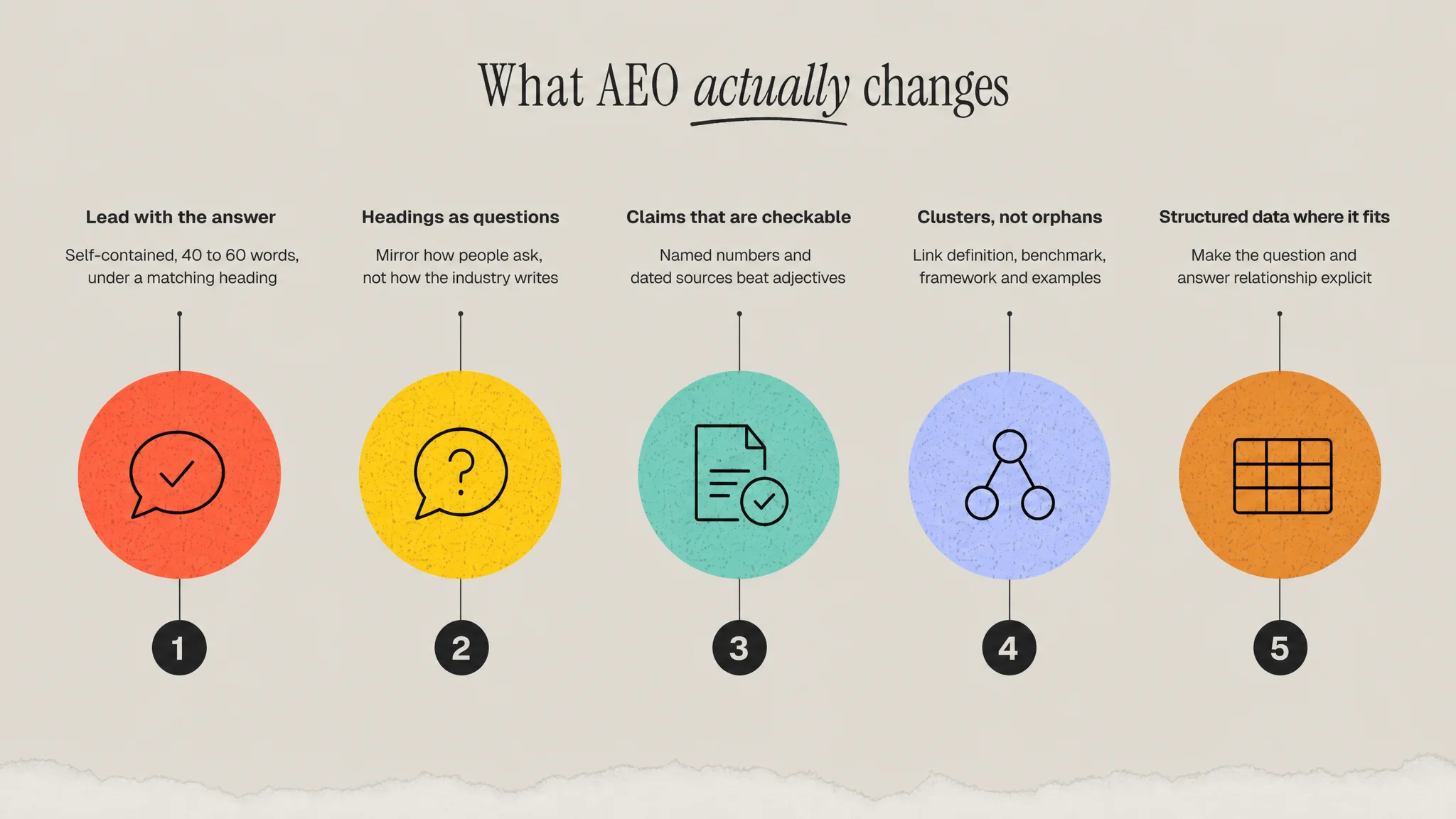
What AEO actually changes in your content
Lead with the answer
Put a direct, self-contained answer in the first 40 to 60 words under the heading that matches the question. No throat-clearing, no history of the industry. If a model lifted only that paragraph, it should still be correct and attributable.
Write headings as questions
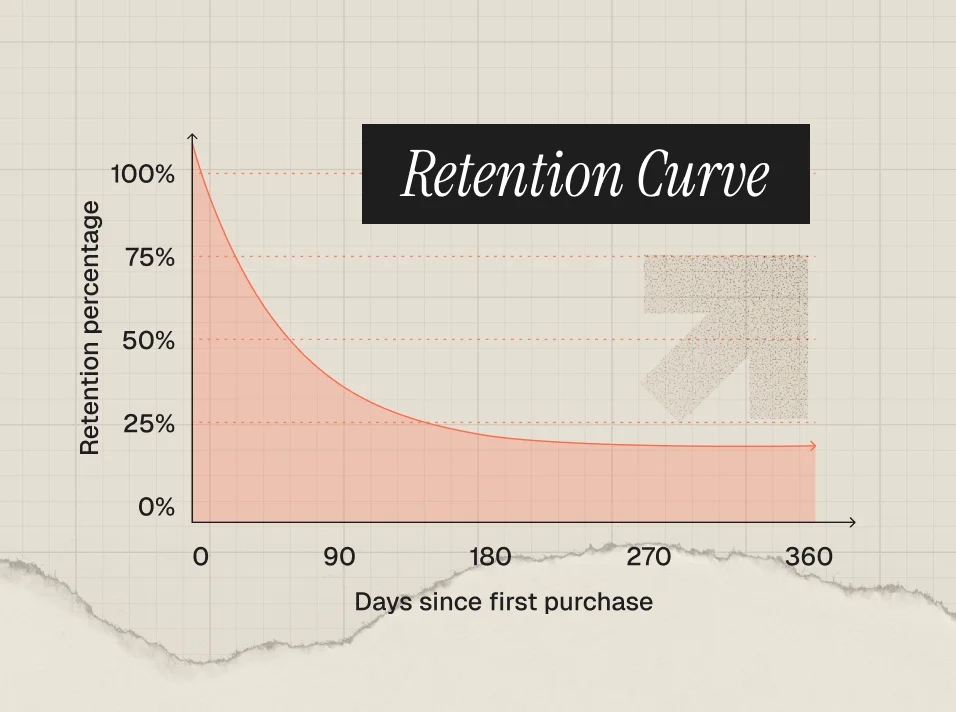
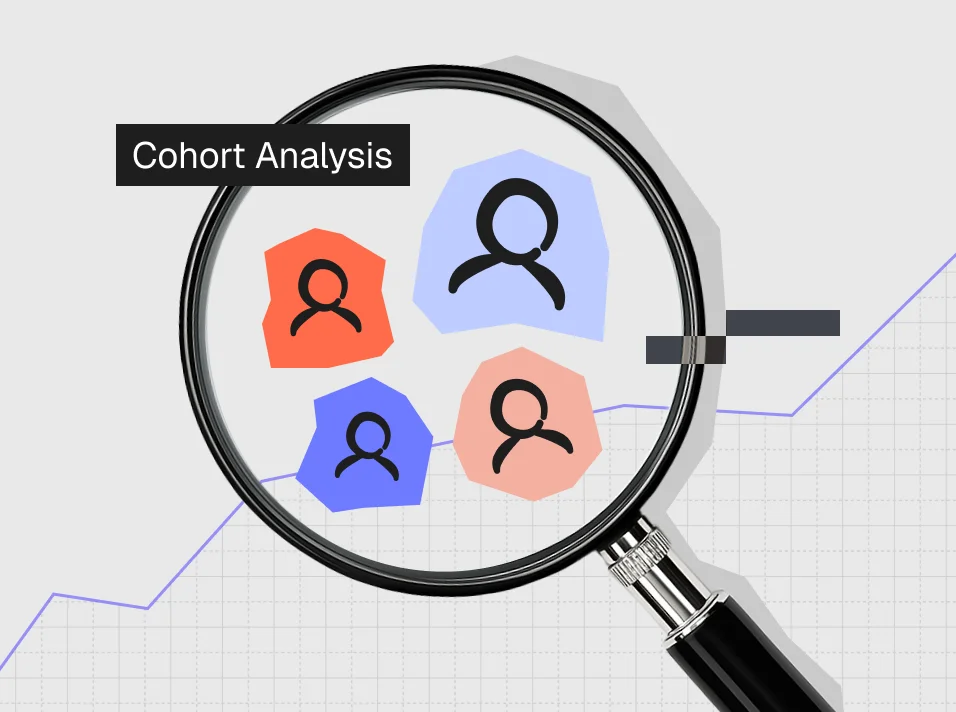
Headings should mirror how people ask, not how the industry writes. "What is a retention curve?" outperforms "Retention curve fundamentals" for retrieval matching. Our own retention curve definition and cohort analysis explainer are built this way deliberately.
Make claims specific and sourced
"Retention improves revenue" is unciteable. "Purple Innovation's direct-to-consumer revenue rose 3.4 percent in Q2 2026 while wholesale fell 19.1 percent" is citeable, because it is checkable. Specificity is what makes a passage worth retrieving.
Build clusters, not orphans
Answer engines weight topical authority. A single article about churn is weaker than a definition anchor linked to a benchmark page, a framework page and three teardowns. See churn prevention, retention benchmarks by vertical and how to audit your lifecycle programme as an example of a linked cluster rather than a set of standalone posts.
Use structured data where it fits
FAQPage and Article markup do not guarantee citation, but they make the question-and-answer relationship explicit rather than inferred. Google's guidance on succeeding in AI search emphasises unique, useful content over markup tricks, and that ordering is the right one.
How to measure AEO
Ranking position is the wrong metric, because there is no position. Track these instead.
- Citation share. Run a fixed set of 20 to 30 buying-intent prompts across the major engines monthly. Record how often your brand is named and how often it is linked. The fixed prompt set matters more than the size of it, because the value is in the trend.
- Share of voice against named competitors. Same prompts, count competitor mentions alongside yours.
- Branded search volume. If AEO is working and clicks are not, branded search should rise as the leading indicator.
- Assisted conversions from direct and branded traffic. The demand AEO creates often lands as a direct visit days later.
- Crawler access. Confirm in your server logs that AI crawlers can actually reach your content. A blocked crawler is a silent zero.
What AEO is not
- It is not a traffic tactic. If you are judged on sessions, AEO will look like a failure while it is working.
- It is not keyword stuffing with a new name. Retrieval works on meaning, not on exact match density.
- It is not a replacement for a crawlable, fast, well-linked site. It sits on top of that.
- It is not instant. Answer engines re-crawl and re-embed on their own schedule. Expect a quarter before the trend is legible.
The bottom line
AEO for marketing is the work of becoming the source an answer engine reaches for. In practice that means clear definitions placed where a machine can find them, specific and checkable claims, and topic clusters dense enough to signal authority.
The uncomfortable part is that success looks different from what most marketing teams are measured on. One percent of readers will click the citation. The other ninety-nine percent will read your claim, in your words, attributed to your brand, and never visit your site that day. That is still worth having. It is just a different kind of win, and it needs a different scoreboard.
Sources
- Google users are less likely to click on links when an AI summary appears in the results, Pew Research Center
- AI Search Has a Citation Problem, Tow Center for Digital Journalism, Columbia Journalism Review
- AI Features and Your Website, Google Search Central
- Top ways to ensure your content performs well in Google's AI experiences on Search, Google Search Central Blog
- Purple Innovation Reports Second Quarter 2026 Results, Purple Innovation Investor Relations
Frequently Asked Questions
What is AEO in marketing?
AEO, or answer engine optimisation, is the practice of structuring and publishing content so AI answer engines retrieve it, use it to compose an answer, and cite the source. Answer engines include Google AI Overviews and AI Mode, ChatGPT, Perplexity, Gemini, Copilot and Grok. Where SEO optimises for a position in a ranked list, AEO optimises for inclusion in a synthesised answer.
What is the difference between AEO and SEO?
SEO optimises for ranked retrieval in a search index, where the unit of optimisation is the page and the goal is a click. AEO optimises for inclusion and citation inside a generated answer, where the unit is the extractable claim and the goal is a named mention. They are complementary: an answer engine cannot cite a page it cannot crawl, parse or trust, so SEO fundamentals remain prerequisites for AEO.
Does AEO actually drive traffic?
Rarely, and that is the point. Pew Research Center tracked 68,879 Google searches and found users clicked a source link inside an AI summary in just 1 percent of visits. Clicks on traditional results fell to 8 percent when a summary appeared, from 15 percent when none did. The value of AEO is the branded mention delivered at high intent, not the session, so it needs a different scoreboard.
How do you measure AEO?
Track citation share rather than ranking position. Run a fixed set of 20 to 30 buying-intent prompts across the major engines every month and record whether your brand was named, linked or absent, alongside competitor mentions. Support that with branded search volume as a leading indicator, assisted conversions from direct traffic, and server-log confirmation that AI crawlers can reach your content.
What is GEO and is it different from AEO?
GEO stands for generative engine optimisation and most practitioners use it interchangeably with AEO. Where people distinguish the two, GEO leans toward the generative model side and AEO toward the retrieval side of the same pipeline. In practice the work is identical: crawlable content, self-contained answers under question-shaped headings, specific and checkable claims, and dense topical clusters.