
Summarize this documentation using AI
Key Takeaways
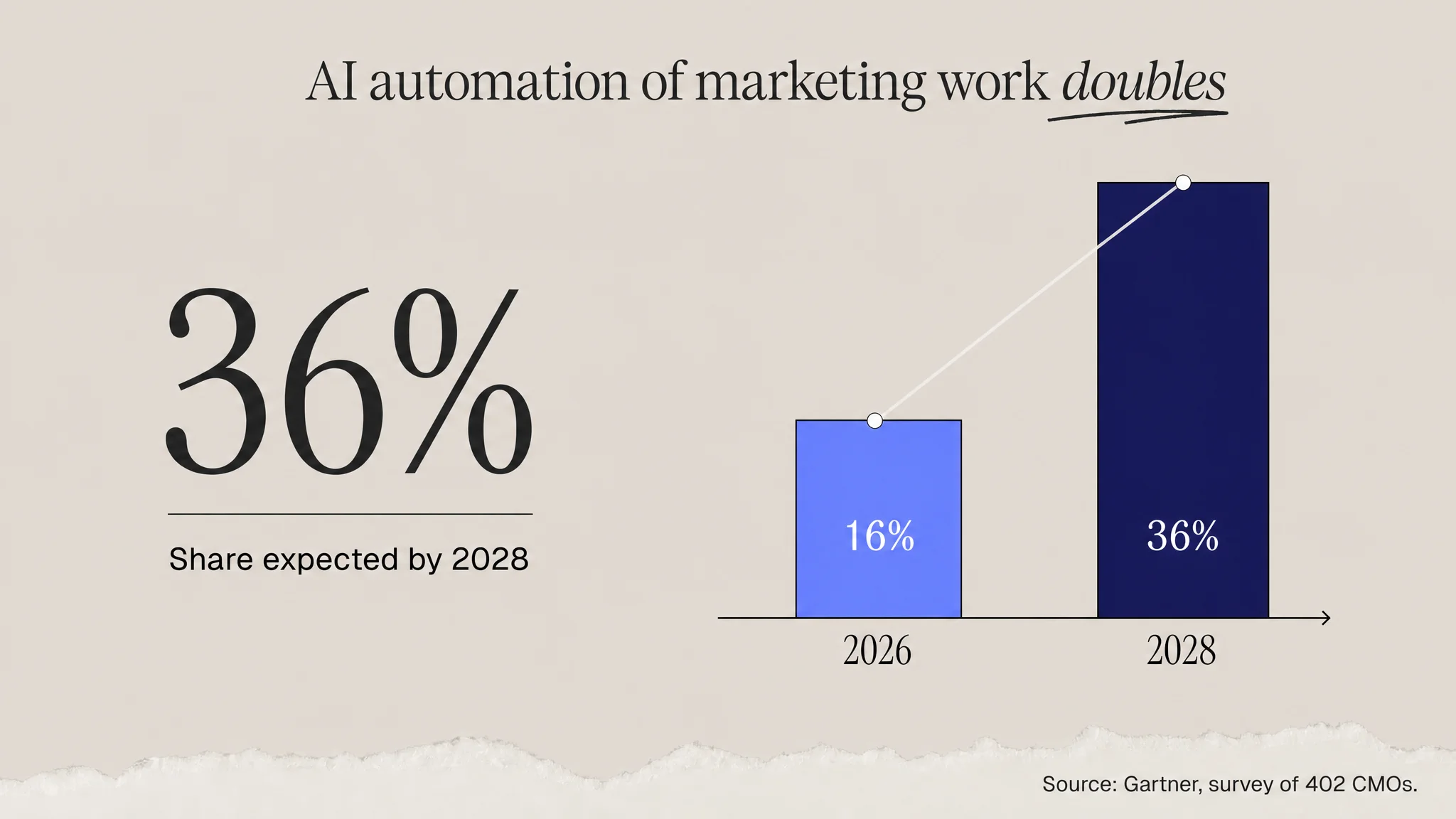
- Gartner's survey of 402 CMOs found AI automates 16 percent of marketing work in 2026, with leaders expecting 36 percent by 2028.
- AI has moved from writing subject lines to deciding timing, audience and next-best-action inside the journey itself.
- The constraint is almost never the model. It is event data quality, and no amount of AI fixes an event stream that arrives late or incomplete.
- Start with three use cases that have a clear control group: send-time optimisation, churn propensity scoring, and creative variant selection.
- Keep a human gate on anything irreversible: discounting, cancellation offers and suppression decisions.
Lifecycle marketing has spent two years being told that AI will transform it. Most of what actually shipped was a subject-line generator bolted onto an email editor. That is now changing, and the shift is worth understanding precisely, because the useful version of AI in lifecycle looks nothing like the demo version.
Where AI actually sits in lifecycle marketing in 2026
AI-powered lifecycle marketing means using models to make the decisions inside a customer journey (who to message, when, on which channel, with what offer) rather than only to generate the words in the message. The generation layer was the easy part and the least valuable.
Gartner surveyed 402 CMOs between August and October 2025 and found that AI automates 16 percent of marketing work in 2026, with respondents expecting that to more than double to 36 percent by 2028. Gartner VP Analyst Kristina LaRocca-Cerrone framed the state of play as a widening gap: "AI experimentation has become table stakes for CMOs. What's emerging now is a widening gap between CMOs who are still testing use cases, and those who are confident enough to use AI to create real brand differentiation."
The gap is not about model access. Everyone has the same models. It is about whether the underlying customer data is good enough for a model to act on.
The four decision layers where AI earns its keep
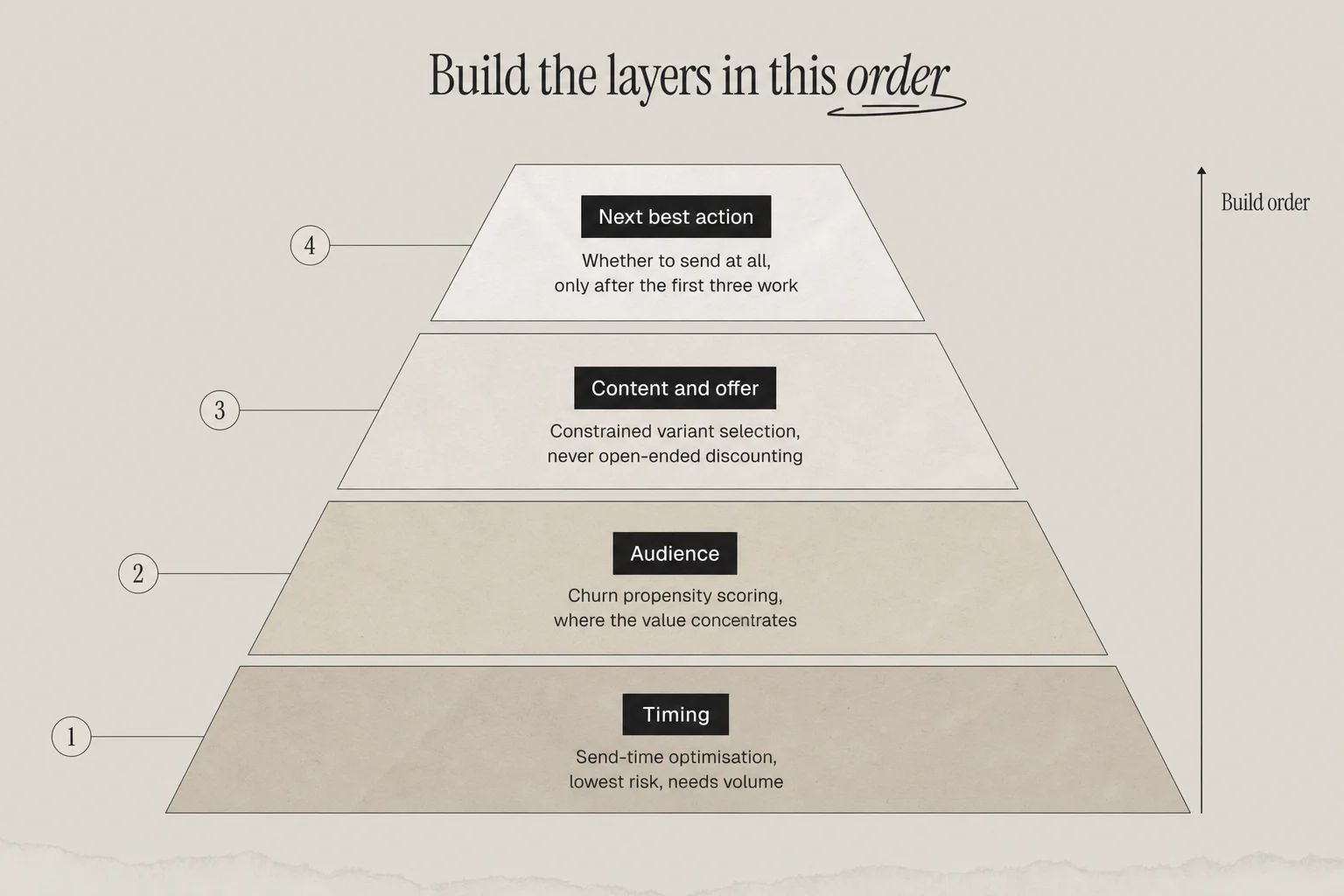
Layer 1: Timing
Send-time optimisation is the most mature and least controversial application. A model learns per-user engagement windows and shifts each send accordingly. It is low risk because the failure mode is a message arriving at a mediocre hour, and it is easy to measure with a holdout.
The caveat is that timing models need volume. Below roughly a few thousand engaged users per segment, per-user models overfit and a simple time-zone rule performs as well.
Layer 2: Audience
Propensity scoring is where the commercial value concentrates. A churn propensity model turns a broad "at risk" segment into a ranked list, which changes what you can afford to do. If you know which 5 percent are genuinely about to leave, a costly intervention becomes economically rational for that 5 percent.
This is where data quality bites hardest. A propensity model trained on incomplete event data will confidently rank the wrong people. Our guide to identifying users who are about to churn covers the behavioural signals worth capturing before you model anything.
Layer 3: Content and offer
Variant selection, where a model chooses among approved creative or offers per user, is genuinely effective and genuinely risky. Effective because personalisation at the offer level outperforms personalisation at the copy level by a wide margin. Risky because an unconstrained optimiser learns that discounts convert, and will happily train your customers to wait for one.
Constrain the offer set. Let the model choose within a range you would be happy for every customer to receive. See email personalisation at scale for the operational patterns.
Layer 4: Next best action
The most ambitious layer: the model decides not just what to send but whether to send at all, across channels, given everything else in flight. This is where fatigue management stops being a static frequency cap and becomes a per-user judgement.
Very few teams should start here. It requires the other three layers to be working and instrumented first.
The prerequisite nobody wants to hear about
Every failed AI lifecycle project we have reviewed failed in the same place, and it was not the model.
- Events arrive late. A churn signal that lands in the platform six hours after the cancel-page visit is a post-mortem, not a trigger.
- Identity is fragmented. The same person is three profiles: app, web and email. Every model trained on that data learns about fragments of people.
- Events are inconsistently named. Three variants of the same action, emitted by three teams over two years, and none of them documented.
- History is too short. Propensity models need enough completed lifecycles to learn from. Ninety days of history cannot predict an annual renewal.
The unglamorous version of an AI lifecycle project is six weeks of event schema work followed by two weeks of modelling. Teams that invert that ratio produce impressive dashboards and no revenue change. Our lifecycle programme audit framework is a reasonable place to start that work.
A 90-day starting sequence
Days 1 to 30: instrument and baseline
- Document your top ten events and confirm each one's latency from occurrence to availability.
- Resolve identity across at least your two largest channels.
- Establish holdout groups now. Retrofitting a control group is not possible, and without one you will be arguing about attribution for a year.
Days 31 to 60: ship two low-risk models
- Send-time optimisation on your highest-volume recurring campaign, with a holdout.
- A churn propensity score, used initially only for reporting so you can check calibration before it drives spend.
Days 61 to 90: connect scoring to action
- Route the top propensity decile into a retention flow, with the remainder as control.
- Introduce constrained offer selection on one flow, never on discounting without a human gate.
- Review calibration: of the users the model said would churn, how many did?
Where to keep humans in the loop
Three decisions should not be fully automated, regardless of model quality.
- Discounting. Margin erosion compounds silently and models optimise for the metric you gave them, not the one you meant.
- Cancellation and save offers. These touch contractual and sometimes regulatory ground.
- Suppression. A model that learns to stop messaging low-engagement users will quietly shrink your addressable base and report improved engagement rates while doing it.
How to measure it honestly
Judge AI lifecycle work on incremental revenue against a holdout, not on model accuracy. An 85 percent accurate churn model that changes nobody's behaviour is worth nothing. A 70 percent accurate model that routes budget to the right decile is worth a great deal.
Track calibration alongside accuracy, measure fatigue and unsubscribe rates as guardrails, and hold the holdout for at least one full billing cycle. For the metric set this sits inside, see lifecycle revenue, cohort LTV versus blended LTV and cohort analysis.
The bottom line
AI-powered lifecycle marketing in 2026 is a data project wearing a model's clothing. The organisations pulling ahead are not the ones with better access to models. They are the ones whose events are clean, whose identity is resolved, and whose holdouts are honest.
Start with timing and propensity, keep humans on the irreversible decisions, and measure against a control group you set up before you started. The 36 percent that Gartner's respondents expect by 2028 will belong to the teams that did the boring part first. For the strategic frame around all of it, see lifecycle marketing strategies by stage and why lifecycle marketing programmes fail.
Sources
- Gartner Survey Reveals Marketing Leaders Expect AI Automation of Marketing Work to Double to 36% by 2028, Gartner
- Customer Journey Orchestration Platform, Braze
- Data-driven segments, Customer.io Docs
- Google users are less likely to click on links when an AI summary appears in the results, Pew Research Center
Frequently Asked Questions
What is AI-powered lifecycle marketing?
It means using models to make the decisions inside a customer journey rather than only to generate message copy. Those decisions are who to message, when to message them, on which channel, and with what offer. The generation layer, such as subject-line writing, was the easy part and the least commercially valuable. The decision layers are where the revenue impact sits.
How much of marketing work is automated by AI in 2026?
Gartner surveyed 402 CMOs between August and October 2025 and found AI automates 16 percent of marketing work in 2026, with respondents expecting that to more than double to 36 percent by 2028. Gartner also describes a widening gap between organisations still testing use cases and those confident enough to use AI for genuine differentiation.
Where should you start with AI in lifecycle marketing?
Start with send-time optimisation and churn propensity scoring, because both have clear holdout measurement and low downside. Run propensity scores for reporting only at first so you can check calibration before they drive spend. Only then connect scoring to action, routing the top propensity decile into a retention flow with the remainder held back as control.
Why do AI lifecycle marketing projects fail?
Almost always on data rather than models. Events arrive too late to trigger anything useful, identity is fragmented across app, web and email so models learn about fragments of people, event names are inconsistent across teams and years, and event history is too short for the lifecycle being predicted. The realistic split is roughly six weeks of event schema work to two weeks of modelling.
What should stay under human control?
Three decisions: discounting, because margin erosion compounds silently and models optimise the metric you gave them rather than the one you meant; cancellation and save offers, because they touch contractual and sometimes regulatory ground; and suppression, because a model that stops messaging low-engagement users will shrink your addressable base while reporting improved engagement rates.
![Featured image: How to Identify Users Who Are About to Churn [2026 Guide for Retention Marketers]](https://cdn.prod.website-files.com/69bbf9f7f2a3f75341357ebc/69f4b4ad14f8c675169e0cba_69c7cec26de0e50005c6e495_698ae45b9ecbf9983380f731_6909f1e088d37bed0144f247_Identify%25252520User%25252520churn-2-min.png)
![Featured image: 25 Best Lifecycle Marketing Strategies - Based on Customer Lifecycle Stages [#2025 Update]](https://cdn.prod.website-files.com/69bbf9f7f2a3f75341357ebc/69f35b7250ddb533f7fcbd8b_69c7ce9f68e818fd4aa3dad6_698ae432a7625eb340e995a0_681eed717eea07585b2e5d5c_Lifecycle%25252520Marketing%25252520Strategies-1-min.png)