
Summarize this documentation using AI
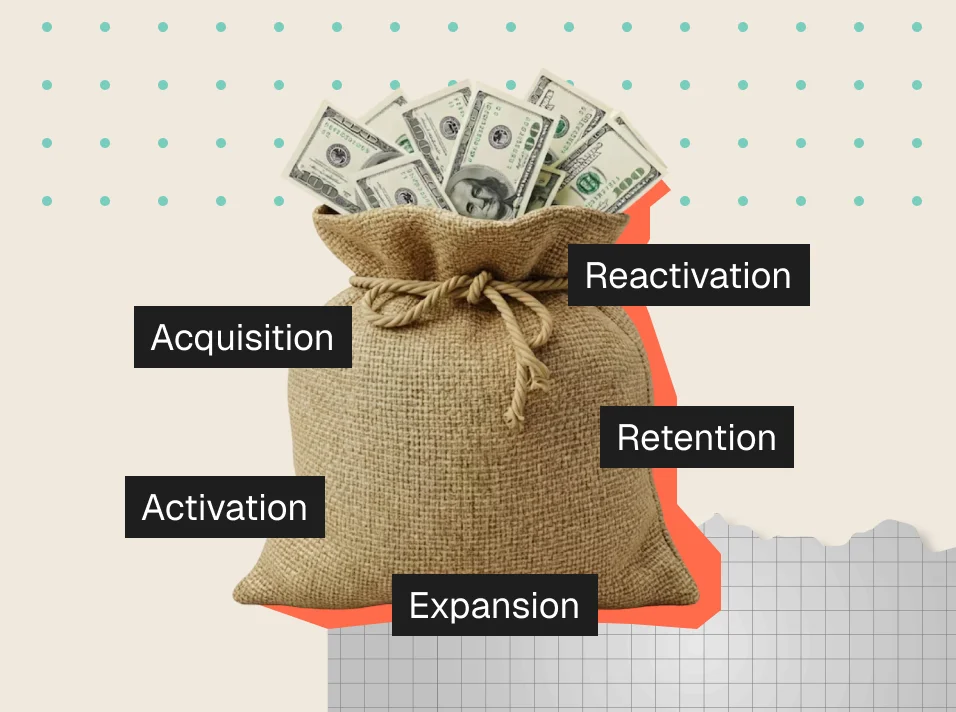
The Lifecycle Revenue Model is a framework for measuring and growing revenue across the entire customer lifecycle (acquisition, activation, expansion, retention, and reactivation) instead of counting it one campaign at a time. It answers a question that blended dashboards cannot: where in the journey is revenue actually created, and which stage is leaking? Most B2C brands optimize the campaign calendar and miss that the majority of durable revenue comes from customers they already have. About 65% of a company's revenue comes from existing customers, and automated lifecycle flows generate up to 30x more revenue per recipient than one-off campaigns (Klaviyo). The Lifecycle Revenue Model turns those facts into an operating model you can manage.
Key Takeaways
- Most revenue is already inside your base. Roughly 65% of revenue comes from existing customers, and the top 5% of customers drive about 35% of ecommerce revenue.
- Repeat buyers are worth more per order. Returning customers spend roughly 67% more per order than first-time buyers.
- Flows, not campaigns, compound. Automated flows generate up to 30x more revenue per recipient than batch campaigns (Klaviyo).
- Blended LTV hides the truth. Only cohort LTV shows whether newer customers are actually retaining better.
- The stage lens changes decisions. Modeling revenue by lifecycle stage tells you where to invest next, and a 5% retention lift can raise profits 25% to 95% (Bain & Company).
What the Lifecycle Revenue Model Is
The Lifecycle Revenue Model reframes the single most-asked question in a B2C business ("how much did we make?") into a more useful one: "how much did we make at each stage of the customer relationship, and is that improving cohort over cohort?" It is the operating layer that sits on top of lifecycle marketing and gives it a P&L. Where a campaign mindset asks "what should we send this week," a lifecycle-revenue mindset asks "which stage is under-monetized and which is leaking." The definition of lifecycle revenue is the starting point; this model is how you operationalize it. The reframing matters because the base is where the money is: existing customers already account for roughly 65% of revenue, so a model that only measures acquisition is optimizing the smaller half of the business.
The Five Revenue Stages
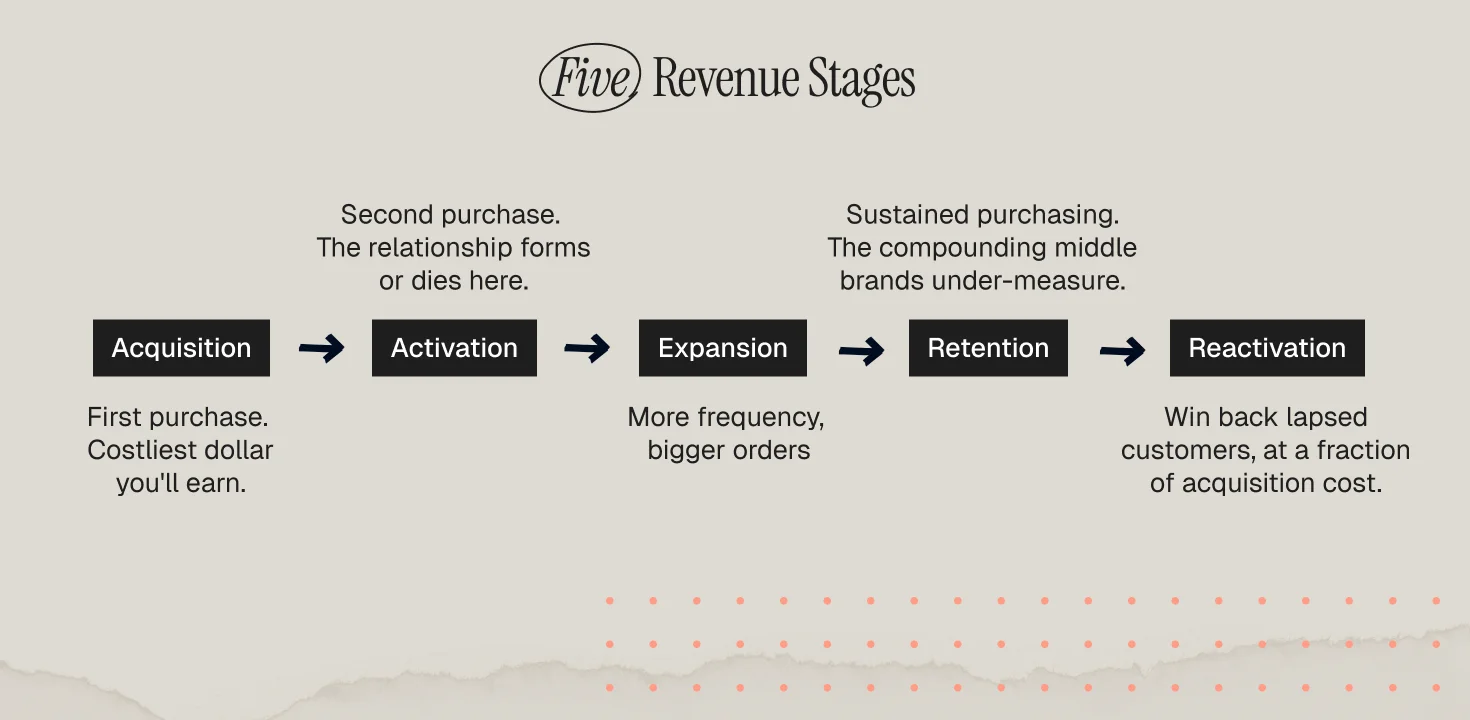
Every dollar a customer will ever spend passes through five stages, and each has a distinct lever. Acquisition is the first purchase, the most expensive dollar you will earn given that acquiring a customer costs 5 to 25x more than retaining one (HBR). Activation is the second purchase, where the relationship either forms or dies, usually driven by a welcome series and a strong first 30 days of customer activation. Expansion is increased frequency and order value, where replenishment flows and cross-sell do the work and repeat buyers spend about 67% more per order. Retention is sustained purchasing, the compounding middle that most brands under-measure. Reactivation is recovering lapsed customers through a win-back flow, typically at a fraction of acquisition cost. Model revenue at each stage and you can see exactly which one to fix first.
Why Blended Numbers Lie
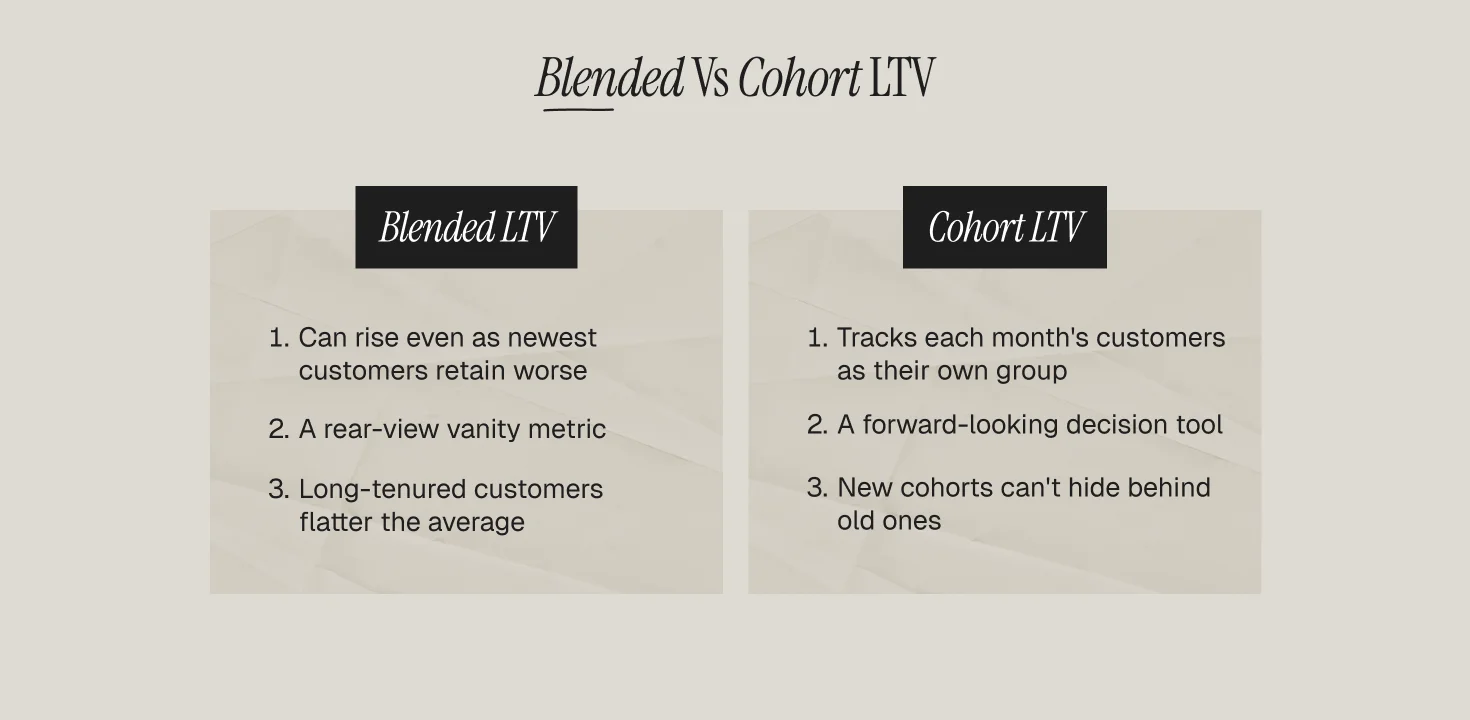
The reason most brands cannot manage lifecycle revenue is that they look at blended averages. A single blended LTV number can rise even as your newest customers retain worse, because a handful of long-tenured customers flatter the average. The fix is to measure cohort LTV rather than blended LTV, so each month's customers are tracked as their own group. This is the same discipline that makes customer lifetime value a forward-looking decision tool instead of a rear-view vanity metric. When you switch from blended to cohort, you often discover that a "growing" business is actually acquiring faster than it retains, which is the quiet failure mode the Lifecycle Revenue Model is designed to expose.
Flows Are the Revenue Engine
The reason lifecycle revenue compounds is automation. A campaign earns once; a flow earns every time a customer hits the trigger. That is why automated flows generate up to 30x more revenue per recipient than batch sends (Klaviyo), and why the best-performing DTC brands lean on their flow library rather than their promo calendar. In lifecycle-revenue terms, each flow maps to a stage: welcome and activation to the second-purchase window, replenishment and cross-sell to expansion, win-back and sunset to reactivation. Wiring the flow library to the stage model is what converts the framework from a reporting exercise into revenue.
How to Model Lifecycle Revenue
Practically, you build the model in three moves. First, tag every revenue event to a lifecycle stage so you can report revenue by stage, not just by channel. Second, cut it by cohort so you can watch each month's customers mature. Third, tie the top-line back to profit: because a 5% retention improvement can lift profits 25% to 95% (Bain & Company), a one-point gain in a mid-lifecycle cohort is worth far more than the same gain in raw acquisition. The output is a simple but powerful dashboard: revenue by stage, by cohort, trending over time. That view is what lets an operator stop guessing and start investing where the model says the next dollar is cheapest.
Frequently Asked Questions
What is the Lifecycle Revenue Model?
It is a framework for measuring and growing revenue across five lifecycle stages (acquisition, activation, expansion, retention, reactivation) and by cohort, rather than by campaign. It shows where revenue is created and where it leaks.
How is lifecycle revenue different from LTV?
LTV estimates the total value of a customer over time; lifecycle revenue is the operating view of revenue produced at each stage of that relationship, ideally tracked by cohort. LTV is the destination; lifecycle revenue is the map.
Why measure revenue by cohort instead of blended?
Because blended averages hide decay. A blended LTV can rise while your newest customers retain worse. Cohorts reveal whether the business is genuinely improving.
How much revenue really comes from existing customers?
Roughly 65% of revenue comes from existing customers, and the top 5% of customers drive about 35% of ecommerce revenue, which is why a model that only tracks acquisition measures the smaller half of the business.
Which stage should I optimize first?
Usually activation (the second purchase), because it has the highest leverage on every downstream stage. Model your stages by cohort and invest where the leak is largest and the fix is cheapest.
-thumbnail.webp)
![Featured image: 25 Best Lifecycle Marketing Strategies - Based on Customer Lifecycle Stages [#2025 Update]](https://cdn.prod.website-files.com/69bbf9f7f2a3f75341357ebc/69f35b7250ddb533f7fcbd8b_69c7ce9f68e818fd4aa3dad6_698ae432a7625eb340e995a0_681eed717eea07585b2e5d5c_Lifecycle%25252520Marketing%25252520Strategies-1-min.png)

