

Summarize this documentation using AI
Revenue per email (RPE), also called revenue per recipient (RPR), is the total revenue attributed to an email send divided by the number of recipients it was delivered to. It answers the only question that ultimately matters about your email program: how much is each send actually worth?
Open rates broke as a reliable signal when Apple's Mail Privacy Protection started inflating them. Click rates measure curiosity, not commerce. RPE is the metric that survives, because it ties email directly to money, which is why Klaviyo treats revenue per recipient as the north-star email metric for ecommerce brands.
This definition anchor covers the formula, what good looks like in 2026, and the levers that move it. It pairs with our related definitions of customer lifetime value and lifecycle revenue.
The Formula
Revenue per Email (RPE) = Attributed Revenue from Send ÷ Emails Delivered
A campaign delivered to 50,000 subscribers that drives $6,000 in attributed revenue has an RPE of $0.12. Use delivered, not sent, so bounces do not distort the number, and hold your attribution window constant (Klaviyo defaults to 5 days for email) or the metric stops being comparable across sends.
RPE vs Related Metrics
RPE vs open/click rate: engagement metrics are diagnostics; RPE is the outcome. A send with a mediocre click rate and high RPE beats the reverse.
RPE vs total campaign revenue: total revenue rewards list size; RPE rewards list quality. A growing list can raise total revenue while RPE quietly collapses, an early warning that you are mailing more people, worse.
RPE vs email ROI: ROI nets out costs. Email remains the highest-ROI owned channel, returning roughly $36 for every $1 spent per Litmus, but RPE is the operating metric you manage weekly while ROI is the board-level rollup.
What Is a Good RPE in 2026?
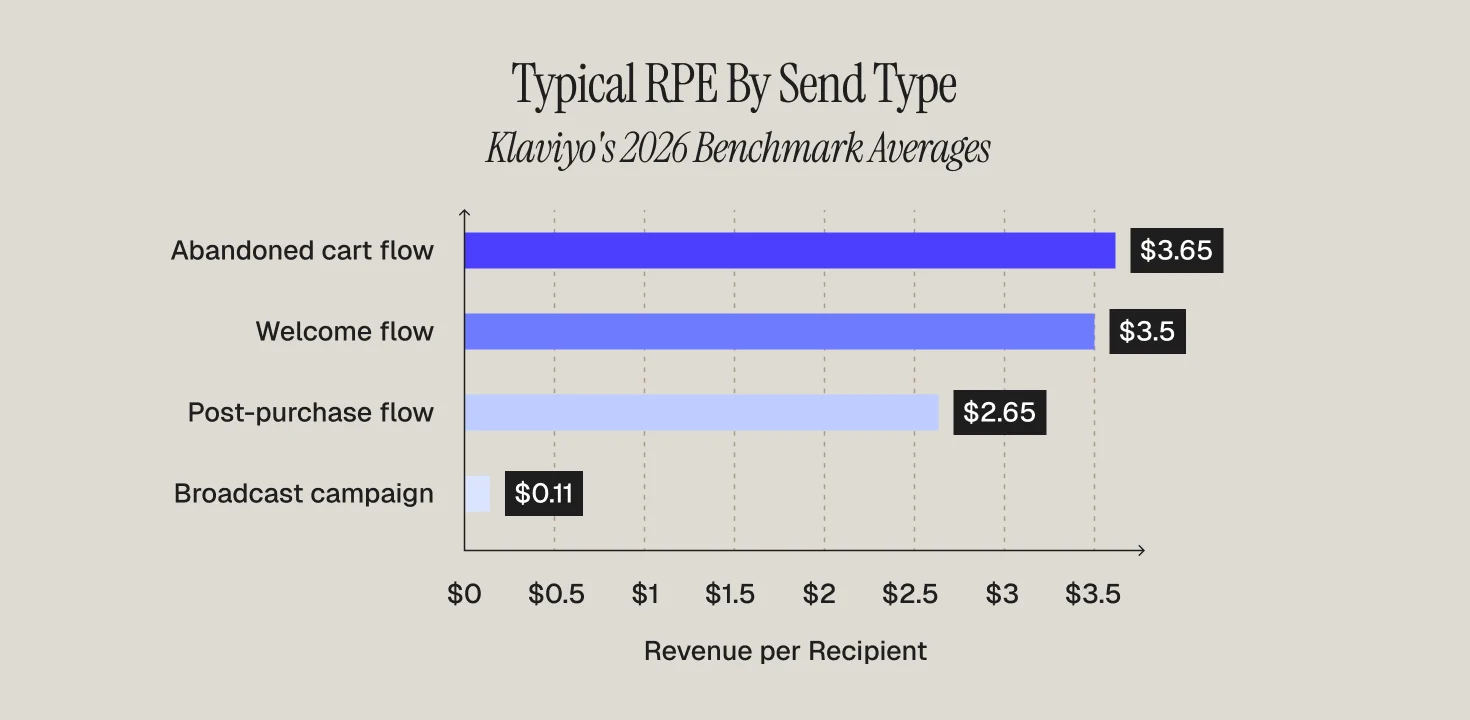
Benchmarks vary widely by vertical, AOV, and send type, and the split that matters most is campaigns vs flows. Behavior-triggered flows routinely earn several times the RPE of broadcast campaigns; abandoned cart and welcome flows post revenue per recipient figures in the $1 to $3+ range for many DTC verticals, against campaign RPEs measured in cents. Check your vertical in Klaviyo's 2026 benchmark data and read it alongside our full ecommerce email benchmarks breakdown.
The honest baseline, though, is your own trailing 90-day RPE by send type. Beat that consistently and the program is improving, whatever the global averages say.
7 Levers That Raise RPE
1. Segment harder. Sending less, to fewer, better-chosen people raises RPE almost mechanically. Category-level and engagement-tier segmentation via behavioral segmentation is the first lever, not the last.
2. Shift revenue share toward flows. Flows out-earn campaigns per recipient, so every automation gap (missing browse, replenishment, or winback coverage) caps program RPE. Start from our map of the best Klaviyo flows for DTC.
3. Suppress the disengaged. Mailing dead weight drags RPE down and hurts deliverability, which then drags every future send. A disciplined sunset flow raises RPE twice.
4. Fix the welcome series. The welcome series is most brands' highest-RPE automation; small conversion gains there move program totals.
5. Test offers, not just subject lines. Subject line tests move opens; offer structure, bundles, and landing pages move revenue.
6. Pair email with SMS deliberately. Coordinated sends lift revenue per profile; duplicated ones split it. See integrating email and SMS.
7. Read RPE by cohort. A send can look great on blended numbers while doing nothing for new-customer cohorts; the same trap covered in cohort LTV vs blended LTV.
Where RPE Fits in Retention Reporting
RPE is a send-level metric. Roll it up weekly by send type, monthly by segment, and quarterly into revenue per subscriber, which connects the email program to retention economics and LTV. That chain, send → subscriber → cohort → LTV, is exactly what we instrument when Propel runs lifecycle marketing for DTC and B2C brands.
Frequently Asked Questions
What is revenue per email?
Revenue per email (RPE), or revenue per recipient (RPR), is the attributed revenue from an email send divided by the number of emails delivered. It measures how much each delivered email is worth in actual sales.
How do I calculate revenue per email?
Divide the revenue attributed to a send by the number of delivered emails. Example: $6,000 in attributed revenue across 50,000 delivered emails equals $0.12 RPE. Keep the attribution window constant across sends so results stay comparable.
What is a good revenue per email benchmark?
It depends on vertical, AOV, and send type. Broadcast campaigns commonly earn cents per recipient, while high-intent flows like abandoned cart can earn $1 to $3+ per recipient. Your own trailing 90-day baseline by send type is the most useful benchmark.
Is RPE better than open rate?
For judging business impact, yes. Open rates have been unreliable since Apple's Mail Privacy Protection began auto-loading pixels, while RPE ties directly to revenue. Open and click rates remain useful as diagnostics for why RPE moved.
Why is my revenue per email declining?
The usual causes: list growth outpacing list quality, over-mailing disengaged segments, missing or stale automations, discount fatigue, or deliverability decay pushing sends to spam. Segmentation, suppression, and flow coverage are the standard fixes.