.webp)
Summarize this documentation using AI
Key Takeaways
- Purple Innovation reported $98.3 million in Q2 2026 net revenue, down 6.5 percent year over year, while direct-to-consumer revenue grew 3.4 percent.
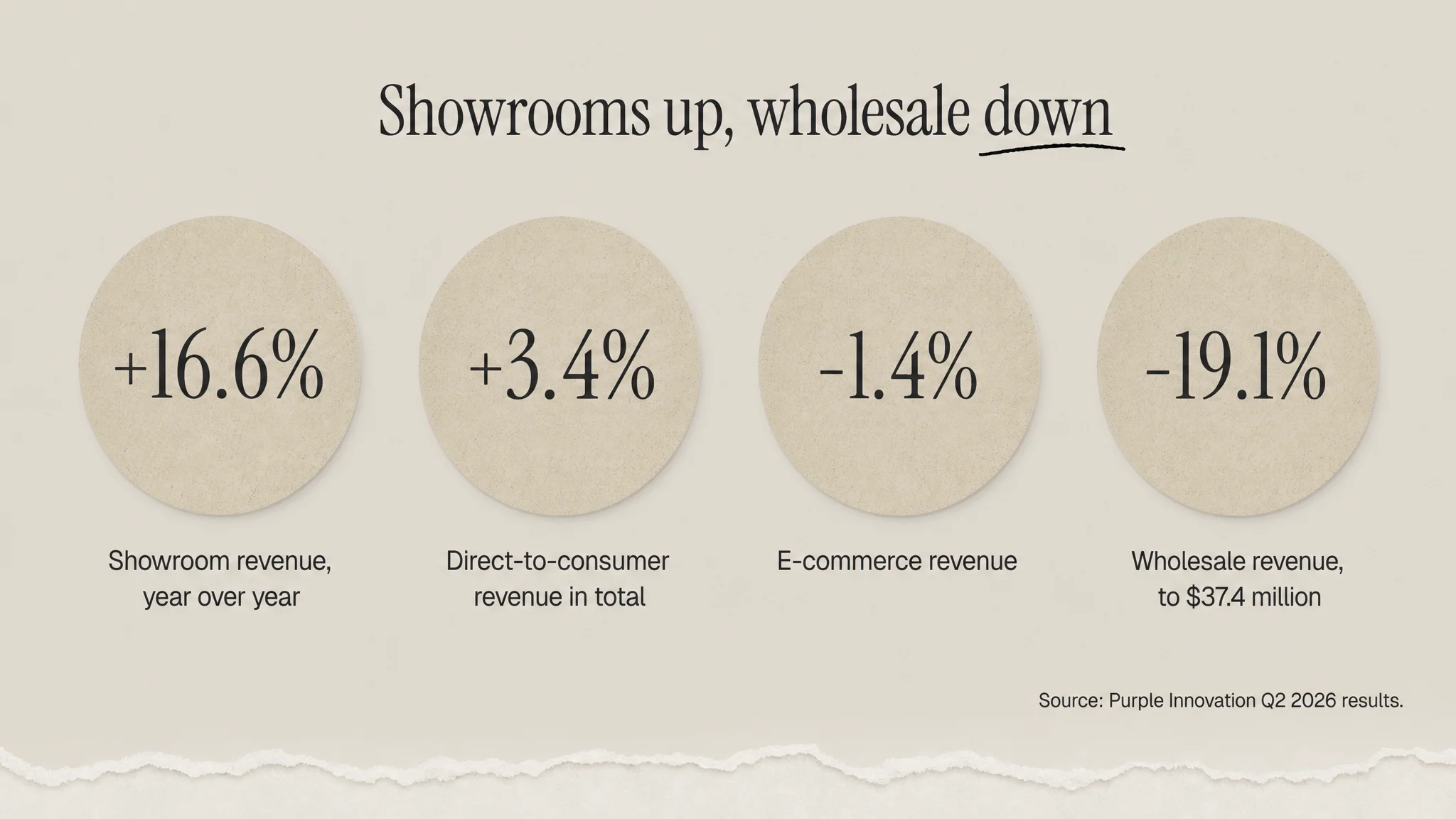
- The split inside DTC is the whole story: showroom revenue rose 16.6 percent while e-commerce fell 1.4 percent.
- Wholesale fell 19.1 percent to $37.4 million, which is what turned growing DTC into shrinking total revenue.
- Gross margin reached 45.2 percent, up roughly 470 basis points, helped by a $5.3 million tariff refund, and adjusted EBITDA improved to $2.1 million from a $2.4 million loss.
- Mattresses are a once-a-decade purchase, so Purple's retention problem is not repeat purchase. It is referral, adjacency and the long gap between the sale and the next one.
Most retention teardowns in this series look at brands with a natural repeat cycle: meal kits, supplements, streaming. Purple is the harder and more instructive case, because the core product is bought roughly once every eight to ten years. Almost every conventional retention lever is unavailable.
That constraint is exactly why it is worth studying. When you cannot rely on repeat purchase, you find out what your lifecycle programme is actually made of.
The numbers, and what they are telling you
Purple Innovation's Q2 2026 results reported net revenue of $98.3 million, down 6.5 percent from $105.1 million in the prior year period. Underneath that headline, the channel mix moved in opposite directions:
- Direct-to-consumer revenue rose 3.4 percent.
- Showroom revenue rose 16.6 percent.
- E-commerce revenue fell 1.4 percent.
- Wholesale revenue fell 19.1 percent to $37.4 million from $46.2 million, driven by a $5.3 million increase in customer and manufacturer payments plus a $3.5 million decline in sales volume.
Profitability moved the right way. Gross margin came in at 45.2 percent, up approximately 470 basis points year over year, primarily due to a $5.3 million tariff refund. Adjusted EBITDA was $2.1 million, a $4.4 million improvement on the prior year's $2.4 million loss. Operating expenses fell 14.3 percent on lower employee and professional services costs, even as advertising spending increased.
The one number that reframes the strategy
Showrooms up 16.6 percent, e-commerce down 1.4 percent. For a brand that built its name on a viral online launch, that inversion is the strategic headline.
The obvious reading is that a high-consideration, high-price, physically-experienced product benefits from being lain on. The more useful reading for lifecycle marketers is that Purple's most productive channel is now the one with the highest cost to serve and the richest data capture. A showroom visit yields intent signals that no amount of on-site behavioural tracking replicates, and it happens at the moment of highest consideration.
What a brand does with that signal in the following seventy-two hours is a lifecycle question, not a retail one.
Teardown: the five lifecycle problems Purple has to solve
1. The consideration window is long and the funnel is not linear
Mattress buyers research for weeks and often months. They compare across three or four brands, read return policies closely, and frequently visit a store between online sessions.
The lifecycle implication is that a standard abandonment flow, tuned for a same-day decision, is mistimed. A browse abandonment sequence that fires three emails in forty-eight hours and then stops has abandoned the customer well before the customer decided anything. The correct shape is a longer, lower-frequency education sequence that stays useful for six to eight weeks. See our comparison of welcome series design for the structural principle: sequence length should match decision length, not campaign convenience.
2. Showroom and online identity must be one identity
If showroom growth is carrying the channel, the highest-value lifecycle work is joining the showroom visit to the online profile. Without it, a customer who lay on a mattress on Saturday receives Monday's generic prospecting email, and the brand looks like it was not paying attention.
This is identity resolution, and it is the least glamorous and most valuable project available to a business with this channel mix. It is the same problem we describe in omnichannel retention, made sharper by a physical touchpoint that generates enormous intent signal and almost no automatic data.
3. The post-purchase window is the entire retention programme
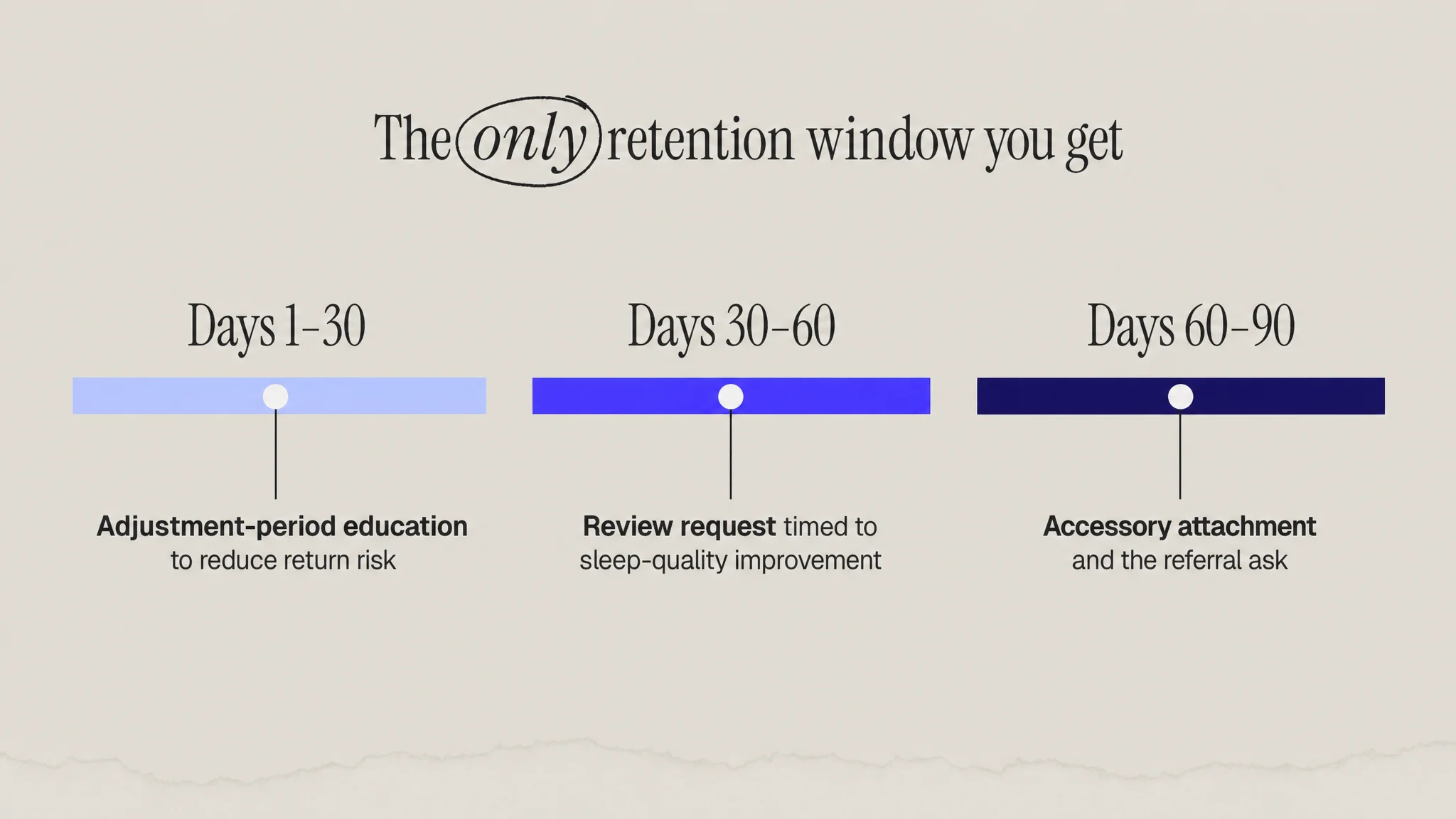
With a ten-year repurchase cycle, the ninety days after delivery are not a follow-up. They are the whole relationship.
Three jobs sit in that window:
- Reduce return risk. Mattress trial periods create a real, dated risk window. An adjustment-period education sequence that explains the break-in feel is a direct margin defence.
- Capture the review while sentiment is peaking. Reviews are the primary acquisition asset in this category. The ask should be timed to sleep-quality improvement, not to delivery.
- Open the referral loop. A satisfied buyer knows other people shopping for mattresses within the following year. That window closes quietly.
4. Adjacency is the only repeat revenue available
Pillows, sheets, mattress protectors, bases and seat cushions have their own, much shorter, replacement cycles. They convert a decade-long relationship into an annual one, and they are the reason a mattress brand should run a replenishment flow at all.
The sequencing matters. Attachment sold at checkout competes with the headline purchase decision and raises cart friction. Attachment sold sixty to ninety days post-delivery, once the product has been validated in the customer's own bed, meets a customer who now trusts the brand's material claims.
5. The product story has to survive summarisation
Purple's differentiation rests on a specific physical claim: the GelFlex Grid. The CEO's stated focus is "helping consumers better understand why the GelFlex Grid is different, strengthening the experience across our direct channels."
That is a harder job than it was three years ago, because a growing share of category research now happens inside AI-generated summaries rather than on brand sites. A differentiation claim that requires a demonstration to land is structurally disadvantaged when the buyer's first exposure is a paraphrased paragraph. This is the practical case for treating clear, checkable, extractable product claims as a lifecycle asset, not just a copywriting concern.
What other brands should take from this
If your repurchase cycle is measured in years
Stop benchmarking yourself against subscription retention rates. Your equivalent metrics are referral rate, review conversion rate, attachment rate and return rate. A mattress brand with a 2 percent annual repeat rate and a 30 percent referral rate is healthier than the inverse, and no standard retention dashboard will show you that.
If a physical channel is outgrowing your digital one
Treat the physical visit as the highest-value event in your stack and instrument it accordingly. The lifecycle programme should be able to answer, on Monday morning, who walked into a showroom on Saturday and what they touched.
If your margin story depends on a one-off item
Purple's 470 basis point gross margin improvement was driven primarily by a $5.3 million tariff refund. That is a real result and a non-recurring one. When you model the retention investment a margin improvement can fund, separate the structural gain from the one-time gain before you commit the budget.
The bottom line
Purple's quarter shows a business with a working direct channel inside a shrinking total, carried by showrooms while e-commerce softens and wholesale falls away. The lifecycle opportunity is not to make people buy mattresses more often, because they will not.
It is to join the physical visit to the digital profile, to own the ninety days after delivery completely, and to convert a decade-long product cycle into an annual accessory relationship. For more teardowns in this series, see Warby Parker, Peloton and Glossier, and for the frameworks behind them, 12 retention strategies that actually work.
Sources
- Purple Innovation Reports Second Quarter 2026 Results, Purple Innovation Investor Relations
- Purple Innovation Reports Second Quarter 2026 Results, PR Newswire
- Google users are less likely to click on links when an AI summary appears in the results, Pew Research Center
Frequently Asked Questions
How did Purple Innovation perform in Q2 2026?
Purple Innovation reported net revenue of $98.3 million, down 6.5 percent from $105.1 million in the prior year period. Direct-to-consumer revenue rose 3.4 percent, with showroom revenue up 16.6 percent and e-commerce down 1.4 percent. Wholesale fell 19.1 percent to $37.4 million. Gross margin was 45.2 percent, up roughly 470 basis points, and adjusted EBITDA improved to $2.1 million from a $2.4 million loss.
How does a mattress brand do retention marketing?
Not through repeat purchase, since mattresses are replaced roughly every eight to ten years. The levers are referral, review conversion, accessory attachment and return prevention. The ninety days after delivery carry almost the entire relationship: reduce return risk with adjustment-period education, capture the review while sentiment peaks, and open the referral loop before the window closes.
Why is Purple growing showrooms while e-commerce declines?
A high-price, high-consideration product that is judged by physical feel benefits from being experienced in person, and Purple reported showroom revenue up 16.6 percent against e-commerce down 1.4 percent in Q2 2026. For lifecycle marketers the implication is that the showroom visit is now the highest-value intent signal in the stack, and joining it to the online profile is the most valuable available project.
What retention metrics matter for a once-a-decade purchase?
Referral rate, review conversion rate, accessory attachment rate and return rate, rather than repeat purchase rate or subscription-style retention curves. A brand with a 2 percent annual repeat rate and a 30 percent referral rate is healthier than the reverse, and a standard retention dashboard built for subscriptions will not surface that at all.
What can other DTC brands learn from Purple?
Three things. Match sequence length to decision length, since a 48-hour abandonment flow is mistimed for a purchase researched over weeks. Treat a growing physical channel as your richest data source and instrument it accordingly. And separate structural margin gains from one-off ones before committing budget: Purple credited its 470 basis point gross margin improvement primarily to a $5.3 million tariff refund.