

Summarize this documentation using AI
Warby Parker retains customers by turning a two-year glasses purchase into a year-round relationship: 352 stores within 30 minutes of most Americans, in-store and virtual eye exams, contact lens resupply, in-network insurance, and a $95 entry price that removes the reason to shop around. The result is 2.71 million active customers spending an average of $336 a year, up 6.6% year over year, per the company's Q2 2026 results.
Glasses are a brutal category for retention: most people replace them every two to three years, and the purchase is often triggered by a doctor, not a marketer. Warby Parker's answer was not to email harder. It added higher-frequency purchase occasions (exams, contacts, second pairs) around the low-frequency one, and built the infrastructure that captures each occasion.
This is Brand Teardown #6 in our series, structured like our Hims & Hers teardown: six lifecycle stages, real numbers from earnings releases and SEC filings, and how we build the same systems for DTC and health brands.
Why Warby Parker Is a Retention Case Study Worth Studying
Warby Parker went public in 2021 as a digitally native brand with a beloved gimmick (Home Try-On) and widening losses. Five years later, FY2025 net revenue was $871.9 million (up 13.0%), the company posted its first full year of positive net income ($1.6 million), adjusted EBITDA hit $95.2 million (10.9% margin), and average revenue per customer reached $324, up 5.7%.
Then in Q2 2026: net revenue of $235.5 million (up 9.8%), 2.71 million active customers (up 4.1% on a trailing 12-month basis), average revenue per customer of $336 (up 6.6%), and 352 stores after 15 net new openings in the quarter.
Notice the shape of that growth. Active customers grew 4.1%; revenue per customer grew 6.6%. More than half the growth is existing customers spending more. That is the signature of a retention engine.
Two definitions matter for the rest of the piece. Warby Parker defines Active Customers as unique accounts with at least one purchase in the preceding 12 months, and Average Revenue per Customer as trailing 12-month net revenue divided by current Active Customers. Because the window is only 12 months, a customer who buys glasses every 24 months drops out in the off year. Every adjacent occasion (an exam, a contacts reorder, sunglasses) keeps that customer "active" in the year they were never going to buy frames.
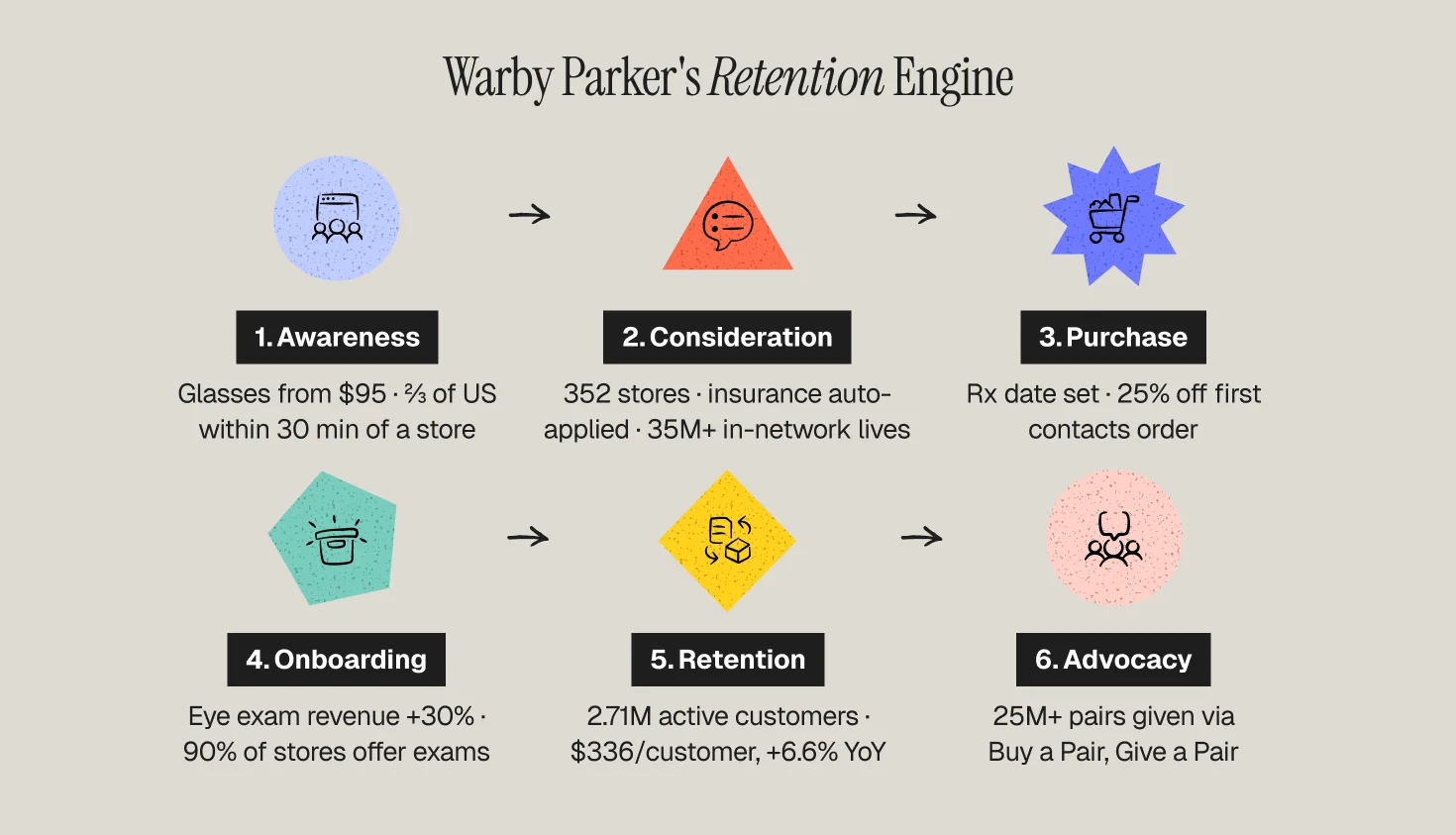
Stage 1: Awareness, A Brand That Pre-Sells Value
The $95 anchor did the marketing
The origin story (glasses cost too much, so here is a $95 pair with a social mission) is still the message on the company's own press releases: designer-quality prescription glasses starting at $95. The price does two retention jobs before anyone buys. It removes price as a reason to defect next time, and it makes the second and third pair feel affordable, which is where revenue per customer growth comes from.
From ecommerce brand to neighborhood optical shop
Nearly two-thirds of the US population lives within 30 minutes of a Warby Parker store, and 50 openings are planned for 2026. Retail revenue grew 13.6% in the quarter while ecommerce was flat at $58.7 million. Every storefront is an always-on billboard in zip codes where the brand already has customers, which lowers re-acquisition cost when the two-year replacement window opens.
Stage 2: Conversion, Removing the Reasons Not to Buy
Home Try-On is gone, on purpose
The program that made Warby Parker famous, five frames shipped free to your door, was retired at the end of 2025. The company said the vast majority of Home Try-On users already lived within 30 minutes of a store, and it took a one-time $3.8 million charge to wind the program down. Co-founder Neil Blumenthal called it a novel way to help customers shop for glasses online that had been overtaken by stores and virtual try-on.
The lesson: a conversion tactic is a means, not an identity. Once stores and AR try-on delivered the same confidence at lower cost, the tactic was cut.
Stores as conversion and data capture
A store visit captures a fresh prescription, a face measurement, an insurance card and a phone number in one 20-minute interaction. About 90% of stores now offer eye exams, so the store is where the next purchase date gets set. It is a physical version of the zero-party data capture that DTC brands try to do with quizzes.
Insurance at checkout
In-network coverage (UnitedHealthcare, Davis Vision, Superior Vision, MetLife Vision and others) is automatically applied at checkout with no reimbursement paperwork needed, and FSA/HSA dollars work on glasses, contacts and exams. Management said in-network lives grew to more than 35 million and insurance penetration reached about 8% of revenue in Q2 2026. A benefit that resets every plan year is a built-in annual purchase trigger.
Stage 3: Onboarding, Setting the Next Purchase Date
Onboarding here is less about a welcome email and more about installing the next occasion:
The prescription gets a clock. Every prescription has an expiration date, and the American Optometric Association's adult guideline now recommends annual comprehensive exams for adults 18 to 39. Warby Parker knows the date; the reminder is a legitimate health message rather than a promotion.
The account becomes one identity across channels. A frame bought in-store, an exam booked on the app and a contacts reorder online resolve to one record. This is the prerequisite for every flow that follows, and where most omnichannel brands break (see omnichannel orchestration).
The first contacts order is discounted. The contacts page currently offers 25% off a first contacts order plus a $50 eyewear credit for buying an annual supply. The intro offer funds a category expansion and the credit routes the contacts buyer back into frames. Compare that with the welcome series most DTC brands run, which stops at "10% off your first order."
Stage 4: Engagement, Filling the Gap Between Frames
The app and virtual try-on
The app has offered AR virtual try-on since 2019, and after Home Try-On ended it became the primary at-home browsing tool. It keeps customers engaged with the catalog (five collections launched in Q2 2026, including Warby Parker Sport) without asking for a purchase, and it produces browsing signals for the kind of flows we describe in behavioral triggers in retention marketing.
Eye exams: the highest-frequency occasion
Eye exam revenue grew more than 30% year over year in Q2 2026 and reached 7% of revenue, up from 6%. Management has said exams could reach 15% to 20% of the business over time. Every exam ends with a new prescription, and a new prescription is the strongest predictor that a customer buys glasses in the next 90 days.
The Virtual Vision Test extends this to customers who will not visit a store: a $15 app-based renewal for 18 to 65 year olds with a single-vision distance prescription, reviewed by a licensed doctor within 48 hours. It keeps the prescription clock running even for the pure ecommerce customer.
Contacts: the subscription-shaped business inside a non-subscription brand
Contact lenses were 2% of revenue at the 2021 IPO and about 11% in Q2 2026, growing high single digits, with 100-plus lenses from Acuvue, Biofinity, Dailies and others and free shipping on every order. Contacts convert an every-two-years customer into an every-90-days customer. Even without a formal subscription, the annual-supply incentive and reorder reminders behave like one, which is why the replenishment flow is the most important automation in this business.
Stage 5: Retention, The Numbers Behind the Repeat
The replenishment cadence, category by category
Warby Parker's own IPO filing disclosed the baseline: for customers acquired between 2015 and 2019, sales retention was roughly 50% within the first two years and nearly 100% over four years. In plain terms, a cohort had re-spent half its first-purchase value by month 24 and all of it by month 48. That is the natural cadence of glasses.
Everything since has compressed that cadence. Contacts reorder every 30 to 90 days. Exams recur every 12 to 24 months. Insurance resets every plan year. Sunglasses and second pairs are impulse-adjacent. Each pulls the next transaction earlier.
Active customers vs. revenue per customer
Active customer growth is decelerating as Home Try-On leads roll off; revenue per customer is accelerating. Management expects stronger active-customer growth in the second half of 2026, but the signal for retention operators is that the base monetizes better every quarter. That is the customer LTV curve you want: wider is nice, deeper is durable.
Why this beats a discount-led win-back
Warby Parker rarely runs sitewide sales. Its "win-back" is structural: an expiring prescription, an unused insurance benefit, an empty contacts box. For brands without such natural triggers, our win-back email flow guide covers how to manufacture them from behavior instead of margin.
Stage 6: Loyalty, Trust as the Program
Buy a Pair, Give a Pair
There is no points program. The loyalty mechanic is the mission. Warby Parker has distributed more than 25 million pairs of glasses through Buy a Pair, Give a Pair across more than 80 countries, and its Pupils Project delivered 65,282 eye exams and 61,068 pairs to students in 2025 alone. Every purchase carries that receipt, which turns a transaction into a story customers repeat. It is the identity-based loyalty we saw in the Glossier teardown, executed through impact rather than community.
Brand trust and the next platform
Trust also shows up in the willingness to try new categories. Google committed up to $150 million to a smart-glasses partnership with Warby Parker; the first Intelligent Eyewear collection is due for holiday 2026 deliveries with 350-plus stores handling demos, pre-orders and support. An installed base of 2.71 million active customers who already trust the brand with their prescriptions is the launch channel. That is loyalty converted into distribution.
What You Can Learn From Warby Parker's Retention Playbook
Add frequency around a low-frequency product. If your hero SKU is bought once every two years, find the exam, the refill and the accessory that fill the gap. Retention is a portfolio problem before it is a messaging problem.
Let the product's own clock drive the reminder. Prescription expiry, benefit reset, days of lenses left. Reminders tied to real deadlines outperform reminders tied to your promo calendar, and they do not erode margin.
Track revenue per customer, not just active customers. Warby Parker's active base grew 4.1% while spend per customer grew 6.6%. Most DTC dashboards would only celebrate the first number.
Kill the tactic when the infrastructure outgrows it. Home Try-On was the brand's signature. It still got cut when stores and virtual try-on did the job cheaper.
Make identity the loyalty program. Twenty-five million pairs given is a better retention asset than a points balance, and it costs less to communicate.
How Propel Builds Retention Systems Like This
At Propel, we build the lifecycle layer that makes a Warby Parker-style engine run for DTC, subscription and health brands: refill-date reminders, replenishment flows timed to consumption rather than a calendar, benefit-reset triggers, cross-category onboarding, and cohort dashboards that separate active-customer growth from revenue-per-customer growth. We do it in Customer.io, Klaviyo and Braze, tying store, app and web behavior to one customer record.
Whether you are a telehealth brand with a 90-day refill cadence or an ecommerce brand whose hero product is bought once a year, our retention marketing services and lifecycle marketing services start with the same question Warby Parker answered: what is the next legitimate reason for this customer to come back, and how do we make sure they hear it on time?
Frequently Asked Questions
What is Warby Parker's customer retention strategy?
Warby Parker retains customers by surrounding an infrequent glasses purchase with higher-frequency occasions: in-store and virtual eye exams, contact lens resupply, in-network insurance that resets each plan year, and affordable second pairs from $95. Stores (352 as of Q2 2026) capture prescriptions and identity data, and the Buy a Pair, Give a Pair mission builds trust. The outcome is 2.71 million active customers spending an average of $336 a year, up 6.6% year over year.
How many active customers does Warby Parker have?
As of Q2 2026, Warby Parker reported 2.71 million active customers on a trailing 12-month basis, up 4.1% year over year. The company defines an active customer as a unique account that made at least one purchase in the preceding 12 months, so an eye exam, a contacts reorder or a pair of sunglasses all count toward keeping a customer active between glasses purchases.
What is Warby Parker's average revenue per customer?
Average revenue per customer was $336 in Q2 2026, up 6.6% year over year, following $331 in Q1 2026 and $324 for full-year 2025. Warby Parker calculates it as trailing 12-month net revenue divided by current active customers. Growth is driven by contacts (about 11% of revenue), eye exams (7% and growing more than 30%), insurance-covered purchases and multi-pair orders.
Why did Warby Parker end its Home Try-On program?
Warby Parker announced in August 2025 that Home Try-On would end by the close of 2025 because most users already lived within 30 minutes of one of its stores and app-based virtual try-on could deliver similar confidence at lower cost. The wind-down carried a one-time charge of $3.8 million.
How does Warby Parker's contacts business support retention?
Contact lenses were about 11% of Warby Parker's revenue in Q2 2026, up from 2% at its 2021 IPO. Contacts turn an every-two-years customer into an every-30-to-90-days customer, with free shipping, an annual-supply incentive that includes a $50 eyewear credit, and prescription renewals through in-store exams or the $15 Virtual Vision Test.
