
Summarize this documentation using AI
Omnichannel retention is the practice of keeping customers active and buying by coordinating every channel you own (email, SMS, push, in-app, direct mail, and support) into one continuous, context-aware conversation, rather than running each channel as a separate campaign calendar.
The operative word is coordinated. Multichannel means you are present in many places. Omnichannel means those places share memory: the SMS knows what the email said, the app knows what the store sold, and the winback flow knows the support ticket is still open.
The gap between those two states is not cosmetic. Companies with strong omnichannel engagement retain 89% of their customers on average, versus 33% for companies with weak omnichannel engagement, per Aberdeen Group's research. That is not a channel effect. That is a memory effect.
Omnichannel retention vs multichannel marketing: the real difference
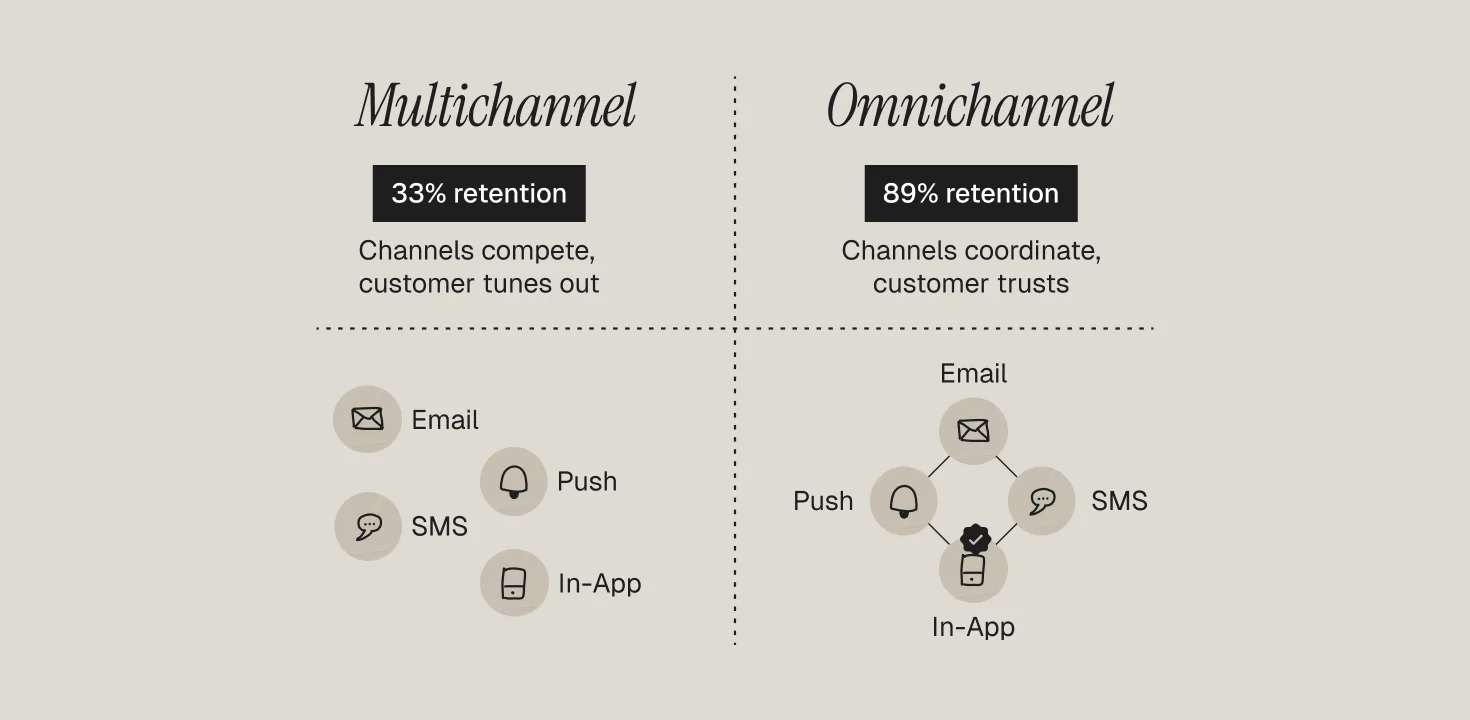
A multichannel brand sends a promo email Monday, a promo text Tuesday, and a push Wednesday, each from its own tool, each blind to the others. An omnichannel brand decides what the customer needs next and picks the cheapest channel that will land it.
Three tests tell you which one you are running. The suppression test: when a customer buys, do all channels stop selling that product immediately? The context test: does your SMS copy assume knowledge of the last email? The escalation test: do channels fire in sequence based on response, or all at once on a schedule? Fail two of three and you are multichannel with extra tools. Our guide to omnichannel orchestration goes deeper on the architecture.
Why omnichannel retention works: the 2026 numbers
The evidence for coordination compounds at every layer of the funnel. Campaigns using 3 or more channels earn a 287% higher purchase rate than single-channel campaigns, and multi-channel campaigns generate a 494% higher order rate (0.83% vs 0.14%). Retention specifically runs 90% higher for omnichannel campaigns than single-channel, and omnichannel shoppers carry roughly 30% higher lifetime value than single-channel customers.
Why does coordination outperform volume? Because retention is a trust game, and inconsistency is what breaks trust. A customer who gets a discount text for the product she bought yesterday learns your brand does not know her. Every incoherent touch trains customers to ignore you, which is why adding channels without adding memory usually lowers performance.
The 5 components of an omnichannel retention system
1. Unified customer profile
One record per human, holding purchases, channel engagement, preferences, and support history. This is the memory layer everything else reads from. It lives in your ESP or CDP; the tool matters less than the discipline of tracking behavioral events consistently.
2. Journey-level logic (not channel-level calendars)
Flows are designed around customer states (new, active, at-risk, lapsed) with channels assigned inside the journey. The replenishment journey might open with email, escalate to SMS on non-response, and finish with a push. Our playbook on personalized campaigns across email, SMS, and push shows the pattern in detail.
3. Cross-channel suppression and frequency capping
The unglamorous 20% that delivers 80% of the trust: global frequency caps, purchase-triggered suppression, and quiet hours enforced across every channel from one place.
4. Channel-role assignment
Each channel gets a job description. Email carries depth and lifecycle weight. SMS carries urgency (campaigns that involve SMS convert 47.7% more often). Push carries immediacy for app users. Support carries save-moments. When channels have roles, adding a channel adds coverage; when they do not, it adds noise. See how to integrate email and SMS for the highest-leverage pairing.
5. Measurement at the customer level
Omnichannel retention is measured in cohort retention curves, repeat purchase rate, and LTV by channel-mix, not in per-channel open rates. A channel that looks mediocre alone (like direct mail) can be the piece that lifts the whole cohort.
How to start: the first 90 days
Days 1 to 30: consolidate. Get email and SMS into one platform (or one suppression brain), define your customer states, and instrument the events that mark them. Days 31 to 60: rebuild your top three revenue journeys (welcome, post-purchase, winback) as cross-channel sequences with escalation logic. Days 61 to 90: add frequency caps, run the suppression test, and stand up cohort-level reporting. The right automation tooling makes this a configuration project, not an engineering project.
Brands that get this right feel different to their customers within a quarter: fewer messages, better timed, each one aware of the last. That feeling is the retention, as we argue in why omnichannel orchestration matters.
How Propel builds omnichannel retention
At Propel, omnichannel retention is the core of our lifecycle marketing services: unified profiles, journey architecture, and channel orchestration on Klaviyo, Customer.io, and Braze, run as an operating cadence rather than a one-time setup. The customer experience gains show up in the retention curve within two quarters.
Frequently Asked Questions
What is omnichannel retention in simple terms?
It is keeping customers by making all your channels act like one salesperson with one memory, instead of five strangers with five scripts. Every message knows what the customer bought, what they ignored, and what was said last, regardless of which channel said it.
How is omnichannel retention different from multichannel marketing?
Multichannel means being present on many channels; omnichannel means those channels share data and logic. The practical test: in a multichannel setup, buying a product does not stop the SMS promoting it; in an omnichannel setup, it does, instantly and everywhere.
What results can brands expect from omnichannel retention?
Benchmarks consistently favor coordination: 89% average retention for strong omnichannel companies vs 33% for weak ones, 287% higher purchase rates for 3+ channel campaigns, and roughly 30% higher lifetime value from omnichannel shoppers.
What channels belong in an omnichannel retention strategy?
Start with the owned channels: email, SMS, push, and in-app if you have an app. Layer in loyalty, direct mail, and support interactions as your profile data matures. The order matters less than the rule: no channel joins the mix until it can read and write the shared customer profile.
What tools do you need for omnichannel retention?
A platform that can hold the unified profile and orchestrate journeys across channels: Klaviyo for ecommerce-centric brands, Customer.io or Braze when app and web logic get complex. Add a CDP only when multiple storefronts or products fragment your identity data.
