.webp)
Summarize this documentation using AI
HelloFresh retains customers by making skipping easier than cancelling, by pushing menu personalization and add-ons that lift average order value (EUR 71.0 in Q2 2026, up 6.5%), and by deliberately shifting spend from discounted acquisition to tenured cohorts, which now generate 34% of meal-kit revenue. Retention, not new-customer volume, is the growth lever it is betting on.
That bet was forced. Meal kits are one of the hardest subscription categories to retain: the product asks for planning, cooking time, and a weekly decision. HelloFresh grew to 7.07 million active customers by Q3 2023 on the back of aggressive discounting, then spent 2024 to 2026 unwinding the retention cost of that model. Group orders fell from 114.6 million in FY2024 to 100.5 million in FY2025, yet AEBITDA rose 14% to EUR 422.8 million.
This is Brand Teardown #7 in the series. As with our Hims & Hers teardown, we walk the six lifecycle stages, pull the numbers from HelloFresh's own reports and earnings calls, and translate each mechanic into something a DTC or subscription operator can build.
Why HelloFresh Is a Retention Case Study Worth Studying
Most teardowns pick a brand at its peak. HelloFresh is more useful because it is mid-turnaround: a EUR 6.8 billion revenue business (FY2025) that has said publicly its old growth engine, discount-led acquisition, no longer pays back, and is rebuilding around retention economics in the open. Three facts frame the study:
- The category churns. HelloFresh reported 7.07 million active customers and 27.99 million orders in Q3 2023, roughly 3.96 orders per active customer per quarter. HelloFresh stopped headlining active customers after 2023 and now reports orders, AOV, and tenure instead, which tells you what management actually optimizes.
- The mix is shifting. Meal kits produced EUR 4.70 billion in FY2025 (down 15%), while ready-to-eat (Factor and siblings) produced EUR 1.92 billion (down 5.4%) and now runs at roughly 30% of Q2 2026 group revenue. Ready-to-eat removes the cooking step, the biggest churn driver in the meal-kit model.
- Tenured cohorts carry the P&L. By Q4 2025, a majority of orders came from customers who had already ordered 50+ boxes. Meal-kit customers with 4+ years of tenure went from 7% of H1 2023 net revenue to 34% in H1 2026.
If your subscription product requires effort (fitness, nutrition, GLP-1 programs, learning), HelloFresh is the closest public analog you will find. Our subscription retention strategies guide covers the framework; this piece shows it applied at scale.
Stage 1: Awareness, Owning "What's for Dinner" Before the Sale
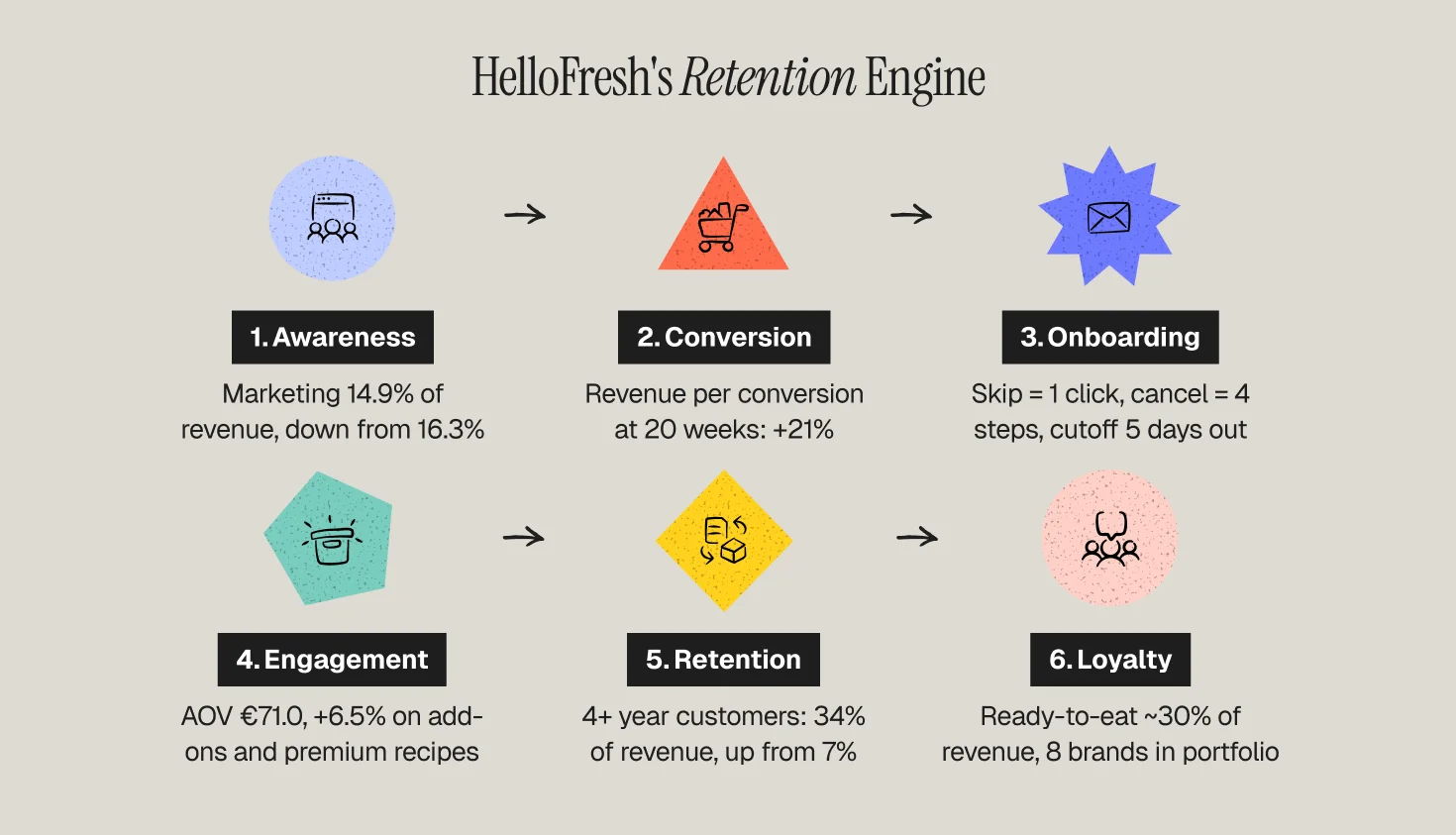
HelloFresh's top of funnel has always been loud: TV, podcasts, influencer codes, referral boxes. What changed in 2025 and 2026 is the discipline. Group marketing spend fell to 14.9% of revenue in Q2 2026 from 16.3% a year earlier, a EUR 45.2 million reduction, and management said it did not want to acquire customers at costs it could not confidently underwrite. Two newer plays are retention-first in design:
- A free product layer. In June 2026 HelloFresh launched Cookbook and Discover globally, free app features that let anyone save recipes from TikTok, Instagram, or a handwritten card and get a personalized recipe feed. Over 1 million recipes were saved within weeks. This creates a relationship (and first-party preference data) with people who have not subscribed, and keeps paused customers inside the app.
- Intent-rich placements. HelloFresh and Factor joined OpenAI's ChatGPT ad pilot in February 2026, targeting intent-rich and highly contextual moments rather than broad reach.
The lesson: awareness that captures a preference signal (a saved recipe, a stated diet) is worth more than awareness that captures a coupon click, because the signal survives the first cancellation.
Stage 2: Conversion, The Discount That Buys the Wrong Customer
HelloFresh's public offers have long spread free meals across the first several boxes plus free shipping on box one. That structure was designed to get customers past the "one and done" trap by rewarding box two, three, and four. It also created a well-known problem: a large pool of deal-seekers who cancel when the discount ladder ends.
You can see the retention cost in the numbers. Orders fell 12.3% in FY2025 and another 13.7% year over year in Q2 2026 as HelloFresh cut promotional acquisition. Yet AOV rose to EUR 71.0 (up 6.5%), order rate rose 4.1% in H1 2026, and net revenue per active customer grew about 10%. Fewer, better customers.
Management put a number on the improvement in cohort quality: cumulative net revenue per conversion after 20 weeks was 21% higher for H2 2025 cohorts than H2 2023 cohorts. That is the metric a retention team should own at conversion, not first-box CAC. If your finance team still reports blended CAC against blended LTV, our piece on CAC vs LTV explains why the ratio hides exactly this problem.
Stage 3: Onboarding, The First Box and the Skip Button
The meal-kit first-box experience is a physical onboarding flow: the box arrives, the recipe cards are the "getting started guide," and the app pings you to rate the meals. HelloFresh gets three things right in the first 30 days.
Menu selection before the box ships
New customers pick from a weekly menu and can set dietary preferences that shape recommendations. Every rating fed back into the app narrows the next week's suggestions. The onboarding job is not "cook this," it is "tell us what you like," which is the data the whole retention engine runs on.
Skip and pause are one click; cancel is four
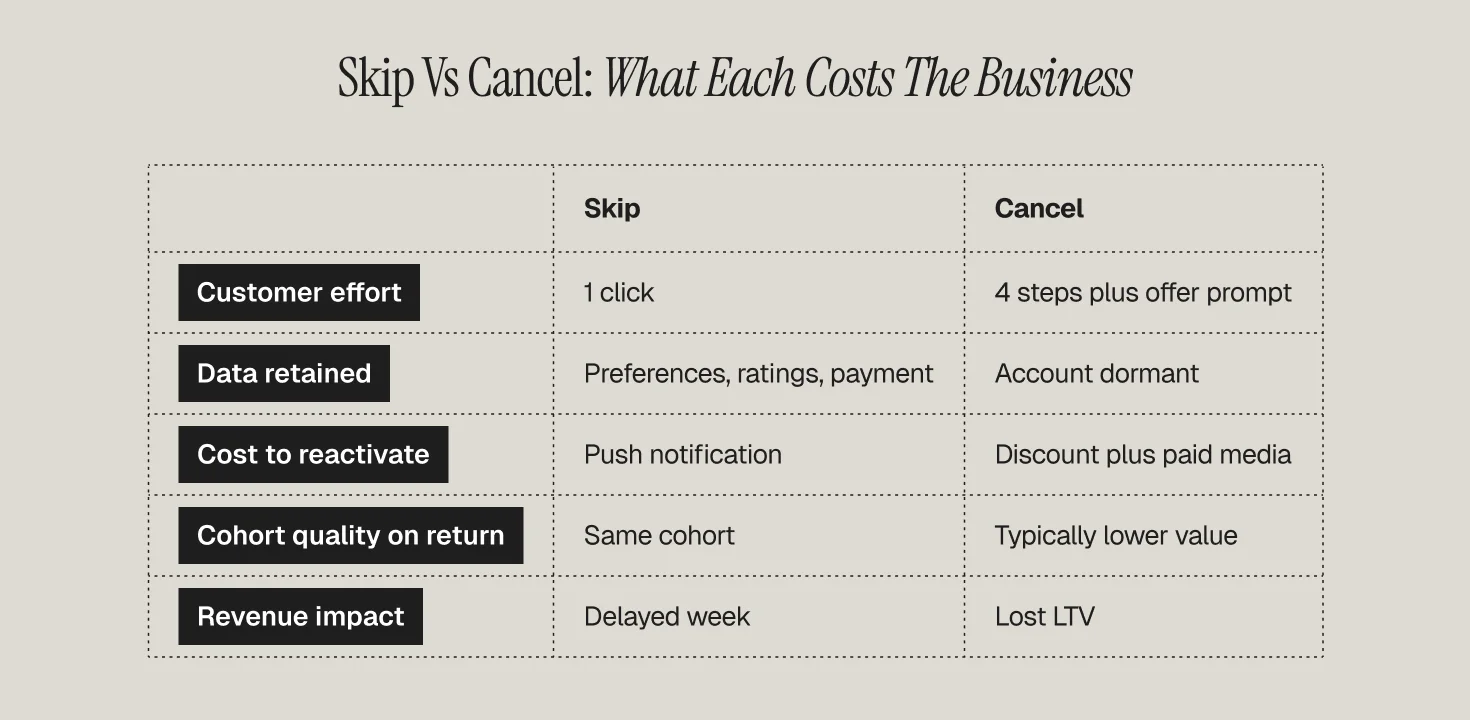
HelloFresh's own help page describes skipping a week from the "My Menu" screen and pausing whether you'll be out of town or simply want a break, while cancelling requires four steps through Account Settings and a "We're sorry to hear you want to cancel" prompt with new offers. Both must be done by 11:59 pm PST five days before delivery.
That asymmetry is the core retention mechanic. A skipped week keeps the customer, their preferences, and their payment method inside the system. Every skip is a chance to win the next week; every cancel is a win-back campaign.
Setting the cadence early
A fixed, communicated cutoff lets the app send predictable "menu closes soon" nudges: a habit loop by design. We apply the same principle to digital products in reducing churn with better onboarding.
Stage 4: Engagement, Personalization, Add-Ons, and the Market
Once a customer is past the first month, HelloFresh's job is to make each weekly decision easier and each box bigger.
Menu breadth as a churn tool
"The Refresh," launched in summer 2025 and described by the company as the largest product investment in its history, doubled the number of recipes in some markets and upgraded ingredient quality. On the Q2 2026 call, management said markets further along in the rollout show higher order rates and lower churn, with the effect strongest in early-adopter markets like the US and the Nordics. Menu variety directly attacks the number one stated reason meal-kit subscribers leave: boredom.
Add-ons and HelloFresh Market
Q2 2026 AOV growth was driven by add-ons, premium recipes and some pricing increases. HelloFresh Market, reachable in the app, sells sides, desserts, proteins, and pantry items into the same delivery. This is classic basket expansion, but it also raises switching costs: the box replaces more of the grocery trip, so cancelling costs the customer more convenience.
The app as the engagement surface
The app is where customers rate meals, edit orders, browse the Market, and now save external recipes with Cookbook. The more food planning lives there, the more behavioral data feeds recommendations, and the more natural the weekly nudge feels. For turning those signals into automated journeys, see behavioral triggers in retention marketing.
Stage 5: Retention, Skip vs Cancel, Win-Back, and Cohort Economics
Skip vs cancel economics
A customer who skips four weeks in a row costs almost nothing to keep and can be reactivated with one push notification about next week's menu. A cancelled customer needs a discount to return, and returns as a lower-quality cohort. HelloFresh's product decisions consistently push toward "skip" and away from "cancel."
Win-back with restraint
HelloFresh runs win-back offers, but the 2025 to 2026 strategy is explicit about not buying back low-value cohorts. Reuters reported in March 2025 that the company would prioritize high value customers over volume while cutting marketing, and Q2 2026 commentary repeated that it holds strict marketing-return thresholds. A win-back that costs more than the re-subscribed margin is churn with extra steps. Our win-back email flow playbook covers tiering offers by prior value.
Cohort behavior in the numbers
- FY2025 orders: 100.53 million, down 12.3%; meals delivered 851.6 million, down 11.8%.
- Q2 2026 orders: 21.8 million versus 25.3 million a year earlier, yet order rate up 4.1% and AOV up 6.5%.
- H1 2026: net revenue per active customer up about 10% in constant currency.
- Long-tenured ready-to-eat customers (2+ years) represented 20% of H1 2026 revenue.
Read those together and you get the retention story: HelloFresh shrank the top of the cohort curve on purpose and steepened the tail. That only works if you measure cohorts, not blended averages, which is why we push cohort LTV over blended LTV for every subscription client.
What the company says about retention
The Q1 2026 release states that high value customer cohorts demonstrate improved retention and higher ordering frequency after experiencing the new product. CEO Dominik Richter in Q2 2026 said the company's product work is clearly landing with customers who know it best, with order rates and basket sizes moving in the right direction. Management also flagged that HelloFresh Unboxed and the free Cookbook keep non-subscribers engaged, a soft win-back channel that costs no discount.
Stage 6: Loyalty, Portfolio, Factor, and Loyalty Mechanics
HelloFresh does not run a points program in the Starbucks sense. Its loyalty system is structural: a portfolio of brands that lets a customer change effort level without leaving the group.
The portfolio as a retention ladder
HelloFresh Group lists HelloFresh, Green Chef, EveryPlate, Chefs Plate, Factor, Youfoodz, The Pets Table, and Good Chop. Price-sensitive customers can move to EveryPlate; health-focused customers to Green Chef; time-poor customers to Factor. The customer's churn from one brand can be another brand's acquisition, at near-zero CAC if the group owns the data and the messaging.
Factor and the ready-to-eat bet
Factor's menu lists 100+ dietitian-designed meals and add-on options each week, with named tracks including GLP-1, Mediterranean, and High Protein. Ready-to-eat removes the cooking step, and the group has kept expanding it (Factor Europe production opened in early 2026, and the "Other" segment, which includes Factor expansion and pet food, grew 36.1% in Q2 2026). Ready-to-eat still runs a thinner margin (3.0% AEBITDA in Q2 2026 versus 15.1% for meal kits), so this is a retention-first, margin-later bet.
Loyalty mechanics that actually exist
- Referral boxes that give both sides free meals, turning loyal customers into a low-CAC channel.
- Tenure benefits in the product, not in points: better recommendations, saved favorites, and premium recipe access improve with usage.
- Free tools for lapsed customers. Cookbook and Discover keep a paused or cancelled customer inside the app ecosystem, which is a loyalty mechanic in everything but name.
For the formal side of this, our explainer on what a loyalty program is contrasts points-based and structural loyalty.
What You Can Learn From HelloFresh's Retention Playbook
- Report revenue per conversion at 10 and 20 weeks, not first-order CAC. HelloFresh reoriented marketing around this metric and stopped buying discount cohorts. Any subscription brand can build the same dashboard in a week.
- Engineer the skip. Make pausing one click, cancelling a guided flow with a save offer, and communicate cutoffs so predictably that your reminders feel like a service.
- Grow the basket to grow retention. Add-ons and premium SKUs raised AOV 6.5% and raised switching costs at the same time.
- Give effort-heavy customers a lower-effort SKU. Factor is HelloFresh's answer to "I love the food but I stopped cooking." Most subscription brands have an equivalent they never build.
- Keep lapsed customers in the ecosystem for free. A free app layer costs less than a win-back discount and preserves data.
How Propel Builds Retention Systems Like This
Propel is a Platinum Customer.io partner that builds lifecycle and retention systems for DTC, subscription, and health brands. For a subscription-box or meal-delivery client, the HelloFresh teardown becomes a build list: a cohort-quality dashboard, a skip-first cancel flow with tiered save offers, menu-closing and delivery-cutoff nudges triggered off account state, add-on cross-sell journeys keyed to rating data, and a win-back program that spends by prior cohort value instead of blanket 50% off.
We run these programs end to end through our retention marketing services and lifecycle marketing services, and we have a dedicated playbook for DTC subscription box growth.
Frequently Asked Questions
What is HelloFresh's customer retention rate?
HelloFresh does not publish a retention or churn rate. It reports proxies: order rate (up 4.1% in H1 2026), average order value (EUR 71.0 in Q2 2026), and tenure mix. Meal-kit customers with 4+ years of tenure produced 34% of H1 2026 net revenue, up from 7% in H1 2023, and by Q4 2025 most orders came from customers with 50+ prior boxes.
How many active customers does HelloFresh have?
The last headline figure HelloFresh reported was 7.07 million active customers in Q3 2023, with 27.99 million orders that quarter. Since then the company has emphasized orders, AOV, and net revenue per active customer instead. Orders were 100.53 million in FY2025 and 21.8 million in Q2 2026, both down year over year.
Why does HelloFresh make it easier to skip than to cancel?
Skipping keeps the customer's account, preferences, ratings, and payment method live, so reactivation costs a push notification about next week's menu. Cancelling forces a discount-led win-back and usually returns a lower-value cohort. HelloFresh's help center describes one-click skipping versus a four-step cancel flow with a save offer.
What is Factor and why does it matter for HelloFresh's retention?
Factor is HelloFresh Group's ready-to-eat brand, offering 100+ dietitian-designed meals a week with GLP-1, Mediterranean, and High Protein tracks. It removes the cooking step, the biggest reason meal-kit subscribers lapse, and gives the group a place to move customers who like the food but stop cooking.
What can DTC and subscription brands copy from HelloFresh?
Four things: measure cohort revenue per conversion at 10 and 20 weeks instead of first-order CAC; design a skip-first pause flow with a guided cancel; grow basket size with add-ons that also raise switching costs; and offer a lower-effort SKU or plan for customers who churn on effort rather than price.
