
Summarize this documentation using AI
Noom sells the least sticky product in consumer tech: behavior change. Diets get abandoned, streaks break, and weight loss apps are deleted faster than almost any other category. Yet Noom built a business that reached $1B in ARR with roughly 1.5 million paying subscribers, reports D30 engagement retention of 40%, which it calls 10x the average health app, and, when the GLP-1 wave threatened to make willpower-based weight loss obsolete, grew a medication companion business to a $100M run-rate within four months of launch.
This teardown breaks down how Noom retains customers across every stage of the lifecycle marketing funnel, and what its GLP-1 pivot teaches every subscription brand about surviving a platform shift. It pairs well with our Hims & Hers retention teardown, the other side of the same GLP-1 disruption story.
Why Noom Is a Retention Case Study Worth Studying
Most apps fight churn with notifications. Noom fights it with curriculum. The product is structured as a psychology course (daily lessons, a coach, food logging) which means every day of use deepens sunk investment in a way passive content cannot. And the model has been stress-tested: category disruption by GLP-1 drugs, layoffs and a resource shift into the medication business in late 2025, and brutal competition from Hims & Hers and WeightWatchers. Noom and WeightWatchers together still account for roughly 60% of global weight loss app revenue.
Stage 1: Awareness, Selling Psychology Instead of Weight Loss
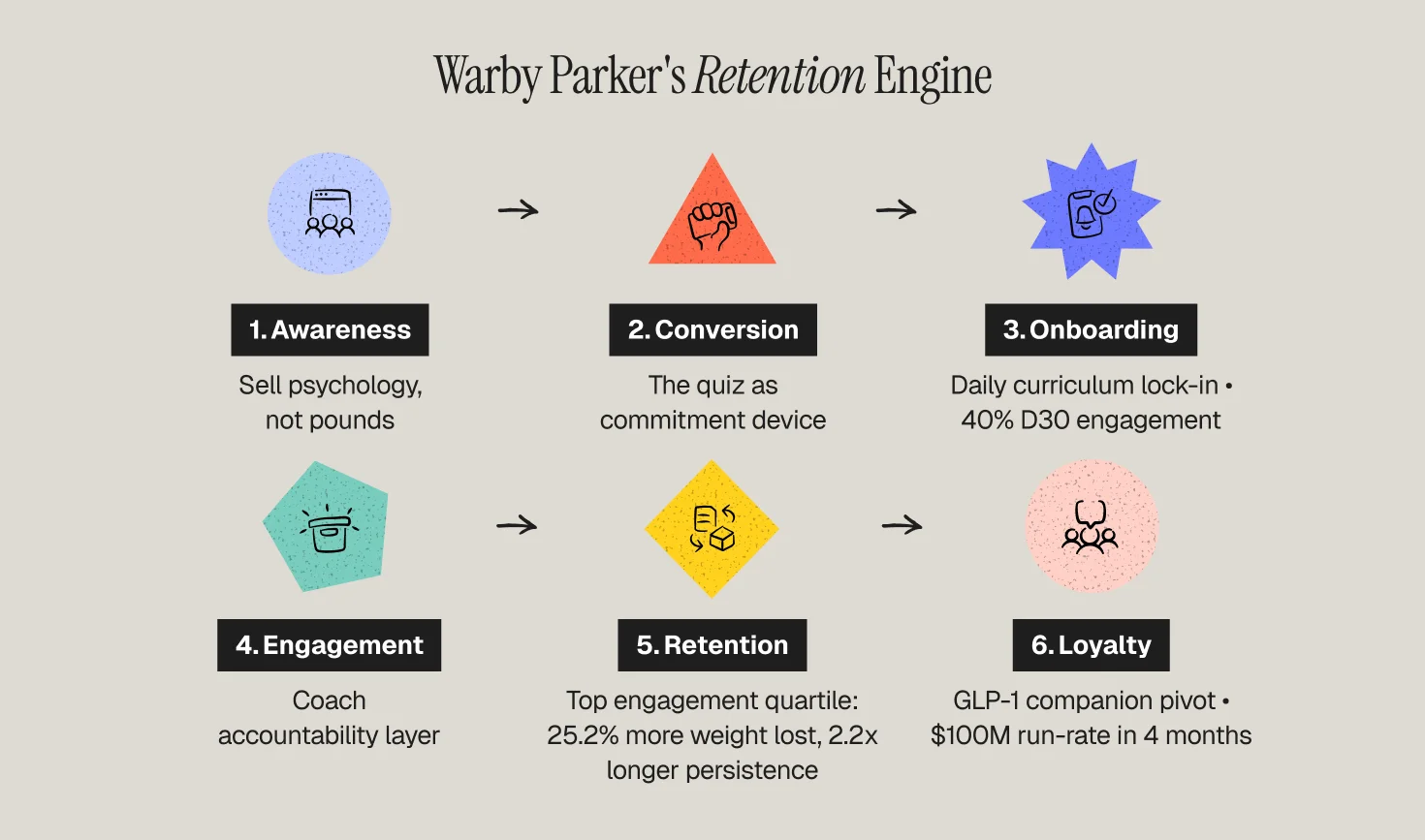
Noom's brand promise ("stop dieting, learn psychology") pre-selects customers who have already failed at outcome-driven programs. That framing does double duty for retention: a customer who buys a learning journey expects a slower curve and churns less when week two results are modest. The lesson for any brand: what you promise in the ad is the retention expectation you will live with in month three, a dynamic we cover in customer retention strategies that work.
Stage 2: Conversion, The Quiz as Commitment Device
Noom's long onboarding quiz is famous (and famously long) because it is not really a signup form. It is a commitment device: by the time a user has answered dozens of questions about habits, motivation, and psychology, they have co-authored their own plan. Self-designed plans are harder to abandon than assigned ones. The trial-to-paid flow then anchors on a personalized timeline ("reach your goal by March"), converting a vague wish into a dated contract with yourself.
Stage 3: Onboarding, The Curriculum Lock-In
Where most apps onboard with feature tours, Noom onboards with a syllabus: short daily psychology lessons that create a course-progress effect. Miss a day and you are behind on something, and being behind is a return trigger. This is textbook habit-loop design: cue (daily lesson unlock), routine (10 minutes of reading plus logging), reward (progress percentage and streak).
The numbers suggest it works: Noom reports 40% D30 engagement retention in a category where day-30 retention for the average health app sits in the single digits.
Stage 4: Engagement, Coaches and the Accountability Layer
Noom layers human accountability on top of the curriculum: goal specialists, group check-ins, and message-based coaching. The retention logic is simple: it is easy to quit an app, harder to quit a person. Even after Noom cut large parts of its human coaching team and shifted toward AI-assisted coaching, the design principle survived: someone (or something) notices when you disappear, and says so.
Stage 5: Retention Economics, Engagement Predicts Everything
Noom's own data makes the engagement-retention link explicit. In its February 2026 Engagement Report, analyzing 30,000+ GLP-1 program members, the most-engaged quartile lost 25.2% more weight at week 40 and persisted 2.2x longer on their medication program than the least-engaged quartile. Engagement is not a vanity metric here; it is the retention mechanism itself, which is why identifying users about to churn by engagement decay is the highest-leverage flow any subscription app can build.
Stage 6: Loyalty, The GLP-1 Pivot
GLP-1 drugs could have killed Noom: why learn portion psychology when a weekly injection suppresses appetite? Instead, Noom repositioned behavior change as the retention layer for the medication itself. It launched Noom GLP-1Rx at $149 a month with an industry-first taper-off guarantee, explicitly targeting the two biggest real-world GLP-1 problems: poor persistence and muscle loss. The business hit a $100M run-rate within four months, Noom users on GLP-1s lose 1.4x more weight than medication alone, and in June 2026 Noom released a free GLP-1 Companion to make its behavior layer the default across the whole category.
The strategic lesson mirrors what we found in the Hims & Hers teardown: when disruption hits, the brands that survive are the ones whose retention was built on relationship and habit, not on product exclusivity. This is the core argument of subscription retention strategy: own the behavior, and you can swap the product underneath it.
What You Can Learn From Noom's Retention Playbook
Structure beats content. A curriculum with progress states retains better than a library of the same material. If your product has content, give it sequence, streaks, and completion.
Make the customer co-author the plan. Effort invested during onboarding converts directly into switching cost. The quiz is not friction; it is the moat.
Instrument engagement as your leading churn indicator. Noom's quartile data shows engagement predicts both outcomes and persistence. Score it weekly and trigger interventions on decay, not on cancellation.
When disruption comes, retain the behavior and swap the product. Noom survived GLP-1 by becoming the medication's companion instead of its competitor, the same move that saved Hims & Hers.
How Propel Builds Retention Systems Like This
At Propel, we build retention and lifecycle programs for health, wellness, and consumer subscription brands, including the fitness and weight loss app playbook Noom's category runs on: habit-loop design, engagement scoring, churn-risk flows, and the GLP-1 patient retention programs now reshaping health brands.
Frequently Asked Questions
What is Noom's customer retention strategy?
Noom retains customers by structuring weight loss as a psychology curriculum: daily lessons, streaks, and coach accountability that build habit and sunk investment. Its reported 40% D30 engagement retention far exceeds typical health app benchmarks, and its own data ties engagement directly to persistence.
How big is Noom's business?
Sacra estimates Noom reached $1B in ARR with about 1.5 million paying subscribers, and together with WeightWatchers it accounts for roughly 60% of global weight loss app revenue. Its GLP-1 medication programs reached a $100M revenue run-rate within four months of their September 2024 launch.
How did GLP-1 drugs change Noom's retention model?
Instead of competing with medication, Noom repositioned as the behavior-change companion to it. Noom GLP-1Rx launched at $149 a month with a taper-off guarantee, and company data shows its most-engaged medication users persist 2.2x longer and lose 25.2% more weight than the least engaged.
What is the difference between Noom's and Hims & Hers' retention strategies?
Hims & Hers retains through clinical relationship and subscription convenience (medication, provider access, care team responsiveness), while Noom retains through behavioral structure (curriculum, streaks, coaching). Both survived GLP-1 disruption the same way: the retention asset was the relationship and habit, so the product underneath could change.
What can DTC and app brands copy from Noom?
Four moves: give your content a sequence with visible progress, make onboarding effortful enough to create ownership, score engagement weekly and intervene on decay, and design your program so the core habit survives even if your hero product gets disrupted.
