
Summarize this documentation using AI
Post-purchase experience optimization is the practice of treating everything that happens after checkout (order confirmation, shipping updates, delivery day, product onboarding, review requests, cross-sell, replenishment and support) as a revenue system rather than a fulfillment afterthought. For DTC brands, the goal is one number: a higher second-order rate inside the first 90 days.
Most DTC brands spend 80% of their lifecycle energy before the first purchase and treat the period after it as a courtesy. Meanwhile the highest-attention messages a brand ever sends (transactional and shipping emails) go out on default templates from Shopify or a shipping app, with no offer, no education and no next step.
This guide breaks the post-purchase flow into five stages, gives you the benchmarks that matter at each stage, and shows how to measure whether the work is actually moving repeat revenue.
Why the post-purchase window is the cheapest revenue you are not collecting
Bain's research on online customer loyalty found that repeat apparel customers spent 67% more per six-month period in months 31 to 36 than they did in their first six months, and that online apparel retailers needed roughly four purchases over 12 months just to break even on acquisition cost. Harvard Business Review's summary of the same body of retention research puts new customer acquisition at 5 to 25 times the cost of keeping an existing one.
The attention is already there. Shopify's own analysis of transactional email puts post-purchase emails at roughly 90% higher revenue per recipient than an average campaign, with open rates up to double those of promotional sends. Klaviyo's 2026 benchmarks show that automated flows produce 5.58% click rates versus 1.69% for campaigns and a 2.11% placed-order rate versus 0.16%. Flows generate about 41% of email revenue from 5.3% of sends.
So the math is simple. The messages people open most are the ones brands optimize least. If you want to understand where post-purchase sits inside the broader retention system, start with how to retain customers for DTC brands and the 90-day activation playbook.
The 5-stage post-purchase framework
We run every DTC post-purchase audit against the same five stages. Each has a job, a timing window and a metric. Skip a stage and the next one underperforms.
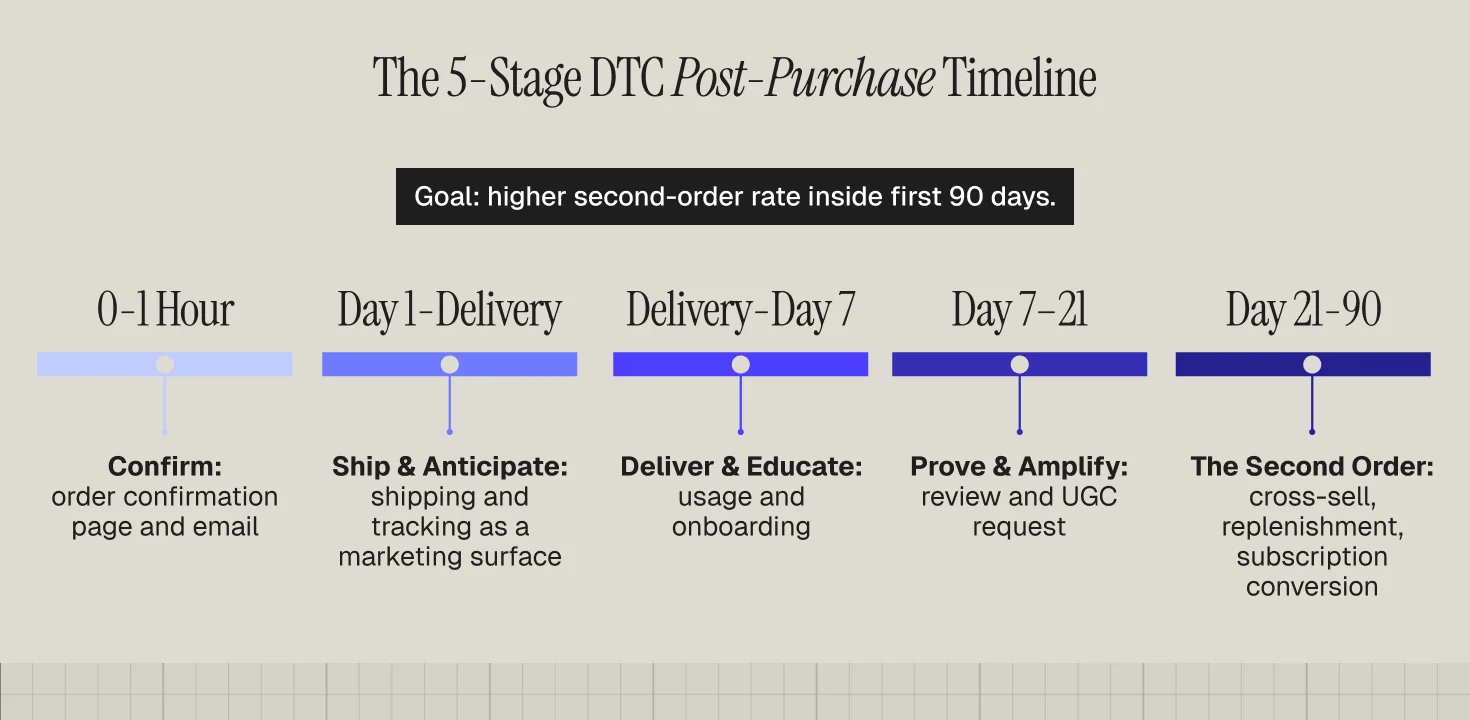
Stage 1: Confirm (0 to 1 hour)
The order confirmation page and email exist to remove doubt: what was bought, what it cost, when it will arrive, how to change or cancel. Get that right first. Then use the leftover attention.
Baymard Institute's checkout research describes the confirmation page as "too often a dead end for users" and recommends six additions: relevant cross-sell with an add-to-order button, newsletter or SMS opt-in, delayed account creation, informational resources tied to the product bought, app promotion and a single-question survey. Baymard found 42% of sites still force account creation before this step instead of after it.
Operator moves for the confirmation email:
- Put the delivery estimate and order summary above the fold. Nothing else earns a click until that is clear.
- Add one "while you wait" block: a getting-started guide, a sizing or care note, or a founder video. Education, not discount.
- Add one post-purchase upsell with a 1-hour add-to-order window. Keep it to one complementary SKU.
- Capture the missing data point you need for personalization: skin type, goal, household size, pet weight. This is your cheapest zero-party data source.
Stage 2: Ship and Anticipate (day 1 to delivery)
Shipping and tracking messages are the most-read emails a DTC brand sends, and almost nobody owns them. Shopify's research notes 60% of shoppers track their orders daily and 17% check more than once a day. Narvar's post-purchase benchmark, built on 125 million consumer interactions across 300+ retailers, found shoppers engage with tracking an average of 3.1 times per order and that marketing assets on branded tracking pages earn about 3x the click-through of email.
That is a marketing surface. Treat it like one:
- Bring shipping notifications into your ESP (Klaviyo, Customer.io, Braze) instead of leaving them in the carrier or shipping app. You need the events for triggers and the branding for trust.
- Use a branded tracking page, not the carrier's. Put the education content, the referral offer and the app download there.
- Message the anticipation, not just the status. "Your retinol ships tomorrow, here is the 3-night ramp plan" outperforms "Your order has shipped."
- Handle delays proactively. A "your package is late, here is what we did" message deflects the ticket and protects the review you will ask for in Stage 4.
Stage 3: Deliver and Educate (delivery day to day 7)
The delivery-day message and the first week decide whether the product gets used. A product that sits in the box does not get reordered. This is customer activation for physical goods: the first successful use is the activation event.
Build the sequence around the product's real usage curve:
- Delivery day: "It arrived. Do this first." One instruction, one photo or 20-second video.
- Day 2 to 3: the most common mistake or the fastest win. Supplements: take with food. Skincare: patch test and start every other night. Apparel: care instructions and fit exchange link.
- Day 5 to 7: expected results checkpoint. "Here is what most people notice by week one, and what takes longer." This resets expectations before disappointment turns into a return.
Two rules. First, education emails should not carry a discount. The moment you attach 15% off, the reader learns to skim for the code and ignore the content. Second, gate nothing. If a customer wants the full guide, link it, do not make them log in.
For subscription and consumable brands, this stage is also where you introduce the replenishment or subscribe-and-save option for the first time, softly. See what a replenishment flow is for the timing math.
Stage 4: Prove and Amplify (day 7 to day 21)
Ask for the review after the product has had a chance to work, and after the shipping problem (if any) has been resolved. PowerReviews' best-practice data puts the ideal ask at 14 days after delivery for soft goods like apparel and cosmetics, 21 days for hard goods, and 7 days for seasonal items, with one follow-up 7 days later. Their data also shows 80% of all reviews come from post-purchase emails and 68% of customers who leave a review do so after the first request.
What most brands get wrong here:
- Asking too early. A review request that lands before the delivery-day email is a review request about the shipping experience.
- Asking without segmentation. If your support system flagged a ticket, suppress the review ask until it is closed. Route unhappy customers to a private feedback form first, and happy ones to the public review.
- Asking with no incentive structure. Loyalty points for a photo review are legal and effective. Discounts for a positive review are neither.
- Not reusing the output. Photo and video reviews feed the next customer's Stage 3 emails.
The referral ask belongs here too. Bain found apparel shoppers referred 3.1 people after their first purchase and 7.1 after ten or more. The best window is right after the customer tells you the product worked.
Stage 5: The Second Order (day 21 to day 90)
Everything above exists to feed this stage. The second order is where DTC economics flip: acquisition cost is sunk, trust is established and the customer has a real reason to come back. Yet most brands run one generic "we miss you" at day 60 and call it a post-purchase flow.
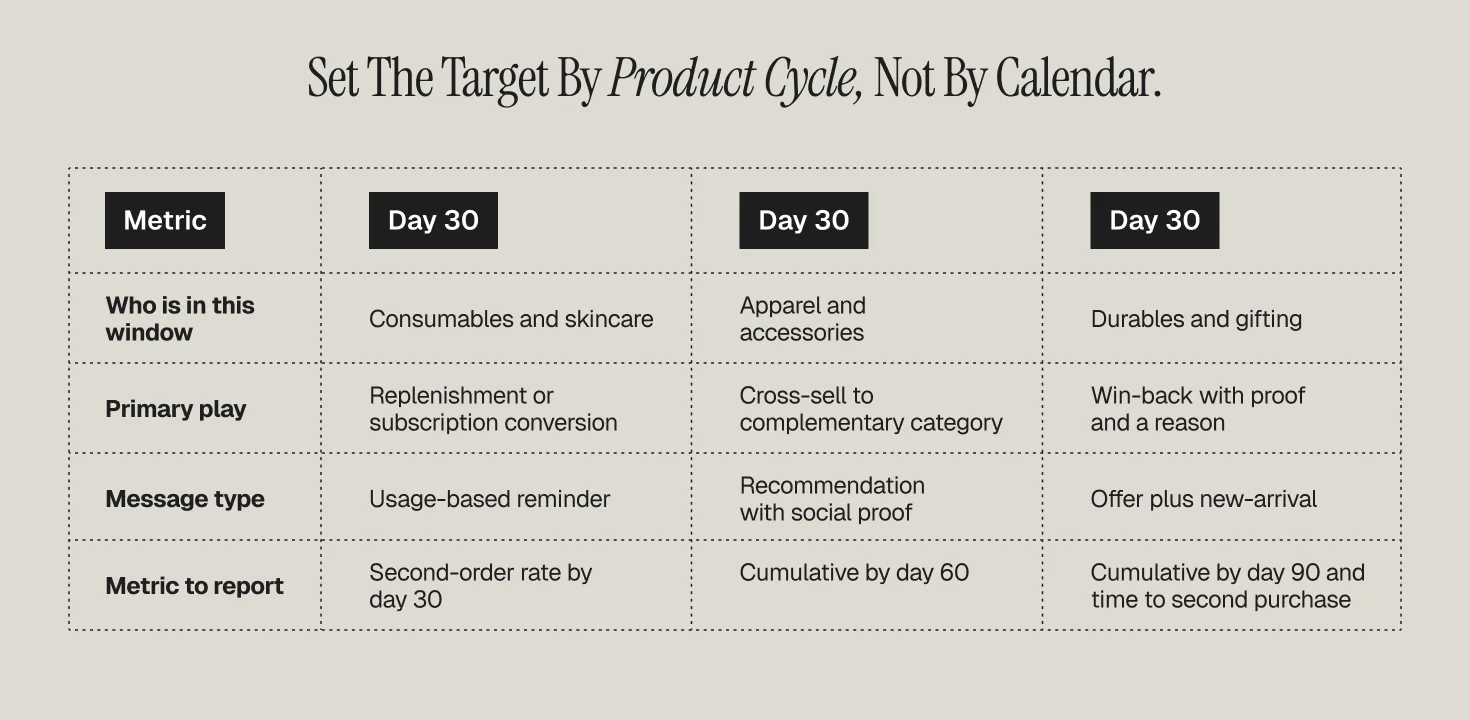
The 30/60/90 math works like this. Pull your last four quarterly cohorts and plot the share of first-time buyers who placed a second order by day 30, day 60 and day 90. Most DTC categories show the same shape: a fast early bump, a plateau, then a slow tail. Your job is to move the plateau up and pull the tail earlier.
Three plays, matched to the product:
Replenishment. For anything consumed, calculate days-of-supply per SKU and per quantity ordered, then trigger a reminder at roughly 80% of that window. Klaviyo's benchmark data shows top-decile flows reach revenue per recipient of $7.79 and click rates above 10%; replenishment flows are usually the ones that get there because timing does the work the offer would otherwise have to do.
Cross-sell. For non-consumables, the second order is usually a different product. Build the recommendation from what actually co-purchases in your order data, not what merchandising wants to push.
Subscription conversion. If you sell a consumable and the customer has reordered twice at a similar interval, the third message should be a subscription conversion with a real reason: locked price, free shipping, skip-any-time. The subscription retention strategies guide covers what happens after the conversion.
If day 90 passes with no second order, the customer leaves the post-purchase flow and enters the win-back flow. Do not blur the two. Post-purchase is optimism and education; win-back is diagnosis and a reason to return.
Support deflection is part of the post-purchase flow
Every "where is my order" ticket is a message the flow should have sent. Every "how do I use this" ticket is a Stage 3 email that did not exist. Audit your last 500 tickets by category and time since order. If 30% are WISMO in days 2 to 6, Stage 2 is broken. If returns cluster around day 10 with "did not work" as the reason, Stage 3 is broken.
Two cheap fixes: put the order status link and the top three FAQs for the purchased SKU into every transactional email, and add a one-tap "I have a question" reply path that routes to a human.
Benchmarks: what good looks like
Post-purchase benchmarks vary widely by category, so anchor to the flow-level numbers and your own cohorts. From Klaviyo's 2026 data, average automated flows land at 5.58% click and 2.11% placed-order rate, and top 10% flows reach 10.48% click and 4.3% placed-order rate. Transactional and shipping emails should sit well above campaign open rates.
Propel client benchmark, DTC consumables: a rebuilt five-stage flow typically moves day-90 second-order rate by 4 to 8 percentage points versus the default Shopify plus ESP setup, with most of the lift coming from Stage 3 education and Stage 5 timing rather than deeper discounts. Cross-check your numbers against the ecommerce email marketing benchmarks before you set targets.
How to measure post-purchase performance
Open and click rates tell you whether the message worked. They do not tell you whether the flow worked. Report these three metrics, always by acquisition cohort, using cohort analysis rather than blended totals:
- Second-order rate (30/60/90). Share of first-time buyers in a monthly cohort who placed a second order within 30, 60 and 90 days. This is the headline metric for the entire post-purchase system.
- Time to second purchase. Median days between order one and order two for the cohort. If your product cycle is 35 days and the median is 58, your Stage 5 timing is late.
- Repeat purchase rate. Share of all customers with two or more orders over a trailing 12 months.
Supporting diagnostics: WISMO tickets per 100 orders, review request conversion, subscription conversion rate from second reorder, and revenue per recipient by stage. Run holdouts on any change to Stage 5; it is the only way to prove the cross-sell was incremental rather than a discount handed to someone who would have bought anyway.
How Propel builds post-purchase systems for DTC brands
Propel designs and runs post-purchase flows inside Klaviyo, Customer.io and Braze for DTC, subscription and health brands. The work starts with a cohort audit, then a rebuild of all five stages with per-SKU timing, education content mapped to the product's usage curve, and holdout-tested Stage 5 plays. Reporting is by cohort, not by email.
If you want the full system, see our retention marketing services and lifecycle marketing services, or start with a 30-minute review of your current post-purchase flow.
Frequently Asked Questions
What is post-purchase experience optimization?
Post-purchase experience optimization is the deliberate design of every touchpoint after checkout: order confirmation, shipping and tracking, delivery-day education, product onboarding, review and referral requests, cross-sell, replenishment, subscription conversion and support. The objective is to raise the share of first-time buyers who place a second order, measured by cohort at 30, 60 and 90 days.
How many emails should a DTC post-purchase flow have?
Most DTC brands need 6 to 10 messages across the five stages, plus transactional emails: confirmation with one next step, one or two shipping and anticipation messages, two or three education emails in the first week, a review request with one follow-up, and two or three second-order messages timed to the product's cycle.
When should a DTC brand ask for a product review?
Ask after the product has had time to work and after any shipping issue is resolved. PowerReviews' data suggests about 14 days after delivery for apparel and cosmetics, 21 days for hard goods and 7 days for seasonal items, with one follow-up a week later.
What is a good second-order rate for DTC brands?
It depends on category and product cycle, so benchmark against your own cohorts first. Consumables should see a meaningful share of second orders by day 30 to 45; apparel and durables take longer and rely on cross-sell. Track second-order rate at day 30, 60 and 90 for each monthly cohort.
Should shipping notifications come from the ESP or the shipping app?
From your ESP wherever possible. Shipping and tracking messages are the most-opened emails a brand sends, and routing them through Klaviyo, Customer.io or Braze gives you branded templates, event data for triggers, and the ability to add education, referral and app prompts.
