Summarize this documentation using AI
Key Takeaways
- Care/of turned a five-minute health quiz into a personalization engine: by 2021 it said six million people had taken it, and that data shaped its product line.
- Its retention model stacked a recurring subscription, personalized daily packs and an app for logging intake, which made the habit, not the product, the thing customers kept.
- Bayer bought a 70% stake in 2020 at a $225 million valuation. In June 2024 the brand cancelled all subscriptions and laid off 143 employees after its funding ended.
- The lesson for supplement brands: personalization earns the first order, but retention has to survive a change of owner, channel and economics. Own the data, the habit loop and the unit economics separately.
Most retention teardowns study brands that are still winning. This one studies a brand that did many things right and still closed. Care/of was a poster child of the 2010s DTC wave: a personalized vitamin subscription built on a quiz, delivered in daily packs printed with the customer's name. It raised venture money quickly, sold a majority stake to one of the world's largest healthcare companies, and then, in the summer of 2024, stopped taking orders.
For supplement and subscription brands, the useful question is not "what went wrong" in the abstract. It is which parts of the retention model worked, and which dependencies outside the retention model ended it. Note that Care/of never published retention or churn figures, so this teardown works from public reporting and the visible customer experience rather than internal metrics.
The Care/of model in one paragraph
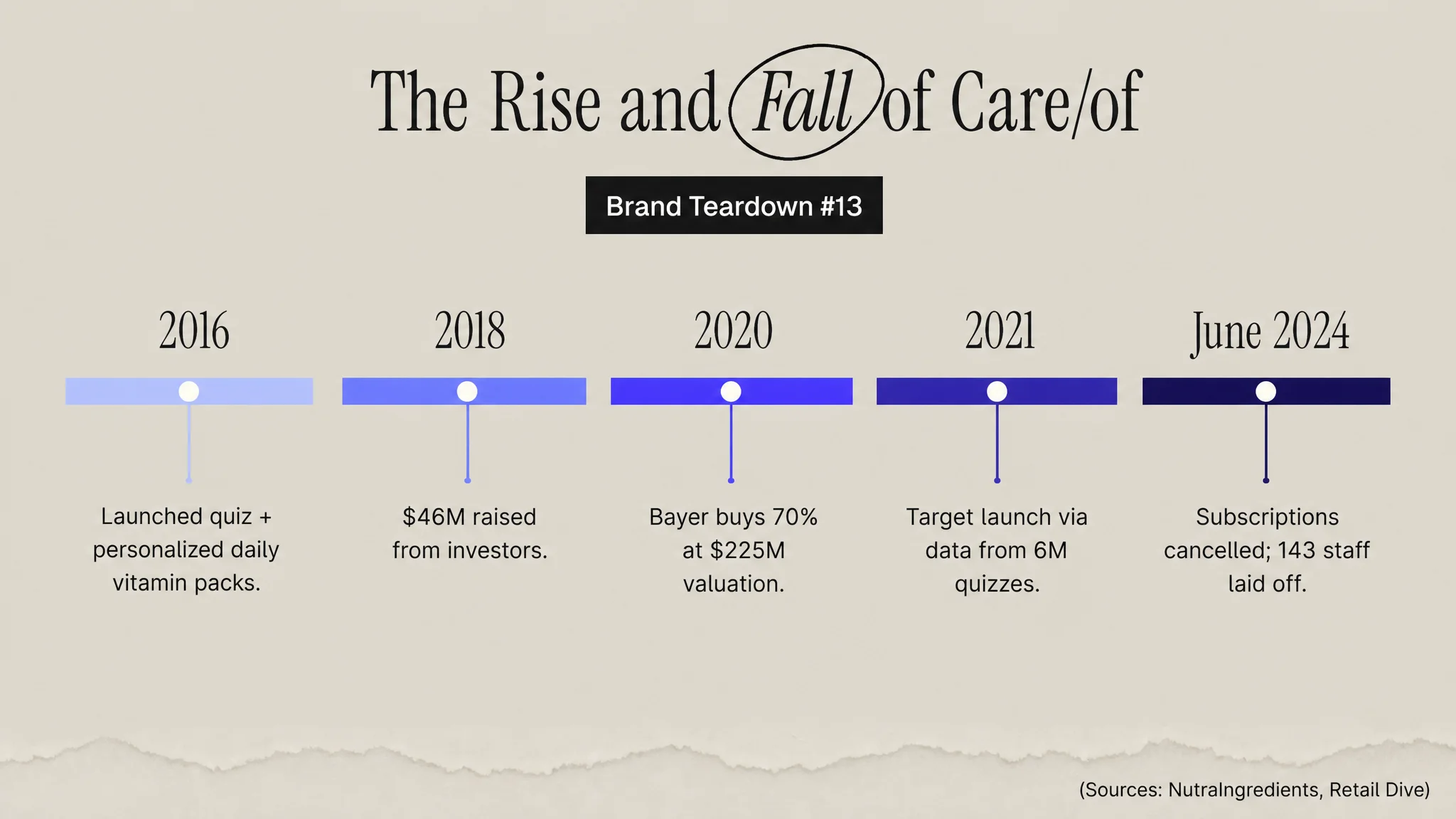
Founded in 2016 by Craig Elbert and Akash Shah, Care/of asked new visitors to take a short quiz about their age, diet, lifestyle and health goals, then recommended a set of vitamins and supplements. Customers subscribed to a monthly supply delivered as daily packets. The company raised $46 million by 2018, and in 2020 Bayer acquired a 70% stake at a $225 million valuation, according to NutraIngredients. In 2021 it launched its first retail range at Target.
What Care/of got right
1. The quiz was a data asset, not just a funnel step
Care/of made the quiz the front door. Modern Retail reported that five million people had taken the core quiz by February 2020, and that the company built extra quizzes as it expanded into new lines like beauty ingestibles. By the Target launch in 2021, Retail Dive reported the range was developed using data from six million quiz-takers.
That is zero-party data at scale: information customers volunteer in exchange for a better recommendation. It does three retention jobs at once. It makes the first box feel made for the customer, it gives the CRM team real segments (sleep, stress, energy, prenatal) instead of guesses, and it tells merchandising what to build next. McKinsey's research on personalization found 71% of consumers expect it and 76% get frustrated when it is missing. Care/of built the expectation into the product itself.
2. The pack made the habit visible
Daily packets with the customer's name turned a cupboard of bottles into one ritual a day. That matters because supplement churn is mostly habit churn: customers do not decide to stop, they forget, the bottles pile up, and the next renewal looks like waste. A pack per day makes progress visible and makes "too much product" less likely. Our guide to retention marketing for supplement brands covers why the first 30 to 60 days of habit formation decide most supplement LTV.
3. The app extended the relationship beyond the box
Care/of built a mobile app where customers could log intake, receive encouragement and read nutrition content. That gave the brand a reason to be present between shipments, which is where subscription relationships are usually won or lost. It is the same logic behind the habit loops we described in our Ritual retention teardown.
4. The data was the strategic prize
When Bayer invested, analysts pointed to the data. Kantar Consulting's Brian Owens told Modern Retail the deal gave Bayer "access to a lot more information about behavior, and from someone who is very loyal." For a retention team, that quote is the clearest proof that the quiz plus subscription model was producing something valuable: a loyal, well-understood customer base.
Why it still closed
None of the public reporting blames the retention model. The stated reasons sit elsewhere, and they are instructive precisely because a CRM team cannot fix them alone.
Funding and owner priorities
In its closure notice, the company said it "no longer" had "funding to operate in the way we have been," as reported by Retail Dive. Bayer said that ceasing investment would let it "better invest in future innovations that help people manage their personal health." All subscriptions were cancelled on June 17, 2024, and 143 employees were laid off effective July 3, 2024. A brand whose growth depended on a parent's continued investment lost that investment when the parent's priorities changed.
Category headwinds after the pandemic
NutraIngredients' financial analysis pointed to a post-pandemic dip in supplement demand, tighter venture funding, and reporting that Care/of's revenue was declining, though the size of the decline was not disclosed.
Retail diluted the differentiator
The same analysis quoted an industry observer who "didn't see its point of difference on the shelf." That is the core tension. Online, Care/of's advantage was the quiz and the personalized pack. On a Target shelf at $14.99 to $18.99, it was one more bottle of vitamins. Retail can be a great acquisition channel, but a personalization brand loses its personalization at the shelf unless the bottle routes the buyer back into the quiz and the subscription.
Five lessons for supplement and subscription brands
1. Put the quiz data to work in every flow, not just the first order
Use quiz answers to drive onboarding content, replenishment timing, cross-sell and win-back. A sleep-goal customer and an energy-goal customer should not receive the same day-21 email. Our explainer on replenishment flows shows how to time these.
2. Measure habit, not just renewals
Track early engagement signals like app logs, pack confirmations or content opens in the first 30 days, and trigger rescue journeys when they drop. Renewal rate tells you what already happened. Habit signals tell you what is about to happen. See our guide to churn prevention.
3. Give every retail buyer a path back to direct
If you sell in retail, design the packaging, inserts and QR codes to bring buyers into the quiz and a first-party relationship. Otherwise retail growth can quietly cannibalize the subscription base that made the brand distinctive.
4. Build retention economics that stand on their own
Know your contribution margin per subscriber, payback period and cohort LTV without assuming fresh capital. Our subscription retention matrix and subscription churn guide show how to read cohort health honestly.
5. Plan the customer exit, too
Care/of's founder emailed customers before the shutdown with a final discount window. Whatever happens to a brand, how it treats subscribers at the end shapes how the market remembers it. Clear cancellation, refund and data-handling communication is part of retention strategy, not an afterthought.
How Care/of compares with other subscription health brands
Ritual leaned on a narrower, transparent product line and a strong brand story. Hims and Hers pairs subscriptions with clinical care, which raises the switching cost. HelloFresh fights churn with flexible skips and pauses. Care/of's distinctive bet was personalization through data. It shows that personalization is a powerful acquisition and onboarding tool, but on its own it does not guarantee a business survives a change in funding, ownership or channel mix.
The bottom line
Care/of proved that a quiz, a personalized pack and a habit loop can build a loyal subscriber base valuable enough to attract a global healthcare company. It also proved that loyalty is not the same as resilience. Supplement brands should copy the data-driven personalization and the visible daily habit, then make sure the economics, the channel strategy and the first-party relationship can stand on their own.
Sources
- NutraIngredients: Care/of to close operations as parent company Bayer explores future innovations
- Retail Dive: Care/of is shutting down
- NutraIngredients: The rise and fall of Care/of, a financial perspective
- Modern Retail: What Care/of got right leading up to its acquisition by Bayer
- Retail Dive: Wellness brand Care/of to drop new vitamin line at Target
- NutraIngredients: Bayer buys majority stake in personalized vitamin startup Care/of
- McKinsey: The value of getting personalization right, or wrong, is multiplying
Frequently Asked Questions
What was Care/of?
Care/of was a direct-to-consumer vitamin and supplement brand founded in 2016 by Craig Elbert and Akash Shah. Customers took a short online quiz about their health goals and lifestyle, received personalized recommendations, and subscribed to a monthly supply delivered as daily packets. Bayer bought a 70% stake in 2020 at a $225 million valuation, and the brand launched a retail range at Target in 2021.
Why did Care/of shut down?
Care/of said it no longer had the funding to operate as it had been, and Bayer said it was ceasing investment to focus on other personal health innovations. Reporting also pointed to declining revenue, a post-pandemic slowdown in supplement demand, tighter venture funding and weak differentiation on retail shelves. All subscriptions were cancelled on June 17, 2024, and 143 employees were laid off.
What made Care/of's retention strategy effective?
Care/of combined a data-rich quiz, a recurring subscription, personalized daily packs and a companion app for logging intake. The quiz made the first order feel tailored and gave the brand real segments to message. The packs and app made the daily habit visible, which matters because most supplement churn comes from customers forgetting to take the product rather than actively deciding to stop.
What can supplement brands learn from Care/of?
Use quiz and zero-party data across every lifecycle flow, track early habit signals rather than only renewals, and give retail buyers a clear route back to a direct relationship. Most importantly, make sure subscription economics work without assuming fresh capital. Care/of shows that strong personalization builds loyalty, but a brand also needs sustainable margins and channel strategy to survive.
Did Care/of publish its retention or churn rates?
No. Care/of did not publicly disclose retention, churn or lifetime value figures, and closure reporting noted that revenue was declining without saying by how much. Any analysis of its retention model has to rely on public reporting about the quiz, subscription design, app and retail strategy, along with the brand's visible customer experience, rather than internal performance data.