Summarize this documentation using AI
Churn prevention is the practice of identifying and fixing the causes of customer loss before customers leave, using behavioral signals, proactive lifecycle communication, and friction removal, rather than trying to win them back after they are already gone. It is the opposite of a win-back campaign: instead of chasing a lapsed customer with a discount, you intervene while the relationship is still active and cheaper to save. The economics make the case on their own. Acquiring a new customer costs five to 25 times more than retaining one (HBR), and a large share of the churn brands accept as inevitable is actually preventable: roughly 53% of subscription attrition is involuntary, caused by failed payments rather than unhappy customers.
Key Takeaways
- Prevention beats recovery. Stopping churn before it happens is far cheaper than winning customers back, given acquisition costs 5 to 25x more than retention (HBR).
- Churn sends signals first. Slowing frequency, falling engagement, and missed refills flag risk early, which is why identifying users about to churn is step one.
- Much of it is involuntary and fixable. About 53% of subscription churn is involuntary (failed payments), recoverable with dunning.
- Onboarding is prevention. Better onboarding measurably reduces churn by getting customers to value before they drift.
- The payoff compounds. A 5% retention improvement can raise profits 25% to 95% (Bain & Company)
What Churn Prevention Is
Churn prevention is a proactive discipline: you monitor for the conditions that precede customer loss and you act on them before the customer decides to leave. It sits at the heart of retention marketing because every dollar of prevented churn is a dollar you do not have to spend re-acquiring. The mindset shift is from reactive to predictive. Most brands only learn a customer is unhappy when they cancel; a prevention program learns it weeks earlier, from behavior, and intervenes while the fix is still cheap.
Churn Prevention vs Win-Back
Prevention and win-back are complementary halves of the same problem, but prevention is the cheaper half. Win-back tries to reverse a decision that has already been made; prevention keeps the decision from being made at all. If your retention rate is slipping and you are not sure why, diagnosing the causes of a declining retention rate is a prevention exercise, whereas a win-back flow is what you run once prevention has failed. A healthy program invests in both, but weights prevention first because it protects margin.
The Early-Warning Signals
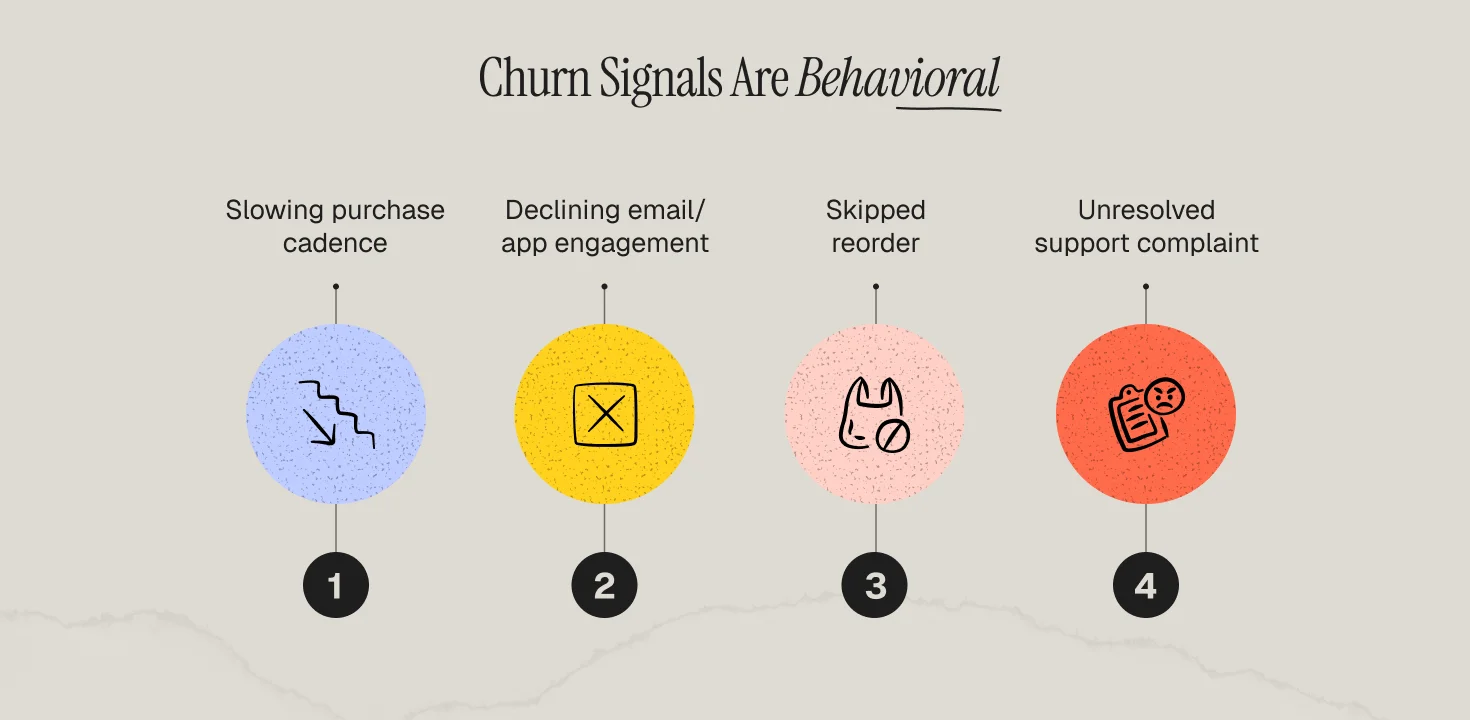
Customers rarely churn without warning; they decay. The signals are behavioral: a slowing purchase cadence, declining email or app engagement, a skipped reorder, a support complaint left unresolved. Catching these requires a system for identifying users who are about to churn, often expressed as a customer health score that rolls the signals into one number. The earlier you can see the decay, the cheaper and more effective the intervention.
Voluntary vs Involuntary Churn
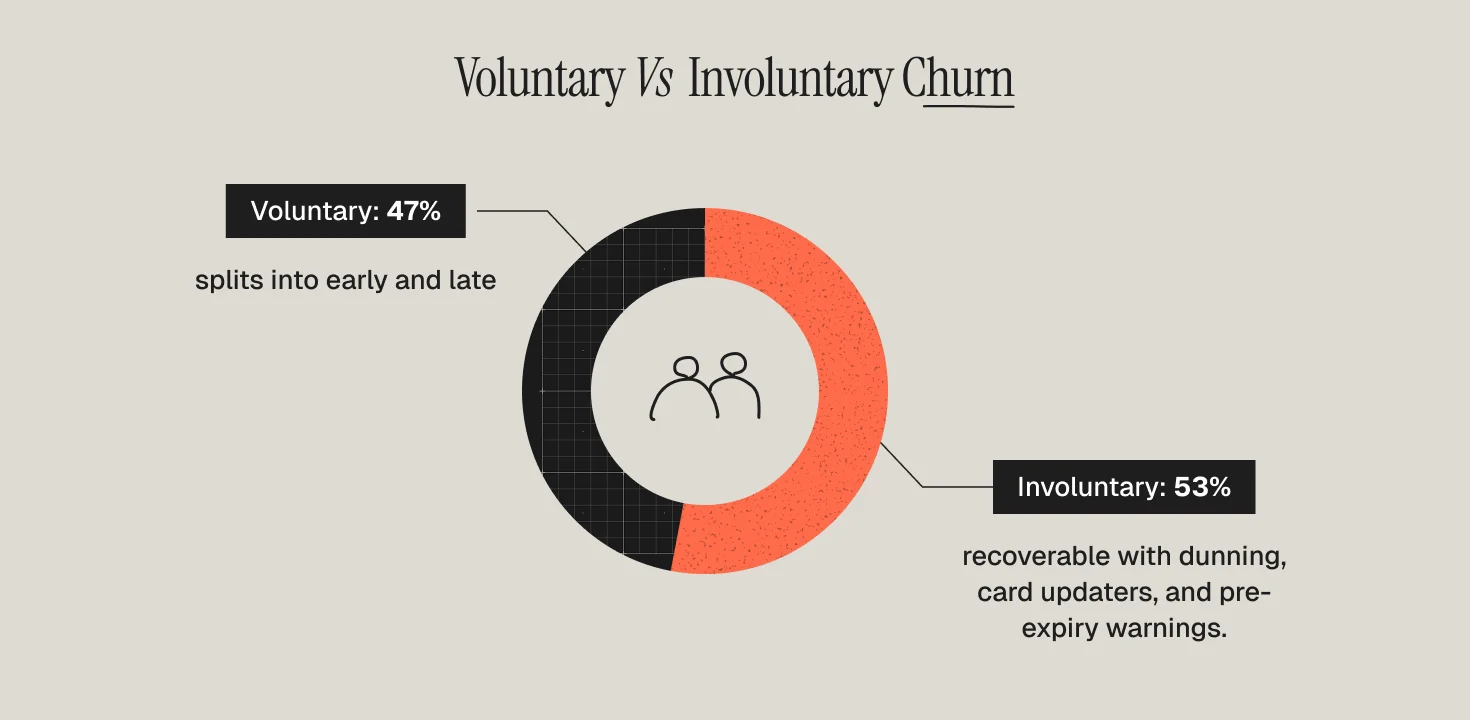
Not all churn is a customer choosing to leave. Involuntary churn (failed payments, expired cards) accounts for about 53% of subscription attrition, and it is the most preventable category of all, recoverable with dunning, card updaters, and pre-expiry warnings. Voluntary churn splits again into early (the customer never reached value, an activation problem) and late (fatigue or price). Getting the subscription churn calculation right is what lets you tell these apart and prevent each with the right tool.
The Churn-Prevention Playbook
A working program has four moves. First, instrument the signals so you can see risk early. Second, fix involuntary churn with payment recovery, usually the single biggest and cheapest win. Third, strengthen the early lifecycle so fewer customers churn before reaching value, primarily through better onboarding. Fourth, run targeted interventions on at-risk segments before they lapse. Done together, these moves are how brands reduce churn structurally rather than papering over it with discounts.
Frequently Asked Questions
What is churn prevention?
The proactive practice of finding and fixing the causes of customer loss (through behavioral signals, lifecycle communication, and friction removal) before customers actually leave, as opposed to winning them back afterward.
How is churn prevention different from a win-back campaign?
Prevention acts before the customer decides to leave; a win-back flow acts after they already have. Prevention is cheaper because it protects the relationship instead of trying to rebuild it.
What are the warning signs a customer is about to churn?
Slowing purchase frequency, declining engagement, skipped reorders, and unresolved complaints. A churn-risk system or health score surfaces these early.
Can you prevent involuntary churn?
Yes, and it is often the easiest win. Since about 53% of subscription churn is involuntary, dunning and card-updater tools recover customers who never intended to leave.
Why is churn prevention worth the investment?
Because acquiring a replacement customer costs 5 to 25x more than retention (HBR) and a 5% retention lift can raise profits 25% to 95% (Bain). Prevention protects both revenue and margin.
![Featured image: How to Identify Users Who Are About to Churn [2026 Guide for Retention Marketers]](https://cdn.prod.website-files.com/69bbf9f7f2a3f75341357ebc/69f4b4ad14f8c675169e0cba_69c7cec26de0e50005c6e495_698ae45b9ecbf9983380f731_6909f1e088d37bed0144f247_Identify%25252520User%25252520churn-2-min.png)