Summarize this documentation using AI
Key Takeaways
- Ritual sells a product with no felt effect into a category with a trust deficit, and built its entire retention system around closing that gap with evidence.
- The subscription is the default, not an upsell: $26.40 on the first order against $33.00 on renewal, free shipping for subscribers, and a 30-day cadence that matches actual consumption.
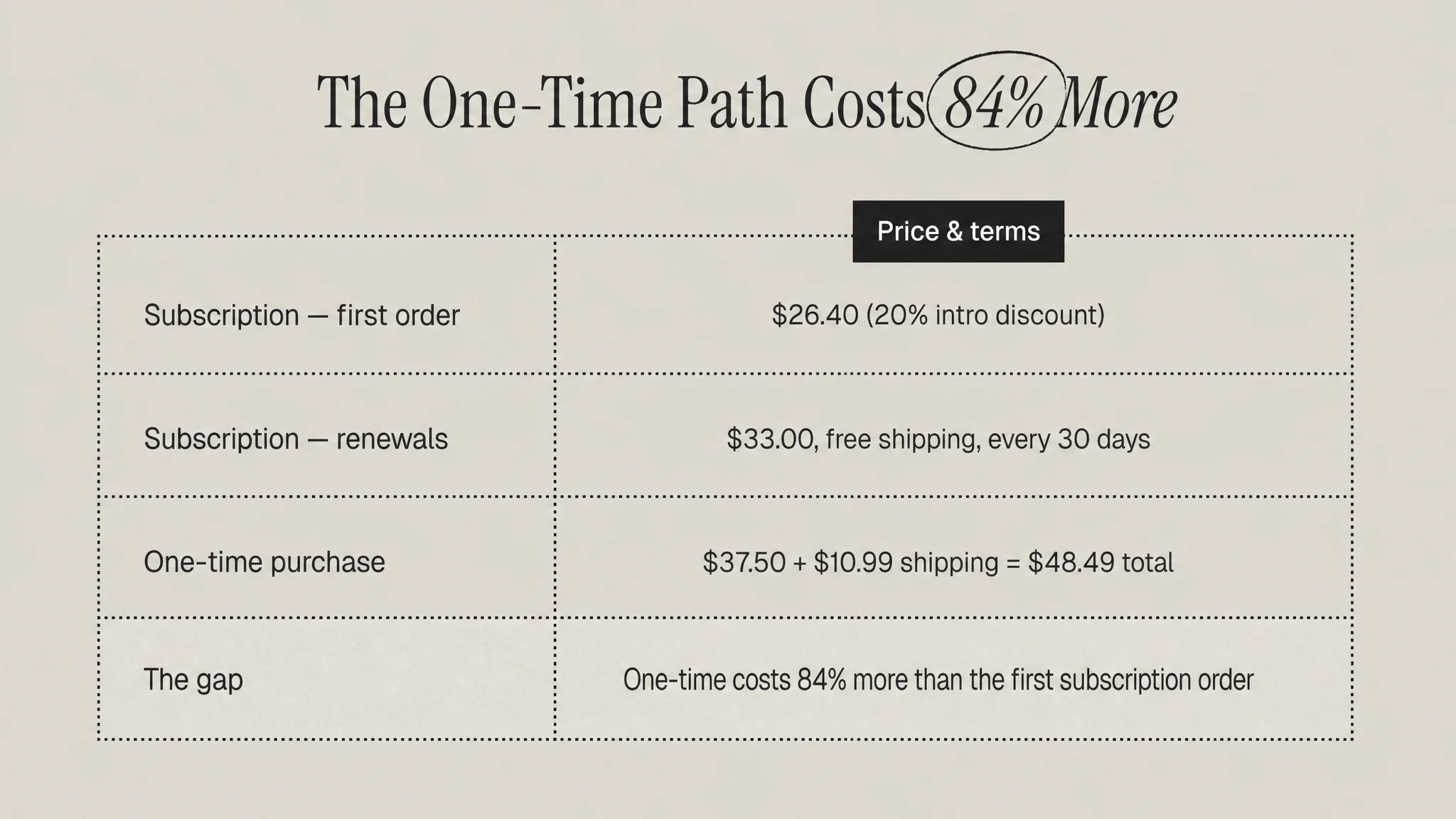
- A one-time purchase costs $37.50 plus $10.99 shipping. That is $48.49 against $26.40, a deliberate 84% penalty for not subscribing.
- Proof is the retention mechanic: USP Verified, third-party heavy metal testing, traceable sourcing, and a clinical trial showing raised vitamin D and omega-3 DHA levels in 12 weeks.
- The transferable lesson is that in low-feedback categories, the churn driver is doubt rather than dissatisfaction, and evidence is the flow that answers it.
Most supplement brands have the same retention problem and almost none of them name it correctly. The customer does not churn because the product disappointed them. They churn because they cannot tell whether it did anything, and a monthly charge for an unverifiable benefit is a very easy thing to cancel.
Ritual, which CNBC reported in March 2025 makes $250 million a year, is worth tearing down because it built its whole system around that specific problem rather than around discounting.
The category problem: a product with no feedback loop
Retention is usually easiest where the product proves itself. Coffee tastes good, the running shoes feel right, the razor shaves. Supplements offer none of that. The benefit is invisible, slow, probabilistic and largely indistinguishable from doing nothing.
Layer on a category-wide credibility problem, an industry where label accuracy has repeatedly been questioned, and you get a customer who is simultaneously unsure the product works and unsure the product is what it says it is.
Those are two distinct doubts and they need two distinct answers. Ritual's positioning, in the founder's own framing, is "traceable sourcing and traceable science. Know what's in your product, where it comes from, and why it works" (Ritual).
Teardown 1: the subscription is the product, not a payment option
Look at the actual pricing on Essential for Women (Ritual):
| Purchase path | Cost |
|---|---|
| Subscription, first order | $26.40 (20% off) |
| Subscription, renewals | $33.00, free shipping |
| One-time purchase | $37.50 plus $10.99 shipping = $48.49 |
The one-time path costs 84% more than the first subscription order. That is not a nudge, it is a wall. Ritual has decided that a non-subscribing customer is close to worthless and priced accordingly.
Two design details are worth stealing. The cadence is every 30 days, which matches a 30-day supply, so the shipment arrives roughly when the bottle empties rather than on an arbitrary billing date. And the friction release valves are all in one place: pause, skip, change delivery date or cancel from the account page. Making cancellation easy sounds like churn risk and generally is not. Hard cancellation converts a churned subscriber into a chargeback and a review.
The renewal cliff is the visible weakness
The honest criticism of this model is the jump from $26.40 to $33.00 at order two, a 25% increase at precisely the moment the customer has the least evidence the product is working. Month two is the highest-risk cancellation window in almost every supplement subscription, and Ritual has put a price rise there.
It is a defensible trade if the proof arrives before the invoice does. It is an expensive one if it does not, which is what makes the next section the load-bearing part of the whole system.
Teardown 2: evidence as a retention flow
This is the part most brands copy badly. They treat certifications as landing page furniture. Ritual treats proof as something the customer needs delivered repeatedly, because the doubt recurs monthly.
The proof stack on a single product includes USP Verified status, Non-GMO Project Verified, a Clean Label Project Purity Award, third-party testing for heavy metals (arsenic, cadmium, lead, mercury), microbes and major allergens, and a clinical trial in which Essential for Women "was shown to increase Vitamin D and Omega-3 DHA levels in 12 weeks."
That clinical claim is the single most important retention asset in the business, and note the timeframe. Twelve weeks is three billing cycles. The brand is explicitly asking for three months before the benefit is measurable, which means the job of months one and two is to keep the customer paying for something they cannot yet feel.
That is a lifecycle job, not a product job. It is why a supplement brand's onboarding sequence should be about mechanism and expectation setting rather than discounts, and why the 90-day activation playbook maps unusually well onto this category.
Teardown 3: traceability as a defensible moat
Anyone can copy a 20% first-order discount by Friday. Naming your suppliers and publishing where each ingredient comes from is a multi-year operational commitment that a competitor cannot fake in a quarter.
Ritual's traceability positioning does retention work in a way discounting cannot, because it changes the question the customer asks at renewal. A discount-anchored subscriber asks whether they can get it cheaper elsewhere. A traceability-anchored subscriber asks whether anyone else can tell them what is in the capsule. The second question has a much smaller set of acceptable answers.
This is the general form of the strongest retention moats: make the switching decision about something your competitor structurally cannot match, rather than about a number they can beat in an afternoon.
Teardown 4: the expansion ladder
Ritual's range now spans daily health, gut, skin, sleep and performance, prenatal, postnatal and fertility, and perimenopause. Read as a retention system rather than a catalogue, two things stand out.
First, the bundle discount runs up to 30% for three or more different items, so expansion is rewarded more than volume. A second product deepens the relationship in a way a second bottle of the same thing does not.
Second, and more interesting, the range follows a life stage rather than a shelf. Prenatal into postnatal into perimenopause is a customer you can hold for fifteen years if you keep meeting them at transitions. The transition is the retention moment, and it is predictable, which makes it triggerable.
Most brands with a life-stage range never build the triggers. They merchandise the products and hope. The subscription retention matrix covers how to map that properly, and behavioral segmentation is the mechanism.
What to take from this
Name your actual churn driver
If your category has no feedback loop, your churn driver is doubt, not dissatisfaction. Those need opposite responses. Dissatisfaction is answered with service recovery and a discount. Doubt is answered with evidence, and a discount actively makes doubt worse by implying the price was the problem.
Put the proof on a schedule
If the benefit takes twelve weeks, the customer needs a reason to stay at week four and week eight. Third-party test results, sourcing stories and mechanism explainers are lifecycle content, not website content. Send them.
Price the non-subscribing path honestly
Ritual has decided one-time buyers are not the business and priced the path accordingly. Half-hearted versions of this, a 5% subscribe-and-save that nobody notices, get the worst of both: no subscription adoption and a discount given away to people who would have subscribed anyway.
Watch month two
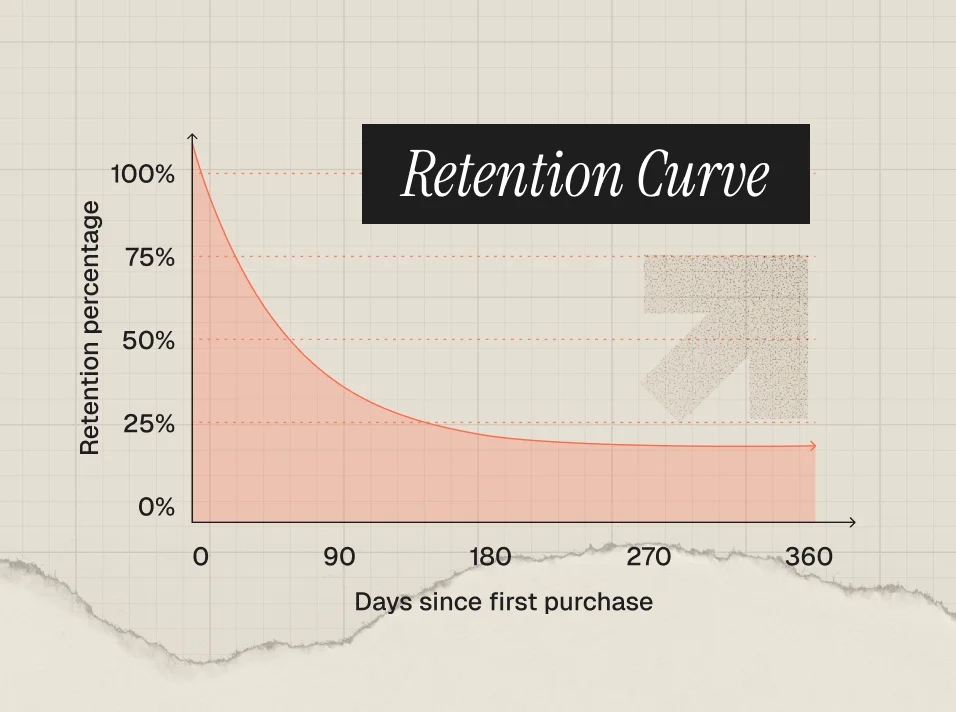
Wherever your introductory price ends, that is your cliff. Instrument it as its own cohort step rather than letting it hide inside a monthly churn average. The retention curve shows what to look for, and the guide to subscription churn covers the calculation.
The bottom line
Ritual's retention system is one idea executed consistently: in a category where the customer cannot verify the product, sell verification. The subscription defaults, the 30-day cadence, the certifications, the clinical trial and the traceable supply chain are all the same move.
The vulnerability is the 25% price step at order two, landing well before the twelve-week proof point the brand itself sets. If that transition is not carried by lifecycle messaging that makes the wait feel deliberate, the pricing structure is quietly working against the product story. That is the tension worth watching, and the lesson worth borrowing: your retention mechanic has to answer the doubt your category actually creates.
Sources
- Ritual, Essential for Women 18+ product page (pricing, subscription terms, certifications, clinical claim)
- Ritual homepage and brand positioning
- CNBC, How Ritual founder Katerina Schneider built a successful vitamin brand, March 2025
Frequently Asked Questions
What is Ritual's customer retention strategy?
Ritual's retention strategy is built on evidence rather than discounting. It makes the subscription the default purchase path by pricing the one-time option at $48.49 against $26.40 for a first subscription order, sets a 30-day cadence that matches actual consumption, and then delivers proof continuously: USP Verified status, third-party testing for heavy metals, traceable sourcing and a clinical trial showing raised vitamin D and omega-3 DHA levels in 12 weeks.
Why is retention harder for supplement brands?
Because the product has no feedback loop. Coffee tastes good and a razor shaves, so the product proves itself. A multivitamin's benefit is invisible, slow and largely indistinguishable from doing nothing, which means the customer cannot verify they are getting value. Add a category-wide credibility problem around label accuracy and the customer is unsure both that the product works and that it contains what it claims. Those are two separate doubts and each needs its own answer.
How much does Ritual cost on subscription versus one-time?
On Essential for Women, a first subscription order is $26.40, a 20% discount, and renewals are $33.00 with free shipping. A one-time purchase is $37.50 plus $10.99 shipping, which is $48.49 in total. The one-time path therefore costs about 84% more than the first subscription order. That is a deliberate structural decision rather than a nudge: Ritual has priced the non-subscribing customer as close to worthless.
What is the weakness in Ritual's retention model?
The renewal cliff. The price rises 25% from $26.40 to $33.00 at order two, which lands at exactly the point where the customer has the least evidence the product is working. Month two is the highest-risk cancellation window in most supplement subscriptions, and the brand's own clinical claim sets the proof point at 12 weeks, or three billing cycles. Unless lifecycle messaging carries months one and two, the pricing structure works against the product story.
What can other DTC brands learn from Ritual?
Four things. Name your actual churn driver, because doubt and dissatisfaction need opposite responses and a discount makes doubt worse. Put proof on a schedule, since test results and sourcing stories are lifecycle content rather than website furniture. Price the non-subscribing path honestly instead of offering a 5% subscribe-and-save nobody notices. And instrument month two as its own cohort step rather than letting it hide inside a monthly churn average.