
Summarize this documentation using AI
Key Takeaways
- At K:BOS 2026 on September 9, Klaviyo made 260+ MCP tools callable from Claude, ChatGPT and other AI systems, so agents can read, write and launch work without anyone opening the Klaviyo interface.
- Headless access is live and rolling out. SQL in the Klaviyo Data Platform, the next-generation personalization models and Customer Agent voice are still in preview.
- The constraint is no longer the interface. It is the quality of your event taxonomy, profile properties and segment logic, because that is what every agent will read.
- The right response this quarter is a data audit, a governed agent pilot on reporting, and a holdout test before you hand any send decision to a model.
For most of its life, Klaviyo has been a place you go. You log in, open the flow builder, check the dashboard, build the segment. At K:BOS 2026 the company said that is no longer the only way in. Klaviyo is now headless: its data and actions are exposed to AI agents running wherever a marketer already works.
That is a bigger shift for DTC lifecycle teams than any single feature on the keynote slide. This piece breaks down what was announced, separates what is live from what is still in preview, and lays out what we would do about it in the next 90 days.
What Klaviyo announced at K:BOS 2026
Klaviyo grouped its K:BOS 2026 updates into four pieces of what it calls an autonomous B2C CRM.
1. Klaviyo Headless
More than 260 Klaviyo MCP tools are now callable directly from Claude, ChatGPT or any AI system that speaks the Model Context Protocol. In Klaviyo's words, agents can "read, write, and go live the same way you would inside Klaviyo, without anyone opening Klaviyo at all." The examples given are practical: custom reporting dashboards, automated weekly performance reviews posted to Slack, and campaign drafts built from whatever tool the team prefers.
2. SQL in the Klaviyo Data Platform
Marketers can ask a question in plain language and Klaviyo translates it into a query, runs it against the brand's own profiles, events, segments, lists, campaigns and catalogs, and returns the answer. It is in preview inside Composer, with Claude and ChatGPT support listed as coming soon.
3. Next-generation personalization
A new personalization layer uses separate specialized models for each decision: audience selection using RFM data, one-to-one content and product recommendations, personalized send times and channel affinity. Klaviyo says it runs on a data platform processing 4 billion signals a day across 9 billion profiles. This is also in preview.
4. Composer and Customer Agent upgrades
Composer, Klaviyo's AI assistant, gains SQL-powered analysis, scheduled recurring tasks and reusable custom skills. Customer Agent adds support for more than 100 languages with automatic locale detection and an incoming voice channel. Klaviyo reports that Customer Agent has exchanged more than 1.3 million messages since launch, and that Composer has more than 138,000 users.
What "headless" actually means for a lifecycle team
Headless software separates the engine from the screen. The data, logic and actions stay in Klaviyo, and the interface becomes optional. For a DTC brand this changes three things.
Your data model becomes the interface
When an agent builds a segment or summarizes flow performance, it is working from your event names, profile properties and catalog fields. If "Placed Order" is tracked twice under two names, if subscription status lives in a free-text property, or if half your SMS consent sits in a legacy list, the agent will reason over that mess with total confidence. Klaviyo's co-CEO Andrew Bialecki put the dependency plainly in the announcement coverage: an agent is only as useful as whether it understands a brand's data, whether it can reach that understanding from wherever it is running, and whether it can act on it for every customer. Two of those three are now Klaviyo's job. The first one is still yours.
This is the same lesson we covered in our guide to what a customer data platform actually does: clean, consistent, well-named data is what makes every downstream tool smart.
Reporting is the obvious first win
The lowest-risk, highest-return use of headless access is read-only. A weekly agent that pulls flow revenue, list growth, unsubscribe and complaint rates, and posts a short written summary to the team channel removes hours of dashboard screenshotting. It also creates a consistent paper trail of what changed week to week, which most DTC teams lack.
Write access needs guardrails
Write and go-live access is where the risk sits. Klaviyo's own community explainer notes that remote MCP connections require an Owner, Admin or Manager role, and that every edit requires review and approval before it goes live. Treat that as the minimum. Decide in writing which actions an agent may draft, which it may schedule, and which always need a named human.
Live vs preview: how to read the roadmap
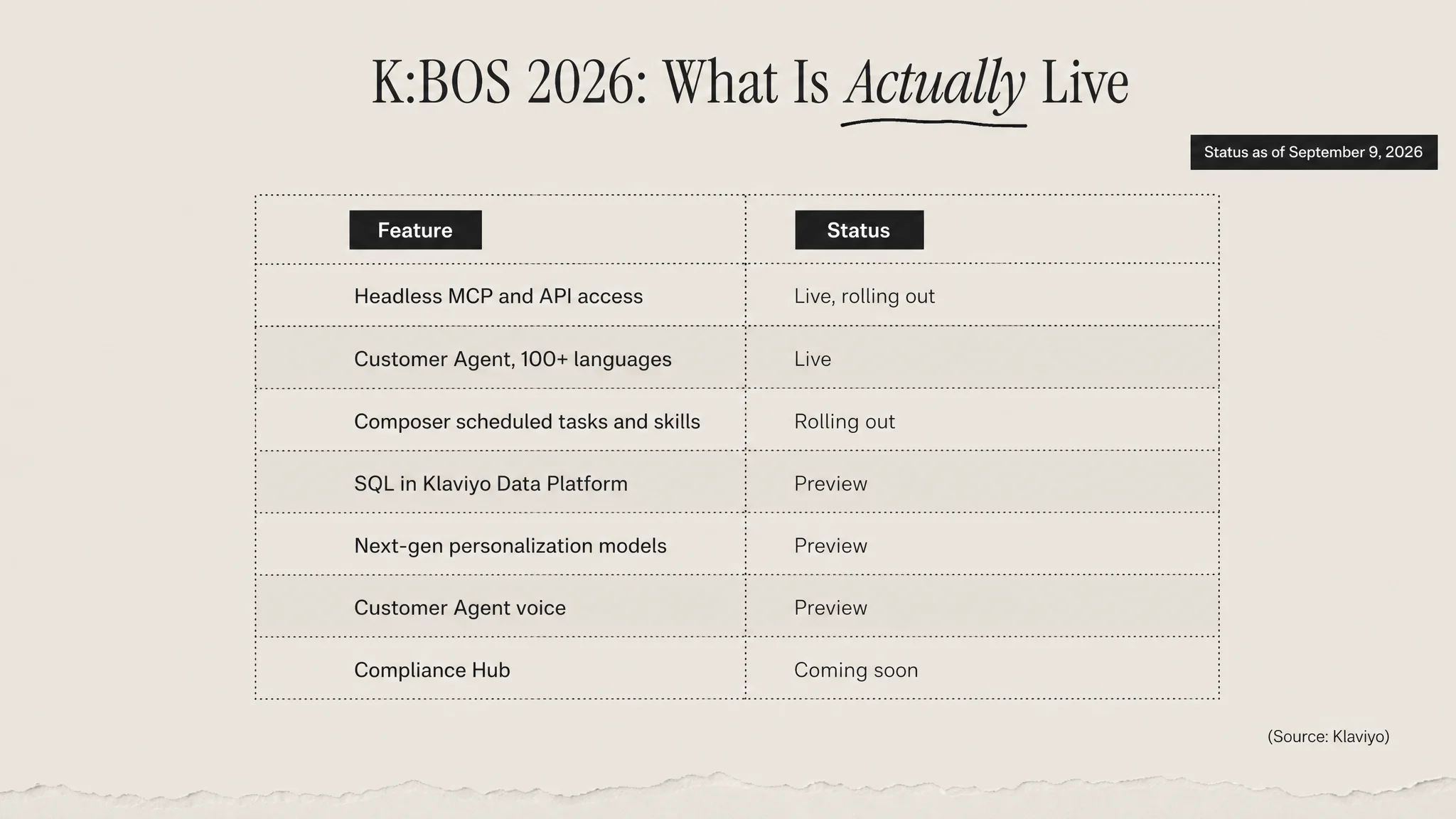
Conference announcements blur availability. Based on Klaviyo's community post, here is the status as of K:BOS:
| Capability | Status at K:BOS 2026 |
|---|---|
| Headless MCP and API access | Live, rolling out |
| Customer Agent language support (100+ languages) | Live |
| Customer Hub expansion | Live |
| Composer scheduled tasks and skills | Rolling out |
| SQL in Composer and MCP | Preview |
| Next-generation personalization | Preview |
| Customer Agent voice | Preview |
| Compliance Hub | Coming soon |
Klaviyo's explainer is explicit that you should not assume general availability or pricing for the voice features. Plan your Q4 around what is live, and pilot previews only where a failure is cheap.
Five moves to make this quarter
1. Audit your event and property taxonomy
List every metric and custom property in the account. Merge duplicates, document what each one means, and kill the ones nothing uses. If you have never done this, our lifecycle marketing audit guide walks through the full checklist.
2. Pilot a read-only reporting agent
Connect one agent with read access only and give it one job: a Monday summary of last week's flow and campaign performance. Compare its numbers against the native dashboard for four weeks before anyone trusts it.
3. Write an agent permissions policy
One page is enough. Who can connect an agent, what scopes it gets, which actions need approval, and who reviews the log. This matters more as BFCM approaches and send volume peaks.
4. Keep a holdout before handing over send decisions
When the new personalization models reach your account, do not switch them on everywhere. Run them against a control group so you can see real lift. Klaviyo's own personalized send-time feature already supports comparing against a randomized control, and the same discipline applies here. Our explainer on incrementality testing covers how to size a holdout, and our send time optimization guide covers what realistic gains look like.
5. Re-check your RFM and segment definitions
The new audience models lean on RFM data. If your recency, frequency and monetary bands were set years ago, refresh them now so the model optimizes toward customers you actually want. Start with our primer on RFM analysis.
Where this leaves teams on other platforms
Klaviyo is not the only ESP moving toward agents. Customer.io has shipped LLM actions inside its journeys, and Braze has been building its own AI tooling. The broader pattern, which we unpacked in AI-powered lifecycle marketing in 2026 and agentic commerce for DTC retention, is that the interface is becoming one of many ways in rather than the only way in. If you are weighing a platform move because of this news, compare the data model and governance first, not the keynote. Our DTC retention tech stack guide is a good place to start, and our read of Klaviyo, Braze and Shopify's Q2 2026 results gives the commercial context behind the push.
The bottom line
Klaviyo going headless means the quality of your retention program will depend less on who knows the flow builder best and more on whose data is cleanest and whose guardrails are clearest. The brands that benefit first will not be the ones that connect an agent fastest. They will be the ones that audit their data, start with read-only reporting, and measure every model against a holdout before trusting it with revenue.
Sources
- Klaviyo: K:BOS 2026, 4 updates powering Klaviyo's autonomous B2C CRM
- Klaviyo Community: K:BOS 2026, what Klaviyo going headless means for you
- Yahoo Finance: Klaviyo goes headless, opening its platform to agents and marketers wherever they work
- Klaviyo: K:BOS 2026 recap
- Klaviyo Help Center: Personalized send time
Frequently Asked Questions
What does it mean that Klaviyo is now headless?
Headless means Klaviyo's data and actions can be used without opening the Klaviyo interface. Since K:BOS 2026, more than 260 Klaviyo MCP tools can be called from Claude, ChatGPT or other AI systems, so an agent can pull reports, build segments or draft campaigns from the tools a team already uses. The data, flows and sending still run on Klaviyo; only the screen becomes optional.
Which K:BOS 2026 features are available now and which are in preview?
According to Klaviyo's own explainer, headless MCP and API access, Customer Agent language support and the Customer Hub expansion are live or rolling out, and Composer scheduled tasks and skills are rolling out. SQL in Composer and MCP, the next-generation personalization models and Customer Agent voice are in preview, and Compliance Hub is listed as coming soon. Klaviyo advises not assuming general availability or pricing for voice.
Is it safe to let an AI agent make changes in Klaviyo?
It can be, with guardrails. Klaviyo requires an Owner, Admin or Manager role to set up a remote MCP connection, and its explainer says edits need review and approval before going live. Start with read-only reporting, write a short permissions policy that names which actions need human sign-off, and review the agent's activity log weekly before expanding its access.
What should a DTC brand do first in response to Klaviyo going headless?
Audit your data before you connect anything. Agents reason over your event names, profile properties and segment definitions, so duplicates and vague fields produce confident but wrong answers. Clean the taxonomy, refresh RFM bands, then pilot a read-only agent that writes a weekly performance summary and check its numbers against native dashboards for a month.
Should brands switch ESPs because of Klaviyo's AI announcements?
Not on the strength of a keynote. Customer.io, Braze and other platforms are adding their own AI and agent capabilities, so the gap between vendors on AI features is moving quickly. A platform decision should rest on data model fit, governance, channel coverage, total cost and migration effort. Pilot the new features you can access today and measure them against a holdout first.