Summarize this documentation using AI
Key Takeaways
- A customer data platform is packaged software that unifies customer data from every source into a single persistent profile, then makes that profile available to other tools.
- The defining characteristics are unification across sources, identity resolution across devices, persistence over time, and accessibility to systems outside the platform.
- It is not a CRM, not a data warehouse and not an ESP, though it overlaps with all three and is frequently sold as a replacement for them.
- Most brands under $10M do not need one. The same outcome usually comes from a properly configured ESP plus clean event tracking, at a fraction of the cost.
- The honest test is whether your problem is that data exists and cannot be joined, or that the data was never collected properly in the first place. A CDP only solves the first.
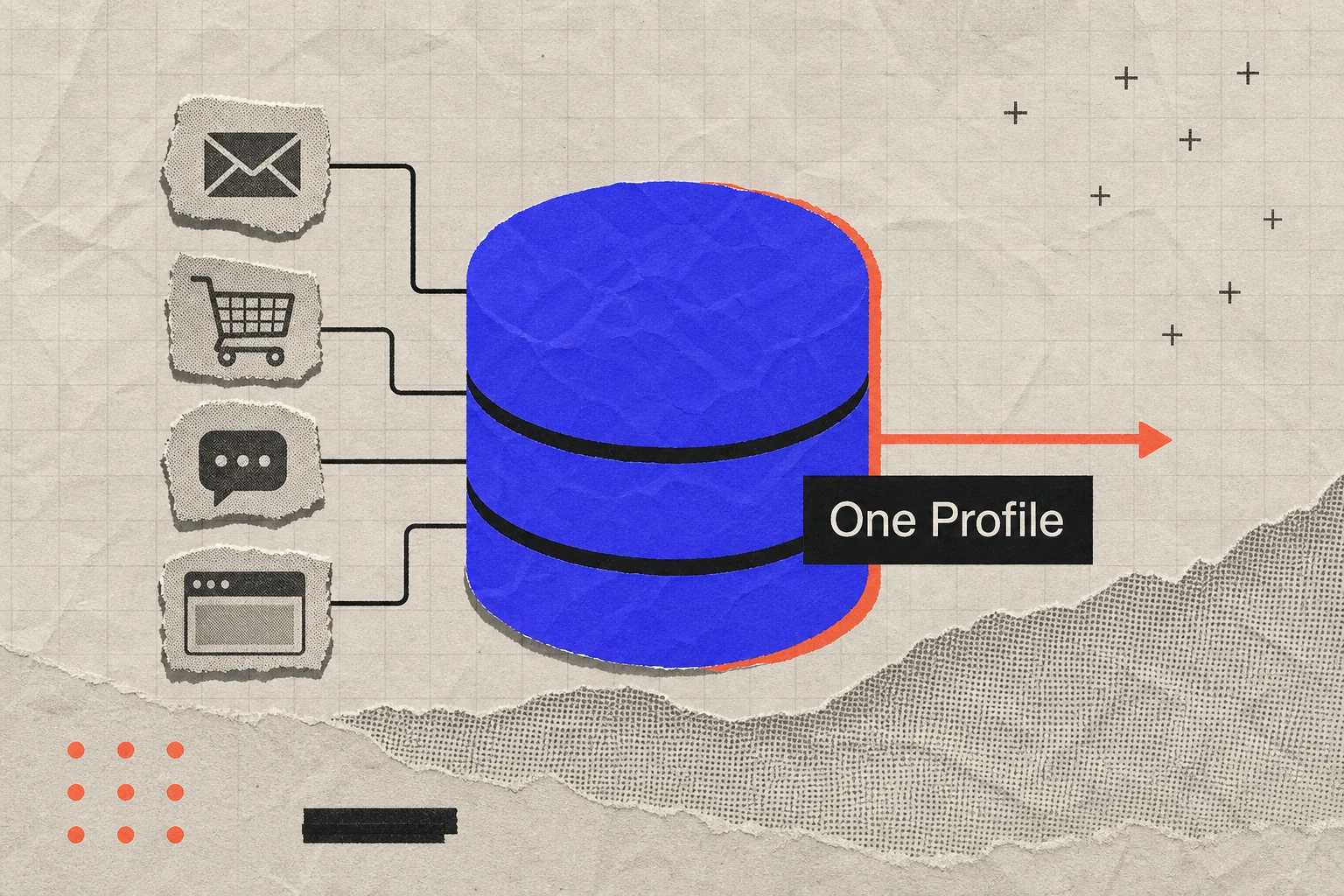
A customer data platform, or CDP, is packaged software that collects customer data from multiple sources, resolves it into a single persistent profile per person, and makes those profiles available to other systems for segmentation, activation and analysis.
The category has been oversold to mid-market DTC brands for several years, so it is worth being precise about what one does and, more usefully, when you do not need one.
The four defining characteristics
- Unification. It ingests from many sources: your store, your ESP, support tickets, ad platforms, offline purchases, app events.
- Identity resolution. It stitches a person's activity across devices and identifiers into one profile, which is the genuinely hard engineering problem.
- Persistence. Profiles survive over time rather than expiring with a session, so historical behaviour stays queryable.
- Accessibility. Other systems can read the profiles. A store nobody can query is a warehouse, not a CDP.
What a CDP is not
| System | Primary job | How it differs |
|---|---|---|
| CRM | Manage relationships and sales interactions | Records what your team did with a person, mostly entered by humans |
| Data warehouse | Store and query data at scale | Built for analysis, not for real-time activation into channels |
| ESP or engagement platform | Send messages and run journeys | Holds a profile, but usually scoped to its own channels |
| CDP | Unify and activate profiles | Sits between the others and feeds them |
The lines blur in practice. Modern engagement platforms have absorbed a great deal of CDP functionality, which is exactly why the buying decision has got harder. Our retention tech stack guide for $1M to $10M DTC brands maps what is genuinely needed at each revenue stage.
What a CDP is actually for
The business case is personalization and segmentation that a single-channel tool cannot support. McKinsey puts the revenue lift from personalization at 10% to 15%, with fast-growing companies deriving 40% more of their revenue from personalization than slower-growing peers (McKinsey).
Capturing that lift requires knowing things about a customer that live in different systems: what they browsed, what they bought offline, what they complained about, where they are in a subscription. A CDP is how those become one addressable fact.
The honest counter-argument
Most mid-market brands do not have a data unification problem. They have a data collection problem, and the two feel identical from the inside.
If your product view events are not firing reliably, buying a platform to unify them unifies nothing. If your ESP already holds purchase history, browse behaviour and email engagement, and you have not yet built a flow library using it, the constraint is build capacity, not architecture. Buying a CDP in that situation adds a migration to a backlog that was already the problem.
The test we use: name three segments you would activate tomorrow that you genuinely cannot build in your current stack. If you cannot name three, the CDP is not the bottleneck.
When a CDP starts to make sense
- Genuine multi-channel. Retail plus ecommerce plus app, with the same human in all three under different identifiers.
- Multiple activation destinations. The same audience needs to reach an ESP, an ad platform and an on-site personalization tool consistently.
- Identity is genuinely hard. Guest checkout, shared devices, marketplace orders, subscriptions under a different email.
- Scale. Enough volume and enough team that the operational overhead is affordable.
Below those conditions, a well-configured engagement platform plus disciplined event tracking usually delivers the same outcome for far less money and a fraction of the implementation risk.
Data hygiene matters more than the platform
A CDP inherits whatever quality you feed it. Duplicate profiles, inconsistent event naming and missing consent flags all survive the migration and become harder to see once they are behind a unified profile view.
Consent is the part most often underweighted. A unified profile assembled without a clear legal basis is a liability rather than an asset, which is one reason zero-party data, volunteered directly by the customer, has become disproportionately valuable.
The bottom line
A CDP unifies customer data into persistent profiles and makes them usable elsewhere. That is genuinely valuable for brands operating several channels with a real identity problem, and largely a distraction for brands whose actual constraint is that nobody has built the flows yet.
Work out which problem you have before you shop. Audit what your current stack can already address with a lifecycle programme audit, and if the gap is real, behavioral segmentation is the capability you are buying it to unlock, alongside customer LTV for value-based decisions.
Sources
Frequently Asked Questions
What is a customer data platform?
A customer data platform, or CDP, is packaged software that collects customer data from multiple sources, resolves it into a single persistent profile per person, and makes those profiles available to other systems for segmentation, activation and analysis. The four defining characteristics are unification across sources, identity resolution across devices and identifiers, persistence over time, and accessibility to systems outside the platform itself.
What is the difference between a CDP and a CRM?
A CRM manages relationships and sales interactions, recording what your team did with a person, and much of it is entered by humans. A CDP unifies behavioural and transactional data from many systems into one profile and pushes it back out for activation. A data warehouse stores and queries data at scale but is built for analysis rather than real-time activation, and an ESP holds a profile but usually scoped to its own channels. The CDP sits between the others and feeds them.
Do I need a CDP?
Most brands under $10M do not. The honest test is whether your problem is that data exists and cannot be joined, or that the data was never collected properly in the first place. A CDP only solves the first. A practical version of the test: name three segments you would activate tomorrow that you genuinely cannot build in your current stack. If you cannot name three, the CDP is not your bottleneck, and a well-configured engagement platform plus clean event tracking will deliver the same outcome for far less.
When does a CDP start to make sense?
Four conditions. Genuine multi-channel operation, such as retail plus ecommerce plus app with the same person appearing under different identifiers. Multiple activation destinations, where one audience must reach an ESP, an ad platform and an on-site personalization tool consistently. Identity resolution that is genuinely hard, with guest checkout, shared devices, marketplace orders and subscriptions under a different email. And enough scale that the operational overhead is affordable.
What is the business case for a CDP?
Personalization and segmentation that a single-channel tool cannot support. McKinsey puts the revenue lift from personalization at 10% to 15%, and finds fast-growing companies derive 40% more of their revenue from personalization than slower-growing peers. Capturing that requires knowing things about a customer that live in different systems: what they browsed, what they bought offline, what they complained about, where they are in a subscription. A CDP is how those become one addressable fact.
-thumbnail.webp)