
Summarize this documentation using AI
Somewhere between $1M and $10M in revenue, every DTC brand hits the same wall: the tools that got you here start actively costing you money. The starter ESP cannot handle behavioral segmentation. Your SMS platform does not talk to your email platform. Nobody can answer what a customer is actually worth at month six.
This guide lays out the retention tech stack we recommend to brands in this exact revenue band, based on the stacks we build and operate at Propel. Not the enterprise stack you will need at $50M, and not the duct-tape stack you ran at $500K: the stack that fits now, with real 2026 pricing, and the order you should buy it in.
Why does the stack matter this much? Because retention channels are the highest-ROI dollars you will spend. Email alone returns an average of $36 for every $1 spent, the highest of any marketing channel, and retail and ecommerce brands average closer to $45. The stack is what turns that potential into recurring revenue.
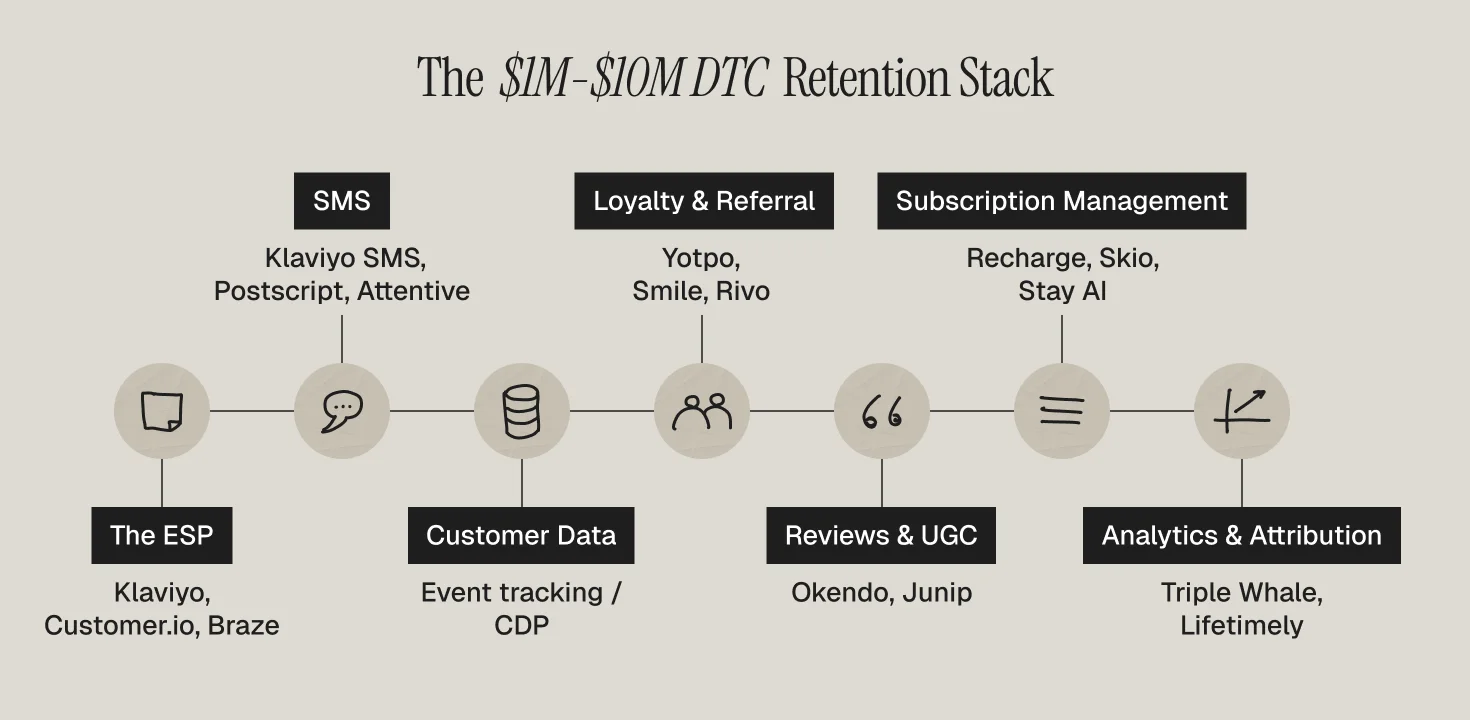
The 7 layers of a $1M-$10M retention stack
A working retention stack for this revenue band has seven layers. You do not need all seven on day one, and we cover build order below, but you should know what the complete picture looks like. For a broader look at how these layers map to team maturity, see our B2C Retention Stack framework.
Layer 1: The ESP (your retention operating system)
Your email service provider is the center of the stack. For most DTC brands in this band, the shortlist is Klaviyo, Customer.io, or Braze, and the honest answer is that Klaviyo wins for pure ecommerce while Customer.io wins when app or subscription logic gets complex. We break down that decision in depth in Klaviyo vs Braze for mid-market brands.
Budget reality: Klaviyo pricing in 2026 runs about $150 a month at 10,000 profiles, $400 a month at 25,000, and $720 a month at 50,000 for email alone. A $3M brand with a 40,000-profile list should budget $500 to $800 a month for the ESP layer.
What matters at this stage is not template design. It is whether your ESP can run the core lifecycle flows (welcome, abandonment, post-purchase, winback, replenishment) on real behavioral triggers.
Layer 2: SMS
SMS is no longer optional for DTC: it is the highest-urgency channel you own. Run it from the same platform as email if you can (Klaviyo SMS, Customer.io, Omnisend) so quiet hours, frequency caps, and suppression lists are shared. A separate best-of-breed tool like Postscript or Attentive makes sense once SMS revenue justifies dedicated tooling. Our guide to ecommerce SMS marketing covers how to keep SMS incremental instead of cannibalistic.
Layer 3: Customer data (the layer everyone skips)
At $1M you can live inside Shopify and your ESP. Somewhere around $3M to $5M, data fragmentation starts silently taxing every campaign: the same customer exists three times, suppression fails, and personalization runs on stale fields.
You have two moves. The lightweight move is disciplined event tracking into your ESP. The heavier move is a CDP like Segment or RudderStack. Most brands in this band only need the lightweight move done well. Our guide to choosing a customer data platform explains when you have actually outgrown it.
Layer 4: Loyalty and referral
Loyalty is the most misunderstood layer: it is not points for the sake of points, it is margin-efficient repeat purchase. The data backs the investment: 90% of loyalty programs now report positive ROI, averaging 4.8x returns, and tiered programs deliver 1.8x higher ROI than flat ones, with VIP members generating 73% higher AOV. Tools like Yotpo Loyalty, Smile, and Rivo all fit this band at $200 to $600 a month.
Layer 5: Reviews and UGC
Reviews are retention infrastructure disguised as acquisition infrastructure: the post-purchase review ask is often the highest-engagement email in the entire program. Yotpo, Okendo, and Junip are the standard picks here.
Layer 6: Subscription management
If you sell consumables, subscription infrastructure (Recharge, Skio, Stay AI) is where retention revenue compounds. The tool matters less than the program design: our subscription retention strategies guide covers passive churn recovery, skip-instead-of-cancel flows, and the surrender-offer ladder.
Layer 7: Analytics and attribution
At minimum, you need cohort-level repeat purchase visibility and a revenue per email view per flow. Tools like Triple Whale, Northbeam, or Lifetimely handle this for the $1M to $10M band without a data team.
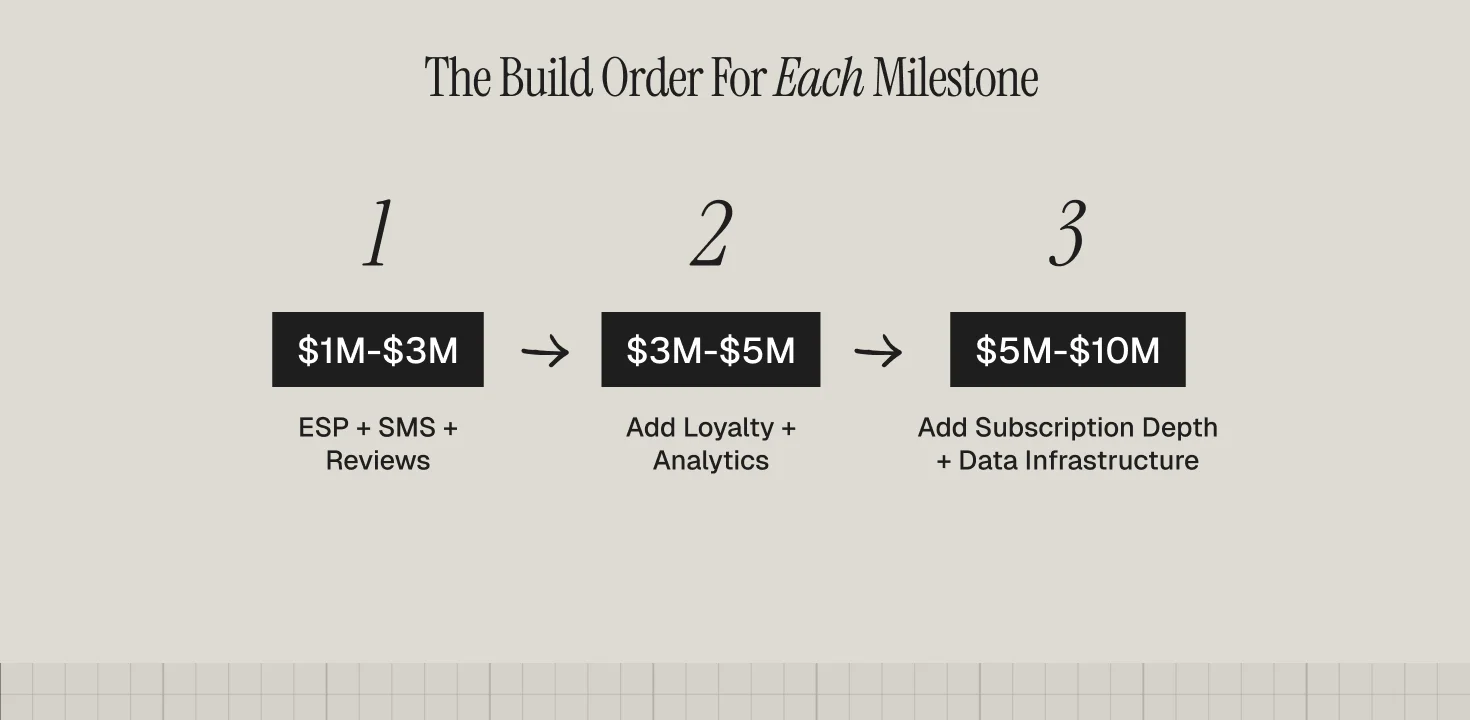
Build order: what to buy at $1M, $3M, and $10M
At $1M to $3M: ESP + SMS + reviews
One platform for email and SMS, a review tool, and disciplined event tracking. Total spend: roughly $500 to $1,000 a month. Skip the CDP, skip standalone loyalty, and put the savings into flow buildout. Most brands at this stage are running 4 flows when the revenue is in 12; our guide on how DTC brands retain customers lists the full set.
At $3M to $5M: add loyalty + analytics
This is where loyalty economics turn positive and where blended metrics start hiding problems. Add the loyalty layer and a cohort analytics tool. Total spend: $1,000 to $2,000 a month.
At $5M to $10M: add subscription depth + data infrastructure
Upgrade subscription tooling, consider the CDP conversation, and pressure-test the whole stack. This is also the point where a done-for-you retention stack setup pays for itself faster than a first retention hire, and where a formal martech stack audit usually finds 20 to 30% of spend going to overlapping tools.
The 3 most expensive stack mistakes we see
- Buying enterprise tools at growth-stage revenue. A $2M brand on Braze is paying for orchestration depth it cannot staff. Match the tool to the team you have, not the team you plan to hire.
- Running SMS and email on separate suppression logic. The customer who bought yesterday gets a winback text today. This single integration failure burns more goodwill than any subject line ever will.
- Adding tools instead of flows. Every layer above only prints money if the flows inside it are built. A top email marketing platform with 4 live flows loses to a mediocre one with 14, every time.
How Propel builds and runs this stack
At Propel, we design, migrate, and operate retention stacks for DTC and subscription brands in exactly this revenue band. We are platform-certified across Klaviyo, Customer.io, and Braze, which means we recommend the stack that fits your margin structure, not the one that pays us referral fees.
Frequently Asked Questions
What tools should a $1M DTC brand use for retention?
At $1M, keep it to three tools: one platform that handles both email and SMS (Klaviyo is the default for pure ecommerce), a review tool like Okendo or Junip, and clean event tracking from your store. Budget roughly $500 to $1,000 a month total and invest the rest in building out lifecycle flows.
How much should a DTC brand spend on its retention tech stack?
A useful benchmark is 1 to 2% of revenue on retention tooling. That maps to roughly $500 to $1,000 a month at $1M to $3M, $1,000 to $2,000 a month at $3M to $5M, and $2,000 to $4,000 a month approaching $10M. Email's average return of $36 per $1 spent makes this the most defensible line in the marketing budget.
Do I need a CDP under $10M in revenue?
Usually not. Most brands under $10M get 90% of CDP value from disciplined event tracking piped directly into their ESP. A true CDP becomes worth the cost when you run three or more channels on separate tools, sell across multiple storefronts, or need identity resolution across app and web.
Klaviyo, Customer.io, or Braze for a mid-market DTC brand?
Klaviyo wins for Shopify-centric ecommerce on speed and ecosystem depth. Customer.io wins when you have app events, trials, or complex subscription logic. Braze is built for enterprise scale and usually overshoots this band on both price and required headcount.
What retention metrics should this stack report on?
At minimum: repeat purchase rate by cohort, 60/90-day retention curves, revenue per email and per SMS by flow, subscription churn split into active versus passive, and loyalty member versus non-member LTV. If your stack cannot produce these five views, it is not a retention stack, it is a sending stack.
