
Summarize this documentation using AI
For most mid-market DTC and subscription brands (roughly $5M to $50M in revenue), Klaviyo is the right lifecycle platform and Braze is overkill. Klaviyo is a self-serve, ecommerce-native email and SMS engine that starts around $45 a month and runs roughly $150 a month at 10,000 contacts (Omnisend). Braze is an enterprise customer engagement platform built for engineering-led, real-time cross-channel programs, with contracts that reportedly begin near $60,000 a year (Dashly). Move to Braze only when mobile-app messaging, real-time cross-channel orchestration, and a dedicated technical team are all true. Otherwise you have not outgrown Klaviyo, you have under-built it.
Key Takeaways
- Klaviyo is built for ecommerce and is self-serve: native Shopify integration, prebuilt commerce events, and no-code flows. Paid plans start near $45/mo and reach about $150/mo at 10K contacts (Omnisend).
- Braze is an enterprise cross-channel platform (push, in-app, Content Cards, email, SMS, WhatsApp), named a Leader in the 2025 Gartner Magic Quadrant for Multichannel Marketing Hubs; deals commonly run into the tens of thousands per year and need technical resources (Dashly).
- The decision is not "which is better." It is "what is the actual constraint on my retention program?" Three signals decide it: a mobile-first surface, real-time cross-channel needs, and a technical owner.
- Retention economics favor finishing what you own: acquiring a new customer costs 5 to 25x more than retaining one (Invesp).
- Migration has a tax. Switching platforms resets your learning curve and your deliverability history. Most mid-market brands earn more by completing unfinished Klaviyo flows than by switching.
Klaviyo vs Braze at a glance
What Klaviyo is actually built for
Klaviyo is an ecommerce-native platform. It connects to Shopify in an afternoon, it understands commerce events like "placed order" and "viewed product" out of the box, and a lifecycle marketer can build a full flow program (welcome, browse abandonment, abandoned cart, post-purchase, replenishment, win-back) without writing code. That is why it dominates mid-market DTC: the time-to-value is days, not quarters.
It is also where most DTC flow revenue is generated, because the platform is opinionated about commerce. If you want a team that can build personalized email flows without manual work, or you are evaluating whether to bring in Klaviyo consultants or a Klaviyo email marketing agency, the surface area is well understood and the talent pool is deep.
What Braze is actually built for
Braze plays in a different category. It is an enterprise customer engagement platform built for real-time, cross-channel orchestration at scale: push notifications, in-app messages, Content Cards, email, SMS, and WhatsApp, all coordinated from a single canvas. It was named a Leader in the 2025 Gartner Magic Quadrant for Multichannel Marketing Hubs (Dashly).
The trade-off is that Braze expects infrastructure. It assumes you have a data pipeline feeding it clean events, a dedicated technical owner (often a marketing-engineering or CRM-ops function), and a budget that starts in the five figures per year and climbs. For an app-first business with millions of users, that is a bargain. For a Shopify brand sending five flows, it is a Ferrari bought to drive to the mailbox.
The three signals you've truly outgrown Klaviyo
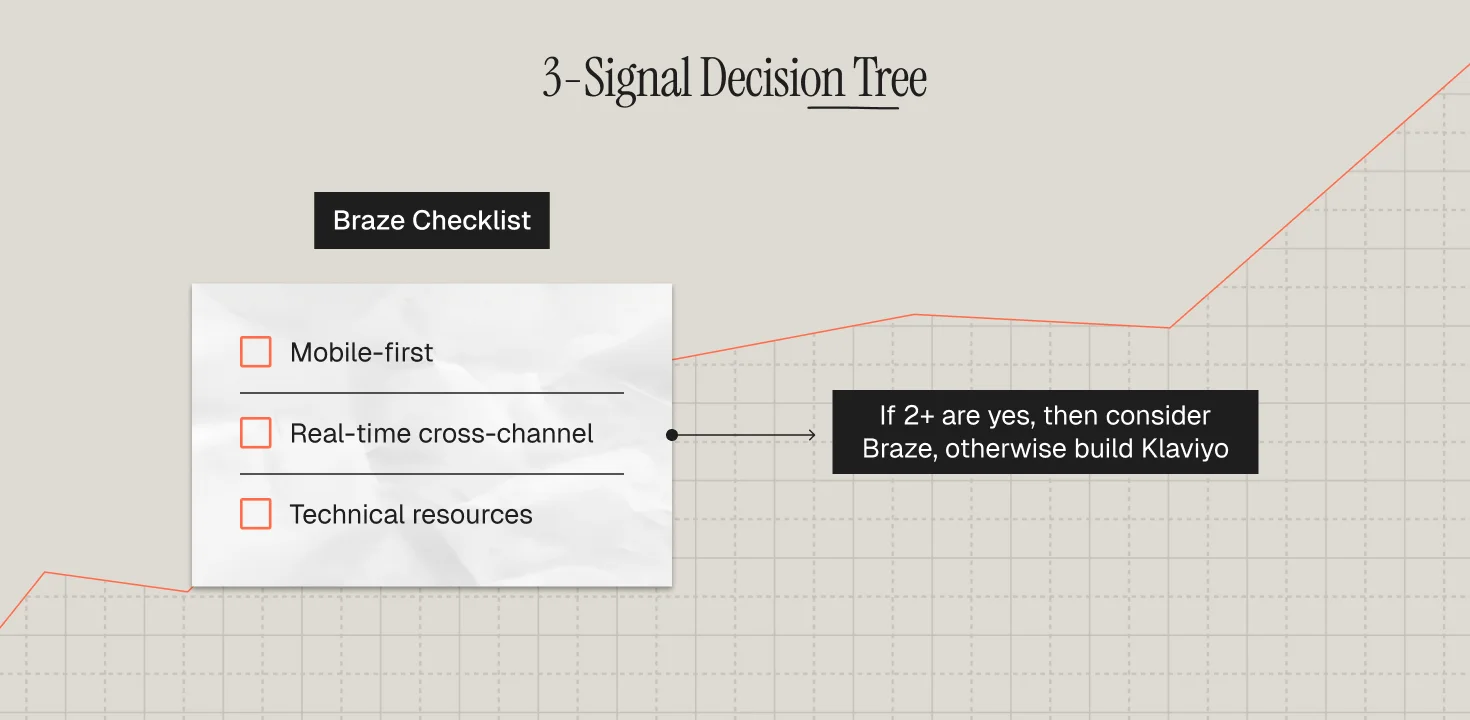
When a mid-market brand asks me whether to move, I check three signals. You usually need at least two to justify the switch.
- The mobile app is the primary surface. If most engagement happens in an app and push or in-app messaging is where retention is won, Klaviyo's email-and-SMS center of gravity will fight you. Braze was born for that.
- You need real-time, event-driven orchestration beyond email and SMS. Many channels, many teams, server-side events, constant experimentation. That is Braze's home field.
- You have the technical resources to run it. Braze is not self-serve. Without a data or engineering owner, you pay enterprise money for a Klaviyo-shaped outcome.
If none of these are true, "upgrading" buys complexity, not revenue.
The pricing reality for mid-market
Klaviyo's pricing is transparent and scales with the size of your active profile list, which makes budgeting predictable as you grow (Omnisend). Braze uses custom enterprise contracts with no published rates; third-party comparisons put typical deals well into the tens of thousands annually (Dashly, G2).
Price is only half the cost. A migration also resets your sending reputation and your flow learnings, and it consumes months of team time. Before you sign, make sure you can attribute revenue cleanly across whichever tool you choose. Our guide to DTC revenue and LTV attribution across Klaviyo, Braze, and Customer.io and the difference between cohort LTV vs blended LTV will tell you whether the platform is actually your constraint, or whether the measurement is.
"We've maxed out Klaviyo" usually means "we under-built it"
A supplement brand came to me convinced they needed Braze. Their pitch: "We've maxed out Klaviyo." We looked. They were running a welcome series, an abandoned cart, and a monthly newsletter. No post-purchase education, no replenishment flow, no win-back, no churn-risk segment. "Maxed out" meant they had built maybe 30% of the program their existing tool already supported.
We spent eight weeks building, not migrating: replenishment timed to the median reorder window, a win-back sequence for lapsed subscribers, and RFM-based segmentation feeding three post-purchase paths. Flow revenue as a share of total email revenue climbed without changing a single platform setting. This is the pattern behind most failed migrations, and it is the same reason most martech audits fail to reduce churn: the tool was never the constraint, the roadmap was. If you are genuinely tool-bound, compare options with our roundup of the best subscription retention tools.
How to decide in 15 minutes
Run the three-signal test before you take a sales call. Mobile-first? Real-time cross-channel? Technical owner in the seat? If you cannot say yes to at least two, invest in finishing the program you already own. Lifecycle maturity, not platform logos, is what compounds. If you want a partner to build that program, see what lifecycle marketing services should actually include and how customer lifecycle marketing drives retention.
Frequently Asked Questions
Is Klaviyo or Braze better for a mid-market DTC brand?
For most mid-market DTC brands, Klaviyo is the better fit: it is ecommerce-native, self-serve, and far less expensive. Braze becomes the better choice only for mobile-first, engineering-resourced businesses that need real-time orchestration across many channels.
How much does Braze cost compared to Klaviyo?
Klaviyo is transparent and scales with your contact list (roughly $45/mo to start, about $150/mo at 10K contacts). Braze uses custom enterprise contracts that third-party sources report commonly run into the tens of thousands of dollars per year.
When should you switch from Klaviyo to Braze?
When at least two of these are true: your mobile app is the primary engagement surface, you need real-time cross-channel orchestration beyond email and SMS, and you have a dedicated technical owner to run the platform.
Can Klaviyo do push and in-app messaging?
Klaviyo supports mobile push and has expanded its app messaging, but its center of gravity is commerce email and SMS. Braze is purpose-built for high-volume, real-time push and in-app experiences.
Does migrating ESPs hurt performance?
It can. Migrating resets deliverability reputation and flow learnings, and consumes months of team time. Treat a switch as a last resort after you have exhausted your current platform.



![Featured image: How to Build Personalized Email Flows Without Manual Work [Propel 2026 Guide]](https://cdn.prod.website-files.com/69bbf9f7f2a3f75341357ebc/69f4b4a14e570d4683513d1c_69c7cebf472d09c1dccbc9ac_698ae45647478a7a644f3cfa_6911954d171d0dd844c6a67c_Personalized%25252520Email%25252520Flows-2-min.png)
