Summarize this documentation using AI
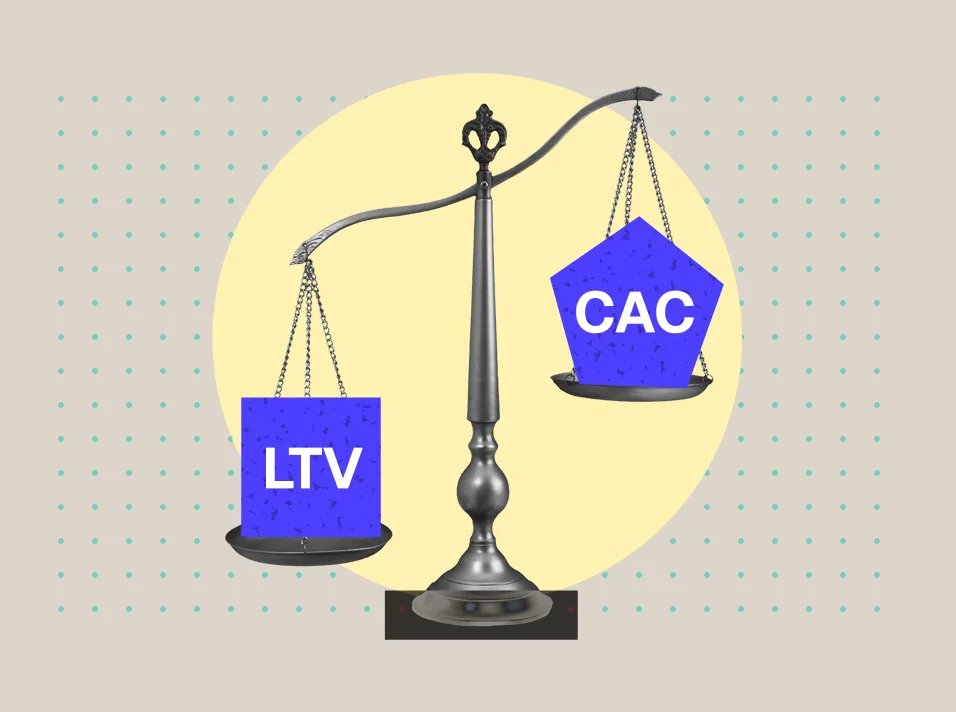
Customer acquisition cost (CAC) is the total sales and marketing spend required to win one new customer. Customer lifetime value (LTV, also called CLV) is the total profit a customer generates across their entire relationship with your brand. Divide LTV by CAC and you get the LTV:CAC ratio, the single clearest measure of whether your growth model actually works. The most commonly cited healthy benchmark is 3:1: every dollar spent acquiring a customer should return roughly three dollars in lifetime value.
That is the direct answer. The rest of this guide covers why the comparison matters more now than ever, how to calculate each metric correctly, a worked DTC example, what healthy benchmarks look like, and the calculation mistakes (blended LTV, revenue-based LTV, ignoring payback) that make bad unit economics look good.
The context making this urgent: acquisition keeps getting more expensive. SimplicityDX found that customer acquisition costs have risen 222% over the last decade, and brands now lose an average of $29 on every new customer they acquire. ProfitWell data published by Paddle shows CAC up roughly 60% across both B2B and B2C in just five years. When CAC only goes up, LTV is the side of the equation you can actually control, which is why lifecycle revenue has become the growth lever of choice for DTC and subscription brands.
What is customer acquisition cost (CAC)?
Customer acquisition cost is the fully loaded cost of converting a prospect into a paying customer over a given period.
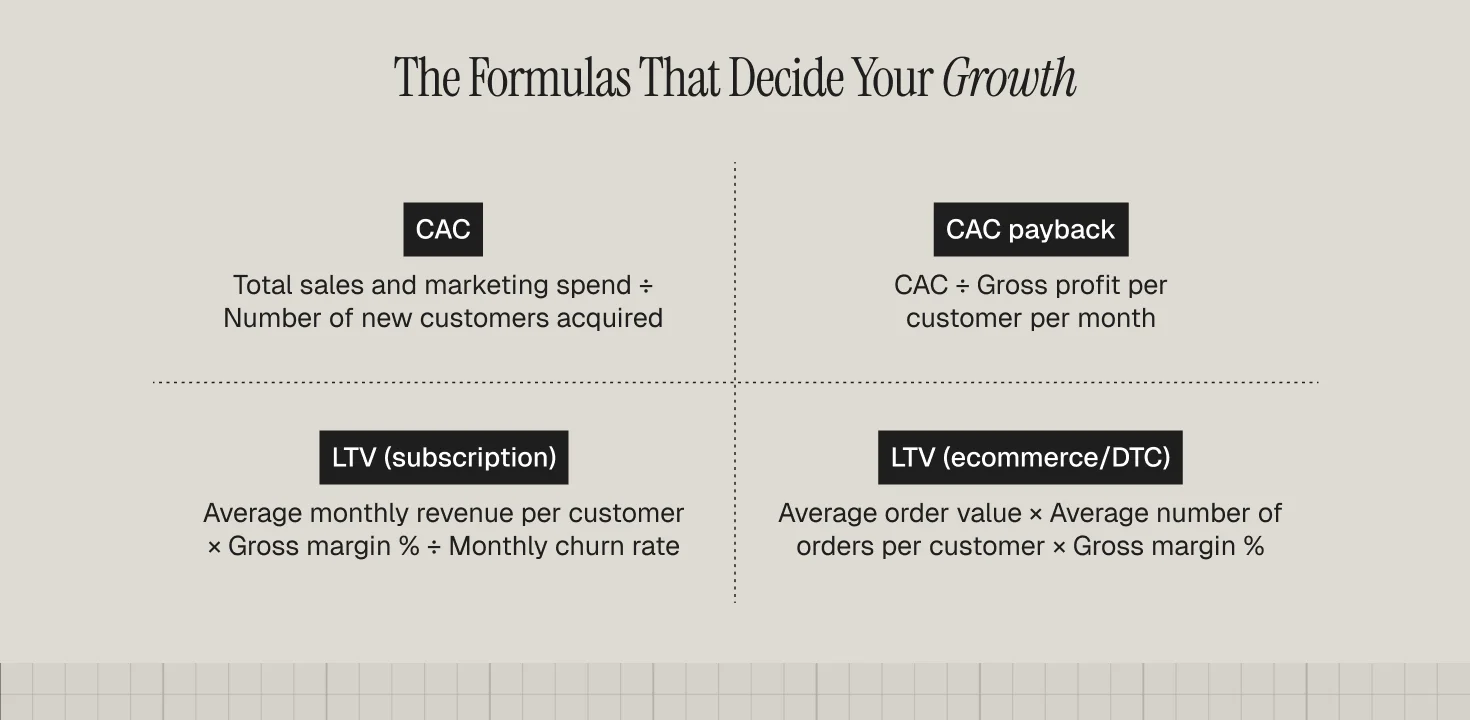
CAC formula:
CAC = Total sales and marketing spend ÷ Number of new customers acquired
"Total spend" should include everything you pay to acquire: ad spend across Meta, Google, TikTok and other channels, agency and freelancer fees, creative production, acquisition-focused tools, and the salaries (or salary portion) of the team working on acquisition. Many brands quietly report ad-spend-only CAC, which understates the real number by 20 to 40% and flatters the ratio.
Two versions are worth tracking separately:
- Paid CAC: paid media spend ÷ customers from paid channels. Use this to judge channel efficiency.
- Blended CAC: all acquisition spend ÷ all new customers (including organic, referral, email). Use this to judge the business.
If blended CAC looks fine but paid CAC is 2x higher, organic is subsidizing your ads, and scaling paid will quietly break your economics.
What is customer lifetime value (LTV)?
Customer lifetime value is the total value a customer generates for your business across their entire relationship with you, from first order to last. We cover the metric in depth in What Is Customer LTV?, but the short version:
LTV formula (ecommerce/DTC):
LTV = Average order value × Average number of orders per customer × Gross margin %
LTV formula (subscription):
LTV = Average monthly revenue per customer × Gross margin % ÷ Monthly churn rate
The gross margin term matters. You acquire customers with real dollars, so you should compare CAC against the real profit a customer generates, not their revenue. Revenue-based LTV is the single most common way brands convince themselves a losing funnel is working.
How do you calculate the LTV:CAC ratio? A worked DTC example
Take a DTC supplement brand with these monthly numbers:
- Ad spend: $60,000
- Agency, creative, and tools: $15,000
- Acquisition team salaries: $25,000
- New customers acquired: 1,250
CAC = $100,000 ÷ 1,250 = $80
Now the customer side:
- Average order value (AOV): $70
- Average lifetime orders per customer: 4.5
- Gross margin: 60%
Revenue LTV = $70 × 4.5 = $315 (do not use this)
Margin LTV = $70 × 4.5 × 0.60 = $189 (use this)
LTV:CAC = $189 ÷ $80 = 2.4:1
On revenue LTV this brand looks like a 3.9:1 rockstar. On margin LTV it is a 2.4:1 business that cannot afford to scale spend aggressively, and every incremental dollar of CAC inflation pushes it closer to breakeven. Same brand, same customers, completely different decision.
What is a healthy LTV:CAC ratio?
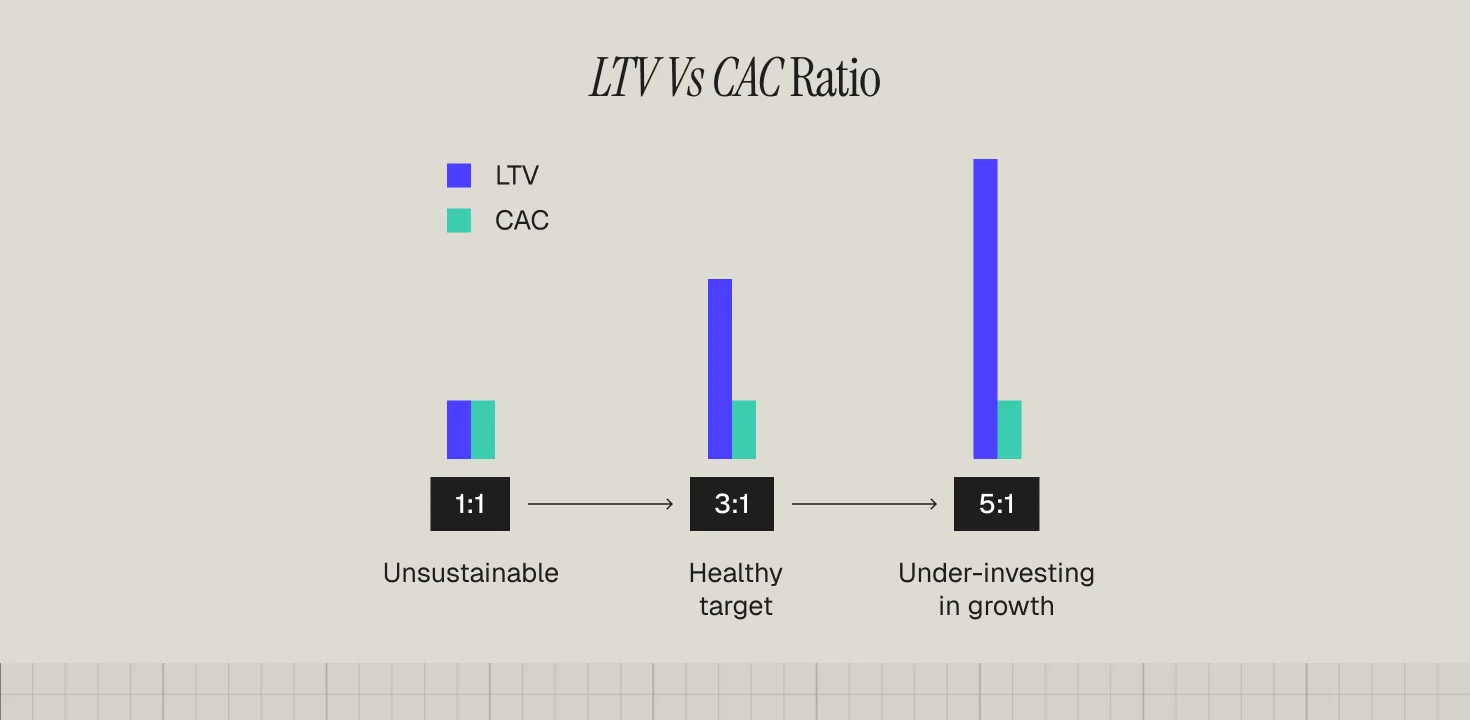
The standard benchmark is 3:1, and First Page Sage's benchmark data puts the ecommerce average right at 3:1 (average LTV of $255 against an average CAC of $84), with industries ranging from roughly 2.5:1 to 5:1. Read the ratio in zones:
- Below 1:1: you lose money on every customer, permanently. Stop scaling and fix the funnel or the product economics.
- 1:1 to 2:1: you acquire at breakeven-ish. Survivable only if retention is improving fast.
- ~3:1: healthy. Acquisition is profitable with enough margin to fund operations and growth.
- 5:1 and above: great economics, but often a signal you are underinvesting in acquisition and leaving growth on the table.
One caveat: the ratio is a compass, not a bank balance. A brand can run a beautiful 4:1 ratio and still die of a cash crunch, which is why the ratio needs a companion metric.
What is CAC payback period?
CAC payback period is how long it takes the gross profit from a customer to repay what you spent acquiring them.
Payback formula: CAC ÷ Gross profit per customer per month
In our example, each $70 order carries $42 of gross profit. Against an $80 CAC, the first order recovers about half; if the average second order lands around month three, payback is roughly three months. The common benchmark, per Geckoboard, is 12 months or less, with high performers recovering CAC in 5 to 7 months. LTV:CAC tells you if the model is profitable; payback tells you if you can afford to run it. Shorter payback means you can recycle cash into acquisition faster and grow without raising money.
Why retention shifts the ratio
Here is the part most acquisition-first teams miss: LTV is not fixed. It is the output of your retention and lifecycle program, which means the LTV:CAC ratio is something you engineer, not something you inherit.
Harvard Business Review notes that acquiring a new customer runs 5 to 25 times more expensive than retaining an existing one, and cites Bain research showing a 5% increase in retention lifts profits by 25 to 95%. The math from our example makes it concrete: lift average lifetime orders from 4.5 to 6 through better retention marketing (welcome flows, replenishment reminders, winbacks, subscription nudges) and margin LTV jumps from $189 to $252. The ratio goes from 2.4:1 to 3.2:1 without touching ad spend.
That is the core argument of the lifecycle revenue model: retention compounds while acquisition inflates. Every improvement in repeat rate raises the ceiling on what you can afford to pay for a customer, which lets you outbid competitors in the same auctions. Brands that treat email, SMS, and push as an LTV engine rather than a promo channel are effectively buying customers at a discount their competitors cannot see.
Common mistakes when comparing CAC and LTV
1. Using blended LTV instead of cohort LTV. A single blended LTV number averages your loyal 2019 customers with last month's discount-chasers and hides decay. Measure LTV by acquisition cohort so you can see what a customer acquired today is actually worth, and compare each cohort's LTV to the CAC you paid for that cohort.
2. Calculating LTV on revenue, not margin. As the worked example showed, revenue LTV turned a 2.4:1 business into a fake 3.9:1 one. Always net out COGS, shipping, and payment fees.
3. Comparing 5-year LTV to this month's CAC. If your LTV projection needs 36 months to materialize but your cash cycle is 60 days, the ratio is academic. Pair the ratio with payback period, and consider using a 12-month LTV for planning.
4. Reporting ad-spend-only CAC. Leaving out salaries, agencies, tools, and creative deflates CAC and inflates the ratio right up until the P&L disagrees.
5. Optimizing the ratio only by cutting CAC. Cheaper traffic usually means worse customers with lower LTV. The durable lever is raising LTV through retention, as the key retention metrics guide breaks down.
6. Treating LTV as static. Recalculate quarterly. Churn, AOV, and mix shift constantly, and a ratio built on last year's LTV is a ratio built on a customer base you no longer have.
How Propel improves your LTV:CAC ratio
Propel is a lifecycle and retention marketing agency for DTC, subscription, and health brands, and the LTV side of this equation is literally our job. We build the lifecycle revenue engine that turns one-time buyers into repeat customers: journey mapping, cohort-level LTV measurement, and full flow buildouts across Klaviyo, Braze, and Customer.io with attribution you can actually trust. Our clients typically see meaningful lifts in repeat purchase rate and per-cohort LTV within two quarters, which shows up directly as a healthier ratio and a higher ceiling on acquisition spend. If your CAC keeps climbing and your ratio keeps shrinking, we should talk.
Frequently Asked Questions
What is the difference between CAC and LTV?
CAC (customer acquisition cost) measures what you spend to win one new customer: total sales and marketing costs divided by new customers acquired. LTV (customer lifetime value) measures what that customer is worth over their entire relationship with your brand, calculated on gross margin. CAC is a cost metric, LTV is a value metric, and comparing them as the LTV:CAC ratio tells you whether your growth is profitable.
What is a good LTV to CAC ratio?
The widely used benchmark is 3:1, meaning each customer generates roughly three dollars of lifetime gross profit for every dollar spent acquiring them. Benchmark data from First Page Sage puts ecommerce at about 3:1 on average, with industries ranging from 2.5:1 to 5:1. Below 1:1 means you lose money on every customer, while ratios above 5:1 often signal you are underinvesting in growth.
How do you calculate customer acquisition cost?
Divide total acquisition spend for a period by the number of new customers acquired in that period. Include ad spend, agency and freelancer fees, creative production, acquisition tools, and the relevant share of team salaries. A brand spending $100,000 per month to acquire 1,250 customers has a CAC of $80. Track paid CAC and blended CAC separately so organic channels do not mask expensive paid acquisition.
Should LTV be calculated on revenue or gross margin?
Gross margin. You pay acquisition costs in real dollars, so LTV must reflect the actual profit a customer generates after COGS, shipping, and payment fees. A customer generating $315 in lifetime revenue at a 60% gross margin is worth $189, not $315. Revenue-based LTV is the most common reason brands believe their unit economics are healthier than they really are.
What is CAC payback period and why does it matter?
CAC payback period is the time it takes a customer's cumulative gross profit to repay their acquisition cost. The common benchmark is 12 months or less, with strong performers at 5 to 7 months. It matters because LTV to CAC only tells you if acquisition is eventually profitable; payback tells you how fast the cash comes back, which determines how quickly you can reinvest in growth without outside capital.
-thumbnail.webp)