Summarize this documentation using AI
Key Takeaways
- Customer.io and Braze solve the same problem at different scales. Customer.io starts at $100 per month for 5,000 profiles, Braze sells enterprise contracts and reported $738.2 million in fiscal 2026 revenue.
- For subscription brands, the deciding factor is rarely features. It is whether your billing events reach the platform cleanly and in real time.
- Choose Customer.io when your team owns its own data pipeline and wants to ship journeys without a solutions architect.
- Choose Braze when mobile push, in-app messaging and content cards carry as much revenue as email, and you need SDK-native delivery.
- Migration cost is the hidden line item. Budget six to twelve weeks of parallel running before you sunset the old platform.
Every subscription brand hits the same wall around the eighteen-month mark. The email platform that got you to $10 million in recurring revenue starts to feel like it is fighting you. Renewal reminders fire on the wrong day. Failed-payment recovery lives in a spreadsheet. Someone on the growth team asks whether push notifications could carry the winback flow, and the answer is that nobody knows, because the mobile app and the messaging platform have never been formally introduced.
That is usually the moment Customer.io and Braze land on the same shortlist. They are both serious lifecycle platforms. They are both a genuine step up from a batch-and-blast ESP. And they are built on materially different assumptions about who is going to operate them.
This guide compares them specifically for subscription businesses: DTC subscription boxes, supplement replenishment brands, consumer apps with paid tiers, and media businesses with recurring billing. If you are evaluating a broader field, our breakdown of Customer.io alternatives and competitors covers the wider market.
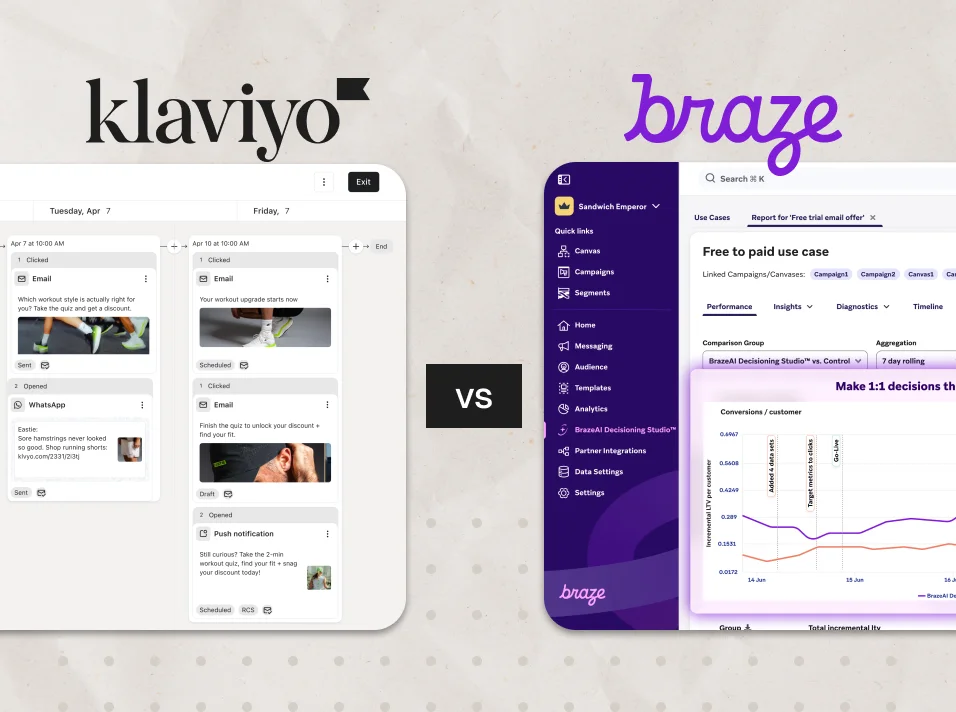
Customer.io vs Braze: the short answer
Customer.io is the better fit when your subscription runs primarily on email and your engineering team is comfortable owning the event pipeline. Braze is the better fit when a large share of engagement happens inside a mobile app and you need push, in-app messages and content cards orchestrated in the same journey as email.
That framing matters more than any feature checklist, because both platforms will technically do what you ask. The question is how much of your team's week each one consumes.
Where each platform actually sits in the market
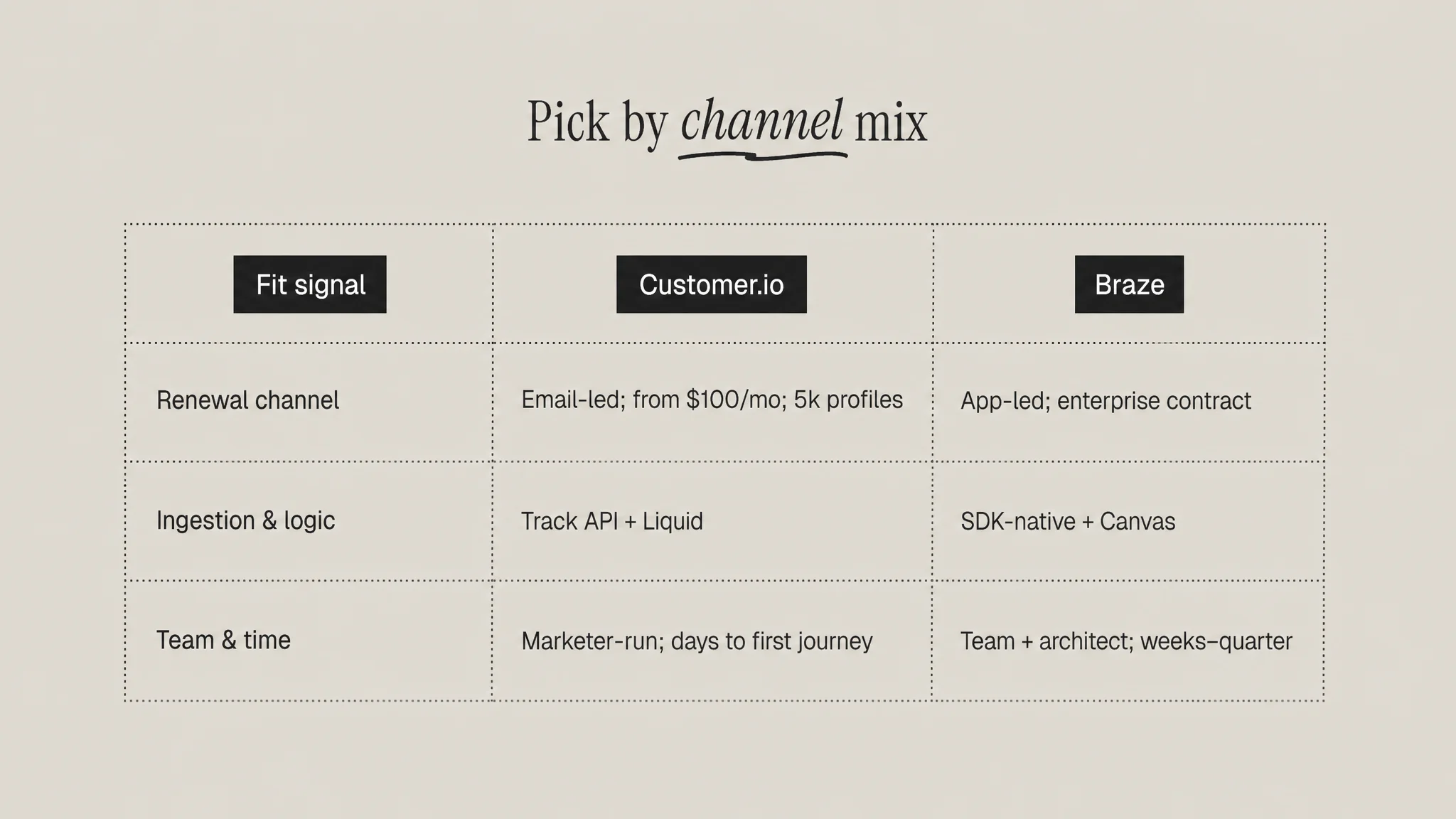
Braze is a public company operating at genuine enterprise scale. Its fiscal year 2026 results reported $738.2 million in revenue, up 24.4 percent year over year, with 2,609 total customers. Of those, 333 customers carried annual recurring revenue of $500,000 or more. Dollar-based net retention sat at 109 percent for the trailing twelve months.
Read those two numbers together and the shape of the business becomes clear. Braze has roughly 2,600 customers and three quarters of a billion dollars in revenue. The average contract is large. The product is designed and priced for teams with a dedicated lifecycle function and, frequently, a solutions architect on the vendor side.
Customer.io publishes its pricing openly. Per the official pricing page, the Essentials plan starts at $100 per month and includes 5,000 profiles, capped at one million monthly emails and two object types. Premium starts at $1,000 per month billed yearly and opens up custom email volumes, ten object types and premium integrations. Enterprise adds dedicated infrastructure, a named customer success manager and audit logging.
Published pricing is not a small thing. It tells you the product is meant to be bought by a marketing team without a six-week procurement cycle, and it means you can model your cost before you talk to anyone.
The five decisions that actually separate them for subscription brands
1. How your billing events get in
This is the decision that quietly determines everything else. A subscription brand's most valuable lifecycle triggers are not opens and clicks. They are subscription created, payment failed, plan downgraded, skip requested and cancellation initiated. If those events do not arrive in the platform within seconds, your dunning flow is decorative.
Customer.io is built around a track API and data-driven segments that recompute as events land. The mental model is that you push events and attributes in, and segments follow. Teams that already run a warehouse or a CDP tend to find this natural.
Braze uses SDK-native ingestion as its primary path, with a REST API alongside. When your subscription state lives in the app, that SDK relationship is an advantage. When your subscription state lives in Stripe or Recharge and never touches the app, you are doing server-side integration work either way.
2. Which channel carries the renewal
Ask a blunt question: if email disappeared tomorrow, how much of your renewal revenue would survive?
- Mostly email. Replenishment boxes, supplement subscriptions, most DTC. Customer.io covers this comfortably and you will not pay for mobile infrastructure you never use.
- Email plus meaningful push. Consumer apps, fitness, media, anything with daily active usage. Braze's journey orchestration and its Canvas model were designed for exactly this multi-channel case.
Most brands overestimate how much push they will actually send. Be honest about it before you buy a platform priced on the assumption.
3. Who builds the journeys
Customer.io journeys are built by marketers with a moderate technical bent. Liquid templating is expected. Someone on the team should be comfortable reading a JSON payload.
Braze Canvas is more visual and more governable, which matters when eight people can edit campaigns and you need approval gates. It also carries more configuration surface, which is why Braze deployments frequently involve a partner during the first quarter.
If you are staffing this decision as well as making it, our guide on what a lifecycle marketing agency does is a useful companion read.
4. What you will pay in year two
Customer.io prices on profiles. Subscription brands accumulate profiles fast, including churned subscribers you keep for winback. Model your profile count at month twenty-four, not month one, and decide your suppression and deletion policy early.
Braze prices on a negotiated contract that typically includes monthly active users and message volume. The number you are quoted in year one is rarely the number in year three. Ask for the renewal uplift in writing.
5. What migration will actually cost you
Neither vendor's migration is trivial. We have documented both directions in detail: Customer.io to Braze and Braze to Customer.io. The consistent pattern across both is that the messaging templates are the easy part. The hard part is re-establishing event parity and proving that every trigger fires identically before you cut over.
A side-by-side view
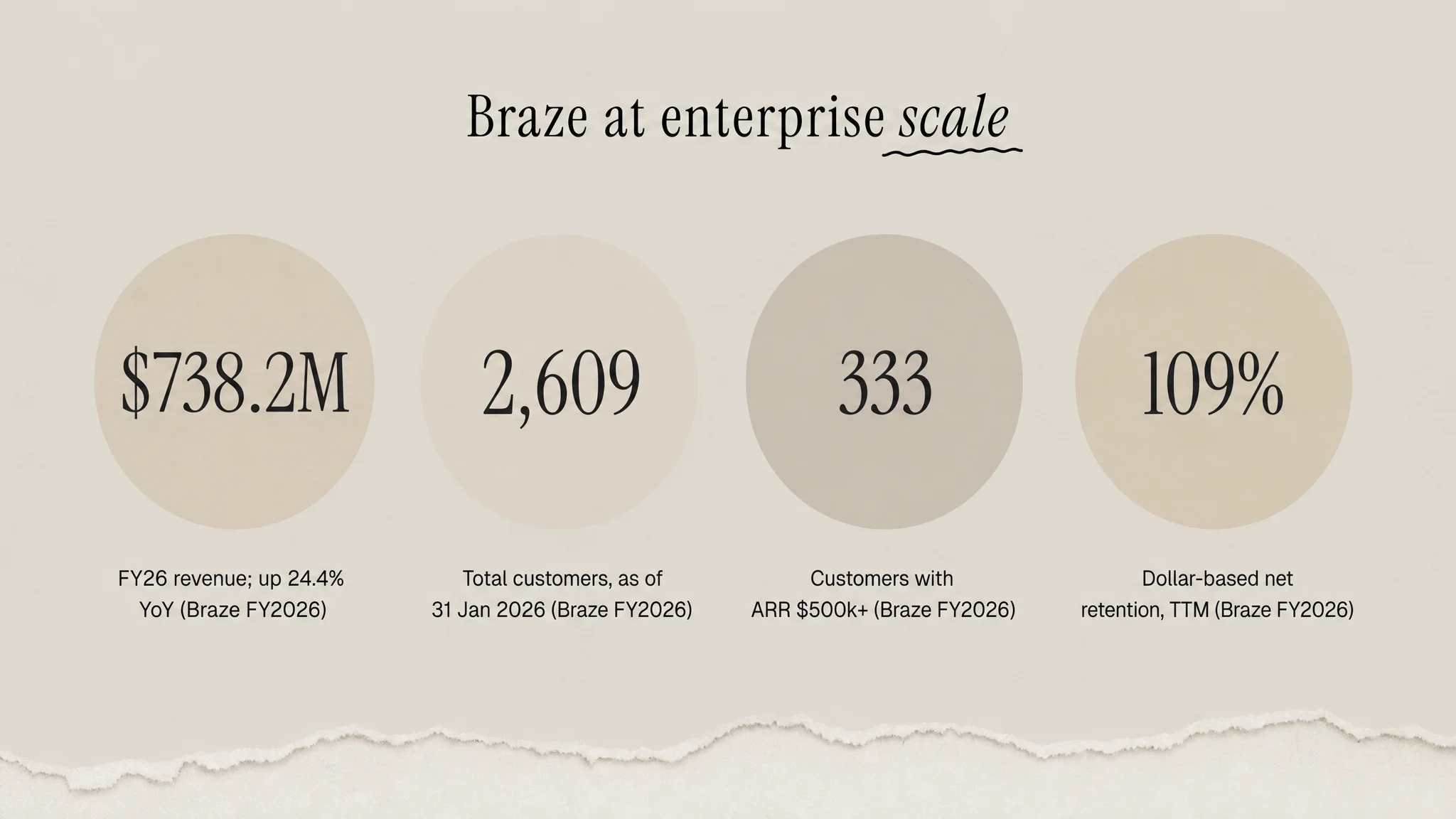
| Dimension | Customer.io | Braze |
|---|---|---|
| Entry price | $100/month, 5,000 profiles (Essentials) | Negotiated contract, enterprise-oriented |
| Pricing transparency | Published publicly | Sales-led |
| Primary data path | Track API and data-driven segments | SDK-native, plus REST API |
| Strongest channel | Email and server-side messaging | Mobile push, in-app, content cards |
| Journey builder | Workflow builder, Liquid templating | Canvas, visual with governance controls |
| Typical buyer | Growth or lifecycle lead | Lifecycle team with engineering partner |
| Time to first journey | Days to weeks | Weeks to a quarter |
The subscription-specific flows to test in your trial
Do not evaluate these platforms on a welcome series. Every tool sends a welcome series. Evaluate them on the four flows that actually protect recurring revenue.
Failed payment recovery
Build the full dunning sequence: an immediate soft notice, a retry-aligned follow-up, a card-update deep link, and a final notice before involuntary churn. Time how long it takes and whether the retry schedule from your billing provider can drive the cadence. Involuntary churn is the cheapest churn to fix and the most commonly ignored. Our guide to reducing subscriber churn covers the sequencing in depth.
Pre-renewal value reminder
Seven days before a renewal charge, the subscriber should see what they got from the last cycle. This flow needs personalisation from your product data, not from your email platform's engagement data, which is a good stress test of the integration.
Skip and pause deflection
When someone heads for the cancel button, a skip or pause offer often saves the relationship. This requires the platform to react to an in-session event within seconds. Test it live.
Post-cancellation winback
The winback window for subscriptions is longer than for one-off purchases, and the messaging is different. See our breakdown of the win-back email flow for the timing benchmarks.
How to make the call in two weeks
- Write down your five highest-value events. If you cannot name them, the platform choice is premature.
- Attribute renewal revenue by channel. Actual numbers, last ninety days.
- Build the dunning flow in both trials. Same spec, same data, and time each build.
- Price both at your month-twenty-four profile count. Include churned profiles you intend to retain.
- Ask each vendor to show a failed-payment flow firing live. Not a slide. A live send.
If the two builds take a similar amount of time and your revenue is email-weighted, take the cheaper, more transparent option. If the Braze build is faster because your events already live in the SDK, that speed is telling you something real about the next three years.
The bottom line
Customer.io and Braze are both credible homes for a subscription brand's lifecycle programme. The wrong question is which is better. The right question is which one your specific data, channel mix and team can operate at full strength within a quarter.
Subscription retention is won on the flows that run when nobody is watching: the failed payment at 2am, the pre-renewal nudge, the pause offer at the cancel screen. Pick the platform that gets those live fastest, and revisit the decision when your channel mix genuinely changes. For the strategic layer above the tooling, start with what subscription retention actually means and our wider guide to retention marketing for subscription brands.
Sources
- Braze, Inc. Reports Fiscal Year and Fourth Quarter 2026 Results, Braze Investor Relations
- Customer.io Pricing, Customer.io
- Data-driven segments, Customer.io Docs
- Customer Journey Orchestration Platform, Braze
- Getting Started: Campaigns and Canvases, Braze Docs
Frequently Asked Questions
Is Customer.io or Braze better for subscription brands?
Neither is universally better. Customer.io suits subscription brands whose renewal revenue is carried mainly by email and whose team can own the event pipeline directly. Braze suits brands where mobile push and in-app messaging carry meaningful revenue alongside email, because its SDK-native ingestion and Canvas orchestration were built for that multi-channel case. Decide by auditing which channel actually drives renewals over the last ninety days.
How much do Customer.io and Braze cost in 2026?
Customer.io publishes its pricing: Essentials starts at $100 per month for 5,000 profiles, Premium starts at $1,000 per month billed yearly, and Enterprise is custom. Braze does not publish list pricing and sells negotiated enterprise contracts. Braze reported $738.2 million in fiscal 2026 revenue across 2,609 customers, with 333 customers above $500,000 in annual recurring revenue, which indicates a large average contract size.
Which platform handles failed payment recovery better?
Both can run full dunning sequences, so the difference is integration latency rather than features. What matters is how quickly your billing provider events reach the platform. Customer.io ingests through a track API with data-driven segments that recompute as events land. Braze ingests SDK-first with a REST API alongside. Build the same dunning flow in both trials and time it before deciding.
How long does migrating between Customer.io and Braze take?
Budget six to twelve weeks of parallel running before sunsetting the old platform. Templates migrate quickly. The slow work is re-establishing event parity and proving every trigger fires identically in both systems before cutover. Subscription brands should validate failed payment, pre-renewal, pause deflection and winback flows individually, since those carry the recurring revenue.
Do I need engineering support to run either platform?
Yes, for the integration in both cases. Day to day, Customer.io journeys are typically operated by a marketer comfortable with Liquid templating and JSON payloads. Braze Canvas is more visual with stronger governance controls, which helps larger teams, but Braze deployments often involve a partner or solutions architect during the first quarter. Neither is a no-code tool once subscription billing events are involved.