Summarize this documentation using AI
Key Takeaways
- Involuntary churn is subscription loss caused by a failed payment, not by a decision to cancel. The customer still wants the product; the charge simply did not go through.
- Paddle reports that payment errors can make up as much as 40% of a company's churn, and Recurly estimated that failed payments could cost subscription businesses more than $129 billion in 2025.
- The causes split into soft declines (insufficient funds, temporary issuer issues), which retries can fix, and hard declines (lost, stolen or closed cards), which need a new payment method.
- The recovery stack has four layers: card updater services, smart retries, dunning messages across email and SMS, and pre-dunning reminders before a card expires.
- It is the cheapest churn to fix, because there is no objection to overcome. The work is operational, and most of it can be automated.
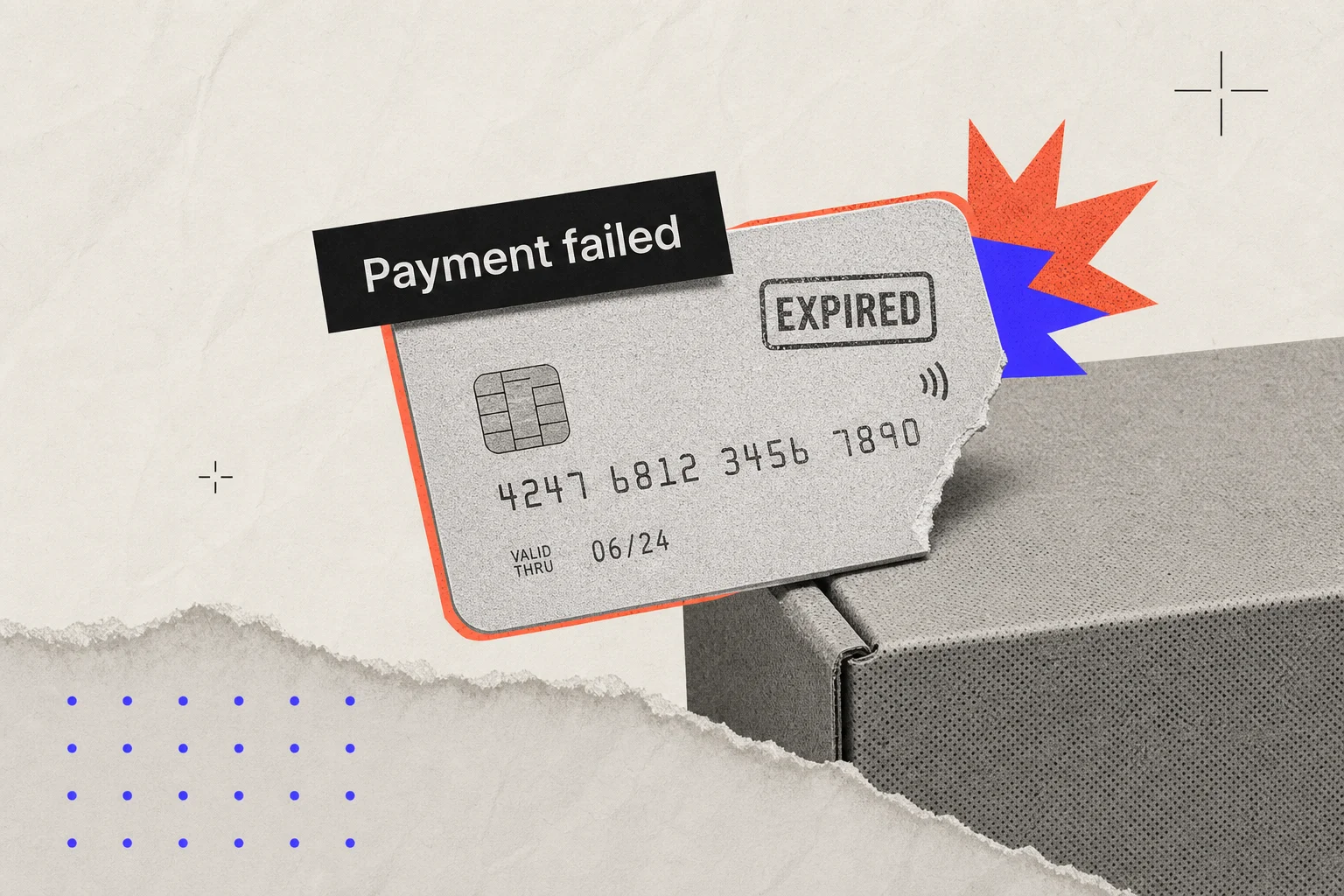
Involuntary churn is the loss of subscribers whose recurring payment fails and is never recovered, so the subscription lapses even though the customer never chose to cancel. Expired cards, replaced cards and bank declines are the usual causes.
It sits alongside voluntary churn, where a customer actively cancels, and the two need completely different responses. Voluntary churn is a product, value or experience problem. Involuntary churn is a billing and communication problem, which is why it is often the fastest revenue win in a churn prevention program.
What counts as involuntary churn
Chargebee defines involuntary churn as customers who cannot continue a service for reasons partly or entirely outside their control, mostly payment processing issues. Its billing system classifies a cancellation as involuntary when the reason is a payment that was not paid, no card on file, a failed fraud review or a compliance or tax failure.
In practice, for a DTC subscription brand, the main triggers are:
- Expired cards. The card on file reaches its expiry date and the renewal charge is declined.
- Replaced cards. The bank reissues a card after loss, theft or a data breach, and the old number stops working.
- Insufficient funds. The account is short on the billing date, often temporarily.
- Issuer and network declines. Generic declines, fraud filters catching a legitimate charge, or authentication requirements the customer never completes.
Soft declines vs hard declines
This distinction decides what you do next. A soft decline is temporary: the card is valid but the charge failed today, for example because of low funds or an issuer timeout. Retrying later can succeed. A hard decline is permanent for that card. Stripe lists codes such as lost card, stolen card, incorrect number and revocation of authorization as hard declines, and its documentation states that it will not execute retries on these until the customer supplies a new payment method. Retrying a hard decline wastes attempts and can attract network penalties, so the only fix is getting the customer to update their details.
How to calculate it
Track involuntary churn separately from total churn, both as a subscriber rate and as revenue.
Involuntary churn rate = subscribers cancelled due to unrecovered payment failure in the period / subscribers active at the start of the period x 100
Chargebee's revenue version is simpler: involuntary cancellation MRR equals the total MRR lost from subscriptions cancelled for involuntary reasons. In its worked example, ten customers on a $10 monthly plan churn involuntarily, which equals $100 of lost MRR.
Two companion metrics make the number actionable:
- Failed payment rate: the share of renewal charges that fail on the first attempt.
- Recovery rate: the share of failed charges eventually collected through retries, card updates or customer action.
Involuntary churn is roughly failed payments multiplied by the share you fail to recover. That tells you whether to work on preventing failures or on recovering them. For the full picture of how this rolls into overall churn, see our guide to subscription churn.
Benchmarks: how big the problem is
Public benchmarks mostly come from billing platforms with a product to sell, so read them as directional.
| Figure | Source | What it tells you |
|---|---|---|
| Up to 40% of churn | Paddle | Payment errors can make up as much as 40% of a company's churn |
| $129 billion | Recurly | Estimated cost of failed payments to subscription companies in 2025 |
| 96% | Recurly | Average renewal invoice paid rate Recurly reports for merchants using its churn management tools |
| 8 tries in 2 weeks | Stripe | Recommended default Smart Retries policy |
| 30 days | Paddle | Default dunning window in Paddle Retain |
The more useful benchmark is your own. Pull failed payment rate, recovery rate and involuntary share of churn for the last six months, by cohort, and you will see whether the problem is growing as your base ages and cards turn over.
How to reduce involuntary churn
Think of recovery as layers, each catching what the previous one missed.
1. Card updater services
Card networks run account updater programs that pass new card details to merchants when a bank reissues a card. Stripe's documentation explains that it automatically attempts to update saved cards when a customer receives a replacement, and that this is widely supported in the United States for American Express, Visa, Mastercard and Discover, with coverage depending on issuer participation elsewhere. Confirm it is switched on with your processor; it fixes failures before they happen.
2. Smart retries
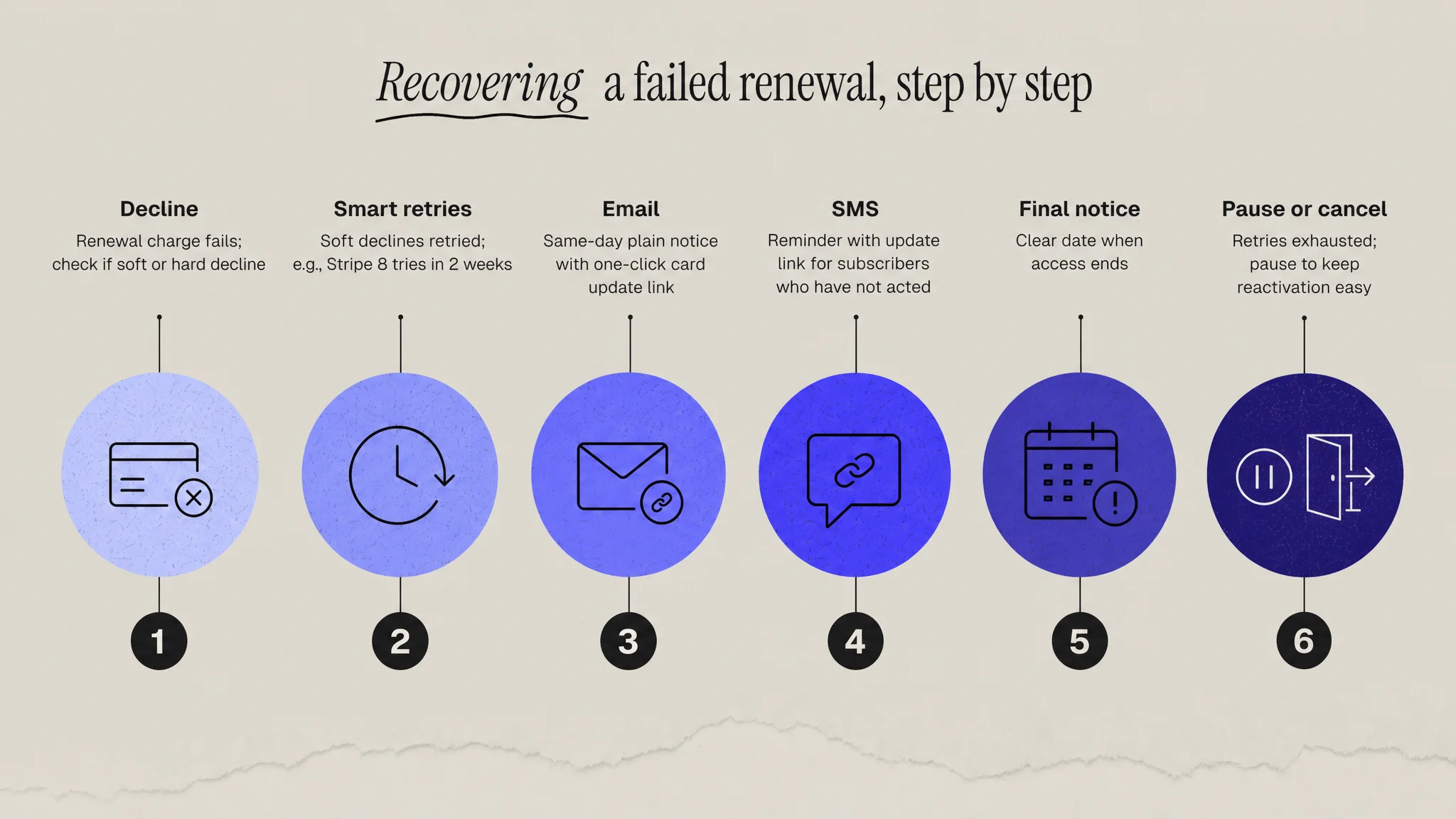
Retrying a soft decline at the right moment recovers revenue with no customer effort. Stripe's Smart Retries use an AI model fed by time-dependent signals, such as the best time to pay and the number of devices that have recently presented the card, to choose retry timing, with a recommended default of eight attempts within two weeks. Avoid fixed daily retries on the same hour; timing matters, and hard declines should not be retried at all.
3. Dunning emails and SMS
Dunning is the sequence of messages asking the customer to fix their payment. The principles that hold up:
- Send the first message on the day of the failure, in plain language, with one link that goes straight to a payment update page. No login wall.
- Escalate gradually. Friendly notice, then reminder, then a clear final notice stating when access ends.
- Add SMS for higher-value subscribers. Paddle's recovery flow layers SMS and in-app prompts on top of email for exactly this reason. Our guide on how to integrate email and SMS campaigns covers sequencing so the channels do not double up.
A typical sequence runs from the decline through retries and escalating messages to a final notice before cancellation or pause.
4. Pre-dunning reminders
The best failed payment is the one that never happens. If you know a card expires next month, ask for an update now. Most billing platforms offer a basic expiring-card email. Brands on Klaviyo, Braze or Customer.io can do better by syncing the card expiry date as a profile property and triggering a branded email 30 days out, with an SMS follow-up closer to the date.
5. Decide what happens at the end
When retries are exhausted, you can cancel, mark the subscription unpaid, leave it past due or pause it. Pausing keeps the relationship and makes reactivation one click away, which is often better than a hard cancel.
Common mistakes
- Blending it into total churn. If involuntary and voluntary churn sit in one number, you cannot tell whether a retention initiative worked or billing simply had a good month.
- Retrying hard declines. It burns attempts and does not work.
- Sending customers to a login page. Every extra step loses people who were happy to pay.
- Running default processor emails only. Platform defaults are a floor. Branded, multi-channel sequences from your lifecycle platform usually outperform them.
- Treating a lapsed payer as a lost customer. Someone whose card failed has not rejected you, so win-back messaging should reflect that.
How it connects to the rest of the lifecycle program
Involuntary churn is where billing and lifecycle marketing meet. Recovered subscribers flow straight back into customer LTV, which is why small gains in recovery compound over a subscriber's lifetime. It belongs in any review of subscription retention, alongside the voluntary churn work covered in how to reduce subscriber churn.
Customers who lapse after dunning ends should enter a dedicated win-back path, ranked by value, as set out in the win-back hierarchy.
The bottom line
Involuntary churn is revenue you lose from customers who still want to pay. Separate it from voluntary churn, measure failed payment and recovery rates, turn on card updates, retry soft declines intelligently, run a short multi-channel dunning sequence and remind customers before cards expire.
Sources
- Paddle, Payment failure: the number one cause of involuntary churn
- Paddle Developer Docs, Payment Recovery (dunning)
- Recurly, Failed payments could cost subscription companies more than $129 billion in 2025
- Stripe Docs, Smart Retries and automatic payment retries
- Stripe Docs, Cards overview: automatic card updates
- Chargebee Docs, What is the Involuntary Cancellation MRR metric report?
Frequently Asked Questions
What is the difference between voluntary and involuntary churn?
Voluntary churn happens when a subscriber decides to cancel, usually because of price, product fit or experience. Involuntary churn happens when the subscriber still wants the service but a renewal payment fails and is never collected, so the subscription lapses anyway. The fixes are different: voluntary churn needs better value and offboarding, while involuntary churn needs payment retries, card updates and clear payment reminders.
What causes most failed subscription payments?
The most common causes are expired cards, cards reissued after loss, theft or a breach, insufficient funds on the billing date, and issuer declines such as fraud filters or authentication requests the customer never completes. Some of these are temporary and clear on a later retry. Others, like a closed or stolen card, will keep failing until the customer adds a new payment method.
How many times should you retry a failed subscription payment?
There is no universal number, but Stripe recommends a default of eight Smart Retry attempts within two weeks, timed by its model rather than on a fixed daily schedule. Retries only help with soft declines such as low funds. Hard declines like lost or stolen cards should not be retried, because they cannot succeed without a new card and repeated attempts can trigger network penalties.
How long should a dunning sequence last?
Billing platform defaults give a useful range. Paddle runs dunning over 30 days by default, while Stripe lets you set a retry period anywhere from one week to two months. The right length depends on billing frequency and margin: monthly plans usually suit a shorter window, while annual plans justify a longer one because each recovered payment is worth more.
Is involuntary churn worth fixing before voluntary churn?
Often, yes. Involuntary churn involves customers who have not rejected the product, so there is no objection to overcome, only a payment to collect. Turning on card updaters, smarter retries and a short email and SMS dunning sequence is mostly configuration work that pays back quickly. Voluntary churn work matters too, but it usually takes longer to show results.