.webp)
Summarize this documentation using AI
A customer health score is a single composite metric, usually on a 0 to 100 scale, that combines behavioral, engagement, and transactional signals into one number that predicts how likely a customer is to stay, grow, or churn. It turns a scattered set of signals (recency, frequency, product usage, support history) into an at-a-glance indicator a team can actually act on. The point of a health score is to be a leading indicator: it tells you a customer is drifting weeks before they cancel, which is exactly the window where intervention is cheapest and most effective, given that acquiring a replacement customer costs five to 25 times more than retaining one (HBR).
Key Takeaways
- One number, many signals. A health score rolls recency, frequency, engagement, and satisfaction into a single 0 to 100 indicator of retention risk.
- It is a leading indicator. Unlike churn rate, which reports the past, a health score predicts the future so you can act before a customer lapses.
- It powers proactive retention. The score is the input that makes identifying users about to churn systematic rather than anecdotal.
- Segments drive action. Splitting customers into healthy, at-risk, and critical bands tells you exactly where to spend retention effort.
- The upside is large. Because a 5% retention lift can raise profits 25% to 95% (Bain), catching at-risk customers early compounds quickly.
What a Customer Health Score Is
A customer health score answers one question: how likely is this customer to still be here next quarter? It exists because the signals that predict churn are scattered across systems (orders, email opens, app sessions, support tickets) and no single one is decisive. The score combines them into a weighted composite so a team can triage thousands of customers at a glance. It is the measurement backbone of proactive retention marketing and a core instrument in any serious retention program, sitting alongside the other retention metrics and KPIs worth mastering.
What Goes Into the Score
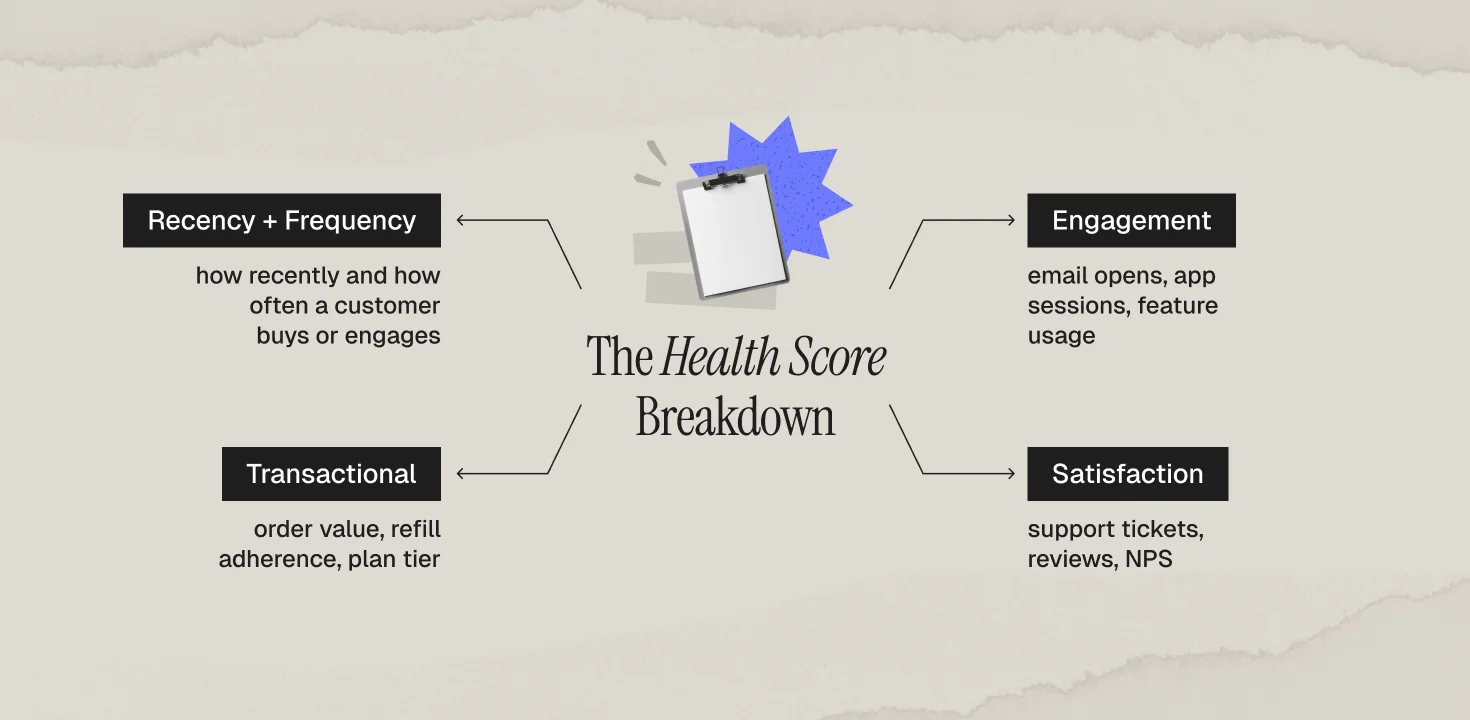
Most health scores blend four families of signal. Recency and frequency (how recently and how often a customer buys or engages) are the backbone, which is why RFM analysis is often the starting point. Engagement (email opens, app sessions, feature usage) shows whether the relationship is active. Transactional signals (order value, refill adherence, plan tier) show commercial depth. And satisfaction signals (support tickets, reviews, NPS) show sentiment. The art is weighting these to reflect what actually predicts churn in your business, which is where behavioral segmentation turns raw signals into meaningful inputs.
Leading vs Lagging Indicators
The reason a health score matters is timing. Churn rate is a lagging indicator: by the time it moves, the customers are already gone. A health score is a leading indicator: it moves while you can still act. This is the same distinction that separates a reporting dashboard from an operating tool. A brand that only watches lagging metrics is always reacting; a brand that watches a health score is intervening, which is the entire premise of customer activation and early-lifecycle retention work.
How to Build a Health Score
Building one is a four-step loop. First, list the signals you can reliably measure. Second, weight them by how strongly each correlates with actual churn in your historical data (do not guess the weights, validate them). Third, normalize to a 0 to 100 scale and set band thresholds (for example, 70+ healthy, 40 to 69 at-risk, under 40 critical). Fourth, backtest: does the score actually separate customers who churned from those who stayed? Then refine. A health score that has not been validated against real churn is just a vanity number.
How to Act on It
A score is only useful if it triggers action. Map each band to a play: healthy customers get growth and advocacy offers, at-risk customers get proactive re-engagement and better onboarding or education if they are early, and critical customers get a targeted save intervention before they lapse. The score turns a vague goal ("reduce churn") into a specific, prioritized worklist, which is what makes proactive identification of at-risk users repeatable instead of reactive.
Frequently Asked Questions
What is a customer health score?
A single composite metric (typically 0 to 100) that combines behavioral, engagement, transactional, and satisfaction signals to predict how likely a customer is to stay, grow, or churn.
What signals go into a health score?
Usually recency and frequency (the RFM backbone), engagement (opens, sessions, usage), transactional depth (order value, adherence), and satisfaction (tickets, reviews). Weights should be validated against real churn.
Why use a health score instead of churn rate?
Churn rate is a lagging indicator that reports loss after it happens; a health score is a leading indicator that predicts it, giving you time to intervene while the fix is still cheap.
How do I build a customer health score?
List measurable signals, weight them by their correlation with actual churn, normalize to 0 to 100, set healthy/at-risk/critical bands, and backtest against historical churn before you rely on it.
How do I act on a customer health score?
Map each band to a play: grow the healthy, re-engage the at-risk, and run targeted saves on the critical. The score becomes a prioritized retention worklist.
![Featured image: How to Identify Users Who Are About to Churn [2026 Guide for Retention Marketers]](https://cdn.prod.website-files.com/69bbf9f7f2a3f75341357ebc/69f4b4ad14f8c675169e0cba_69c7cec26de0e50005c6e495_698ae45b9ecbf9983380f731_6909f1e088d37bed0144f247_Identify%25252520User%25252520churn-2-min.png)
.png)