
Summarize this documentation using AI
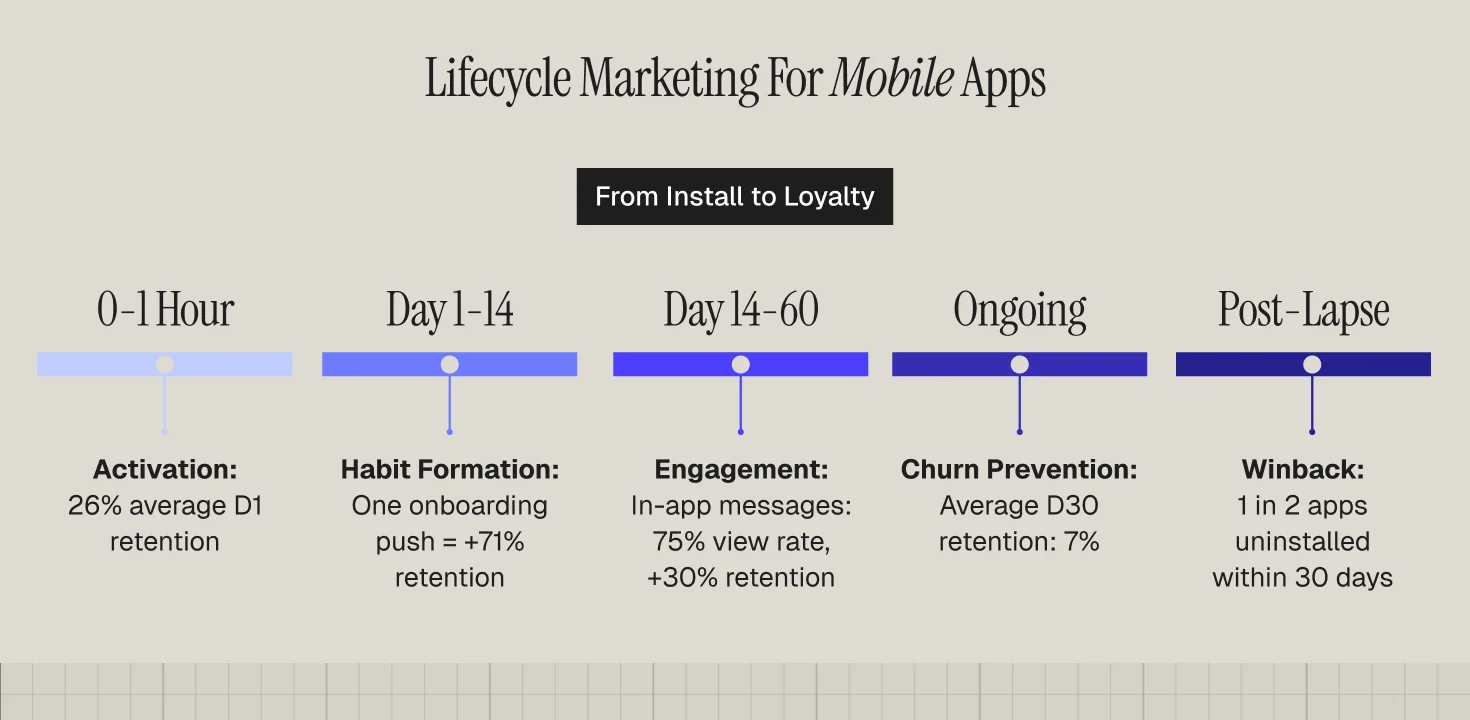
The brutal math of mobile apps: the average app keeps 26% of users on day 1, 13% by day 7, and roughly 7% by day 30. More than 1 in 2 apps installed are uninstalled within 30 days. You can spend your way past that wall with paid installs, or you can build the lifecycle machine that keeps the users you already paid for.
Lifecycle marketing for mobile apps is that machine: coordinated messaging across push, in-app, email, and SMS, triggered by what users actually do, mapped to each stage from install to loyalty. This playbook covers the stages, the flows that matter at each one, and the 2026 benchmarks to hold yourself against.
At Propel, we build these programs for consumer apps on Braze, MoEngage, OneSignal, and Customer.io. Here is the playbook we run.
Why apps need lifecycle marketing more than any other business model
An ecommerce brand that loses a customer loses future orders. An app that loses a user loses everything, usually within 72 hours: the average app loses 77% of its daily active users within the first 3 days after install.
Three structural facts drive the playbook. First, the drop-off is front-loaded, so onboarding messaging carries more weight than any other flow. Second, apps own channels ecommerce does not: push and in-app messaging reach users at near-zero marginal cost, and owned-media audiences show 30% higher day-30 retention than paid acquisition cohorts. Third, engagement is the retention signal: 90% of users who engage with an app at least once a week are likely to become long-term users. Every flow below exists to manufacture that weekly habit. This is the same behavioral trigger logic that powers retention in every vertical, compressed into a faster clock.
The 5 lifecycle stages for mobile apps (and the flows that move each one)
Stage 1: Activation (day 0 to 1)
The activation window is measured in minutes, not days. The job: get the user to the first value moment (first workout logged, first playlist saved, first order placed) before the session ends.
Flows that matter: a progressive onboarding sequence of in-app messages that drives setup completion, a permission-priming screen before the OS push prompt (opt-in rates average 60% overall, but 51% on iOS vs 81% on Android, and priming is the biggest lever), and a same-day email that bridges users back if the first session ends early. Our definition guide to customer activation covers how to pick your activation event.
Stage 2: Habit formation (day 1 to 14)
This is where the 77% three-day cliff lives. The single highest-leverage tactic is embarrassingly simple: sending just one onboarding push notification in the first week increases 2-month retention by 71%, and pairing that push with a second channel (email or in-app) pushes the lift to 130%.
Flows that matter: a day-1 to day-14 habit ladder (streaks, progress milestones, feature discovery), behavioral nudges triggered by incomplete actions, and a stalled-user rescue flow that fires when a new user goes 48 hours silent. Full channel tactics in our push notification strategy playbook.
Stage 3: Engagement deepening (day 14 to 60)
Once the habit exists, widen it. In-app messaging is the workhorse here: it reaches only active users, carries a view rate around 75%, roughly 3x push, and apps using it well see retention improve by about 30%.
Flows that matter: feature adoption campaigns, cross-feature discovery, personalized content digests, and (for freemium apps) upgrade moments triggered by usage ceilings rather than calendars.
Stage 4: Churn prevention (ongoing)
By day 30, an average app retains 7%, but the top quartile holds 5 to 8% and category leaders like fintech reach 9 to 10%. The difference is almost always a real churn-risk flow. Score declining session frequency, then intervene early with value reminders, not discounts. Our guide on identifying users about to churn covers the signal stack.
Stage 5: Winback and re-permission (post-lapse)
Uninstall is not the end: email and SMS survive the uninstall, which is exactly why apps need channels beyond push. A winback sequence that leads with what changed since the user left consistently outperforms generic we-miss-you sends.
Channel roles: push vs in-app vs email vs SMS
The most common mistake in app lifecycle marketing is treating channels as interchangeable megaphones. Each has a distinct job. Push re-engages users who are away (reaction rates average 4.6% on Android and 3.4% on iOS, so it is a volume-and-timing game). In-app converts users who are present. Email carries depth: receipts, digests, education, and winback after uninstall. SMS is the scarcity channel, reserved for high-value, time-critical moments.
Orchestration across all four is where platform choice matters. We compare the two leading consumer-app platforms in Braze vs MoEngage for consumer apps.
Benchmarks to hold your app against (2026)
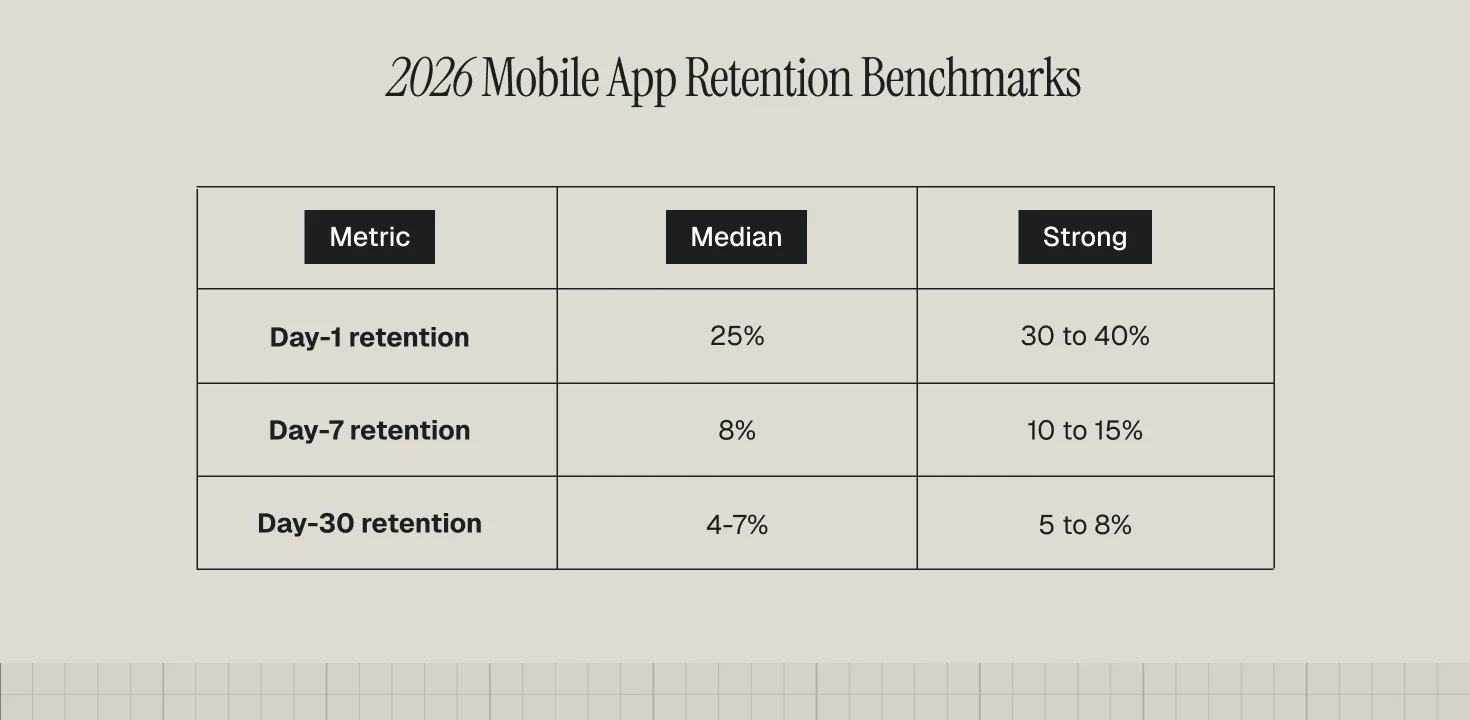
Day-1 retention: 25% is median, 30 to 40% is strong. Day-7: 8% median, 10 to 15% strong. Day-30: 4 to 7% median depending on source, 5 to 8% strong, with fintech at 9% and shopping apps at 8.7%. Push opt-in: 60% blended. DAU/MAU: 20% is good, 25%+ is exceptional. If you are below median at day 7 but fine at day 1, your problem is habit flows, not acquisition quality. If you are below median at day 1, fix onboarding before touching messaging volume. For vertical-specific programs, see our guides on retention for lifestyle apps and fitness and weight loss apps.
How Propel runs lifecycle for apps
We design and operate mobile app retention programs end to end: activation event definition, flow architecture, platform implementation, and weekly experiment cycles. If your D30 is stuck under 5% and paid CAC keeps climbing, the fix is lifecycle, not more installs.
Frequently Asked Questions
What is lifecycle marketing for mobile apps?
Lifecycle marketing for mobile apps is the practice of sending coordinated, behavior-triggered messages across push, in-app, email, and SMS, mapped to the user's stage: activation, habit formation, engagement, churn prevention, and winback. Its goal is moving users to the next stage rather than broadcasting to everyone.
What is a good day-30 retention rate for a mobile app?
Across all categories the median sits around 4 to 7%. Above 5% is healthy for most B2C apps, above 9% is strong for fintech, and 8 to 15% is excellent for shopping and social apps. Sources vary slightly: Adjust benchmarks put D30 at 7% while AppsFlyer data puts iOS at 5.3% and Android at 3.8%.
Do push notifications actually improve retention?
Yes, measurably. Users who receive even one onboarding push in their first week retain 71% better over two months, and pairing push with a second channel raises the lift to 130%. The caveat: excessive notifications drive deletes, with about 30% of users uninstalling over notification spam.
Which platform is best for app lifecycle marketing?
For consumer apps at scale, Braze and MoEngage lead on orchestration depth; OneSignal wins on speed-to-value for earlier-stage apps; Customer.io wins when app and web lifecycle logic need to share one brain. The right answer depends on event volume, team size, and how much journey complexity you will actually staff.
How is app lifecycle marketing different from ecommerce lifecycle marketing?
The clock is faster and the channels are different. Apps lose 77% of daily actives within 3 days, so onboarding flows dominate; ecommerce loses customers over months, so post-purchase and replenishment flows dominate. Apps also own push and in-app channels, while ecommerce leans on email and SMS.
