
Summarize this documentation using AI
TL;DR
- Strategic Right-Sizing: Migrating from Braze to Klaviyo is not a "downgrade." It is a move toward operational agility, replacing high-cost developer dependency with marketer-led execution.
- The Data Export Hurdle: Braze is an enterprise "walled garden." You cannot use a simple CSV export; you must utilize Braze’s Data Export API or SFTP "Currents" to preserve user profile integrity.
- The Mobile Context: For brands where the mobile app is the primary revenue driver, this migration requires a specialized evaluation of push notification and in-app messaging parity.
- Revenue Lift: By shifting to a native ecommerce data model, brands typically see a 20%+ lift in email-attributed revenue as they move from broad multi-channel journeys to SKU-specific behavioral flows.
The Strategic Framework: Why Braze to Klaviyo is "Right-Sizing"
Braze is an enterprise-grade customer engagement platform (CEP). It was architected for global conglomerates with massive technical resources and complex multi-channel needs spanning mobile apps, web, and even connected devices. For brands like HBO or DoorDash, Braze is the correct choice.
However, many mid-market DTC ecommerce brands end up on Braze through rapid growth, venture capital directives, or "early-stage overshoot." These brands often find themselves paying enterprise premiums for features like Content Cards or In-App Messaging that their transactional web-based model doesn't actually utilize.
The Klaviyo advantage in this context is "Marketer Independence." In Braze, a new segment or a sophisticated multi-step "Canvas" often requires a marketing engineer or a Jira ticket to a developer. In Klaviyo, a retention manager can build SKU-specific segments and trigger flows based on real-time Shopify events in minutes.
At Propel, we view this migration as a move from "Technical Overhead" to "Strategic Agility." You are trading unused enterprise complexity for a platform that is purpose-built to maximize DTC revenue and LTV attribution.
Evaluating the "Mobile-First" Risk
Before committing to the migration, a senior operator must perform a "Channel Audit." Braze is a mobile-first platform; Klaviyo is an ecommerce-first platform.
You should migrate if:
- 90%+ of your revenue is web-based (Shopify, WooCommerce, BigCommerce).
- Your mobile app serves primarily as a "wrapper" for the web experience.
- Your team is using less than 20% of Braze's "Canvas" features.
- You find Braze’s ecommerce data integration to be "clunky" or reliant on custom API calls rather than native SKU-level visibility.
You should hesitate if:
- Your mobile app is a core part of the product experience (e.g., a fitness app or a high-frequency delivery app).
- You rely heavily on In-App Messages or Content Cards to drive retention.
- You have high-volume push notification logic that requires deep orchestration across multiple app versions.
For the transactional DTC brand, the "Mobile Gap" is usually negligible compared to the massive gains in behavioral triggers and ecommerce segmentation provided by Klaviyo.
The Data Migration: Moving from an API-First Model
The single biggest technical hurdle in a Braze-to-Klaviyo migration is data extraction. Braze does not provide a "Download All" button for your customer database.
1. The API Extraction Method
To maintain data integrity, you must use the Braze Users by Global Control Group Export or the Data Export API.
- The Key Identifier: Braze often uses an external_id. Klaviyo uses the email_address as the primary key. You must ensure your export correctly maps these two fields to avoid creating duplicate "ghost" profiles in Klaviyo.
- Custom User Attributes: These are the equivalent of Klaviyo "Custom Profile Properties." Export these as CSVs, but be ruthless—if an attribute isn't being used for current segmentation or personalization, don't pay to store it in Klaviyo.
2. Subscription Groups vs. Lists
Braze manages consent through "Subscription Groups." Klaviyo manages it through "Lists" and a dedicated "Suppression List."
The Operator Move: You must export every Subscription Group separately to ensure that someone who opted out of "Weekly Newsletters" but stayed in "Product Updates" is mapped correctly to a corresponding Klaviyo List.
What Transfers and What Must Be Rebuilt
A. What Transfers (With Effort) ✅
- Identity Data: Name, Email, Phone, and City/State.
- Historical Traits: Attributes like "Favorite Category," "Loyalty Tier," or "Skin Type" (Custom User Attributes).
- Consent History: Unsubscribes and hard bounces (these are non-negotiable and must move first).
B. What Requires a Full Rebuild 🔄
- Canvases to Flows: Braze's multi-channel Canvases cannot be imported. You must re-map every logic step into a Klaviyo Flow. This is actually a major opportunity to implement proven customer retention strategies that were previously buried in Braze logic.
- Templates: Braze uses a different Liquid syntax than Klaviyo’s Django-based editor. All email and SMS templates must be rebuilt from scratch.
- Push Notifications: If you are keeping Push, the SDK and the notification logic must be re-implemented using Klaviyo’s mobile push infrastructure.
C. What You Lose Permanently ❎
- Engagement History: You cannot "backfill" opens and clicks from Braze into Klaviyo. Your engagement history in Klaviyo starts at zero.
- Content Cards: There is no 1:1 equivalent in Klaviyo for Braze’s "Content Card" system.
Braze to Klaviyo: Step-by-Step Migration Process
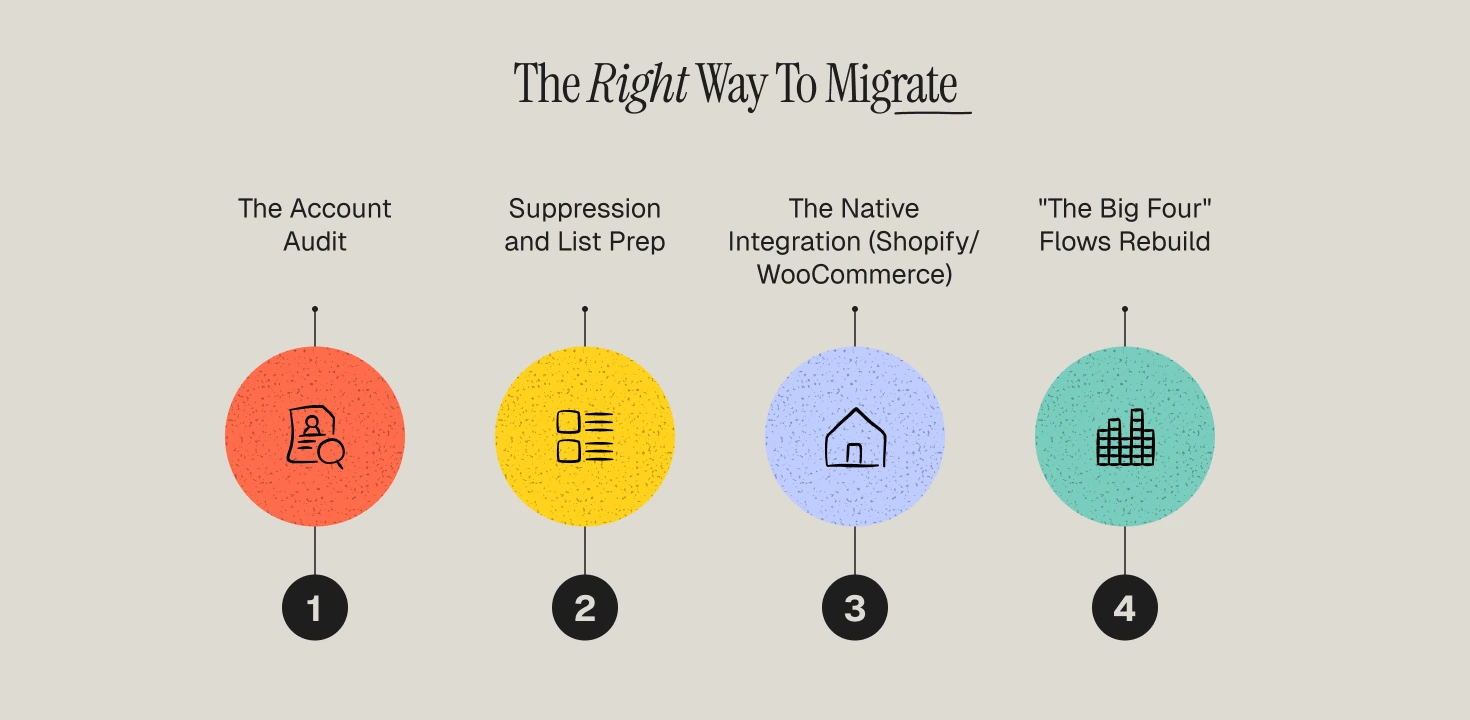
1️⃣ Phase 1: The Account Audit
Don't just look at the list; look at the triggers.
- Document every "Custom Event" being sent from your store to Braze.
- Identify which events are "Transactional" (Order Confirmation) and which are "Behavioral" (Added to Cart).
- Create a "Mapping Document" that shows exactly which Braze User Attribute corresponds to which Klaviyo Profile Property.
2️⃣ Phase 2: Suppression and List Prep
In an enterprise move, compliance is your biggest risk.
- Export your "Global Unsubscribe" and "Hard Bounce" lists from Braze.
- Upload these to Klaviyo's Suppression List before you do anything else. * This prevents "The Dead Window"—where a legacy Braze user who unsubscribed months ago accidentally receives a Welcome Flow email from your new Klaviyo account.
3️⃣ Phase 3: The Native Integration (Shopify/WooCommerce)
One of the primary reasons to move to Klaviyo is the native integration.
- Connect the Klaviyo app to your Shopify or WooCommerce store.
- Verify that the "Started Checkout" and "Placed Order" events are firing correctly.
- The Backfill: Klaviyo will automatically pull your historical purchase data from your ecommerce platform. This means you don't need to export "Purchase History" from Braze—Klaviyo will rebuild your customer's shopping history directly from the source of truth (your store).
4️⃣ Phase 4: Rebuilding "The Big Four" Flows
Do not replicate Braze logic exactly. Use this as a chance to implement behavioral segmentation.
- Welcome Series: Trigger on list subscription. Add a conditional split: Has Placed Order zero times.
- Abandoned Cart: Trigger on Started Checkout. Split by Cart Value. Offer a discount only to high-value carts.
- Browse Abandonment: Trigger on Viewed Product. This was likely difficult to set up in Braze; in Klaviyo, it’s a native trigger.
- Post-Purchase: Trigger on Placed Order. Use this to drive a second purchase based on the specific SKU they just bought.
Deliverability and The Warm-Up Phase
Braze often utilizes dedicated IPs or specialized sending pools. When you move to Klaviyo, you are moving to a new infrastructure. If you blast your entire 100k+ list on day one, you will end up in the spam folder.
The 30-Day Warm-Up Schedule:
- Days 1–7: Send only to "30-Day Engaged" (Openers and Clickers). Keep volume low.
- Days 8–14: Expand to "60-Day Engaged" and recent buyers.
- Days 15–21: Expand to "90-Day Engaged."
- Days 22–30: Full list sends, excluding "Sun-setted" or unengaged profiles.
Monitor your bounce rates (target <2%) and spam complaints (target <0.08%) daily during this window. This is where mastering customer retention metrics becomes a deliverability insurance policy.
Operational Gains: Life After Braze
1. Speed of Execution
In Braze, launching a seasonal campaign might involve a technical audit. In Klaviyo, the marketing lead can build a segment of "Customers who bought Blue Shirts but not Red Shirts" and send a campaign in 15 minutes. This operational speed is a major driver of improving customer retention in ecommerce.
2. Unified SMS and Email
Braze handles multi-channel well, but it often treats SMS as a separate, complex module. Klaviyo’s unified flows allow for "Coordinated Retargeting."
- Example: If a customer hasn't opened an Abandoned Cart email within 4 hours, Klaviyo can automatically send an SMS. This level of orchestration is a "drag-and-drop" task in Klaviyo, whereas it requires "Canvas" complexity in Braze.
3. Predictive Analytics
Klaviyo’s native data science layer is a significant upgrade for DTC.
- Predicted LTV: Target your "Future VIPs" before they actually spend the money.
- Churn Risk: Identify customers who are trending toward "Lapsed" and trigger a win-back sequence automatically.
- Next Expected Order Date: Time your emails to land exactly when the customer is most likely to need a refill or a restock.
Making the Business Case Internally
If you are the operator proposing this move, you need to speak to three different audiences:
To the CFO: Cost Efficiency
"We are paying $X for an enterprise tool where 80% of the features are unused. By moving to Klaviyo, we reduce our platform cost by 30-50% and eliminate the need for a dedicated $100k/year marketing engineer."
To the Marketing Team: Agility
"We are moving to a platform where we no longer need to wait on IT to launch a browse abandonment flow. We can A/B test templates, segments, and timing in-house, increasing our revenue-per-email (RPE) immediately."
To the Data Team: Integrity
"Klaviyo’s native Shopify/WooCommerce integration is more reliable than our custom API pipeline in Braze. We will have SKU-level visibility and better customer data infrastructure for our lifecycle marketing."
Revenue Expectations: The 90-Day Roadmap
- Days 1–30 (Infrastructure): Focus on the warm-up. Total email revenue may dip slightly as you restrict volume to "clean" your reputation.
- Days 31–60 (The "Klaviyo Lift"): As you launch SKU-specific flows and better-segmented Abandoned Cart logic, you should see attributed revenue recover and surpass Braze levels.
- Days 61–90 (Scaling): With a warmed-up domain and behavioral segmentation in place, you begin to see the 20%+ lift that justifies the migration.
The Migration Opportunity: Beyond Data Plumbing
Most agencies treat a Braze-to-Klaviyo migration as a technical task. We treat it as a Lifecycle Reset.
Moving to Klaviyo gives you a "clean slate" to fix the structural inefficiencies that suppress your retention. If you simply replicate your Braze Canvases in Klaviyo, you are paying for a premium tool to execute a legacy strategy. Our migration framework focuses on implementing the advanced advantages of customer segmentation that were previously too complex to build.
Need to right-size your retention stack?
At Propel, we specialize in high-stakes Braze-to-Klaviyo migrations for DTC brands. We handle the technical API mapping, the flow re-architecture, and the deliverability warm-up so your team can focus on growth. Schedule a Migration Diagnostic with Propel today.
Frequently Asked Questions
How long does a Braze to Klaviyo migration take?
A senior-level migration for an enterprise brand takes 8–12 weeks. This includes the technical data extraction (API/Currents), logic mapping, template rebuilding, and a full 30-day deliverability warm-up.
Will I lose my mobile app push notifications?
No, but you must rebuild the SDK integration. Klaviyo supports push, though its logic is more focused on ecommerce-driven events (e.g., Price Drop or Back in Stock) rather than the generalized app engagement focus of Braze.
Is Klaviyo "powerful" enough for an enterprise brand?
Yes. Klaviyo supports SOC2 compliance, advanced user permissions, and processes millions of events per second. For DTC, it is often more powerful because its data model is specifically designed for SKU-level logic.
What is the biggest mistake brands make?
Trying to replicate "Braze Logic" in Klaviyo. Braze is a tool of complexity; Klaviyo is a tool of precision. When you move, simplify your flows. Focus on the events that drive the most revenue (Purchases and Checkouts) rather than every minor app interaction.
Do I need an agency for this migration?
If you are doing $20M+ in GMV, yes. The technical mapping of Braze Data Extensions and the deliverability risk associated with moving off a dedicated Braze IP requires professional oversight. Talk to a top retention marketing agency to ensure your revenue remains stable during the transition.
