Summarize this documentation using AI
Healthcare marketing automation is the use of software to trigger, personalize, and send patient and provider communications (email, SMS, in-app, and ads) based on real behavior, clinical timing, and lifecycle stage, without a marketer touching each message. In practice it means welcome journeys fire when someone books a first visit, refill reminders land before a prescription runs out, no-show rates drop because reminders are automatic, and reactivation flows win back lapsed patients. Done right, it is HIPAA-compliant by design: PHI is handled inside infrastructure covered by a Business Associate Agreement (BAA), and consent is respected at every step.
This guide is written for telehealth founders, clinic operators, and online-pharmacy marketers who want fewer manual sends and more measurable retention. It pairs with our deep dives on retention and lifecycle marketing for telemedicine and retention and lifecycle marketing for online pharmacies.
Key Takeaways
- The healthcare marketing and communications market grew to roughly $26.52B in 2026 and is projected to reach about $43.26B by 2032 (8.43% CAGR), so automation is now table stakes, not an edge.
- Marketing automation returns an average of $5.44 for every $1 spent (a 544% ROI), which is why lifecycle flows usually pay back faster than paid acquisition.
- 75% of U.S. health systems now use at least one AI application, up from 59% in 2025, signalling mainstream adoption of automated and AI-driven workflows.
- Marketing automation can drive about 80% more leads and about 77% more conversions when flows are built around real behavior and timing.
- HIPAA compliance is non-negotiable: PHI must live inside BAA-covered infrastructure (email, SMS, analytics), and consent must be captured and honored at every touch.
The 9 workflows at a glance
What is healthcare marketing automation?
Healthcare marketing automation is software that sends the right message to the right patient or provider at the right moment, triggered by behavior and clinical timing rather than manual effort. It connects your booking system, EHR-adjacent data, pharmacy events, and CRM to a messaging engine, then runs journeys: onboarding, reminders, follow-ups, refills, reactivation, and education. The defining constraint in healthcare is that any message touching protected health information must run inside infrastructure covered by a Business Associate Agreement. So healthcare marketing automation is the intersection of three things: lifecycle marketing logic, patient and provider data, and HIPAA-safe delivery. When those line up, you get personalization at scale without compliance risk.
Why healthcare marketing automation matters in 2026
The economics have shifted. The healthcare marketing and communications market grew to roughly $26.52B in 2026 and is projected to reach about $43.26B by 2032 at an 8.43% CAGR, which means competitors are investing and patient inboxes are crowded. At the same time, marketing automation returns an average of $5.44 for every $1 spent, so the leverage is real for teams that build flows instead of one-off campaigns. Adoption is mainstream too: 75% of U.S. health systems now use at least one AI application, up from 59% in 2025. For telehealth and pharmacy brands, the retention math is the headline. Acquiring a new patient costs far more than keeping one, and automation is how you keep them. See our breakdown of how HealthTech apps can improve customer retention.
How does healthcare marketing automation work?
It works in four layers. First, data: events flow in from your booking platform, payment system, pharmacy or refill engine, and CRM (new patient, visit completed, prescription filled, lapsed). Second, segmentation: patients are grouped by stage, condition category, consent status, and behavior, so messaging stays relevant and compliant. Our Customer.io segmentation prompts OS for HealthTech shows how to structure this. Third, triggers and journeys: each event starts a flow (a booking triggers onboarding, a fill date triggers a refill reminder). Fourth, delivery and measurement: messages send through BAA-covered email and SMS infrastructure, and outcomes (opens, bookings, refills, revenue) feed attribution so you can prove what worked and reallocate spend.
9 healthcare marketing automation tools & workflows
1. Patient onboarding and welcome journeys (Klaviyo, Customer.io)
The first 14 days set the tone for the whole relationship. A welcome journey confirms the booking, explains what to expect, collects consent, and nudges patients to complete intake before the visit. Klaviyo and Customer.io are both strong here: Klaviyo is widely used by DTC health and supplement brands for email and SMS automation, while Customer.io is favored for event-driven journeys and flexible segmentation. The outcome is faster activation and fewer first-visit no-shows, because patients arrive informed and prepared. Build the flow around real events (booked, intake started, intake completed) rather than a fixed calendar, so each patient gets the next step they actually need.
2. Appointment reminders and no-show reduction (SMS + automation)
No-shows are lost revenue and lost care. An automated reminder sequence (confirmation, a reminder 24 hours out, and a short pre-visit nudge) cuts no-show rates without staff making calls. SMS carries most of the weight because open rates are high and patients respond fast, but it must run through HIPAA-safe infrastructure when any PHI is involved. Pair reminders with easy reschedule links so a conflict becomes a moved appointment instead of an empty slot. The business outcome is a measurably lower no-show rate and recovered revenue per provider hour, which usually shows up within the first few weeks of going live.
3. Prescription refill and replenishment reminders timed to the dose schedule
For online pharmacies and any brand shipping recurring medication or supplements, refill timing is the single highest-leverage flow. The reminder should be timed to the dose schedule, landing a few days before the supply runs out so the patient reorders without a gap. This protects adherence and revenue at the same time. Platforms like Klaviyo and Customer.io can trigger these flows off fill dates and expected run-out windows. Our retention and lifecycle marketing for online pharmacies guide goes deep on this, and the same logic applies to DTC supplements. The outcome is a higher refill rate and fewer lapses in therapy.
4. Post-visit follow-up and review or reputation requests (Customer.io, HubSpot)
After a visit, two things matter: did the patient get what they needed, and will they tell others. A post-visit flow checks in, surfaces next steps or aftercare, and (when appropriate and consented) asks for a review. Customer.io handles the behavioral timing well, and HubSpot is useful when follow-up overlaps with CRM and provider relationships. Reputation compounds: more genuine reviews lift trust and lower acquisition cost over time. Keep review requests respectful of clinical context and consent, and never tie them to PHI in a non-compliant channel. The outcome is a steady stream of reviews and stronger word-of-mouth without manual outreach.
5. Lapsed-patient reactivation and win-back (Klaviyo, Customer.io)
Every practice and pharmacy has patients who drifted: no booking in 90 or 180 days, or a subscription that quietly ended. A reactivation flow detects the lapse and reaches out with a relevant reason to return (a check-up due, a refill available, a new service). Klaviyo and Customer.io both support the behavioral triggers and segmentation this needs. Win-back is high-ROI because these patients already know and trust you, so the cost to re-engage is far below new acquisition. The outcome is recovered patients and higher lifetime value. Our telemedicine retention guide covers how to sequence these without being pushy.
6. B2B and provider lead nurture (HubSpot)
Many healthcare businesses sell to providers, clinics, or employers, not just to patients. That is a longer, multi-touch sale that benefits from structured nurture. HubSpot is a common fit here: it pairs CRM, email automation, and lead scoring so sales sees which accounts are warming up. A nurture track educates the buyer, shares proof, and routes qualified leads to a rep at the right moment. The outcome is a shorter sales cycle and more booked demos, with marketing and sales working from the same data. Keep patient PHI out of this B2B layer entirely; provider nurture is business contact data, not clinical data.
7. HIPAA-compliant email and SMS infrastructure (Paubox, LuxSci, Keragon)
None of the workflows above are safe without compliant delivery. Paubox and LuxSci are providers focused on HIPAA-compliant email (and related secure communication), and both will sign a Business Associate Agreement. Keragon positions itself as HIPAA-compliant automation and integration for healthcare workflows. The job of this layer is to make sure any message touching PHI travels through infrastructure covered by a BAA, with the right encryption and access controls. Think of it as the foundation under your messaging engine: pick the infrastructure first, then build flows on top. Verify each vendor's current BAA terms and capabilities before you rely on them.
8. Patient-education and adherence drip content (Klaviyo, Customer.io)
Patients who understand their treatment stick with it. An education drip delivers short, useful content over time: how to take a medication, what to expect, lifestyle support, and when to follow up. Klaviyo and Customer.io let you sequence this by condition category and stage, so a new patient and a six-month patient get different content. The outcome is better adherence and lower churn, because education builds confidence and habit. Keep content general and consented when it could touch PHI, and lean on segmentation so it stays relevant rather than generic. This pairs naturally with the refill and onboarding flows above.
9. Analytics and attribution automation (call tracking + AI attribution)
If you cannot measure it, you cannot defend the budget. Attribution automation ties patient actions (calls, bookings, refills, revenue) back to the campaigns and flows that drove them. Call tracking matters in healthcare because many patients still pick up the phone, and AI-assisted attribution helps connect multi-touch journeys that span email, SMS, and ads. The outcome is clear ROI and smarter allocation: you see which flows earn their keep and shift spend toward them. Feed these results back into your segmentation and journeys so the whole system improves over time. This closing loop is what turns scattered campaigns into a compounding lifecycle program.
Is healthcare marketing automation HIPAA-compliant?
It can be, and it must be. Healthcare marketing automation is HIPAA-compliant only when every system that touches protected health information operates under a signed Business Associate Agreement and handles PHI with proper encryption, access controls, and audit logging. That covers your email and SMS infrastructure, your automation platform, and your analytics. Two practical rules: first, never send PHI through a channel or vendor that will not sign a BAA. Second, capture and honor consent at every step, and keep clinical data out of marketing-only tools that are not covered. Providers such as Paubox, LuxSci, and Keragon exist specifically to provide BAA-covered delivery. Compliance is a design choice you make up front, not a patch you add later.
How to choose a healthcare marketing automation platform
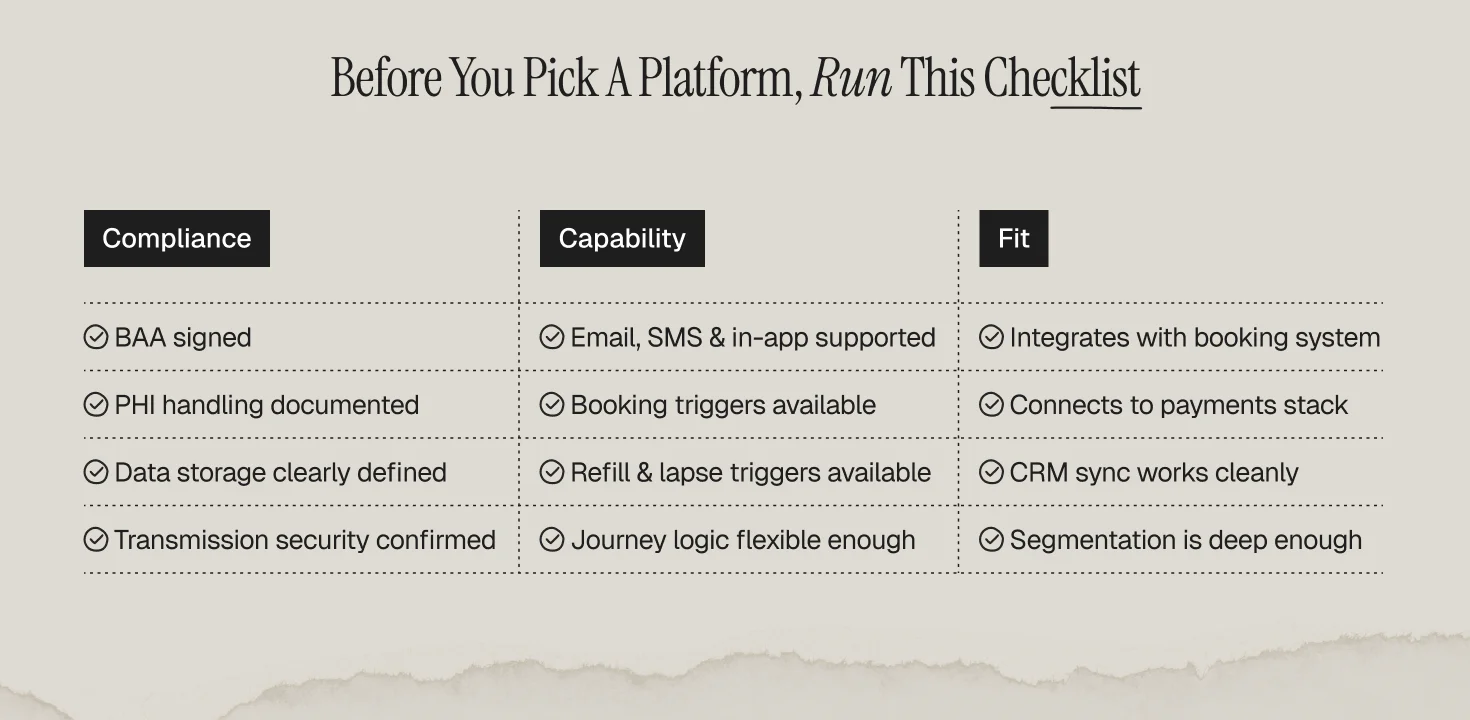
Start with compliance, then capability, then fit. Ask: will the vendor sign a BAA and document how PHI is handled? Does it support the channels you need (email, SMS, in-app) and the triggers your workflows depend on (bookings, fill dates, lapses)? How well does it integrate with your booking system, pharmacy or payments stack, and CRM? Then weigh segmentation depth, ease of building journeys, and reporting. For DTC-style health and supplement brands, Klaviyo is a frequent choice; for event-driven lifecycle journeys, Customer.io is strong; for B2B and provider sales, HubSpot fits well; and for the compliant delivery layer underneath, evaluate Paubox, LuxSci, or Keragon. If you want a partner to run it, see the best HealthTech email marketing agencies for 2026.
Marketing automation returns $5.44 for every $1 spent
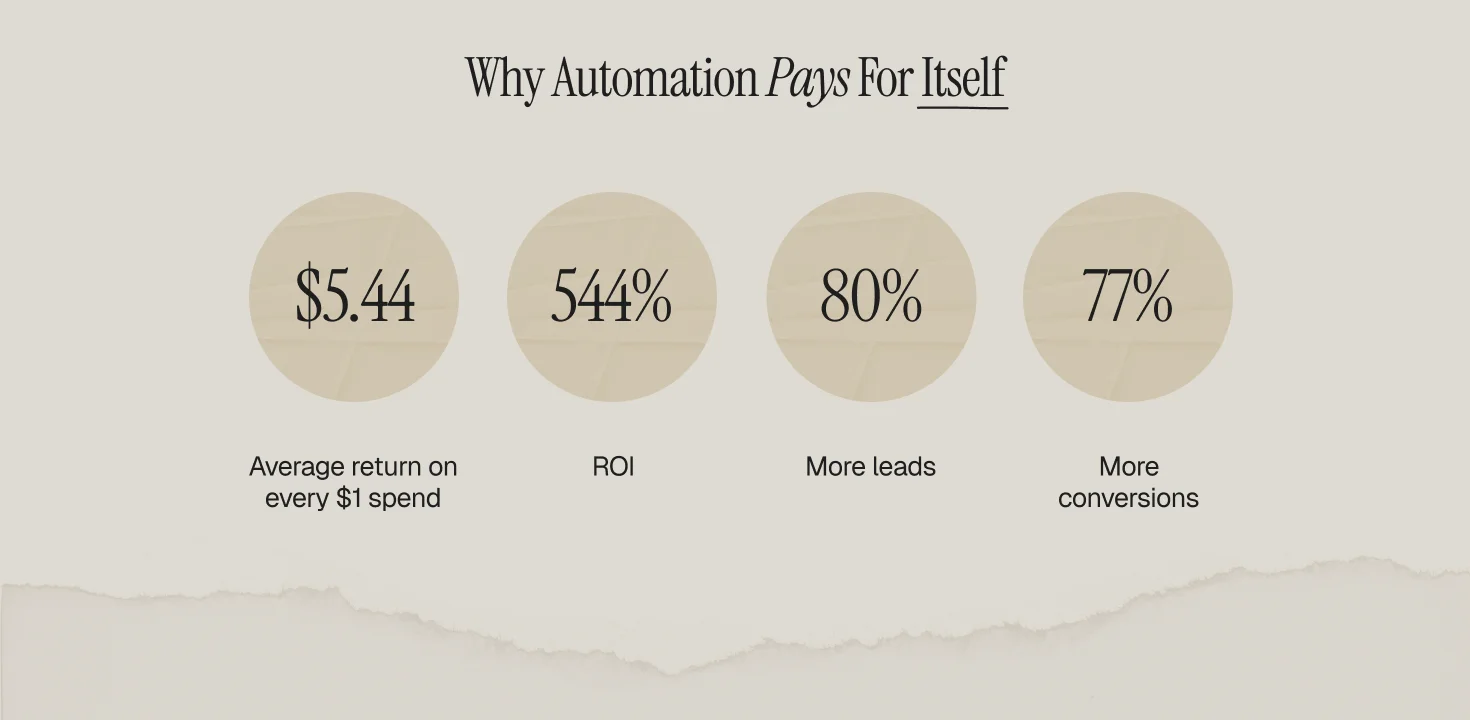
The clearest argument for building lifecycle flows is the return. Marketing automation returns an average of $5.44 for every $1 spent, a 544% ROI, and well-built automation can drive about 80% more leads and about 77% more conversions. In healthcare, that return shows up as recovered no-shows, higher refill rates, reactivated patients, and reviews that lower acquisition cost. The reason flows beat one-off campaigns is timing: a refill reminder that lands before the supply runs out, or a welcome journey that fires on booking, meets the patient at the exact moment of need. That is also why automation tends to pay back faster than buying more paid traffic.
Frequently Asked Questions
What is healthcare marketing automation?
Healthcare marketing automation is software that triggers, personalizes, and sends patient and provider communications based on behavior and clinical timing, without manual sends. It runs journeys like onboarding, appointment reminders, refill reminders, follow-ups, reactivation, and education, all through HIPAA-safe infrastructure when PHI is involved.
Why is marketing automation important in healthcare?
Because it improves retention and outcomes at the same time. Automated reminders cut no-shows, refill flows protect adherence, and reactivation wins back lapsed patients. Marketing automation returns an average of $5.44 per $1 spent.
Is healthcare marketing automation HIPAA-compliant?
It can be, when every system touching PHI runs under a signed Business Associate Agreement with proper encryption, access controls, and audit logging.
What are the best healthcare marketing automation platforms?
Common choices include Klaviyo and Customer.io for patient lifecycle and DTC-style flows, HubSpot for B2B and provider nurture, and Paubox, LuxSci, or Keragon for HIPAA-compliant delivery.
How fast do results appear?
Some flows show results quickly. Appointment reminders can lower no-show rates within the first few weeks, and refill reminders affect the next reorder cycle. Reactivation and education compound over months.
![Featured image: How HealthTech Apps Can Improve Customer Retention in 2025? [Expert Guide]](https://cdn.prod.website-files.com/69bbf9f7f2a3f75341357ebc/69f4b4952b919dd9bd4f1aa9_69c7cebde8051f4e1dd257e4_698ae4536010effb729a65f9_684e6b4fbf7e32c28a8f0eae_Health%25252520Tech%25252520Retention%25252520(1).png)