
Summarize this documentation using AI
Healthcare content marketing is the practice of creating educational, trustworthy content (articles, guides, videos, and tools) that helps patients understand their health and choose a provider with confidence. It works because patients research before they book: 82% of patients look up a provider online before scheduling, and roughly 1 billion health-related searches happen on Google every day (WebFX). The 25 ideas below are organized from foundational trust-builders to advanced, conversion-focused formats, so a virtual-care or clinic brand can build a patient-trust content engine that earns visibility in both search and AI answers.
Key Takeaways
- Patients research first. 82% research providers online before booking and 71% read reviews (WebFX). Content is the first impression.
- Education outperforms promotion. Educational posts earn about 2.3x more engagement than promotional posts, and hospitals draw roughly 68% of inbound organic traffic from informational blog content (WebFX).
- The category is investing. 95% of healthcare organizations use or plan to use content marketing (click-vision), and the healthcare digital marketing market is about $6.4B in 2026, growing near 18% a year (WebFX).
- Trust is the metric. Providers who share expertise online see materially higher patient trust; content that is accurate, clearly authored, and compliant compounds that advantage.
- Content fuels retention, not just acquisition. The same educational library that wins a new patient also keeps them engaged across the telemedicine lifecycle.
Why healthcare content marketing works
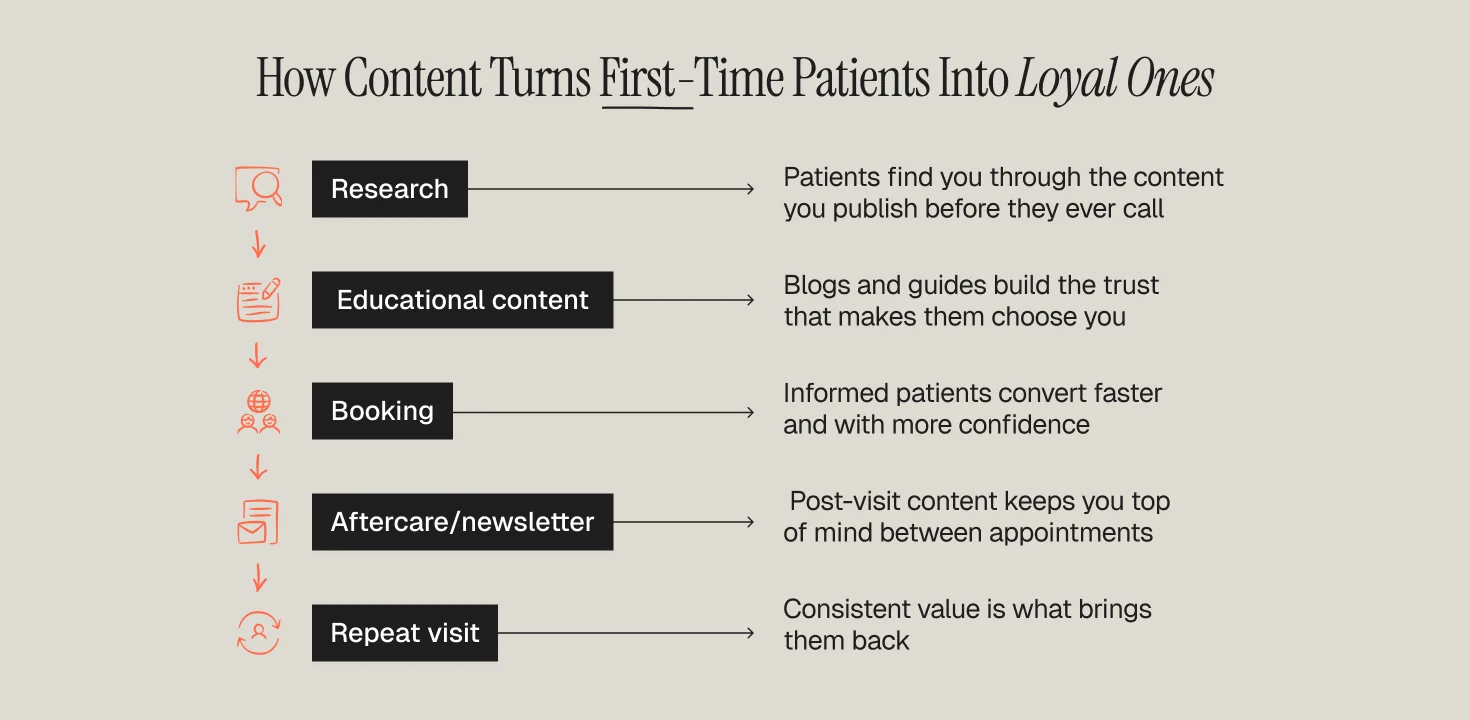
Healthcare is a high-consideration, high-anxiety purchase. Before a patient books a telehealth visit or chooses a clinic, they want to know they will be understood and safe. Content is how you earn that belief at scale. Nearly 60% of US adults search online for health information, and educational content is what they reward with attention and trust. A strong healthcare content marketing strategy does double duty: it ranks for the questions patients ask, and it nurtures the patients you already have so they come back.
Internal-link note for publish: link "healthcare content marketing strategy" and the page's main hub anchor to the healthcare marketing pillar once that post is live (scheduled later in the calendar). Until then, the live cross-links below carry the internal-linking weight.
Foundational trust-builders (ideas 1-9)
- Condition explainer hubs. Plain-language guides to the conditions you treat, written at an 8th-grade reading level. These capture high-intent search and become your most-linked assets.
- "What to expect at your first visit" walkthroughs. Reduce pre-visit anxiety by showing the exact steps of a telehealth or in-person appointment.
- Treatment option comparison guides. Neutral, evidence-based comparisons (for example, medication vs lifestyle approaches) that respect patient autonomy.
- Provider bios with real credentials and photos. Patients trust faces and qualifications; 37% specifically value providers who share their expertise (WebFX).
- Consented patient stories. Real outcomes, shared with documented permission, are the most persuasive trust signal you own.
- Symptom and triage guides. "When to see a doctor" content that helps patients self-route responsibly and positions you as the next step.
- Cost and insurance transparency guides. Clear pricing and coverage explanations remove the single biggest booking objection.
- FAQ libraries built from real questions. Mine your support inbox and visit notes (de-identified) for the questions patients actually ask.
- Preventive care checklists. Age- and risk-based screening reminders that demonstrate you care about outcomes, not just visits.
Engagement and education formats (ideas 10-18)
- Medication guides. How to take it, what to expect, and interaction warnings, with clear medical-review bylines.
- Myth vs fact posts. Debunk common misinformation in your specialty; these earn shares and position you as the authority.
- Seasonal health content. Flu season, allergy season, and awareness months give you a predictable, search-aligned calendar.
- Post-visit care instructions. Aftercare content improves outcomes and gives patients a reason to return to your site.
- Clinician video explainers. Short videos from real providers; video earns up to 10x the engagement of text (WebFX).
- Live Q&A and webinar recaps. Repurpose provider Q&As into evergreen articles and clips.
- A medical glossary. Define the terms patients encounter; glossaries win featured snippets and AI citations.
- An educational newsletter. Pair health tips with service updates. Lifecycle email is where content converts into repeat visits, the same engine we cover for healthtech retention.
- Local condition landing pages. City-plus-condition pages capture geo-intent for clinics and hybrid telehealth.
Advanced and conversion-focused content (ideas 19-25)
- Accessibility-first content. Readable formatting, captions, and translations widen reach and signal inclusivity.
- Data-backed trend reports. Original or curated data (telehealth adoption, wait times) earns links and media coverage.
- Meet-the-team and behind-the-scenes content. Humanizing your clinicians builds the parasocial trust that drives bookings.
- Interactive tools. Risk calculators and assessments (with clear disclaimers) drive engagement and email capture.
- Care-navigation guides. Help patients choose the right specialist or service line; this reduces mismatched bookings.
- Privacy and compliance explainers. Tell patients how you protect their data. In a HIPAA world, transparency about privacy is itself a trust-builder.
- Review-response and reputation content. Publicly and professionally responding to reviews (71% of patients read them) closes the trust loop and feeds local SEO.
For regulated verticals like GLP-1 and online pharmacy, pair these ideas with a compliant lifecycle program; see our online pharmacy retention playbook and, for tooling, Customer.io vs Iterable for healthcare.
How to measure it
Track organic traffic and rankings on condition and "near me" terms, assisted bookings (content-touched conversions), email capture rate from content, and engagement depth (time on page, video completion). Tie content to retention by measuring repeat-visit rate among patients who engage with your educational library versus those who do not.
Frequently Asked Questions
What is healthcare content marketing?
It is the creation of educational, trustworthy content (articles, guides, videos, tools) that helps patients understand their health and choose a provider, while improving search and AI visibility for the practice.
Why is content marketing important in healthcare?
Because 82% of patients research providers online before booking and educational posts earn about 2.3x the engagement of promotional ones. Content is the first and most scalable trust-builder.
What types of content build the most patient trust?
Condition explainers, consented patient stories, clinician videos, transparent cost and privacy guides, and responsive review management consistently build the most patient trust.
Is healthcare content marketing HIPAA-compliant?
Educational content is generally fine; the compliance risk appears when you use protected health information (PHI). Keep PHI out of public content and obtain documented consent for any patient story.
How much should a healthcare brand invest in content?
It varies, but the category is investing heavily: 95% of healthcare organizations use or plan content marketing, and digital healthcare marketing shows roughly 4.8x ROI for organizations that commit.
![Featured image: How HealthTech Apps Can Improve Customer Retention in 2025? [Expert Guide]](https://cdn.prod.website-files.com/69bbf9f7f2a3f75341357ebc/69f4b4952b919dd9bd4f1aa9_69c7cebde8051f4e1dd257e4_698ae4536010effb729a65f9_684e6b4fbf7e32c28a8f0eae_Health%25252520Tech%25252520Retention%25252520(1).png)