Summarize this documentation using AI
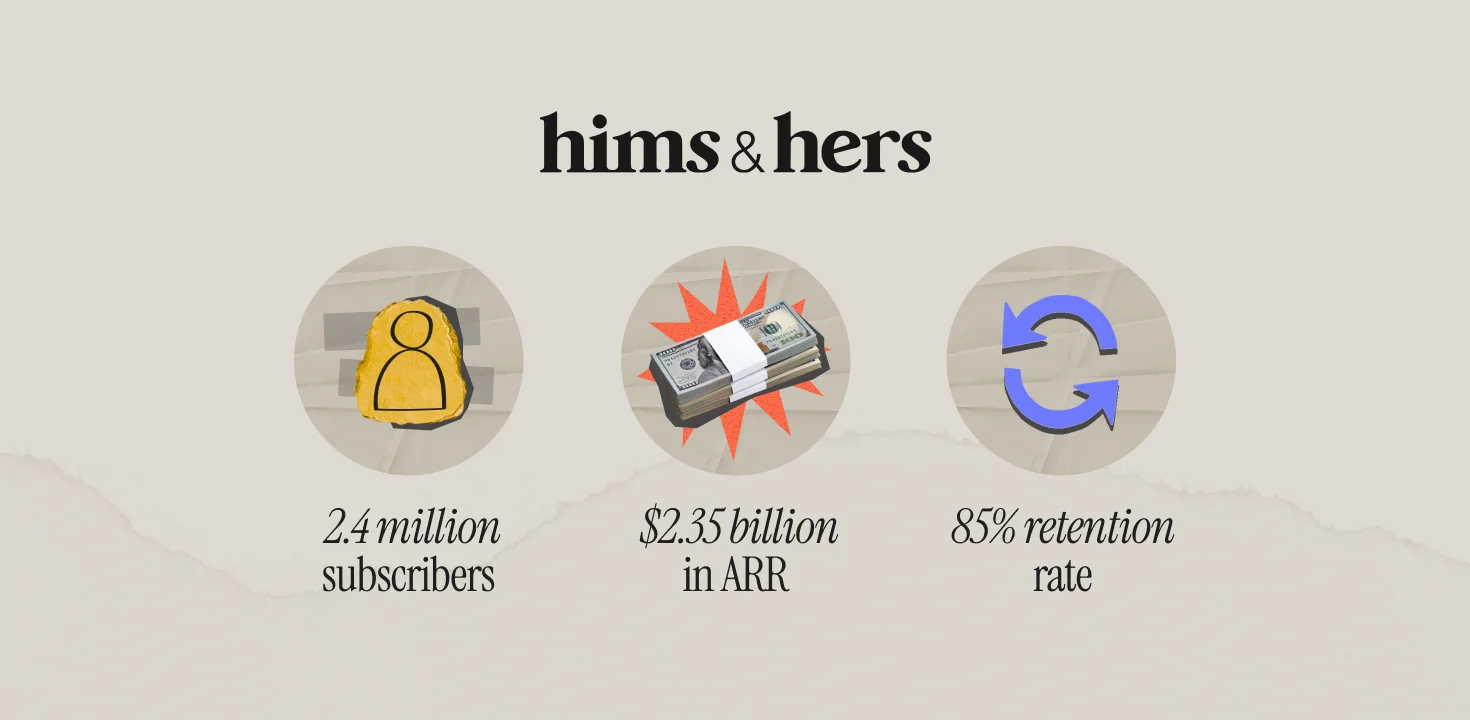
Hims & Hers didn't become the largest telehealth GLP-1 provider by accident. With 2.4 million subscribers, $2.35 billion in annual revenue, and an 85% retention rate, the company has built a retention engine that most health brands can only aspire to. At Propel AI, we have cracked the same retention marketing playbook and building for brands like Eden, Strut Health.
But here's what makes the Hims story worth studying: their retention playbook was stress-tested in real time. FDA warning letters. A Novo Nordisk patent lawsuit. An SEC investigation. A forced pivot from compounded semaglutide to a legitimate partnership with the very company suing them. Through all of it, subscribers stayed.
This teardown breaks down how Hims & Hers retains customers across every stage of the lifecycle marketing funnel—and what their GLP-1 launch reveals about building retention into a subscription health business from day one.
Why Hims & Hers Is a Retention Case Study Worth Studying
Most telehealth platforms treat retention as an afterthought—a dashboard metric reviewed quarterly. Hims treats it as architecture. Over 90% of their revenue is recurring. Monthly revenue per subscriber climbed 52.7% year-over-year to $84. And when their GLP-1 business faced existential regulatory pressure, they didn't lose their customer base—they restructured the business around keeping it.
That's the difference between tracking customer retention metrics and engineering them.
Stage 1: Awareness — Building a Brand That Pre-Sells Trust
Normalizing the Conversation
Before Hims ever asks for a subscription, they've already done the hardest retention work: making the customer comfortable. Their brand strategy centers on normalizing health topics that most people find awkward—hair loss, sexual wellness, weight management, and mental health.
This matters for retention because customers who feel shame about their purchase are more likely to cancel quietly. Hims removes that friction before it starts—a principle we see consistently across high-performing retention strategies.
Example: Their Super Bowl campaigns didn't just drive awareness—they positioned weight loss medication as something to talk about openly, not hide in a medicine cabinet. That brand framing reduces cancellation hesitancy months later.
Aggressive, Multi-Channel Acquisition
Hims invests heavily in customer acquisition—over $182 million quarterly across paid search, social, influencer marketing, and brand campaigns. They work with 1,200+ nano and mid-tier creators who drive roughly 35% of conversions.
But the retention insight is in how they acquire. Influencer content creates social proof and community identification before a customer ever signs up. Customers who discover Hims through a trusted creator have higher initial trust—and trust compounds into retention. This is why the most direct cause of customer loyalty is almost always trust-based, not price-based.
Stage 2: Conversion — Frictionless Entry That Sets Up Long-Term Value
The $199 Price Anchor
When Hims launched compounded semaglutide injections at $199/month—compared to $1,800/month for brand-name Wegovy—they didn't just win on price. They created a value perception that made staying feel like a smart financial decision every single month.
Even after pivoting to FDA-approved medications through their March 2026 Novo Nordisk partnership, the pricing narrative carries forward. Customers who joined at the disruptive price point perceive ongoing value relative to retail alternatives.
Consultation-First, Subscription-Second
The onboarding flow leads with a medical consultation, not a checkout page. Patients answer health questions, get matched with a licensed provider, and receive a personalized treatment plan before ever entering payment information.
This sequence matters because it frames the subscription as a medical relationship, not a product purchase. Medical relationships have significantly lower voluntary churn than product subscriptions—a pattern we break down in our guide on how to reduce subscriber churn.
Stage 3: Onboarding — The First 30 Days That Define Everything
MedMatch AI Personalization
Hims' proprietary MedMatch AI tool processes millions of data points to optimize treatment recommendations. This isn't a generic quiz—it produces genuinely personalized treatment plans that reduce wait times by 40% and increase retention by 41%.
Why 41% matters: In a category where first-month cancellation is the biggest churn driver, personalization during onboarding is the single highest-ROI retention lever. If the first medication feels right, the patient stays. If it doesn't, they leave regardless of everything else you do. This is exactly why AI for customer retention is becoming non-negotiable for health brands.
Setting Expectations Early
Hims' clinical data shows patients lose an average of 20.9 pounds (10.3% of body weight) over six months. They communicate this timeline during onboarding—not as a caveat, but as a framework for progress.
This is critical. GLP-1 weight loss is gradual. Patients who expect rapid results and don't see them in week two are the most likely to cancel. By anchoring expectations to a six-month journey from day one, Hims keeps patients engaged through the early plateau period—a principle that applies broadly to reducing churn with better onboarding.
Stage 4: Engagement — Keeping Subscribers Active Between Shipments
The Integrated App Experience
Hims doesn't just ship medication—they ship a relationship. The Hims & Hers app combines medication management, weight tracking, progress visualization, and direct provider messaging into a single experience.
This "productization of the relationship" transforms a pill-in-the-mail subscription into a daily engagement touchpoint. Patients who interact with the app regularly—checking weight trends, reading educational content, messaging their provider—are significantly less likely to churn. Understanding these behavioral triggers in retention marketing is what separates high-retention health platforms from the rest.
24/7 Care Team Access
Hims' care teams exchanged 6.7 million messages with patients, with 75% receiving responses within 5 hours. In a medical context, responsiveness isn't a nice-to-have—it's a retention mechanism.
Example: A patient experiencing mild nausea (a common GLP-1 side effect) who gets a reassuring response from their provider within hours stays on treatment. That same patient, left waiting 48 hours, starts Googling alternatives.
Content as a Retention Tool
The platform delivers curated education across nutrition, mental health, and physical wellness—content designed not to sell, but to support the treatment journey. This positions Hims as a health partner rather than a pharmacy, deepening the relationship beyond the transaction. It's a textbook example of how lifecycle email marketing extends beyond promotional messaging.
Stage 5: Retention — The Systems That Keep 85% of Subscribers
Subscription Stickiness by Design
With 95% of revenue recurring and no hidden membership fees, the subscription model is designed to minimize friction at every renewal. There are no surprise charges, no add-on upsells mid-cycle, and no complicated tier structures.
The psychology is simple: when the default behavior (staying subscribed) is easier than the alternative (researching a new provider, getting a new consultation, rebuilding a treatment plan), patients stay. This maps directly to the subscription retention strategies that work across health and wellness verticals.
Side Effect Management as Churn Prevention
Only 10.3% of Hims GLP-1 patients reported side effects, and just 4.5% found them intolerable. But the real retention insight is what happens when side effects do occur.
Hims' clinical team doesn't wait for patients to complain. They proactively check in, adjust dosing, and offer alternatives. This transforms a potential churn moment into a trust-building interaction. Ninety-seven percent of patients reported improvement in overall health—a stat that's only possible with active side-effect management. Knowing how to identify users who are about to churn before they leave is the key.
The 75% Six-Month Adherence Rate
In a category where 80% dropout within six months is common, Hims maintains 75% adherence at the six-month mark. This isn't luck—it's the compounding effect of every upstream decision: proper personalization, expectation setting, active engagement, and responsive care.
Stage 6: Loyalty — Surviving a Crisis Without Losing Customers
The Regulatory Pivot
In early 2026, Hims faced an existential challenge. Novo Nordisk sued them for patent infringement. The FDA issued warning letters. Their compounding pharmacy had quality control issues flagged by inspectors. The SEC opened an investigation.
Most companies would hemorrhage customers during this kind of crisis. Hims didn't—because the retention infrastructure they'd built wasn't dependent on a single product formulation. It was built on the relationship.
The Novo Nordisk Partnership (March 2026)
Instead of fighting a losing legal battle, Hims pivoted. On March 9, 2026, they announced a strategic partnership with Novo Nordisk to distribute FDA-approved Ozempic, Wegovy injections, and Wegovy tablets directly through their platform. The stock surged 46%.
For existing subscribers, the transition was positioned not as a downgrade but as an upgrade: same personalized care experience, now with FDA-approved medications. The retention lesson? When you've built trust through the relationship—not just the product—you can change the product without losing the customer. This is the essence of why retention marketing matters more than acquisition.
Cross-Category Expansion
Hims doesn't just retain GLP-1 customers—they expand them. With five specialty areas (mental health, sexual health, hair care, skin care, and weight loss), a customer acquired for weight loss becomes a candidate for hair loss treatment, skincare products, or mental health support.
This cross-sell strategy increases customer lifetime value while simultaneously reducing churn. A customer using two Hims products is significantly harder to lose than a customer using one.
What You Can Learn From Hims' Retention Playbook
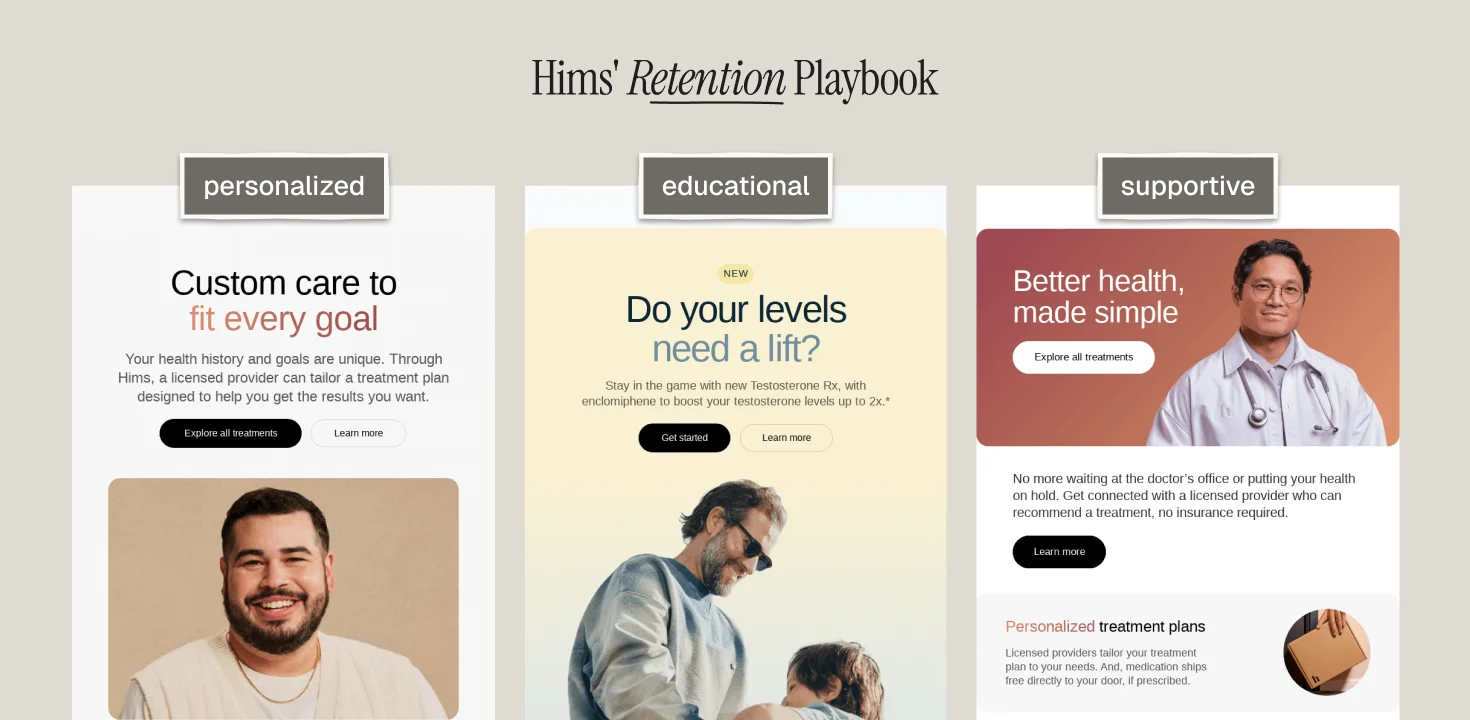
Personalization is the highest-ROI retention lever. Hims' 41% retention lift from AI personalization justifies significant technology investment. If you're still sending generic treatment plans, you're leaving retention on the table.
Engineer the relationship, not just the product. Hims' app, care team access, and educational content transform a medication subscription into a health partnership. The product can change (and did). The relationship persists.
Manage the first 30 days like they're the entire customer lifetime. Expectation-setting, fast personalization, and responsive support during onboarding determine whether a customer stays for six months or six weeks.
Build retention that survives crisis. Hims' regulatory challenges tested their retention infrastructure at maximum stress. The 85% retention rate held because it was built on trust and convenience—not just price or product exclusivity.
How Propel Builds Retention Systems Like This
At Propel, we build retention and lifecycle marketing systems for health, wellness, and DTC brands. As Platinum Customer.io Partners, we design the personalized flows, behavioral segmentation, and multi-channel engagement that drive the kind of retention metrics Hims achieves at scale.
Whether you're launching a GLP-1 program, scaling a telehealth subscription, or reducing churn in your subscription brand—we've done it.
FAQs
What is Hims & Hers' customer retention rate?
Hims & Hers maintains an approximately 85% retention rate across their subscriber base, with 75% of GLP-1 weight loss customers remaining adherent at the six-month mark.
How does Hims use AI for customer retention?
Hims uses their proprietary MedMatch AI tool to process millions of data points and create personalized treatment plans. This personalization increases customer retention by 41% compared to standard treatment approaches.
What happened with Hims and Novo Nordisk in 2026?
Novo Nordisk sued Hims for patent infringement in February 2026 over compounded semaglutide. By March 2026, the companies reached a settlement and formed a partnership, allowing Hims to distribute FDA-approved Ozempic and Wegovy directly through their platform.
How much revenue does Hims generate from GLP-1 weight loss?
Hims generated over $225 million in weight loss revenue in 2024, contributing to total annual revenue of $2.35 billion with 2.4 million subscribers and monthly revenue per subscriber of $84.
What makes Hims different from competitors like Ro and Noom?
Hims differentiates through broader medication selection (oral and injectable options), AI-driven personalization via MedMatch, transparent pricing without hidden membership fees, and the largest marketing investment in the telehealth space driving brand trust and community identification.
