

Summarize this documentation using AI
Key Takeaways
- Senior D2C/B2C leaders: Master budget allocation between acquisition and retention marketing.
- The Core Mechanisms: Why Retention Compounding Outperforms Linear Acquisition
- Fixing LTV:CAC Attribution: The Operator's Guide to Revenue True-Up
When your top-line revenue is growing but contribution margins are compressing, the underlying system failure almost always points to a misallocation between customer acquisition and retention marketing. Throwing more budget at top-of-funnel channels becomes a margin liability when LTV:CAC ratios hover dangerously close to 2:1.
Senior marketing and growth leaders know that the generic advice of "balancing" the two functions is insufficient. The real operational friction lies in dynamically allocating marketing budget between customer acquisition and retention based on cohort payback velocity, Repeat Revenue, and the stage of business maturity.
You cannot optimize what your stack cannot attribute, which is why treating customer acquisition and retention as a philosophical debate rather than a strict financial modeling exercise leads to massive capital inefficiency.
The Core Mechanisms: Why Retention Compounding Outperforms Linear Acquisition
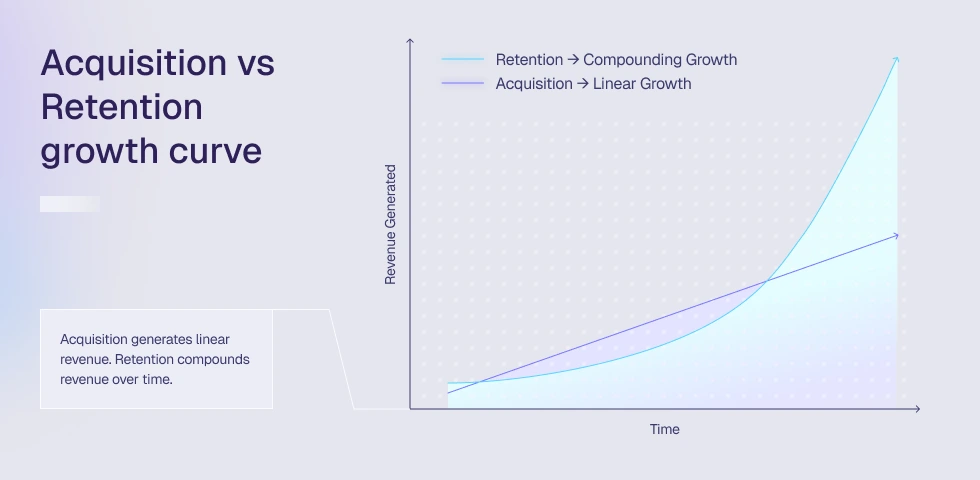
At a systems level, the financial physics of customer acquisition vs retention marketing operate on entirely different curves. Acquisition marketing delivers a linear, non-compounding revenue. Every marginal dollar spent yields a progressively lower return due to audience exhaustion and auction inflation. Retention marketing, driven through owned channels like email, SMS, and push notifications, delivers exponential compounding revenue.
The cost disparity is the first mechanical driver. The blended CAC for a mid-market D2C brand routinely sits between $100 and $300, depending on the vertical, and increases by roughly 15% to 25% annually due to platform privacy changes and saturated ad networks. In contrast, the marginal cost of triggering a highly personalized, behavioral lifecycle flow in a platform like Braze or Customer.io is fractions of a cent.
When conversion rates for net-new acquisition hover between 2% and 5%, whereas existing customer repeat purchase rates driven by segmentation convert at 60% to 70%, the Return on Investment (ROI) gap becomes a chasm.
However, optimizing solely for retention ROI creates an equally dangerous failure mode: cohort starvation. Acquisition must be viewed strictly as a top-of-funnel feeder mechanism designed to acquire customers at an acceptable initial payback, while the retention engine is responsible for driving the gross margin expansion that actually funds the business.
Stage-Based Budget: Customer Acquisition V/s Retention Marketing Allocation Framework for D2C Brands
A static 50/50 budget split between acquisition and retention marketing is a myth. Capital allocation must evolve dynamically based on the maturity of your gross revenue retention (GRR) and the depth of your historical data.

Early-Stage Growth (The 70/30 Split)
In the initial scaling phase (typically under $5M ARR for D2C), brands lack the cohort volume necessary to make retention compounding mathematically significant. The system requires a heavy 70% allocation toward paid acquisition channels to build the baseline audience. During this phase, leaders must tolerate lower LTV:CAC ratios (often dipping near 2:1) and longer payback periods (up to 12 months).
The 30% budget allocated to retention should be strictly deployed towards automated, high-intent lifecycle flows like welcome series, abandoned checkout, and basic post-purchase replenishment.
Mid-Market Scaling (The 60/40 Split)
If the brand continues spending 70% on acquisition, they will hit a growth ceiling dictated by Meta's rising CPMs. At this stage, the 40% retention marketing budget must fund advanced behavioral segmentation, predictive churn modeling, and omnichannel orchestration across SMS and email.
The goal is to push the LTV:CAC ratio above 3:1 by increasing the 90-day repeat purchase rate. The financial consequence of nailing this phase is that the brand can afford a higher initial CAC than competitors because their backend retention engine converts single-buyers into subscribers at a higher velocity.
Mature Enterprise (The 40/60 Split)
At scale, 60% of the marketing budget and internal resourcing should be dedicated to lifecycle and retention marketing, with acquisition capped at 40%. At this level, 50% to 65% of total top-line revenue must come from repeat purchases and expansion revenue.
The acquisition budget is no longer tasked with driving net-new topline growth; it is tasked with replenishing the natural cohort decay. If a mature brand is still spending 60%+ on acquisition, it is a definitive diagnostic signal that their onboarding flows, product experience, or data infrastructure is fundamentally broken and they need a lifecycle martech audit.
| Business Stage | Acq / Ret Split | Target LTV:CAC | Max Acceptable Payback | Primary Operational Focus |
|---|---|---|---|---|
| Early-Stage | 70% / 30% | > 2.0x | < 12 Months | Volume acquisition, baseline flows |
| Mid-Market | 60% / 40% | > 3.0x | < 9 Months | Behavioral triggers, SMS expansion |
| Mature Scale | 40% / 60% | > 4.0x | < 6 Months | Predictive churn, omnichannel ROI |
Fixing LTV:CAC Attribution: The Operator's Guide to Revenue True-Up
The primary reason VPs of Growth misallocate budgets between customer acquisition and retention marketing is due to broken attribution models. They artificially inflate ROAS (Return on Ad Spend) while ignoring the compounding nature of Customer Lifetime Value (LTV). Acquisition channels claim credit for downstream revenue that was actually secured by retention infrastructure.
To correctly model budget allocation between retention marketing and acquisition, you must calculate True LTV based on gross margin, not just top-line revenue.
The formula is: (Average Order Value × Purchase Frequency × Customer Lifespan) × Gross Margin.
If your D2C brand operates at a 65% gross margin, a $100 AOV is only yielding $65 in contribution. If your CAC is $130, you are losing $65 on the first transaction. The only mathematical way this cohort becomes profitable is if your retention marketing engine drives at least two more purchases within the payback window.
The system fails when acquisition and lifecycle teams operate in silos. The acquisition team optimizes for lowest initial CAC, bringing in highly discount-sensitive traffic. The lifecycle team then fails to convert these low-propensity users, resulting in an LTV:CAC ratio that plummets below 2:1. Leaders must implement an attribution model that scores the quality of acquired cohorts based on their 30-day and 60-day repeat rates, dynamically feeding that data back into the acquisition algorithms.
A highly effective way to structure this is by reading this breakdown on DTC revenue LTV attribution for Klaviyo, Braze, and Customer.io.
Cohort Payback Windows: The Ultimate Rebalancing Signal
Customer LTV is a lagging indicator. It takes years to fully realize and is dangerous to use for real-time budget allocation. Senior operators, instead, use cohort payback windows as the primary diagnostic signal to balance acquisition and retention marketing spend. Payback velocity tells you exactly how many months it takes for the gross margin of a cohort to exceed the CAC spent.
When cohort payback windows begin to stretch from 6 months to 10 months, it means one of two things:
- your acquisition costs have spiked
- your early-stage retention drops (D30 and D60) have steepened.
If you only look at blended metrics, you will miss the root cause.
A healthy D2C retention curve should show a flattening out by Day 90. If your curve continues to point sharply downward at D90, your product or your onboarding lifecycle flows are failing. If the curve is flat but payback is still slow, your intervention point is cross-selling. You must deploy your retention budget to trigger expansion revenue campaigns using zero-party data.
Stack Integration Tradeoffs: The Invisible Drain on Marketing Budgets
You cannot execute advanced budget reallocation if your marketing technology stack is fragmented. The most common tradeoff growth leaders make is indexing heavily on native acquisition integrations while underfunding the data pipelines required to power advanced retention. When your CDP (Customer Data Platform) is not properly syncing real-time behavioral events from your product to your engagement layer (like Braze or Customer.io), your retention budget is essentially being set on fire.
Strategic budget allocation requires technical investment in omnichannel orchestration. You must accept the tradeoff of spending budget upfront on data infrastructure such as a Segment to Mixpanel to Braze pipeline to unlock the behavioral triggers that make retention marketing profitable. Without this infrastructure, you are limited to static, batch-and-blast email campaigns that yield poor deliverability and negligible LTV lift.
What We've Seen at Propel
Theoretical acquisition and retention marketing budget frameworks only matter if they survive contact with the field. At Propel, we routinely audit mid-market and enterprise D2C brands that have misaligned their capital allocation, resulting in compressed margins and stagnant growth. The intervention always starts with diagnosing the data infrastructure and LTV assumptions.
When Dorsia approached us, they were operating on an unsustainable 65/35 acquisition-heavy budget split despite having millions in historical revenue data. Their Meta CAC was rising, and their LTV:CAC ratio had slipped below 2.5:1.
By auditing their Customer.io instance and implementing strict RFM segmentation models, we shifted their strategy. We reallocated the retention marketing budget into highly personalized retention triggers based on product replenishment cycles. This single shift increased their repeat purchase rate by 28% and doubled their LTV without increasing top-funnel spend.
The Volume Misconception: Why "Acquisition First" Destroys D2C Margins
The most dangerous misconception among executive leadership is that growth velocity requires an acquisition-first mindset. Board members and investors often demand top-line user growth, leading CMOs to prioritize customer acquisition over repeat revenue.
This misconception frames retention marketing as a defensive mechanism, a "leaky bucket" patch, rather than an offensive revenue engine. When operators view retention purely as churn mitigation, they underfund it. The reality is that acquisition without a mathematically sound retention flywheel is just subsidized product sampling.
If your business model relies on customers buying exactly once, you do not have a D2C brand; you have an arbitrage operation entirely at the mercy of Meta's ad auction. The brands that win the decade do not just optimize their CAC; they build operational moats through habit-forming lifecycle marketing, turning a $50 initial loss into a $500 long-term profit.
We help D2C businesses like yours turn $50 loss into $500 profit by fixing your retention marketing strategy. Book a free strategy session with us today!
Frequently Asked Questions
What is the definitive signal that my acquisition budget is too high?
If your cohort payback window extends beyond 12 months, or your LTV:CAC ratio dips below 3:1 while your D90 repeat purchase rate stays flat, your acquisition budget is structurally misallocated. You are funding growth that retention cannot sustain.
How should we attribute LTV across both acquisition and retention channels?
Stop using platform-native last-click attribution. Utilize a Customer Data Platform (CDP) to implement a multi-touch model that assigns incremental credit to retention touchpoints — email sequences, SMS flows, loyalty nudges — based on their measured impact on repeat purchase probability within a defined cohort window.
Why does retention marketing yield a higher ROI but receive less budget?
Retention ROI is exponentially higher because the marginal cost of sending behavioral emails or push notifications is near zero, while the marginal revenue from a repeat purchase is nearly equivalent to the first purchase. The budget imbalance exists because acquisition is easier to attribute and defend to leadership — not because it produces better returns.
How do stack integration costs distort acquisition vs retention budget decisions?
Most CFOs evaluate acquisition and retention costs in isolation, ignoring the shared infrastructure spend — CDPs, ESPs, attribution tools — required to make either work. If your data stack is built purely around acquisition (last-click Meta reporting, top-of-funnel analytics), you are effectively subsidizing acquisition intelligence while running retention blind. The operator-level fix is to audit which platforms are genuinely shared, allocate their cost proportionally to the revenue contribution of each motion, and surface the true cost-per-retained-customer alongside your CAC.
What does 'acquisition without a retention flywheel' actually cost at scale?
Brands that operate on an acquisition-first model without a mathematically sound retention engine are essentially running subsidized product sampling. Every customer who churns after one purchase means the full CAC was spent for zero long-term return. At $5M+ GMV, where email and SMS alone can account for 20–35% of revenue, each percentage point of churn improvement compounds into material LTV gains. The brands that win the decade are not just optimizing CAC — they are building operational moats through habit-forming lifecycle marketing that turns an initial $50 loss into $500 in long-term profit.
