
Summarize this documentation using AI
Telemedicine solved the access problem. A patient in rural Texas can now see a dermatologist in Manhattan without leaving their couch. But solving access created a new problem: when patients can see any provider from anywhere, what keeps them seeing your provider?
The data tells the story. No-show rates in telemedicine range from 5.5% to 50% depending on specialty. Patient dropout in ongoing treatment programs hits 26% at 30 days, 55% at 90 days, and 69% at 180 days. The convenience that makes telemedicine attractive also makes it easy to leave.
Retention in telemedicine isn't about technology. It's about designing a lifecycle that makes the patient-provider relationship feel as real, responsive, and personal through a screen as it does in person—maybe more so. This is how the best telemedicine brands build it.
Why Telemedicine Has a Unique Retention Challenge
In traditional healthcare, switching costs are high. Your doctor has your history. Your pharmacy knows your prescriptions. Driving to a new clinic takes effort. Inertia keeps patients loyal.
Telemedicine removes almost all of those switching costs. Your medical records are portable. Consultations happen in minutes. A competitor is one Google search away. The only thing keeping a patient on your platform is the quality of the experience and the strength of the relationship.
That makes telemedicine the purest test of retention marketing in healthcare. You can't rely on friction to keep patients—you have to earn their return every single time.
Brands like Kiaora, which specializes in personalized hormone therapy for women, and Natural Cycles, the FDA-approved digital birth control app, understand this. They've built retention into the clinical model itself—not bolted it on as an afterthought.
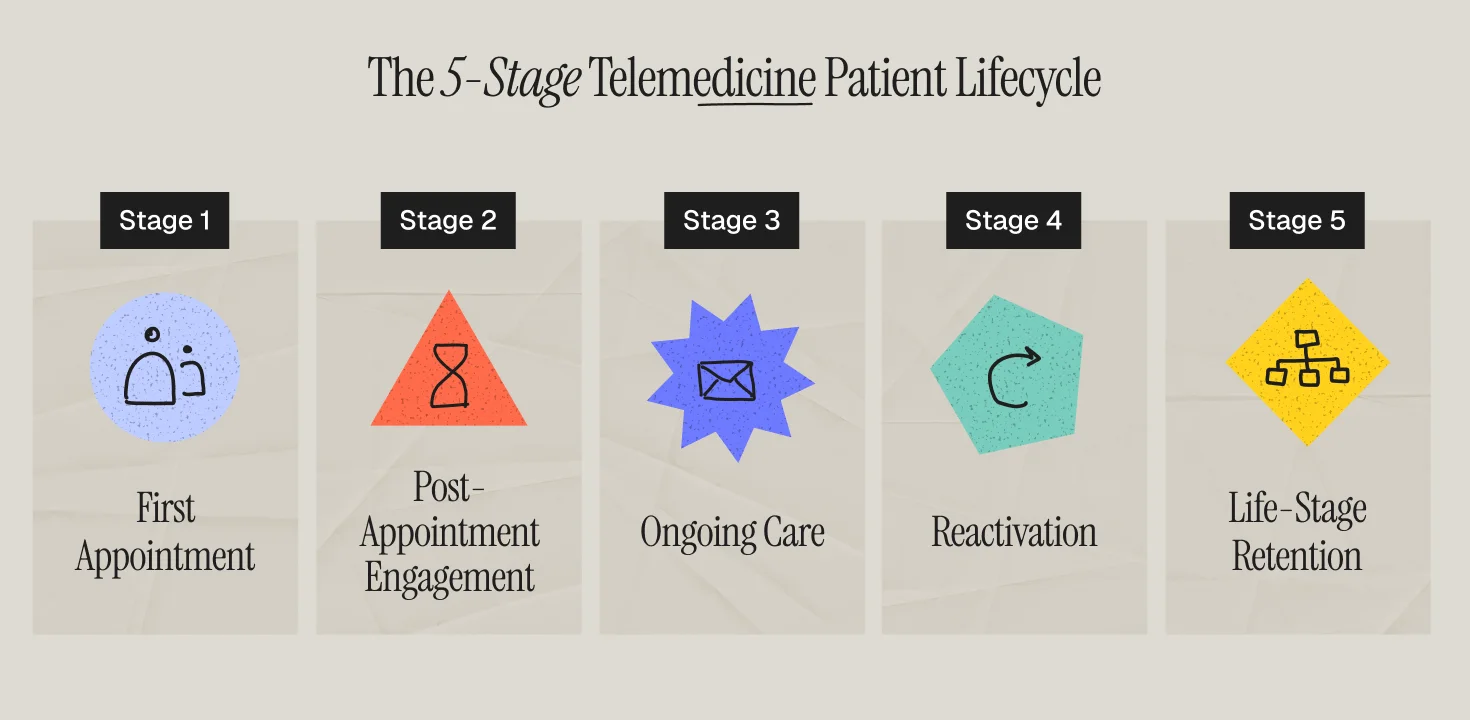
Stage 1: First Appointment — Retention Starts Before the Visit
Reducing No-Shows With Pre-Visit Design
Telemedicine reduces no-show rates from 25% (in-person average) to 12%—a 48% improvement. But that still means roughly one in eight patients doesn't show up for their scheduled appointment. At scale, that's significant lost revenue and broken care continuity.
The brands reducing no-shows further invest in pre-visit experience design. This includes a tech-check workflow 24 hours before the appointment (confirming the patient's device, camera, and internet work), escalating reminders via SMS, email, and push notification as the appointment approaches, and a clear pre-visit checklist so the patient knows what to prepare.
Example: A telemedicine platform sends a text 24 hours before the appointment: "Your consultation with Dr. Patel is tomorrow at 2pm. Here's what to have ready: [checklist]. Test your video connection here: [link]." A second reminder goes out 1 hour before. A third, 5 minutes before, with a direct join link.
This three-touch sequence doesn't just reduce no-shows—it signals to the patient that their appointment matters, reinforcing the relationship before it starts. This is the kind of behavioral trigger in retention marketing that compounds over time.
The First-Visit-to-Second-Visit Gap
The most critical retention metric in telemedicine is the conversion from first visit to second visit. A patient who books a second appointment has 3-4x higher lifetime value than a one-and-done visitor.
What determines whether a patient returns? Three things: did they feel heard during the consultation, did they receive a clear next step, and was follow-up communication timely and relevant.
The first factor is clinical. The second and third are lifecycle marketing problems—and they're where most telemedicine platforms fail.
Stage 2: Post-Appointment Engagement — The 48 Hours That Matter Most
The Post-Visit Follow-Up Sequence
The 48 hours after a telemedicine appointment are the highest-leverage window for retention marketing. The patient has just invested time and vulnerability in a medical consultation. They're processing information, potentially starting a new treatment, and deciding whether this platform is worth returning to.
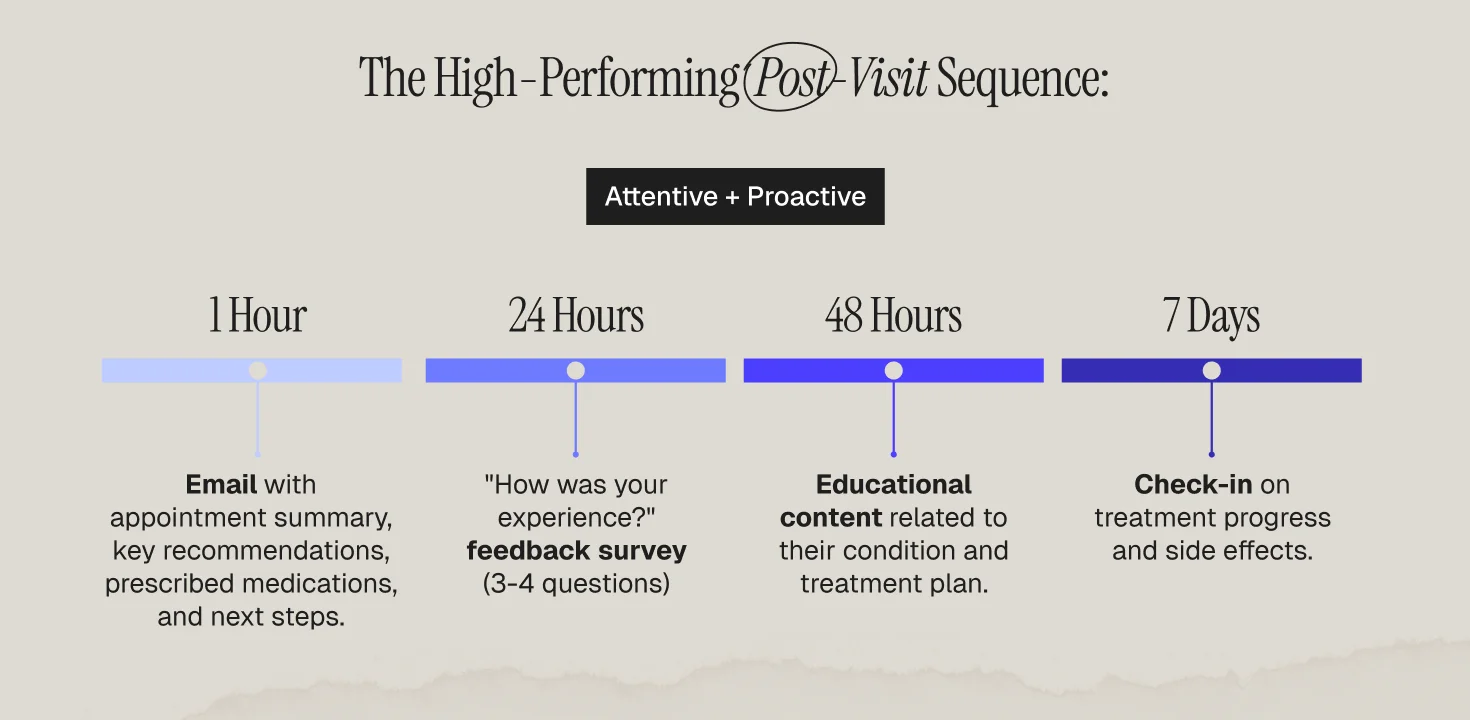
A high-performing post-visit sequence:
Within 1 hour: appointment summary email with key recommendations, prescribed medications, and next steps. Within 24 hours: "How was your experience?" feedback survey (short—3 questions maximum). Within 48 hours: educational content related to their condition and treatment plan. Within 7 days: check-in on treatment progress and side effects.
This sequence serves dual purposes. Clinically, it supports treatment adherence. Strategically, it creates four engagement touchpoints in the first week—establishing a communication rhythm that makes the platform feel attentive and proactive. This is the lifecycle email touchpoint strategy that top health platforms use.
Post-Appointment Surveys as Retention Intelligence
Post-appointment surveys aren't just patient satisfaction tools. They're early warning systems for churn—one of the most effective ways to identify users who are about to churn.
A patient who rates their experience 3/5 or below is significantly more likely to not book a second appointment. If your lifecycle system detects a low score, it should trigger a provider-initiated outreach within 24 hours—not an automated "sorry to hear that" email, but a genuine follow-up from the care team asking what could be improved.
This intervention converts a potential churner into a patient who feels heard. And patients who feel heard stay.
Stage 3: Ongoing Care — Building the Relationship Between Appointments
The Engagement Gap Problem
Most telemedicine platforms go silent between appointments. A patient has a consultation, receives their treatment plan, and then... nothing, until their next appointment reminder shows up weeks or months later.
This creates what we call the "engagement gap"—a period where the patient has no connection to the platform, no reason to open the app, and no emotional investment in the provider relationship. The longer the gap, the higher the churn risk. This is exactly why most retention strategies fail after onboarding.
Kiaora addresses this directly with their hormone therapy model. Because bioidentical hormone therapy requires ongoing monitoring—patients typically see results after 3 months—Kiaora builds regular touchpoints into the treatment protocol. Progress check-ins, lab result reviews, and dosage adjustments create natural engagement moments that keep patients connected to the platform between formal appointments.
Natural Cycles takes a different approach: daily engagement. By asking users to take their temperature every morning, the app creates a daily habit that reinforces the platform's role in the patient's life. The data becomes the engagement mechanism—every temperature reading is a touchpoint, every cycle prediction is a reason to open the app.
Building a Content Engine for Patient Education
Educational content is the most underutilized retention lever in telemedicine. Patients who understand their condition and treatment are more likely to stay adherent and remain on the platform.
The key is relevance and timing. A patient newly prescribed hormone therapy doesn't need a general article about menopause—they need specific information about what to expect in weeks 1-4 of BHRT treatment, when to expect symptom relief, and what side effects are normal versus concerning.
This is where behavioral segmentation meets clinical content. By segmenting patients by condition, treatment stage, and engagement level, telemedicine platforms can deliver content that feels personally relevant rather than generically educational. The advantages of customer segmentation in lifecycle marketing are amplified in healthcare, where personalization directly impacts clinical outcomes.
Stage 4: Reactivation — Winning Back Dormant Patients
Why Patients Go Dormant
In telemedicine, patients go dormant for predictable reasons. Their condition improved (or they think it did). They experienced side effects and didn't know what to do. Cost became a barrier. They simply forgot—life got in the way.
Each of these reasons requires a different reactivation approach, rooted in behavioral segmentation. A patient who stopped because of cost needs a pricing conversation. A patient who stopped because of side effects needs a clinical intervention. A patient who simply forgot needs a reminder of the value they received.
The Reactivation Playbook
For patients dormant 30-60 days: Light-touch re-engagement. An email highlighting new services, updated pricing, or relevant health content related to their previous treatment. No hard sell—just a reminder that the platform exists and is ready when they are.
For patients dormant 60-120 days: Value-driven outreach. A personalized message from their previous provider: "It's been a while since your last visit. We'd love to check in on how [treatment] is working for you." This provider-initiated contact feels clinical, not commercial.
For patients dormant 120+ days: Win-back campaign. A compelling offer—discounted consultation, new treatment option relevant to their condition, or a health assessment—combined with social proof from patient outcomes. At this stage, you're essentially re-acquiring a patient at a fraction of the cost of acquiring a new one. Learn more about winning back dormant users.
The Power of Telemedicine in Reactivation
Here's the retention advantage telemedicine has over traditional healthcare: reactivation is frictionless. A dormant patient doesn't need to call a front desk, navigate a phone tree, or drive to a clinic. They tap a notification, open an app, and book a consultation in 30 seconds.
This low-friction return path means reactivation campaigns in telemedicine should convert at significantly higher rates than in traditional healthcare—if the message is right and the timing is relevant. The retention email templates we've compiled can serve as a starting framework.
Stage 5: Life-Stage Retention — Keeping Patients Through Transitions
The Natural Cycles Model
Natural Cycles offers one of the most elegant life-stage retention strategies in digital health. Their app supports users through birth control, pregnancy planning, pregnancy tracking, postpartum recovery, and perimenopause—covering decades of a woman's reproductive health journey.
When a user transitions from birth control to pregnancy planning, they don't need to find a new app. They switch modes within Natural Cycles. When they become pregnant, they switch again. Each transition that would typically cause churn in a single-purpose app becomes a retention event in Natural Cycles' multi-stage model.
The retention insight: design your platform to grow with the patient, not just serve their current need. A telemedicine brand that only treats one condition loses the patient when that condition resolves. A brand that supports the patient through multiple health stages retains them for years. This is the same subscription retention strategy that works across all recurring-revenue health brands.
Supporting Multiple Conditions
Kiaora's expansion from core BHRT into thyroid management and weight management follows this same principle. A patient who comes for hormone therapy and later needs thyroid support doesn't need to find a new provider—Kiaora expands the relationship.
This cross-condition strategy increases patient lifetime value while simultaneously creating switching costs. The more of a patient's health that's managed on one platform, the harder it is to leave.
Key Metrics for Telemedicine Retention
First-to-second appointment conversion: The percentage of patients who book a follow-up after their initial consultation. Target: above 60%.
No-show rate: Track by appointment type, specialty, and patient segment. Target: below 12% (matching the telemedicine industry benchmark).
Engagement between appointments: Are patients opening the app, reading content, or messaging providers between visits? Low inter-appointment engagement predicts churn.
Reactivation rate: What percentage of dormant patients (60+ days inactive) return within 90 days of a reactivation campaign? Target: above 15%.
Patient lifetime (in months): How long does the average patient stay active on the platform? Benchmark against your acquisition cost to understand unit economics. Compare these to industry benchmarks.
How Propel Builds Telemedicine Retention
At Propel, we've built retention and lifecycle marketing systems for telemedicine brands including Kiaora and platforms leveraging Natural Cycles' life-stage approach. We understand the unique challenge of building patient loyalty in a low-friction, high-choice environment.
Our lifecycle marketing services and behavioral segmentation capabilities are designed specifically for health platforms where clinical communication and marketing automation need to work together. As one of the best HealthTech email marketing agencies, we specialize in exactly this intersection.
FAQs
What is a good retention rate for a telemedicine platform?
Strong telemedicine platforms maintain 60%+ first-to-second appointment conversion and below 12% no-show rates. For ongoing treatment programs (chronic conditions, hormone therapy), target 70%+ retention at 90 days. See how these compare to other industries.
How does telemedicine compare to in-person healthcare for patient retention?
Telemedicine reduces no-shows by 48% compared to in-person visits (12% vs 25%). However, the low switching costs mean overall patient loyalty depends more heavily on experience quality, personalization, and engagement between appointments.
What's the most effective way to reduce telemedicine no-shows?
A three-touch reminder sequence (24 hours, 1 hour, and 5 minutes before appointment) combined with a pre-visit tech check reduces no-shows to single digits. SMS reminders are the most effective channel, followed by push notifications.
How do you reactivate dormant telemedicine patients?
Segment by inactivity duration and reason. Patients dormant 30-60 days respond to light content-driven outreach. Patients dormant 60-120 days respond to provider-initiated check-ins. Patients dormant 120+ days need win-back offers with reduced friction to re-engage. See our full dormant user reactivation approach.
How does Propel help telemedicine brands improve retention?
Propel builds complete lifecycle marketing systems for telemedicine platforms—from post-appointment engagement sequences to behavioral segmentation, reactivation campaigns, and cross-condition expansion strategies. We work with brands like Kiaora to turn one-time patients into lifelong subscribers.
