Summarize this documentation using AI
The online pharmacy market is projected to hit $260.4 billion by 2032, growing at 15.8% annually. But here's the number that should keep online pharmacy founders up at night: the average pharmacy loses 1-2% of its customer base every single month to attrition—and that's the industry "normal."
In a business where acquiring a patient costs significantly more than retaining one, and where prescription adherence directly impacts both revenue and health outcomes, retention isn't just a marketing metric. It's the business model.
This playbook breaks down how the best online pharmacies—from category leaders to brands we work with at Propel AI, including Strut Health and Eden—build lifecycle marketing systems that keep patients refilling, engaged, and loyal.
Why Retention Is the Only Growth Lever That Matters for Online Pharmacies
Acquisition in online pharmacy is expensive and getting more expensive. Between regulatory compliance costs, physician network overhead, and competitive paid media, the cost to acquire a single patient can exceed $100 in many categories.
But here's the asymmetry that makes retention the real game: a patient who stays for 12 months is worth 5-8x their first-month revenue. Prescription medications are inherently recurring. The product literally needs to be repurchased. Your only job is to make sure the patient repurchases from you.
The pharmacies winning the retention marketing game understand that the prescription itself is not the product. The experience around the prescription—convenience, trust, personalization, and proactive care—is what patients are actually subscribing to.
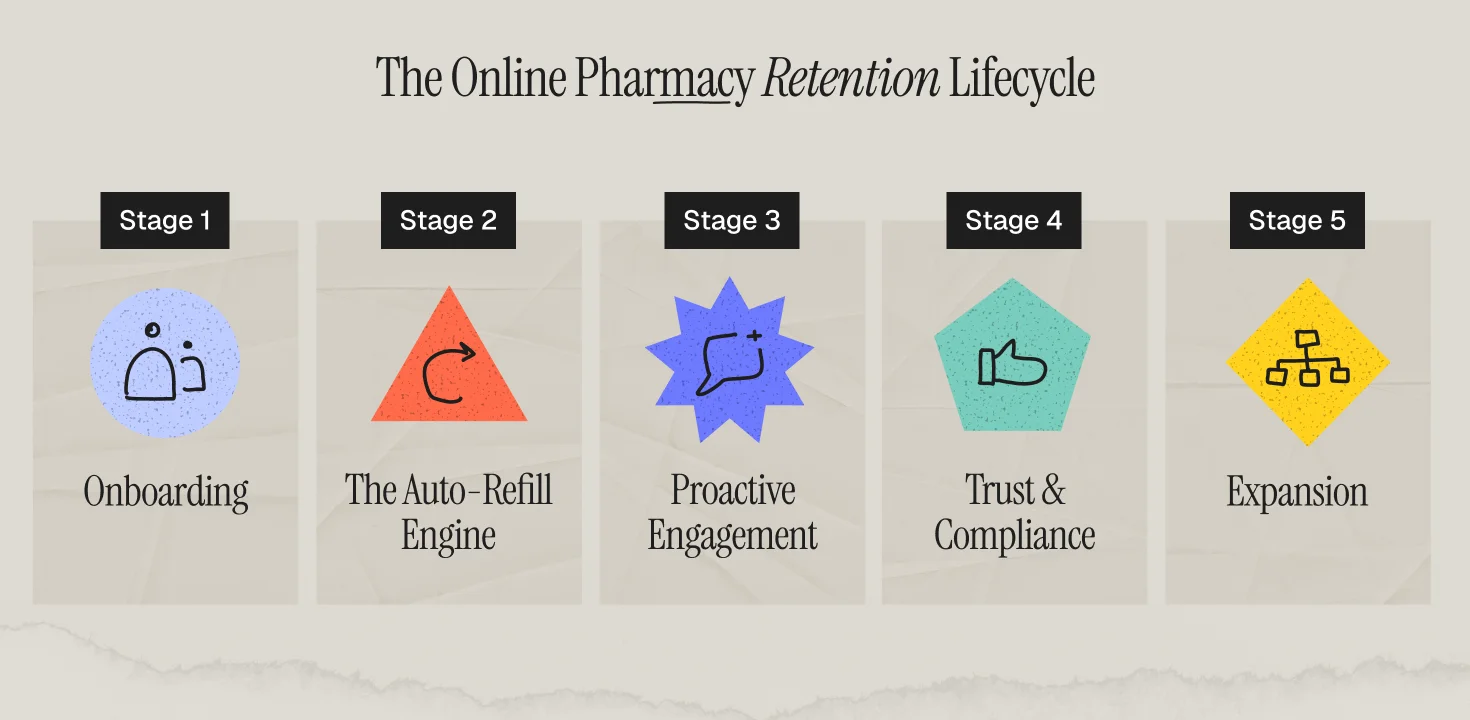
Stage 1: Onboarding — The First Prescription Sets the Retention Trajectory
Making the First Fill Frictionless
The single biggest churn moment in online pharmacy is between prescription and first fill. Every hour of delay, every confusing status update, every additional step between "your prescription is ready" and "your medication has shipped" is a patient considering whether to just walk into a CVS instead.
What the best pharmacies do:
The brands leading in retention—including Eden with their flat-rate GLP-1 pricing and Strut Health with their custom-compounded prescriptions—eliminate pricing surprises and complexity at first fill. Eden charges a consistent monthly rate regardless of dosage changes, removing the cost anxiety that causes early cancellation. Strut Health's physician-founded model bundles consultation fees with prescriptions, so patients never see a surprise bill.
Example: A patient prescribed semaglutide for weight loss receives their medication, dosing instructions, side-effect guidance, and care team contact information within 48 hours of their consultation—all in a single, coherent onboarding sequence. No separate logins. No pharmacy portal. No insurance maze.
Setting the Adherence Foundation
Medication adherence drops dramatically after the first month if patients aren't given a framework for what to expect. The best onboarding sequences include: what to expect in week one (including common side effects), when to expect results, how to reach their care team, and what their refill schedule looks like.
This isn't just good medicine—it's retention engineering. A patient who understands their treatment timeline is a patient who gives the medication time to work before considering cancellation. We cover this principle in depth in our guide on why most retention strategies fail after onboarding.
Stage 2: The Auto-Refill Engine — Turning Adherence Into Revenue
Why Auto-Refill Programs Are the Highest-Impact Retention Lever
Research shows that automatic refill programs improve medication adherence from 73-76% to 77-84%. That 3-8% lift doesn't sound dramatic until you calculate the revenue impact across thousands of patients over 12 months.
But the real value of auto-refill isn't the adherence lift—it's the behavioral default it creates. A patient on auto-refill has to take an active step to stop receiving medication. A patient on manual refill has to take an active step to continue. The difference between those two default behaviors is the difference between a 70% retention rate and a 90% retention rate. This is the same behavioral trigger principle that powers retention across every subscription vertical.
Building Smart Refill Logic
The best auto-refill systems don't just repeat the same order every 30 days. They account for: dosage changes recommended by the provider, seasonal patterns in medication use, patient-reported side effects that may require formulation adjustment, and upcoming appointment dates that might change the prescription.
Strut Health takes this further with custom-compounded prescriptions—because the formulation is personalized to the patient, it creates natural switching costs. A patient optimized on a custom compound can't easily replicate that at a competitor. That's retention through product differentiation, not just convenience.
Stage 3: Proactive Engagement — The Messages That Prevent Silent Churn
The Refill Reminder Sequence
The most dangerous moment in online pharmacy retention is 3-5 days before a patient's medication runs out. If they haven't placed a refill order by this point, they're either: considering stopping treatment, already ordering from a competitor, or simply forgetting.
Patient reminder calls increase cumulative refill rates by 22.8% within 14 days. SMS alerts when prescriptions are ready reduce abandonment by 23%. These aren't optional communications—they're the difference between a retained patient and a lost one.
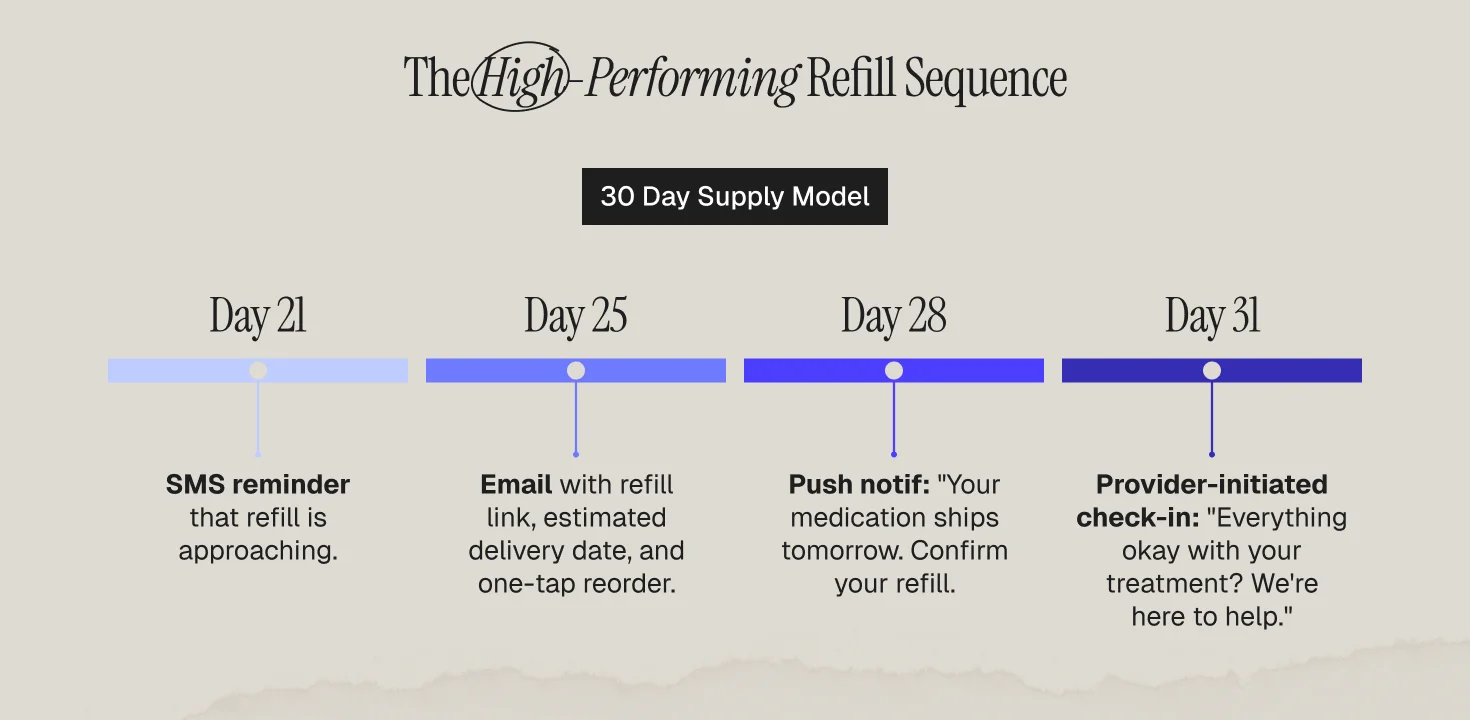
A high-performing refill sequence looks like this:
Day 21 (of a 30-day supply): SMS reminder that refill is approaching. Day 25: Email with refill link, estimated delivery date, and one-tap reorder. Day 28: Push notification — "Your medication ships tomorrow. Confirm your refill." Day 31 (if no refill): Provider-initiated check-in — "Everything okay with your treatment? We're here to help."
The fourth message matters most. It reframes a missed refill from a passive lapse into an active conversation—giving the care team a chance to address whatever caused the hesitation. This is the customer retention email strategy that separates high-performers from average.
Adherence-Based Behavioral Messaging
Beyond refill reminders, the best online pharmacies segment patients by adherence behavior and adjust messaging accordingly—a core principle of behavioral segmentation.
High-adherence patients receive: progress updates, wellness content related to their condition, referral incentives, and cross-category recommendations.
Declining-adherence patients receive: side-effect check-ins, dosage adjustment offers, provider consultation invitations, and motivational content tied to their health goals.
Lapsed patients receive: reactivation campaigns, updated pricing or plan options, new product announcements relevant to their condition, and a direct line to a care coordinator.
This behavioral segmentation—the kind Propel builds using tools like Customer.io and Klaviyo—transforms generic email marketing into a clinical engagement system. We've built these exact flows using our Customer.io Segmentation Prompts OS for HealthTech.
Stage 4: Trust & Compliance — The Retention Levers Unique to Pharmacy
Regulatory Compliance as a Retention Advantage
Online pharmacies operate under strict regulatory requirements: valid prescriptions must be verified before dispensing (DEA Controlled Substances Act), controlled substances require additional oversight, and patient counseling obligations exist in most jurisdictions.
Most pharmacies treat these requirements as costs. The smart ones treat them as retention opportunities.
Example: A mandatory pharmacist consultation before first fill isn't just a compliance checkbox—it's a chance to build a personal connection with the patient, address concerns, and reinforce the value of staying on treatment. Patients who speak with a pharmacist during onboarding have measurably higher adherence rates.
The Trust Gap in Online Pharmacy
Patients choosing an online pharmacy over a physical one are taking a trust leap. They can't see the pharmacist. They can't inspect the medication before accepting it. They're trusting a website with their health.
The pharmacies winning on retention close this trust gap through: transparent communication about sourcing and quality (Strut Health's triple-accredited compounding pharmacy partnership), responsive care teams (Eden's 24/7 provider messaging), clear privacy practices, and visible clinical credentials.
Every interaction that reinforces "we're a real medical practice, not just a delivery service" strengthens retention. This is how HealthTech apps improve customer retention—by closing the trust gap that digital-first brands inherently face.
Stage 5: Expansion — Growing Revenue Per Patient
Cross-Category Prescriptions
A patient who comes to an online pharmacy for one condition is a candidate for treatment of adjacent conditions. The lifecycle marketing opportunity: identify patients who may benefit from additional treatments and facilitate those conversations through provider-initiated outreach.
This isn't upselling—it's comprehensive care. A patient prescribed a dermatology treatment who also mentions fatigue in a follow-up message may be a candidate for thyroid evaluation. A GLP-1 weight loss patient experiencing mood changes may benefit from mental health support.
The key is provider-driven expansion, not marketing-driven. Patients trust medical recommendations. They resist promotional emails.
90-Day Supply Migration
Moving patients from 30-day to 90-day prescriptions is one of the simplest retention strategies in online pharmacy. Longer supply cycles mean: fewer decision points where a patient might switch, lower per-unit costs that reinforce value, better adherence outcomes (convenience drives compliance), and higher commitment signaling from the patient.
The lifecycle trigger: after a patient's third consecutive 30-day refill, offer a 90-day option with a price incentive. Patients who accept are signaling high intent to continue—and their retention rate will reflect it.
Key Metrics Every Online Pharmacy Should Track
First-fill-to-second-fill rate: The percentage of patients who refill after their initial prescription. Target: above 75%. This is your single most important retention metric.
Auto-refill enrollment rate: What percentage of eligible patients are on auto-refill? Target: above 60%. Below this, you're leaving retention on the table.
Time-to-first-fill: How long between prescription and first medication delivery? Every day of delay costs you patients. Target: under 72 hours.
Refill adherence rate (PDC): Proportion of days covered by medication over a treatment period. Target: above 80% for chronic conditions. Learn more about measuring retention performance.
Net revenue retention (NRR): Revenue from existing patients including expansion, contraction, and churn. Target: above 100%—meaning expansion revenue from existing patients exceeds lost revenue from churn.
How Propel Builds Retention for Online Pharmacies
At Propel, we've built lifecycle marketing and retention systems for online pharmacy and telehealth brands including Eden and Strut Health. We understand the unique challenges of this vertical—from regulatory compliance to clinical communication to adherence-based segmentation.
As Platinum Customer.io Partners, we design the behavioral flows, smart refill sequences, and multi-channel engagement systems that turn first-time patients into long-term subscribers. We're also among the best HealthTech email marketing agencies in the USA.
If you're running an online pharmacy and your retention rate isn't where it should be, we can help.
FAQs
What is a good retention rate for an online pharmacy?
A strong online pharmacy should target 85%+ monthly retention for chronic medication patients and above 75% first-fill-to-second-fill conversion. Industry average attrition is 1-2% monthly, but top performers cut this significantly through auto-refill programs and proactive engagement.
How do auto-refill programs improve pharmacy retention?
Auto-refill programs shift the behavioral default from "patient must act to continue" to "patient must act to stop." Research shows this improves adherence by 3-8 percentage points and dramatically reduces passive churn—patients who simply forget to reorder.
What lifecycle marketing tools work best for online pharmacies?
Platforms like Customer.io and Klaviyo enable the behavioral segmentation and multi-channel automation that pharmacy retention requires. The key is building flows triggered by adherence behavior—not just calendar dates—so messaging adapts to each patient's actual engagement pattern.
How does Propel help online pharmacy brands with retention?
Propel builds complete lifecycle marketing systems for online pharmacies, including refill automation flows, adherence-based segmentation, provider-initiated engagement sequences, and cross-category expansion campaigns. We work with brands like Eden and Strut Health to drive measurable retention improvements.
What's the biggest mistake online pharmacies make with retention?
Treating retention as a marketing problem instead of a product and clinical problem. The pharmacies with the highest retention rates don't just send better emails—they build better onboarding, faster fulfillment, responsive care teams, and personalized treatment plans that make staying easier than leaving.
