Summarize this documentation using AI
Lifecycle revenue is the total revenue a customer generates across every touchpoint, channel, and purchase over the duration of their relationship with a brand — measured as a per-cohort compounding curve, not a single transaction value. It is the operating metric brands use when they treat retention as a discipline instead of a marketing tactic. For DTC and subscription businesses, lifecycle revenue is what you build forecasts, paid acquisition budgets, and product roadmaps around — because it's the only metric that captures the exponential impact of retention rather than the linear impact of a single repeat purchase.
Key Takeaways
- Lifecycle revenue ≠ LTV. LTV is a backwards-looking unit-economics number. Lifecycle revenue is a forward-looking, cohort-aware curve.
- A 5-point retention lift = 25–30% increase in lifecycle revenue — exponential, not linear (Saras Analytics, 2026).
- Average Shopify CLV at year 3 sits at $168; top-performing stores hit $250–$450+ (Easyappsecom, 2026).
- Cohort-level lifecycle revenue beats blended LTV for forecasting — blended numbers hide a 2–3× spread between best- and worst-performing acquisition channels.
- 30-day activation is the single biggest lever. Subscribers who engage with the product in the first 30 days are 3–5× more likely to still be subscribed at month 12 (Eightx, 2026).
Lifecycle revenue vs LTV vs CLV — and why the difference matters
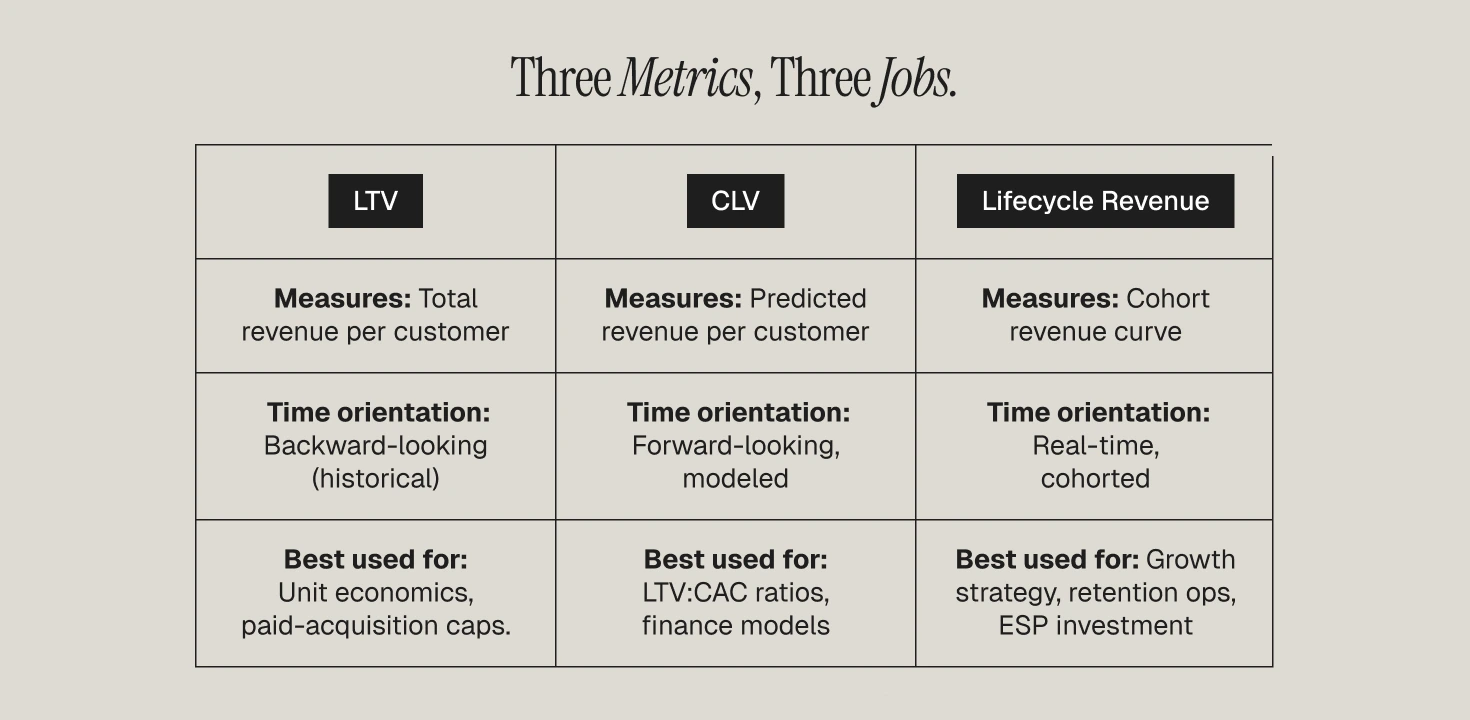
Customer Lifetime Value (LTV) gets used as shorthand for "how valuable is a customer." It's a useful number, but it's a blended, lagging number — it tells you what already happened. Lifecycle revenue is the operational version of the same idea: a per-cohort curve that tells you how revenue is currently accumulating across the customer relationship, broken down by acquisition channel, product line, subscription tier, and ESP-driven lifecycle stage.
The shift from LTV to lifecycle revenue mirrors a shift from finance-led measurement to growth-led measurement. Finance teams need a single dollar figure. Growth teams need a curve — because the shape of the curve tells you where the leverage is.
The lifecycle revenue formula
Lifecycle revenue is calculated as the cumulative gross revenue per cohort over time, expressed as a curve indexed to the cohort's acquisition date:
Lifecycle Revenue (cohort C, day T) = Σ (Order revenue) for all customers in cohort C, from day 0 to day T
Most teams report at three anchor points: Day 90, Day 180, and Day 365. The slope between those anchors is what matters. A flat slope between Day 90 and Day 365 = your retention is broken, even if the Day 365 number looks fine versus benchmark.
The 4 levers that move lifecycle revenue
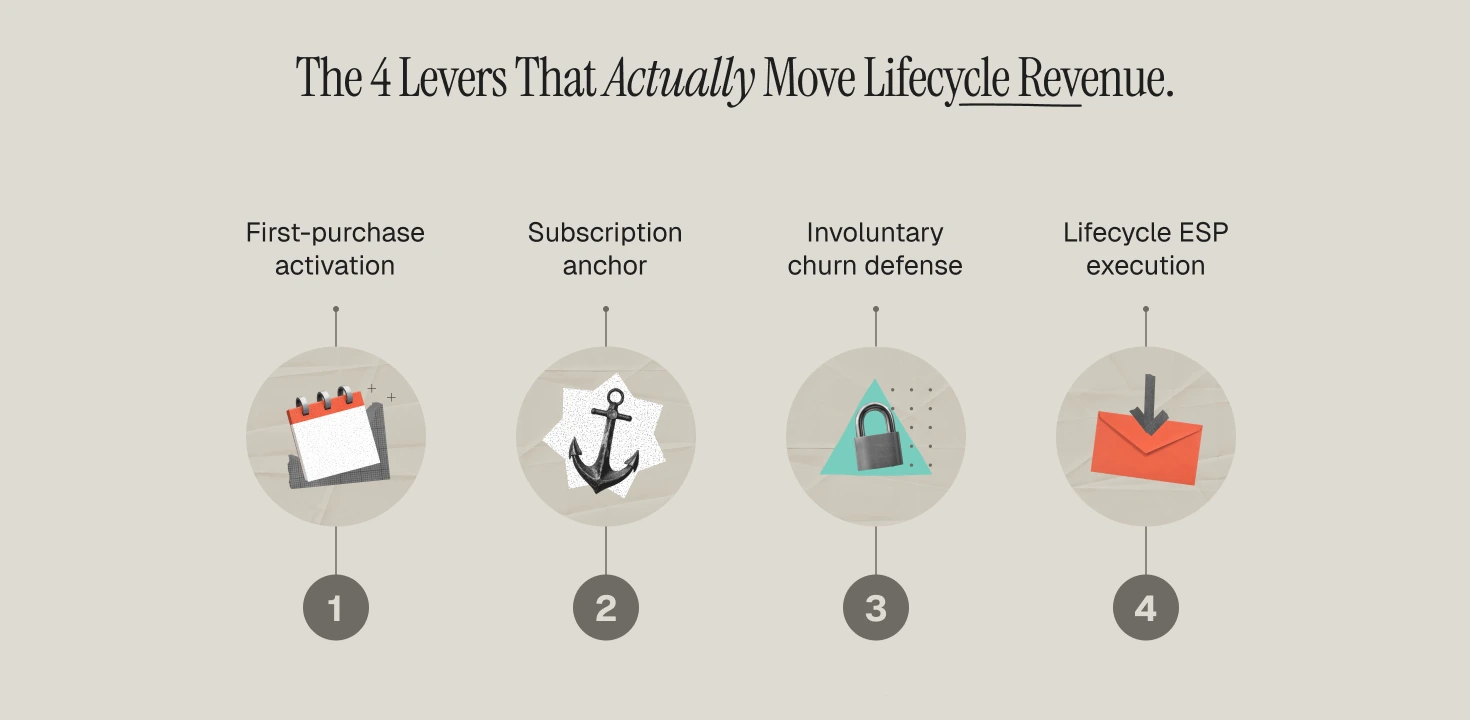
Lever 1: First-purchase activation
Subscribers who engage with the product in the first 30 days are 3–5× more likely to still be active at month 12 (Eightx, 2026). Most brands' onboarding flows end at day 7 — they're leaving the highest-leverage retention window untouched.
Lever 2: Subscription anchor
Replenishment subscriptions sit at 4–7% monthly churn. Curation models sit at 10–15% (Eightx, 2026). The model you choose is a lifecycle-revenue decision, not a packaging decision.
Lever 3: Involuntary churn defense
20–68% of subscription churn is failed payments (Eightx, 2026). Card-updater APIs, retry cadences, and pre-dunning emails are lifecycle-revenue infrastructure — not nice-to-haves.
Lever 4: Lifecycle ESP execution
A well-instrumented Klaviyo, Customer.io, or Braze account drives 30–50% of post-acquisition revenue through behavior-triggered flows. The brands compounding lifecycle revenue treat the ESP as a product surface, not a marketing channel.
Why cohort-level reporting beats blended LTV
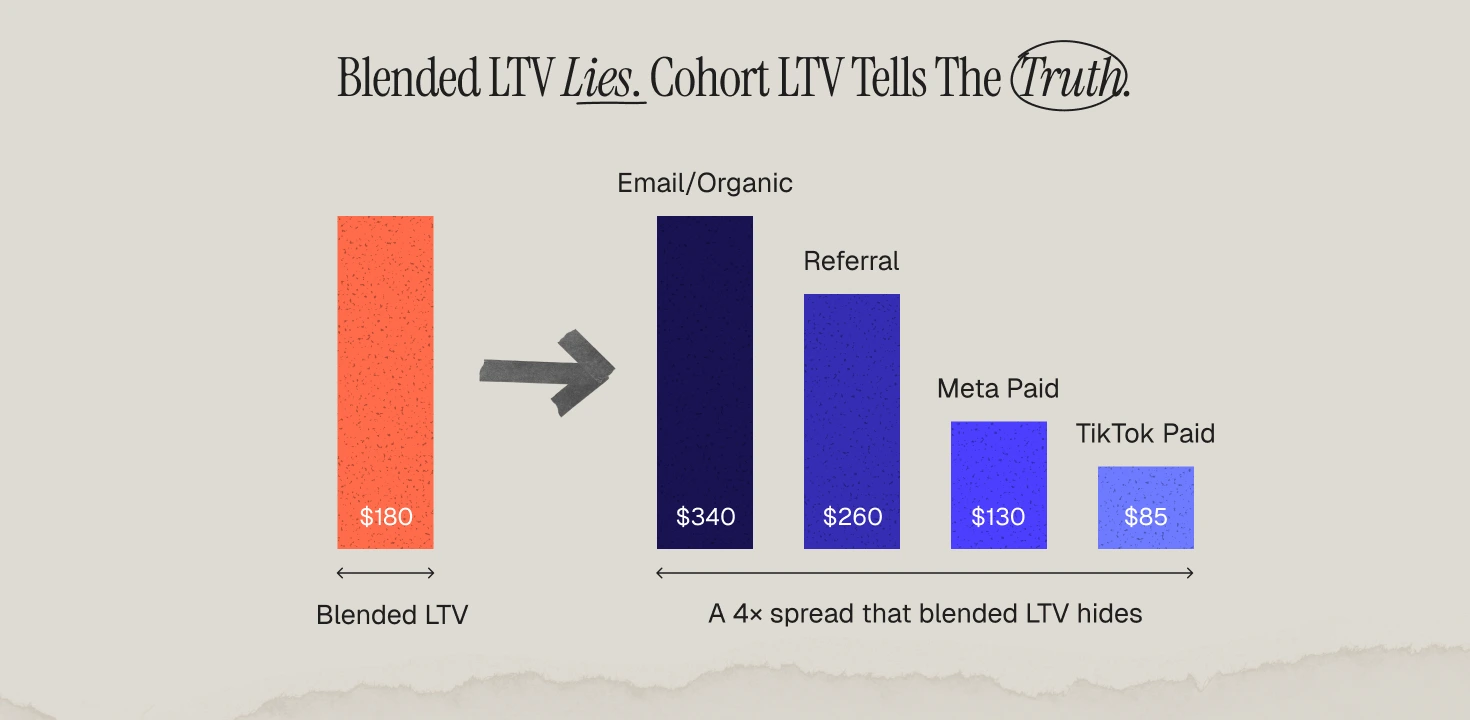
A blended LTV of $180 can hide a 4× spread between your best and worst acquisition channels. Email/organic might be returning $340 per customer while TikTok paid returns $85. The CFO budgeting paid spend off the blended number is over-investing in the worst channel and under-investing in the best one — that's where margin disappears.
For more on cohorted retention measurement, see our guide on customer retention rates by industry.
The 4 KPIs every retention dashboard needs in 2026
- 30-day activation rate — % of new subscribers who used the product in their first 30 days.
- Monthly churn split by voluntary vs involuntary — flag if involuntary >25% of total.
- Net revenue retention by acquisition cohort — never blended.
- Lifecycle revenue at Day 90, 180, and 365 — measure the slope, not just the endpoint.
Frequently Asked Questions
Is lifecycle revenue the same as LTV?
No. LTV is a single dollar figure per customer that tells you what already happened. Lifecycle revenue is a per-cohort revenue curve over time that tells you what's compounding right now.
How often should I report lifecycle revenue?
Monthly at minimum, with anchor points at Day 90, Day 180, and Day 365 of each acquisition cohort. Weekly if you're inside an active retention rebuild.
What's a "good" lifecycle revenue for a DTC brand?
Top-decile DTC brands hit $250–$450+ over 3 years on Shopify; median sits around $168 (Easyappsecom, 2026). The brand-specific benchmark depends on AOV, subscription anchor, and category.
How is lifecycle revenue different from MRR or ARR?
MRR and ARR are point-in-time revenue snapshots. Lifecycle revenue is cumulative per cohort over time. A subscription business needs both — MRR/ARR for finance, lifecycle revenue for growth.
Does my Klaviyo or [Customer.io](http://Customer.io) account already track lifecycle revenue?
Most don't out of the box. They track flow revenue, campaign revenue, and channel revenue — not cohorted lifecycle revenue. You usually need a BI layer (Looker, Mode, or a custom dashboard) on top.
