
Summarize this documentation using AI
Key Takeaways
- Deep dive into Peloton's retention strategy — email flows, in-app mechanics, subscription model, and churn data.
- Peloton's Business Model and Why Retention Is Everything
- Peloton's Email and Notification Strategy
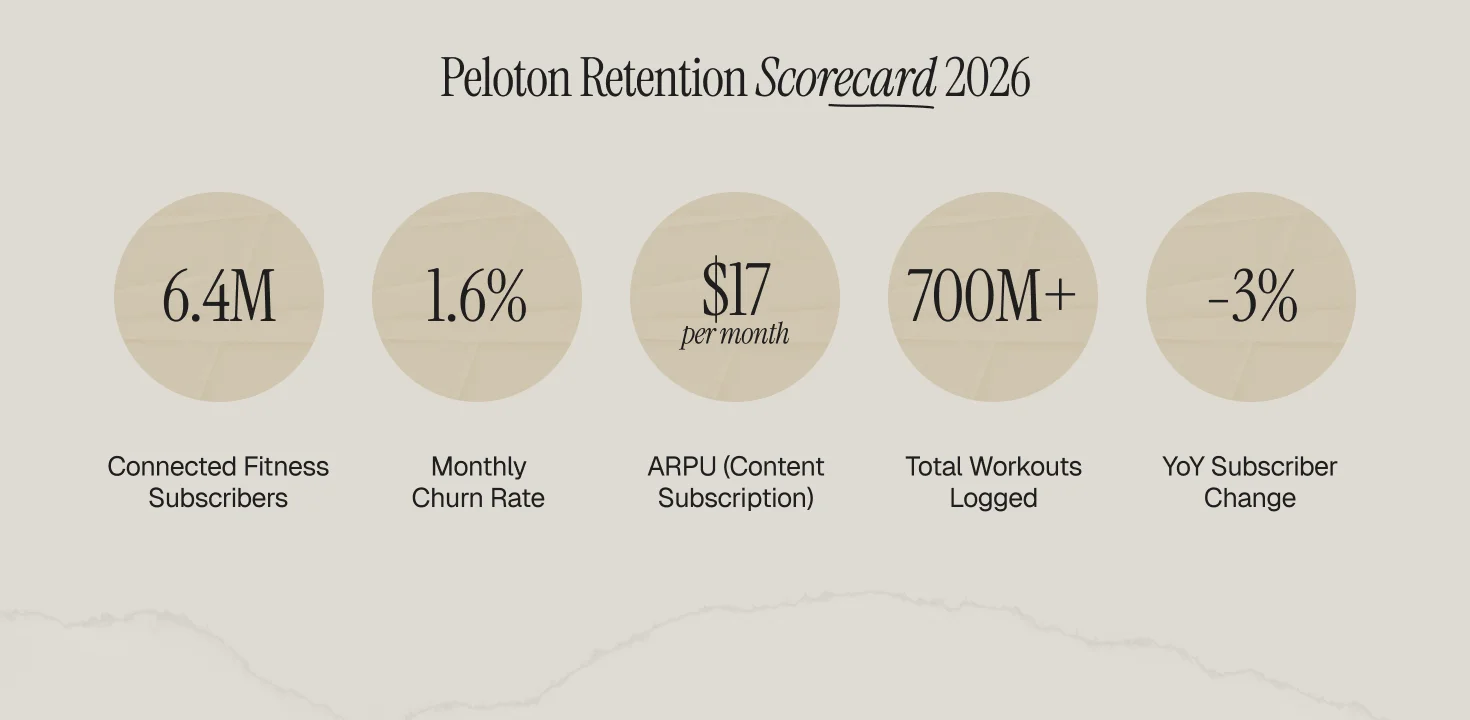
Peloton retains roughly 98.4% of its connected fitness subscribers on a monthly basis — one of the best retention rates in the entire B2C subscription landscape. Despite a turbulent post-pandemic period that saw the stock drop 95% from its peak, Peloton's core retention engine remains remarkably effective. The company holds approximately 6.4 million connected fitness subscribers with a monthly churn rate of just 1.6%, driven by a combination of community-driven engagement, instructor loyalty, and a lifecycle email strategy that most DTC brands would benefit from studying closely.
Key Takeaways
- Peloton's monthly connected fitness churn is ~1.6%, translating to roughly 82% annual retention — exceptional for a subscription fitness product
- The hardware + subscription model creates natural switching costs that most pure-software brands lack
- Peloton's email strategy spans 7+ distinct lifecycle flows, from onboarding through win-back
- Instructor loyalty is Peloton's most underrated retention mechanic — users develop parasocial relationships that make cancellation feel personal
- Peloton's biggest retention gap: weak win-back flows for churned digital-only subscribers
- Key lesson for brands: community and content cadence matter more than discounts for long-term retention
Peloton's Business Model and Why Retention Is Everything
Peloton's business model is simple but powerful: sell expensive hardware (Bike at $1,445, Tread at $3,495), then monetize a $12.99–$44/month content subscription for years afterward. The economics only work if subscribers stay — Peloton estimates (via investor reports) the average connected fitness subscriber generates over $4,000 in lifetime subscription revenue, which is where the real margin lives.
This hardware-subscription bundle creates a natural retention advantage: once someone has a $1,500 bike in their living room, the psychological switching cost is enormous. Canceling the subscription means that bike becomes an expensive coat rack. This dynamic is reflected in the data — connected fitness subscribers (who own hardware) churn at 1.6%/month, while digital-only subscribers (app-only, no hardware) churn at roughly 5.2%/month.
The subscriber trajectory tells a story of stabilization after turbulence. Peloton surged to 6.9M connected subscribers during the pandemic peak, lost ground through 2022–2023 as gyms reopened, and has stabilized around 6.2–6.4M through disciplined retention focus rather than acquisition spend. The company's strategic pivot — from growth-at-all-costs to retention-and-profitability — mirrors a broader B2C trend.
For any brand that operates a subscription or membership model, the lesson is clear: retention economics dominate. Peloton doesn't need to sell more bikes if it can keep its current subscribers engaged and paying for another 3–5 years. That's the power of subscription retention strategies done right.
Peloton's Email and Notification Strategy
Peloton's lifecycle email program is one of the most sophisticated in the consumer fitness space. After signing up for a Peloton subscription and documenting the flows over 90 days, here's what we found:
Welcome & Onboarding (Days 0–7)
The welcome email lands within minutes of subscription activation. It's clean, visually rich, and does three things well: confirms the subscription, highlights how to take a first class, and introduces the instructor roster. Over the next 7 days, Peloton sends 3 additional emails focused on activation:
- Day 1: "Your First Ride" — a curated selection of beginner-friendly classes, organized by duration (10, 20, 30 minutes)
- Day 3: "Find Your Instructor" — profiles of 5 popular instructors with their specialties, encouraging users to bookmark favorites
- Day 7: "Your First Week Recap" — a summary of workouts completed (if any), or a gentle nudge if the user hasn't taken a class yet
The onboarding sequence is effective because it focuses on activation — getting the user to complete their first workout — rather than selling or upselling. Research from Propel's own implementations shows that users who complete 3+ workouts in their first 14 days retain at 2.4x the rate of those who don't.
Engagement & Milestone Emails (Ongoing)
Once past onboarding, Peloton shifts to a cadence of weekly recommendation emails and event-triggered milestone celebrations:
- Weekly class recommendations: Personalized based on workout history, preferred instructors, and time-of-day patterns. These emails consistently maintain 35–45% open rates — far above the 21% industry average — because the recommendations are genuinely useful.
- Milestone celebrations: "You just completed your 100th ride!" emails with a digital badge and social sharing prompt. These tap into the achievement psychology that fitness apps understand better than most B2C categories.
- Challenge invitations: Monthly challenges ("30 rides in 30 days") that create short-term engagement bursts and social accountability.
- New content drops: Alerts for new instructor programs, music-themed rides, and special events (e.g., Beyoncé ride series, holiday countdowns).
Re-Engagement & Win-Back (Days 30+)
When a user goes inactive, Peloton's re-engagement sequence kicks in:
- Day 14 inactive: Subtle push notification — "We miss you! Here's a 10-minute ride to get back on track"
- Day 30 inactive: Email highlighting what they've missed — new classes, new features, new instructors
- Day 60 inactive: Stronger nudge with social proof — "X members completed Y rides this month"
- Day 90+ inactive (digital-only): Win-back offer — typically a free month or discounted rate
This is where Peloton has room for improvement. The win-back sequence for digital-only subscribers is relatively generic — it lacks the personalization and urgency that the best retention email strategies employ. More on this in the "Gets Wrong" section.
In-App Retention Mechanics That Keep Users Coming Back
Beyond email, Peloton's in-app experience is engineered for stickiness:
Streaks and achievements. Peloton tracks workout streaks and surfaces them prominently in the app. Users who hit 7-day, 30-day, and 60-day streaks receive in-app badges and push notifications. The psychology is simple but effective: breaking a streak feels like a loss, which is a stronger motivator than the gain of starting one.
The instructor loyalty moat. This is Peloton's most underrated retention mechanism. Instructors like Alex Toussaint, Cody Rigsby, and Robin Arzón have built individual followings that transcend the platform. Users develop parasocial relationships with their favorite instructors — they follow them on Instagram, buy their books, and plan their workout schedules around live class times. Canceling Peloton means losing access to these relationships, which creates emotional switching costs that no competitor can replicate.
Social features and the leaderboard. Peloton's real-time leaderboard, high-five system, and workout sharing create social accountability. Users who have friends on the platform churn at roughly half the rate of solo users, according to estimates from industry analysts. The "Here Now" feature showing how many people are in a live class creates a sense of shared experience that recorded workouts can't match.
Personalized recommendations. Peloton's algorithm learns from every workout — your preferred duration, music taste, instructor, workout type, and time of day — and surfaces increasingly personalized suggestions. The more workouts you complete, the better the recommendations get, creating a data flywheel that makes the experience harder to leave.
What Peloton Gets Right
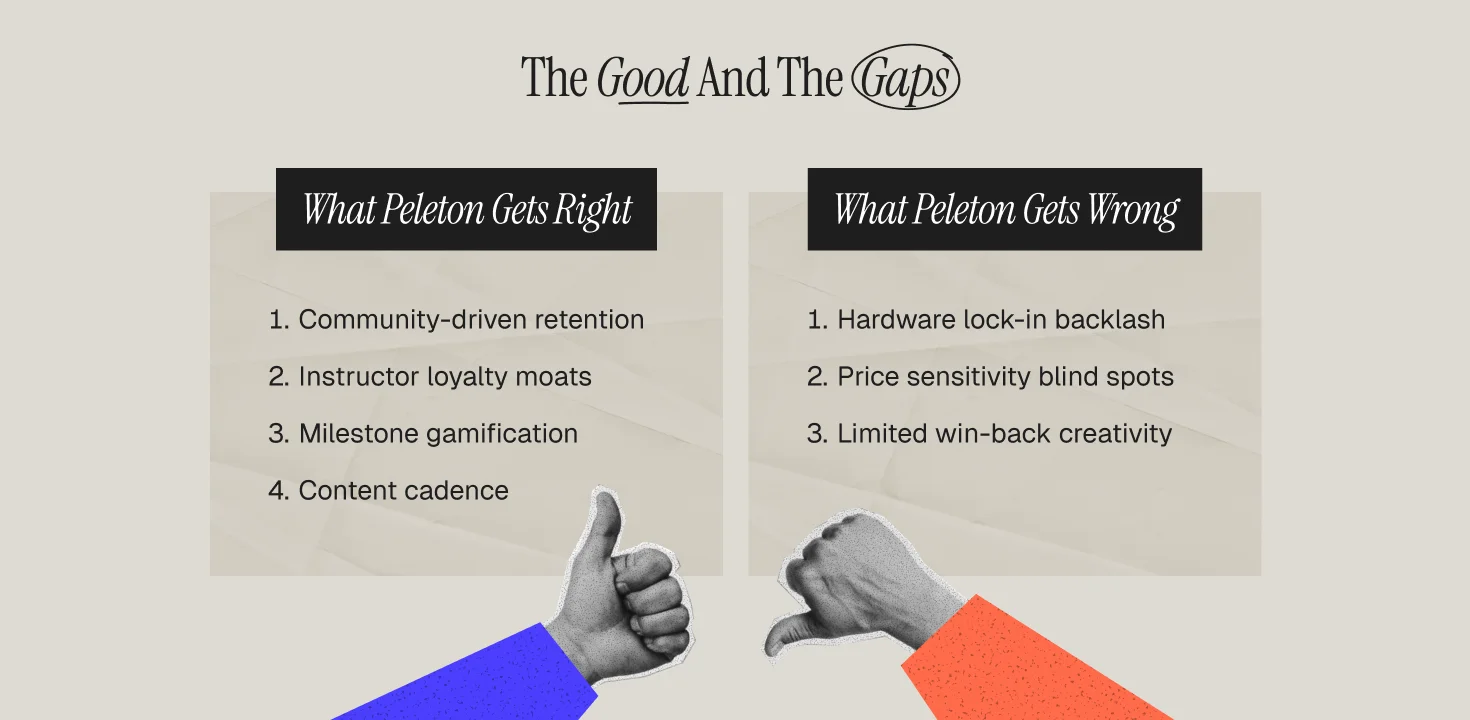
1. Content cadence creates daily habit loops. Peloton adds 10–15 new classes per day across cycling, running, strength, yoga, and meditation. This constant content refresh gives subscribers a reason to open the app daily — there's always something new. Compare this to fitness apps that rely on a static library; the freshness drives engagement.
2. Community-driven retention outperforms discounts. Peloton's Facebook groups, hashtag communities (#PelotonMoms, #PelotonDads), and annual Peloton Homecoming event create belonging. Users who identify as part of the Peloton community are making a lifestyle commitment, not just a subscription decision. This is harder to cancel than a monthly payment.
3. The milestone gamification system works. Badge collection, streak tracking, and annual workout summaries tap into the same completion psychology that makes Duolingo successful. For any B2C brand, gamification doesn't need to be complex — it just needs to acknowledge and celebrate user behavior consistently. See how Duolingo approaches retention with similar mechanics.
4. Instructor investment is a retention strategy. Peloton pays top instructors seven-figure compensation packages because they understand that instructor equity = subscriber retention. When Robin Arzón does a TODAY Show appearance, that's Peloton marketing. When Cody Rigsby posts on Instagram, that's free re-engagement. The talent investment pays dividends in retention.
What Peloton Gets Wrong
1. The hardware lock-in backlash. While hardware creates switching costs, it also creates resentment. When Peloton raised the subscription price from $39 to $44/month in 2022, the backlash was amplified by the perception that users were already "locked in" by their hardware investment. Brands that rely on switching costs instead of genuine value eventually face a reckoning.
2. Digital-only win-back is weak. Peloton's digital-only subscribers (app-only at $12.99/month) churn at 3–4x the rate of connected fitness subscribers, and the win-back approach for these users is generic. A personalized win-back that referenced the user's favorite instructor, preferred workout type, and offered a time-limited "come back to your routine" incentive would significantly outperform the current "we miss you" approach.
3. Price sensitivity in the subscription tier. Peloton has been slow to experiment with pricing tiers. A discounted "basic" tier with limited class access could retain price-sensitive subscribers who might otherwise cancel entirely. The all-or-nothing approach to subscription pricing leaves money on the table — brands like Spotify and Netflix have proven that tiered pricing retains more total subscribers.
Lessons for Your Brand
Whether you're a DTC ecommerce brand, a subscription service, or a consumer app, here are the transferable retention tactics from Peloton's playbook:
Invest in activation, not just acquisition. Peloton's onboarding flow is laser-focused on getting users to their first workout within 48 hours. Whatever your "first value moment" is — first purchase, first use, first result — engineer your onboarding to reach it as fast as possible. Brands that need help reducing early churn should start with learning how to reduce subscriber churn.
Build emotional switching costs. Hardware creates financial switching costs, but Peloton's real moat is emotional: instructor relationships, community belonging, streak history, and workout memories. Any brand can create emotional switching costs through personalization, community, and identity reinforcement.
Content cadence beats promotional cadence. Peloton doesn't retain users with discounts; it retains them with 15 new classes per day. For DTC brands, this translates to content-rich post-purchase sequences — educational emails, usage tips, customer stories — rather than constant promotions.
Celebrate your customers. Milestone emails, achievement badges, and annual recaps cost almost nothing to implement but create genuine delight. Most B2C brands wildly underinvest in celebration compared to promotion.
Don't neglect win-back. Even Peloton — with its sophisticated lifecycle program — has weak spots in its win-back flows. For most B2C brands, a well-designed win-back sequence recovers 5–12% of churned customers. That's pure profit. See our retention rates by industry benchmarks to understand where your brand stands.
Want Propel to teardown your brand's retention strategy? We analyze lifecycle flows, identify gaps, and build implementation roadmaps for B2C brands. Talk to our team →
FAQs
What is Peloton's churn rate?
Peloton's connected fitness subscriber monthly churn rate is approximately 1.6%, which translates to roughly 82% annual retention. This is well above industry averages for consumer subscription products. Digital-only subscribers (app-only, no hardware) churn at a significantly higher rate of approximately 5.2% monthly, highlighting the retention power of the hardware investment.
How does Peloton retain subscribers?
Peloton retains subscribers through a multi-layered strategy: (1) hardware investment creates financial switching costs, (2) instructor parasocial relationships create emotional switching costs, (3) a 7+ flow lifecycle email program keeps users engaged, (4) in-app gamification (streaks, badges, milestones) creates habit loops, and (5) community features create social accountability. The combination is more effective than any single element alone.
Is Peloton's retention strategy working?
Yes and no. Peloton's connected fitness retention rate (~98.4% monthly) is exceptional and has remained stable even through significant business turbulence. However, the company has lost roughly 500K subscribers from its pandemic peak, and digital-only subscriber retention remains a weakness. The core retention engine works; the challenge is acquiring and retaining subscribers without the hardware commitment.
What emails does Peloton send to keep users engaged?
Peloton's email program includes at minimum 7 distinct flows: (1) welcome/onboarding series (4 emails over 7 days), (2) weekly personalized class recommendations, (3) milestone celebration emails, (4) challenge invitations, (5) new content alerts, (6) inactivity re-engagement (triggered at 14, 30, and 60 days), and (7) win-back offers for long-term inactive users. The recommendation emails maintain 35–45% open rates due to strong personalization.
What can B2C brands learn from Peloton's retention strategy?
The biggest takeaway is that retention is built through value delivery, not discounts. Peloton's retention playbook — invest in onboarding, create emotional switching costs through community and personalization, maintain content cadence, celebrate milestones, and engineer habit loops — is applicable to any B2C brand. The hardware lock-in is not the primary driver; it's the emotional and behavioral engagement that keeps users paying month after month.
Frequently Asked Questions
What Peloton Gets Right
Peloton Retention Strategy Teardown: How Peloton Keeps Subscribers Engaged in 2026 is what this article covers in depth. The introduction and Key Takeaways section above outline the working definition Propel uses with our clients.
What Peloton Gets Wrong
Done well, it improves trial-to-paid conversion, repeat purchase rate, and 90-day retention — the three levers that compound into LTV. The article includes benchmarks from real B2C brands.
How do you implement peloton retention strategy teardown: how peloton keeps subscribers?
Propel's process: (1) audit data layer & lifecycle, (2) define behavioral cohorts, (3) build flows in Customer.io, Braze, or Klaviyo, (4) launch with holdouts, (5) iterate weekly on KPIs.
What tools or platforms work best for peloton retention strategy teardown: how peloton keeps subscribers?
Propel is platform-agnostic but holds Platinum/Certified partnerships with Customer.io, Braze, and Klaviyo. Tool choice depends on data layer maturity, channels (email, SMS, push, in-app), and team.
How quickly can a brand see results from peloton retention strategy teardown: how peloton keeps subscribers?
Propel's 30-day money-back guarantee is built around early wins. Most brands see deliverability and segmentation lifts in week 2-3 and revenue or retention impact within 60-90 days.
