
Summarize this documentation using AI
Key Takeaways
- Learn how top online pharmacies like Hims & Hers achieve 85% retention rates.
- Why Retention Matters More Than Acquisition for Online Pharmacies
- Key Retention Metrics for Online Pharmacies
Why Retention Matters More Than Acquisition for Online Pharmacies
The economics of online pharmacy are uniquely suited to retention marketing. Prescription medications are recurring by nature — a customer who fills a 90-day prescription four times a year is worth 4x their first transaction. Yet most online pharmacies spend 80%+ of their marketing budget on acquisition and less than 20% on keeping the customers they've already converted.
Here's what the data shows:
- Hims & Hers reports retention rates of 85% with a customer acquisition cost (CAC) payback period of under one year
- Patients in telehealth programs with integrated reminder systems show a 62% improvement in medication adherence compared to traditional care models
- 80% of the American population has now used telehealth services, creating a massive addressable retention audience (Storm3)
For online pharmacies, every retained customer means predictable recurring revenue, lower CAC amortization, higher lifetime value, and better health outcomes (which drives referrals and reviews).
Key Retention Metrics for Online Pharmacies
| Metric | What to Measure | Target |
|---|---|---|
| Monthly Churn Rate | % of subscribers canceling per month | < 7% for replenishment |
| 90-Day Retention Rate | % of new subscribers still active at 90 days | > 65% |
| Save Rate | % of cancellation attempts saved by cancellation flow | > 30% |
| Win-Back Rate | % of churned subscribers who resubscribe within 90 days | > 10% |
| LTV:CAC Ratio | Lifetime value divided by customer acquisition cost | > 3:1 |
| Subscriber Engagement Score | Composite of email opens, site visits, product reviews | Trending upward quarter-over-quarter |
Before building your retention program, you need to know what to measure. Here are the metrics that matter most for digital pharmacies:
7 Proven Retention Strategies for Online Pharmacies
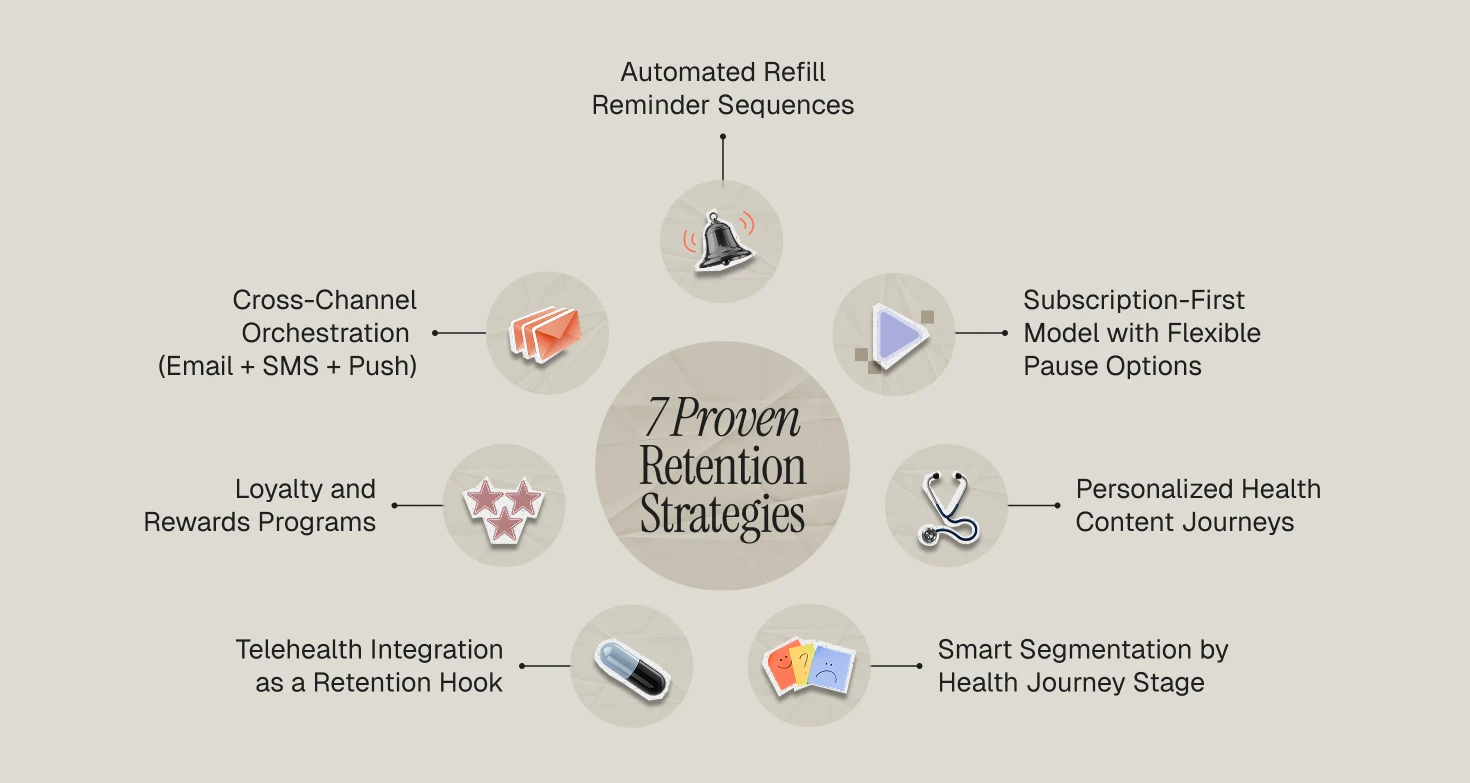
Strategy 1: Automated Refill Reminder Sequences
The most direct retention lever for online pharmacies is the automated refill reminder. When a customer fills a 30-day prescription on Day 1, your system should trigger a reminder sequence starting at Day 22–25 — before they run out, not after.
How to implement this:
Build a multi-touch reminder flow: email at Day 22, SMS at Day 25, push notification at Day 28. Each touchpoint should include the medication name, dosage, one-click refill link, and any relevant insurance or discount information. Platforms like Customer.io and Klaviyo make this flow architecture straightforward with event-based triggers.
According to research, patients in programs with integrated analytics-driven reminder systems show a 62% improvement in medication adherence. That's not just a retention win — it's a health outcome win.
Strategy 2: Subscription-First Model with Flexible Pause Options
The most effective online pharmacies default to subscription models rather than one-time purchases. But the key retention insight is flexibility: allowing customers to pause, skip, or adjust delivery frequency reduces potential churn by 20–30% compared to rigid subscription models.
What this looks like in practice:
Offer 30, 60, and 90-day delivery cycles. Let customers pause without canceling. Send proactive check-in emails before each renewal asking if they need to adjust. Build a cancellation flow that offers alternatives (pause, frequency change, product swap) before confirming cancellation.
Strategy 3: Personalized Health Content Journeys
Online pharmacy customers aren't just buying products — they're managing health conditions. A retention program that provides personalized health education based on their medication category creates genuine value beyond the transaction.
Example content journeys:
For a customer on a diabetes medication: send a welcome email with medication tips, a Week 2 email with dietary guidance, a Month 1 email with lifestyle research, and ongoing monthly health insights. This approach mirrors what companies like Hims & Hers and Ro have implemented — content that builds trust and positions the pharmacy as a health partner, not just a fulfillment center.
Strategy 4: Smart Segmentation by Health Journey Stage
Not all pharmacy customers are the same. A new customer filling their first prescription has different needs than a long-term subscriber who's been with you for two years. Behavioral segmentation is critical for online pharmacies.
Key segments to build:
- New patients (0–30 days): Focus on onboarding, medication education, and first-refill conversion
- Active subscribers (1–12 months): Focus on adherence, cross-sell related health products, and satisfaction surveys
- At-risk patients (missed refills, declining engagement): Trigger win-back sequences with personalized outreach
- Long-term loyalists (12+ months): Referral programs, loyalty rewards, and premium service tiers
Strategy 5: Telehealth Integration as a Retention Hook
Online pharmacies that integrate telehealth consultations into their platform create a powerful retention loop. When a customer can refill their prescription AND consult with a provider in the same platform, switching costs increase dramatically.
The telehealth market is projected to continue growing with retention as a key focus area for 2026. Brands like Ro, Hims & Hers, and Nurx have all built integrated telehealth-to-pharmacy pipelines where the consultation drives the first fill, and the pharmacy experience drives retention.
Retention tactics within telehealth integration:
Follow-up emails after telehealth visits with prescription details and next steps. Automated appointment reminders for recurring consultations. Satisfaction surveys after each telehealth interaction. Provider continuity — matching patients with the same provider builds relationship stickiness.
Strategy 6: Loyalty and Rewards Programs
Pharmacy customers respond to loyalty programs differently than typical ecommerce customers. Points-per-purchase models can work, but the most effective pharmacy loyalty programs reward adherence behaviors — refilling on time, completing health assessments, or referring friends.
Program structure example:
Award points for on-time refills (not just purchases), health survey completions, and referrals. Redeem points for free delivery, OTC product discounts, or telehealth consultation credits. This approach aligns business incentives (retention) with customer incentives (better health outcomes).
Strategy 7: Cross-Channel Orchestration (Email + SMS + Push)
Online pharmacy customers are time-sensitive — a missed refill reminder can mean a gap in medication. That's why single-channel communication isn't enough. The most effective pharmacy retention programs use omnichannel orchestration to reach customers through their preferred channel at the right moment.
Channel hierarchy for pharmacy retention:
- Email: Best for health content, detailed prescription information, and monthly summaries
- SMS: Best for urgent refill reminders, delivery updates, and appointment confirmations. SMS sees open rates of 90–98% making it ideal for time-sensitive pharmacy communications
- Push notifications: Best for in-app reminders, loyalty point updates, and flash offers on OTC products
Build automated flows that escalate across channels. If a customer doesn't open the Day 22 refill email, trigger an SMS on Day 25. If they don't respond to SMS, send a push notification on Day 27. This approach ensures no refill falls through the cracks.
Real Brand Examples: Retention in Action
Hims & Hers
Hims & Hers has built one of the most effective retention engines in digital health. Their model combines telehealth consultations with subscription pharmacy fulfillment, creating a closed loop where the consultation drives the first prescription and the pharmacy experience drives refills. They report 85% retention rates and a CAC payback period under one year.
Amazon Pharmacy
Amazon Pharmacy leverages its Prime membership as a retention tool — Prime members get free delivery and discounted pricing on prescriptions. This bundles pharmacy retention into a broader ecosystem, making switching costs extremely high. Their integration with Alexa for refill reminders is a masterclass in cross-channel retention.
Capsule
Capsule differentiates on experience — same-day delivery, pharmacist consultations via chat, and a clean mobile app. Their retention approach focuses on removing friction from the refill process, making it easier to stay than to switch.
Alto Pharmacy
Alto Pharmacy emphasizes transparency and proactive communication. They notify customers about price changes, insurance issues, and delivery status before the customer has to ask. This proactive approach builds trust — a key driver of pharmacy retention.
Building Your Retention Tech Stack
The right technology stack makes the difference between manual, inconsistent communication and automated, personalized retention at scale.
| Layer | Tool | Purpose |
|---|---|---|
| Email/SMS Platform | Klaviyo, Customer.io, Braze | Automated flows, campaigns, segmentation |
| Subscription Management | Recharge, Bold Subscriptions | Subscription billing, pause/skip logic |
| Customer Data Platform | Segment, mParticle | Unified customer profiles, event tracking |
| Analytics | Mixpanel, Amplitude | Retention cohort analysis, churn prediction |
| Telehealth Integration | Custom or third-party API | Consultation scheduling, provider matching |
For a deeper look at platform options, see our guide to retention marketing tools.
Frequently Asked Questions
What is a good retention rate for an online pharmacy?
A strong retention rate for an online pharmacy is 75–85% at 6 months and 60–70% at 12 months. Leading brands like Hims & Hers report retention rates of 85%. The key driver is subscription models with automated refill reminders — pharmacies using these consistently outperform those relying on one-time purchases.
How do online pharmacies reduce churn?
The most effective churn reduction strategies for online pharmacies include automated refill reminder sequences (email + SMS + push), flexible subscription options (pause, skip, adjust frequency), personalized health content that builds trust, proactive communication about pricing and delivery, and cancellation flows that offer alternatives before confirming.
What role does email marketing play in pharmacy retention?
Email marketing is the backbone of pharmacy retention. It handles refill reminders, health education content, subscription management communications, and win-back sequences for lapsed customers. Automated email flows generate 41% of total email revenue from just 5.3% of sends, making them the most efficient retention channel for pharmacies.
How does telehealth integration improve pharmacy retention?
Telehealth integration creates a closed loop — patients consult a provider, receive a prescription, and fill it through the same platform. This increases switching costs, builds provider relationships, and enables automated follow-up sequences. The telehealth market continues to grow with integrated pharmacy services as a key differentiator.
What's the best email marketing platform for online pharmacies?
The best platform depends on your scale and complexity. [Klaviyo](https://www.trypropel.ai/resources/best-klaviyo-partners-and-service-providers) works well for Shopify-based pharmacies with straightforward flows. [Customer.io](https://www.trypropel.ai/resources/top-customer-io-agencies-you-should-consider-for-all-your-marketing-automation-needs) excels at event-driven automation for complex health journeys. [Braze](https://www.trypropel.ai/resources/best-braze-partners-and-service-providers) is ideal for enterprise pharmacies needing real-time, cross-channel orchestration. For help choosing, see our [healthtech email marketing agency](https://www.trypropel.ai/resources/healthtech-email-marketing-agency) guide.
