Summarize this documentation using AI
Most scaling brands misunderstand the unit economics of ecommerce SMS marketing. They treat it as a "louder" email channel, blasting the same promotional codes to a more expensive endpoint. This creates a dangerous illusion of high ROI while masking severe margin erosion and long-term list fatigue.
The objective for senior retention operators isn't just generating "platform revenue." The goal is proving incremental lift; driving sales that would not have occurred through organic or email channels.
If your ecommerce retention stack treats SMS marketing as a generic broadcast tool, you are likely overpaying for conversions that were already in motion. At Propel, we specialize in diagnosing these structural failures, helping brands rebuild systems that prioritize contribution margin over vanity metrics.
The Economics of Ecommerce SMS Marketing: Why Every Character Counts
Ecommerce SMS marketing is a high-cost, high-reward channel. Because costs-per-send are significantly higher than email, every message requires a rigorous business case. If a message doesn't change customer behavior faster or more effectively than a cheaper email would, it belongs in the inbox, not the messages app.
Mature ecommerce teams evaluate SMS marketing through the lenses of incrementality and "opt-out risk." Klaviyo’s 2026 benchmark data highlights that flow-based SMS generates exponentially more revenue relative to volume than mass campaigns. When brands treat SMS as a campaign-only channel, they leave significant money on the table while simultaneously raising the "temperature" of their list.
The Propel operating rule is simple: use SMS marketing for ecommerce where waiting costs revenue. This applies to high-velocity moments: a cart about to expire, a subscription nearing its lapse window, or a VIP drop with finite stock. We often see brands mistake volume for growth, whereas we view restraint as the ultimate lever for long-term LTV.
5 Ecommerce SMS Marketing Strategies that Drive Revenue
The strongest SMS ecommerce marketing strategies are not generic “send more” tactics. They are systems that tie message timing to customer behavior, lifecycle stage, and commercial margin.
1. Escalate, do not duplicate, cart recovery
Cart recovery should almost never begin with SMS. Start with email, because it is cheaper and better for explanation. Then escalate to text only if the shopper still has high purchase intent and has not converted. That order preserves margin while still capturing urgency. Email reminds, SMS closes. If both messages say the same thing at the same time, you are paying twice for one job.
- Email: “Your cart is waiting. Here are the items you saved.”
- SMS: “Your cart is still saved. Checkout before stock changes: [link]”
Propel Insight & Implementation:
When implementing this for high-GMV fashion brands, Propel identifies a common bottleneck: "Attribution Overlap." If the email and SMS are sent too close together, both platforms claim the sale, leading to a 200% over-reporting of revenue.
Our success here lies in building a "wait-and-see" logic into the flow. We suppress the SMS if the email has been opened but the link hasn't been clicked within a 4-hour window, or if the cart value is below a certain margin threshold. This surgical implementation ensures we aren't spending $0.03 to "recover" a sale that was already moving toward the finish line via a $0.0001 email.
2. Use replenishment timing based on actual purchase cadence
The best SMS marketing programs for ecommerce do not guess at day 30 or day 45. They use the customer’s prior purchase cadence to time the reminder. A customer who reorders every 24 days should not get the same message as someone who buys every 60 days. The message should arrive when the product is likely running low, not when your calendar says it is convenient.
- “Time to restock your daily essentials. Reorder now and keep your routine uninterrupted.”
- “Your last purchase is likely running low. Tap to reorder in one click.”
Propel Insight & Implementation:
The bottleneck we often face is "Data Fragmenting." Many brands have purchase data in Shopify but cadence data is not synced in real-time to their SMS tool. Propel solves this by building customer data infrastructure and creating dynamic cohorts based on the "Average Inter-purchase Time" (AIPT).
In a recent implementation for a supplement brand, we saw a 22% lift in LTV by simply shifting from a flat 30-day reminder to a personalized $AIPT - 3$ day trigger. The challenge is ensuring the SMS doesn't fire if a customer recently bought a different SKU that fulfills the same need; a logic gap we bridge through advanced product-tag suppression.
3. Reserve SMS for VIP access and scarcity moments
SMS is at its best when it signals exclusivity. Use it for early access and limited-stock alerts, but only for customers who have earned that access. If you text every sale, the SMS marketing for ecommerce stops feeling special. Restricting access can lower the number of eligible sends, but it usually raises engagement and reduces churn in the audience.
- “Early access is live for SMS subscribers only.”
- “Your preferred size is back in stock. It may not last long.”
Propel Insight & Implementation:
We’ve found that the biggest hurdle is "List Ego". Marketing teams are often afraid to send to a smaller, segmented list because the total revenue number looks lower. However, Propel consistently proves that "VIP-only" SMS windows create a "Halo Effect." By giving the top 5% of customers a 2-hour head start via text, we create a surge in initial velocity that triggers social proof for the broader email list later. Success is measured not just by the SMS revenue, but by the decrease in the 90-day churn rate of that VIP cohort.
4. Pair order updates with future revenue
Transactional texts are trust-building moments. When the customer is watching the order closely, you have a clean path to future engagement. A customer who trusts your delivery experience is more likely to respond to a launch message later.
- “Your order has shipped. Track delivery here: [link]”
- “Your package is out for delivery. Need help? Reply here.”
Propel Insight & Implementation:
The bottleneck here is often the "Customer Support Loop." If you invite replies in a transactional text but don't have an automated way to route those to Zendesk or Gorgias, you create a negative experience.
Propel implements "Two-Way Utility" flows. We’ve seen significant success by following a delivery confirmation with a "How to Use" video link 24 hours later. This builds brand equity without asking for a sale, making the next promotional SMS 3x more likely to convert because the brand has provided "unearned" value first.
5. Use SMS as the final nudge in win-back flows
SMS should be the short, direct final nudge for customers who have already ignored the earlier email win-back sequence. Each message in the flow should increase urgency. The final text needs to be concise and specific, providing one clear reason to return.
- “We saved your account. Come back this week and see what is new: [link]”
- “Your exclusive offer ends tonight. Tap to return.”
Propel Insight & Implementation:
Win-backs are high-risk for opt-outs. Propel’s approach involves a "Sunset Suppression" gate. If a user hasn't engaged with the last three emails and doesn't click the final win-back SMS, we automatically move them to a "dormant" list to protect deliverability.
The implementation success here comes from using "Loss Aversion" language; reminding them of their loyalty points balance or an expiring "welcome back" credit. It’s the last chance to reanimate a buyer without the high cost of Meta retargeting.
Where Ecommerce SMS Marketing Fits in Omnichannel Retention
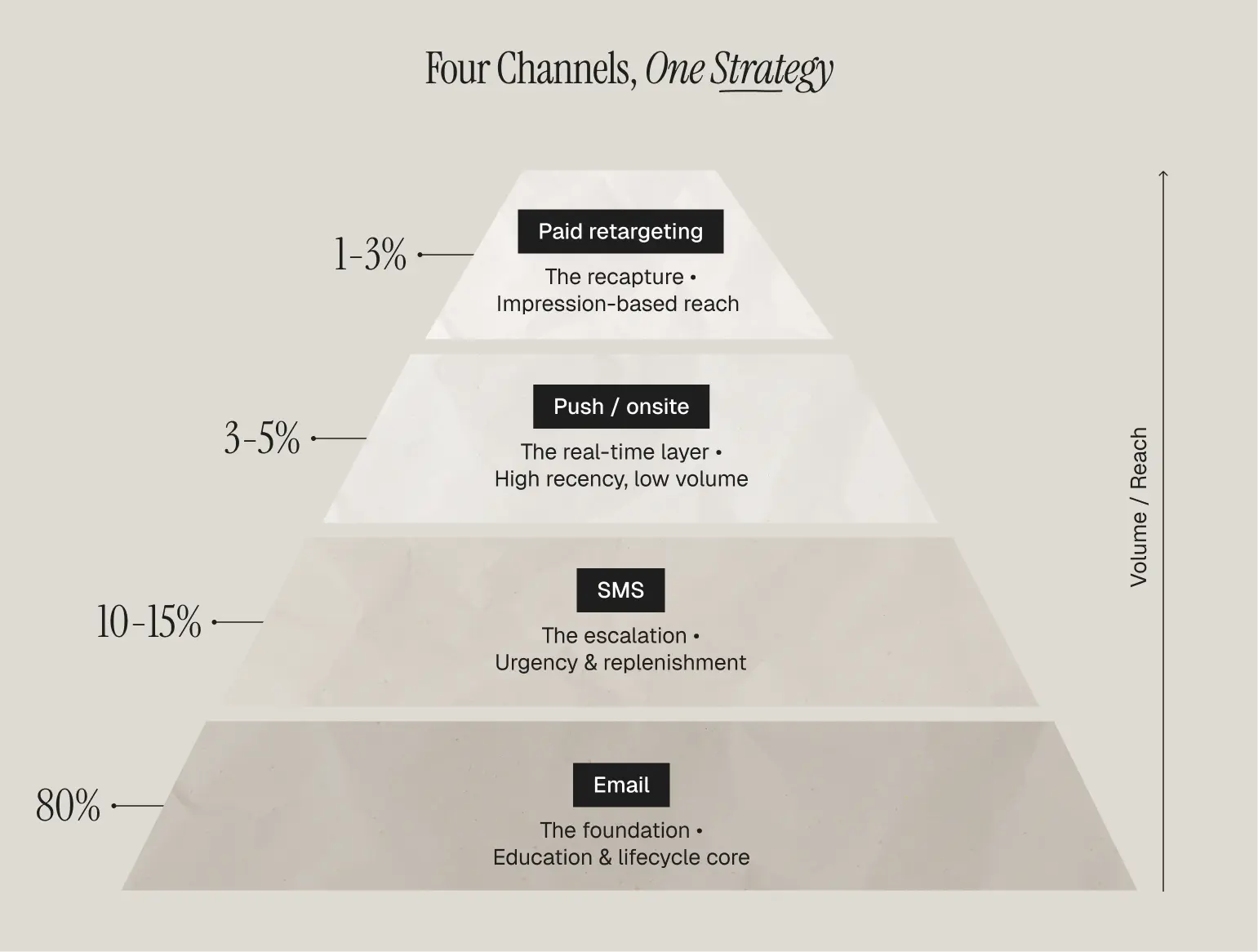
The right question is not whether SMS marketing for ecommerce is better than email. The right question is what job SMS should perform inside the total stack of omnichannel. Email remains the foundation for storytelling; SMS is the short-form escalation layer for high-intent moments.
A practical allocation model for ecommerce retention marketing involves coordinating four distinct layers:
- Email (The Foundation): Core lifecycle coverage, broad segmentation, and educational content. 80% of your total sends usually happen here.
- SMS (The Escalation): High-intent moments, replenishment, and "Final Call" urgency. This handles 10-15% of volume but carries a higher "Intent-per-Message" weight.
- Push or Onsite (The Real-Time Layer): For active users who are currently in the app or on the site. This covers the "last mile" of the session.
- Paid Retargeting (The Recapture): For users who have opted out of the above or have gone dormant.
At Propel, we focus on "Channel Harmony." If your SMS grows faster than your email list, you are likely cannibalizing your margins. The goal is to maximize the blend across channels. We use SMS sparingly enough that it feels like a "VIP notification" but frequently enough that it contributes measurable, incremental margin.
Best Platforms for Ecommerce SMS Marketing
The market has matured beyond simple "send" tools. When selecting a platform for ecommerce SMS marketing, the goal is finding a "system of record" for your customer behavior.
Top Ecommerce SMS Marketing Platforms for 2026:
- Klaviyo: The industry standard for integrated Email and SMS. Its primary strength is the unified profile, allowing for perfect cross-channel suppression.
- Attentive: High-performance SMS specialist. Excellent for high-volume brands that need advanced "Two-Way" conversational capabilities and robust list-growth tools.
- Postscript: Deeply integrated with the Shopify ecosystem. Ideal for brands looking for a dedicated SMS focus with specialized replenishment features.
- Sendlane: A rising contender for brands wanting to consolidate their stack with high deliverability and transparent pricing.
How to Choose Your Platform
Choosing a service should be a governance question, not a feature question. Propel evaluates SMS marketing platforms for ecommerce based on these non-negotiable criteria:
- Data Ingestion Speed: Can the platform trigger a message within 60 seconds of a site event?
- Cross-Channel Suppression: Can it "see" an email open and cancel a scheduled SMS in real-time?
- Holdout Testing: Does the platform allow for "Ghost Groups" to measure true incremental lift?
- Operational Usability: Can a non-technical marketer build a branching logic flow without a developer?
Advanced Ecommerce SMS Marketing Tips for Elite Execution
To move beyond basic "best practices," consider these unconventional tactics:
- The "Silent Period" Suppression: Don't just cap frequency; cap "Contextual Clutter." If a customer just placed an order, suppress all promotional SMS for 48 hours to allow the "Transactional Trust" to build.
- SMS-to-Zero-Party-Data: Use "Reply with [A, B, or C]" to segment users. Instead of a link, ask: "Which skin type do you have?" The reply segments them automatically for the next 6 months of flows.
- MMS-to-SMS Flip: Use an image (MMS) for the first message in a flow to catch the eye, but use plain text (SMS) for the follow-up. It saves 3x the cost while feeling more personal and less like an ad.
- Dark-Post Alignment: If a customer clicks an SMS, immediately exclude them from your Meta "Purchase Intent" retargeting audiences for 24 hours. Why pay for a Facebook ad if they just clicked your text?
- V-Card Integration: Ask customers to "Add us to contacts" in the first welcome text. This ensures your brand name and logo appear in their message list, increasing long-term open rates.
What to Measure: Moving Beyond Vanity
If you want to judge ecommerce SMS properly, stop looking at "platform-attributed revenue."
- Incremental RPR (Revenue Per Recipient): The difference in spend between the group that got the text and a holdout group that didn't.
- Unsubscribe Velocity: Are you losing more in "List Equity" than you are gaining in "Daily Sales"?
- Contribution Margin after SMS Cost: Take the revenue, subtract COGS, subtract the SMS send cost ($0.03-$0.05), and then look at your profit.
What We Have Seen at Propel: The Reality of the Field
Across hundreds of audits, Propel has observed a recurring pattern: Performance improves exponentially when SMS marketing for ecommerce is treated as a service rather than a sales pitch. Our internal data confirms that the highest-earning flows are not the ones with the biggest discounts, but the ones with the most accurate timing.
We have seen brands significantly lower their customer acquisition costs (CAC) simply by cleaning up their "replenishment noise". Our engagements typically reveal that when a brand stops duplicating concurrent email and SMS sends, their "opt-out" rate drops by nearly 40% within sixty days. We’ve witnessed firsthand that channel discipline is often the fastest path to increasing net profit per customer.
Conclusion
SMS marketing for ecommerce is a double-edged sword. Used as a "megaphone," it leads to list decay and margin erosion. Used as a "scalpel," it becomes the most powerful tool in your retention stack. The brands that win Ecommerce SMS marketing in 2026 are those that treat SMS as an escalation layer, prioritizing timing over volume and incrementality over attribution.
Propel has helped dozens of scaling brands reclaim their margins by auditing and rebuilding their SMS strategies from the ground up. We don't just send texts; we build retention engines.
Ready to stop "blasting" and start building? Book a demo call with Propel today to see how we can drive incremental profit for your brand.
Frequently Asked Questions
Should SMS replace email?
No. SMS escalates email. Email builds the brand; SMS closes the high-urgency sale.
What is the best use case for ecommerce SMS marketing?
Personalized replenishment. It solves a problem for the customer and creates a recurring revenue loop for the brand.
Why do SMS programs fail?
SMS programs for ecommerce fail due to lack of discipline. Brands get addicted to the "instant revenue" of a blast and ignore the long-term cost of list fatigue.
How do I choose the best SMS marketing platforms for ecommerce?
Look for a service that offers cross-channel suppression to ensure you aren’t paying for a text when a customer has already engaged with an email. The best platforms prioritize data ingestion speed, allowing you to trigger messages based on real-time site behavior rather than static lists.
What are the most effective text messaging marketing strategies for ecommerce brands?
The most impactful strategy is using behavioral replenishment to send restock reminders based on a customer's actual purchase cadence. Additionally, use SMS as an escalation layer for cart recovery, sending a text only after a cheaper email has failed to convert the shopper.
