Case Studies
Eden Health Case Study: More Conversions. Far Fewer Sends.

Eden Health sells GLP-1 and longevity treatments direct to consumers in one of the most competitive corners of telehealth. Acquisition was working; the lifecycle channel was not. Eden was acquiring new users at scale, yet email and SMS converted only a small share of them, cross-sell outside GLP-1 had stalled to almost nothing, and retention sat at roughly seven months.
Eden brought in Propel as an extension of the team, with three shared 90-day goals: hit an aggressive incremental-revenue target, lift cross-sell from 1.03 to 1.5, and extend retention from seven months to ten.
Eden's program was built for reach, not relevance. The abandoned-cart series had ballooned, and only the first two emails carried their weight; open rates fell sharply after that. The program mailed at scale but converted at just 0.3%, and new users arrived through more than two dozen entry paths with almost none of that intent signal shaping what they received. New-user conversion was stuck near 16%, cross-sell attach hovered below 1%, and roughly 7.5% of contacts were already unreachable from unsubscribes and bounces.
Propel's first move was to stop guessing. The team mapped every way a user could enter Eden's database, then rebuilt the audience around two signals that actually predict a purchase: what someone wants, and how ready they are to buy.
Instead of mailing the whole file, Propel focused on the genuinely targetable base, stripping out users with no intent data and contacts unreachable by email or SMS.
Every user was tagged into one of eight product tracks (semaglutide, tirzepatide, other weight loss, hair, longevity, strength, HRT, mood), with semaglutide and tirzepatide split out because tirzepatide buyers show higher paying propensity. Each user was scored low, medium, or high intent by how far they progressed: started the questionnaire, completed it, or entered payment details to view pricing.
Low-intent users got education, proof, and testimonials. Medium-intent users got Eden's value proposition against cheaper competitors, including same-price-at-every-dose and support reassurance. High-intent users got a direct path back to checkout, timed to the two-to-three-week GLP-1 buying window.
Rather than pushing add-ons to everyone, Propel targeted only proven, higher-trust cohorts of repeat subscribers, tested product angles, found NAD+ outperformed the alternatives, and timed cross-sell to the window when side effects surface and adherence support is most welcome.
Propel designed a six-stage post-purchase journey, from activation through the pre-renewal save window, dunning, post-month-one reinforcement, the month-two silent-churn window, and final renewal, targeting a 70% month-one retention rate.
Every campaign ran against a control group, so lift was measured against Eden's real baseline rather than assumed, and tracked weekly across Customer.io and Omni.
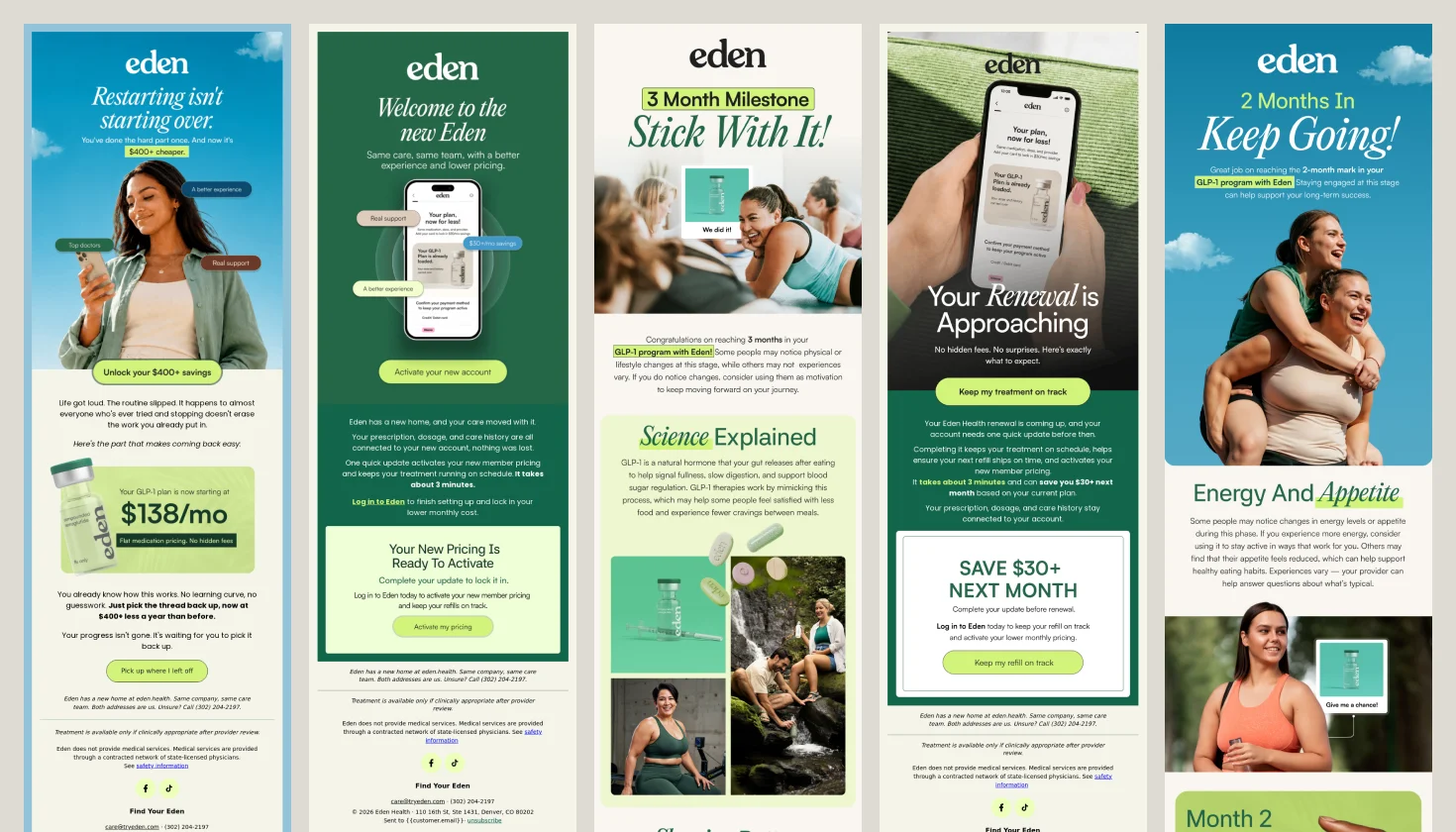
Cumulatively, campaign-attributed conversions passed the 90-day revenue target.
With the targeting foundation in place, Eden and Propel are scaling SMS, expanding the retention journey, and extending the cohort model across Eden's full product line.
Our friendly team is always here to chat.
Where your lifecycle flows are underperforming and the revenue you’re missing
How AI-driven personalization can move the needle on retention and LTV
Quick wins your team can action this quarter
Whether Propel is the right fit for your brand, stage, and stack
